Filed Pursuant to Rule 424(b)(3)
Registration No. 333-291017
PROSPECTUS
Hyperliquid Strategies Inc
Up to 160,000,000 Shares of Common Stock
This prospectus relates to the potential offer and sale from time to time by Chardan Capital Markets LLC (“Chardan” or the “Selling Securityholder”) of up to 160,000,000 shares of our common stock, par value $0.01 per share (“Common Stock” or “Pubco Common Stock”), that have been or may be issued by us to Chardan pursuant to a ChEF Purchase Agreement, dated as of October 22, 2025, by and between us and Chardan (as amended from time to time, the “Purchase Agreement”), establishing a committed equity facility (the “Facility”). Such shares of our Common Stock that we may elect, in our sole discretion, to issue and sell to Chardan from time to time under the Purchase Agreement are referred to herein as the “Purchase Shares”. The actual number of shares of our Common Stock issuable will vary depending on the then current market price of shares of our Common Stock sold to Chardan under the Facility, but will not exceed the number of shares of Common Stock set forth in the first sentence of this paragraph unless we file an additional registration statement under the Securities Act of 1933, as amended (the “Securities Act”) with the Securities and Exchange Commission (the “SEC”). See “The Committed Equity Financing” for a description of the Purchase Agreement and the Facility and “Selling Securityholder” for additional information regarding Chardan and “Plan of Distribution (Conflicts of Interest)” for a description of compensation payable to Chardan.
We are not selling any securities under this prospectus and will not receive any of the proceeds from the sale of the shares of our Common Stock by Chardan. We may receive up to $1.0 billion in aggregate gross proceeds from Chardan under the Purchase Agreement in connection with sales of the shares of our Common Stock to Chardan pursuant to the Purchase Agreement after the date of this prospectus. However, the actual proceeds from Chardan may be less than this amount depending on the number of shares of our Common Stock sold and the price at which the shares of our Common Stock are sold. In connection with the execution of the Purchase Agreement, we agreed to pay Chardan a commitment fee consisting of (i) $125,000 payable on the later of the date of the closing of the transactions contemplated by the Transaction Agreement (defined below) and the date the registration statement of which this prospectus forms a part is effective (the “Commencement Date”), (ii) $250,000 payable once we have received an aggregate of $25.0 million in proceeds from sales of our Common Stock under the Facility and (iii) $625,000 payable once we have received an aggregate of $50.0 million in proceeds from sales of our Common Stock under the Facility (collectively, the “Commitment Fee”). We also paid Chardan a documentation fee equal to $25,000 (the “Documentation Fee”) as consideration in connection with the preparation of the Purchase Agreement. See “Plan of Distribution” for a discussion of the fees and expenses payable by us to Chardan under the Purchase Agreement.
This prospectus provides you with a general description of such securities and the general manner in which Chardan may offer or sell the securities. More specific terms of any securities that Chardan may offer or sell may be provided in a prospectus supplement that describes, among other things, the specific amounts and prices of the securities being offered and the terms of the offering. The prospectus supplement may also add, update or change information contained in this prospectus.
Chardan may offer, sell or distribute all or a portion of the shares of our Common Stock acquired under the Purchase Agreement and hereby registered publicly or through private transactions at prevailing market prices or at negotiated prices. We will bear all costs, expenses and fees in connection with the registration of the shares of our Common Stock, including with regard to compliance with state securities or “blue sky” laws. The timing and amount of any sales of the shares of our Common Stock purchased by Chardan are within the sole discretion of Chardan. Chardan is an underwriter under the Securities Act, and any profit on the sale of shares of our Common Stock by Chardan and any discounts, commissions or concessions received by Chardan may be deemed to be underwriting discounts and commissions under the Securities Act. Although Chardan is obligated to purchase shares of our Common Stock under the terms and subject to the conditions and limitations of the Purchase Agreement to the extent we choose to sell such shares of our Common Stock to it (subject to certain conditions), there can be no assurances that we will choose to sell any shares of our Common Stock to Chardan or that Chardan will sell any or all of the shares of our Common Stock, if any, purchased under the Purchase Agreement pursuant to this prospectus. Chardan will bear all commissions and discounts, if any, attributable to its sale of shares of our Common Stock. See “Plan of Distribution (Conflicts of Interest).”
You should read this prospectus and any prospectus supplement or amendment, together with additional information described under the heading “Where You Can Find More Information,” carefully before you invest in our securities.
We will not sell any Purchase Shares to Chardan, and no sales of shares of our Common Stock would be made by Chardan under this prospectus, until after the closing of the transactions contemplated by the Business Combination Agreement that we entered into on July 11, 2025 with Sonnet BioTherapeutics Holdings, Inc., a Delaware corporation (the “Company” or “Sonnet”), Rorschach I LLC, a Delaware limited liability company (“Rorschach”), TBS Merger Sub Inc., a Delaware corporation and our wholly owned subsidiary (“Company Merger Sub”) and Rorschach Merger Sub, LLC, a Delaware limited liability company and our wholly owned subsidiary (“Rorschach Merger Sub”) (as amended on September 22, 2025 and as further amended from time to time, the “Transaction Agreement”). The Transaction Agreement provides (i) Rorschach Merger Sub will merge with and into Rorschach (the “Rorschach Merger”), with Rorschach surviving the Rorschach Merger as our direct wholly owned subsidiary, and (ii) immediately following the Rorschach Merger, Company Merger Sub will merge with and into the Company (the “Company Merger” and, together with the Rorschach Merger, the “Mergers” or “Business Combination”), with the Company surviving the Company Merger as our direct wholly owned subsidiary. On December 2, 2025, the Business Combination was consummated.
We intend to use any net proceeds from any sales of shares of our Common Stock to Chardan under the Facility for general corporate purposes, including potential purchases of HYPE Tokens.
Upon the closing of the Business Combination, our Common Stock was listed on the Nasdaq Capital Market under the symbol “PURR”.
We are an “emerging growth company” as that term is defined in the Jumpstart Our Business Startups Act of 2012 and a “smaller reporting company” as defined under the federal securities and, as such, are subject to reduced public company reporting requirements.
Investing in our securities involves a high degree of risk. Before buying any securities, you should carefully read the discussion of the risks of investing in our securities in “Risk Factors” beginning on page 15 of this prospectus.
Neither the SEC nor any state securities commission has approved or disapproved of the securities to be issued under this prospectus or determined if this prospectus is truthful or complete. Any representation to the contrary is a criminal offense.
The date of this prospectus is December 2, 2025.
TABLE OF CONTENTS
| i |
ABOUT THIS PROSPECTUS
This prospectus is part of a resale registration statement on Form S-1 that we filed with the SEC whereby the Selling Securityholder may, from time to time, sell the securities offered by it described in this prospectus. We will not receive any proceeds from the sale by such Selling Securityholder of the securities offered by it described in this prospectus.
Neither we nor the Selling Securityholder has authorized anyone to provide you with any information or to make any representations other than those contained in this prospectus or any applicable prospectus supplement or any free writing prospectuses prepared by or on behalf of us or to which we have referred you. Neither we nor the Selling Securityholder takes responsibility for, and can provide no assurance as to the reliability of, any other information that others may give you. Neither we nor the Selling Securityholder will make an offer to sell these securities in any jurisdiction where such offer or sale is not permitted. No dealer, salesperson or other person is authorized to give any information or to represent anything not contained in this prospectus, any applicable prospectus supplement or any related free writing prospectus. You should assume that the information appearing in this prospectus or any prospectus supplement is accurate as of the date on the front of those documents only, regardless of the time of delivery of this prospectus or any applicable prospectus supplement, or any sale of a security. Our business, financial condition, results of operations and prospects may have changed since those dates.
The Selling Securityholder and its permitted transferees may use this resale registration statement to sell securities from time to time through any means described in the section titled “Plan of Distribution.” More specific terms of any securities that the Selling Securityholder and its permitted transferees offer and sell may be provided in a prospectus supplement that describes, among other things, the specific amounts and prices of the securities being offered and the terms of the offering.
We may also provide a prospectus supplement or post-effective amendment to the registration statement to add information to, or update or change information contained in, this prospectus. Any statement contained in this prospectus will be deemed to be modified or superseded for purposes of this prospectus to the extent that a statement contained in such prospectus supplement or post-effective amendment modifies or supersedes such statement. Any statement so modified will be deemed to constitute a part of this prospectus only as so modified, and any statement so superseded will be deemed not to constitute a part of this prospectus. You should read both this prospectus and any applicable prospectus supplement or post-effective amendment to the registration statement of which this prospectus forms a part, together with the additional information to which we refer you in the section of this prospectus titled “Where You Can Find More Information.”
This prospectus contains summaries of certain provisions contained in some of the documents described herein, but reference is made to the actual documents for complete information. All of the summaries are qualified in their entirety by the actual documents. Copies of some of the documents referred to herein have been filed or will be filed as exhibits to the registration statement of which this prospectus is a part, and you may obtain copies of those documents as described below under “Where You Can Find More Information.”
This prospectus contains certain market data and industry statistics and forecasts that are based on studies sponsored by us, independent industry publications and other publicly available information. Although we believe these sources are reliable, estimates as they relate to projections involve numerous assumptions, are subject to risks and uncertainties, and are subject to change based on various factors, including those discussed under “Risk Factors” in this prospectus. Accordingly, investors should not place undue reliance on this information.
This prospectus contains references to trademarks, trade names and service marks belonging to other entities. Solely for convenience, trademarks, trade names and service marks referred to in this prospectus may appear without the ® or TM symbols, but such references are not intended to indicate, in any way, that the applicable licensor will not assert, to the fullest extent under applicable law, its rights to these trademarks and trade names. We do not intend our use or display of other companies’ trade names, trademarks or service marks to imply a relationship with, or endorsement or sponsorship of us by, any other companies.
Unless the context otherwise requires, references in this prospectus to “Pubco,” “we,” “us” and “our” and any related terms refer to Hyperliquid Strategies Inc and its consolidated subsidiaries.
| ii |
FREQUENTLY USED TERMS
Unless otherwise stated in this prospectus or the context otherwise requires:
“Advisor” means Rorschach Advisors LLC, a Delaware limited liability company;
“Advisor Agreements” means the Advisor Rights Agreement and Advisory Agreement to be entered into between Pubco and Rorschach Advisor LLC in connection with the Closing;
“Advisor Shares” means that number of shares of Pubco Common Stock equal to 5% of the shares of Pubco Common Stock issued and outstanding, on a fully-diluted, as converted basis, immediately following the Company Merger Effective Time;
“Advisor Warrants” means the warrants issuable to the Advisor to purchase a number of shares of Pubco Common Stock equal to, in the aggregate, 15% of the fully diluted number of outstanding shares of Pubco Common Stock immediately after Closing, pursuant to the Transaction Agreement;
“Aggregate Company Consideration” means the aggregate number of shares of Pubco Common Stock payable to the Company Securityholders in connection with the Company Merger in accordance with the terms and conditions of the Transaction Agreement and the Transaction Documents;
“Aggregate Rorschach Consideration” means an aggregate of number shares of Pubco Common Stock to be issued at the Rorschach Merger Effective Time to the Rorschach Members in accordance with the Transaction Agreement, determined by dividing (a) one-fifth of the sum of (i) (A) the HYPE Tokens Value held by Rorschach immediately prior to the Rorschach Merger Effective Time plus (B) any Contributed Cash held by Rorschach immediately prior to the Rorschach Merger Effective Time, by (ii) the Company Price Per Share, and, once calculated, (b) adding to such total number of shares of Pubco Common Stock determined in clause (a) the total number of Advisor Shares to be issued to Rorschach;
“Aggregate Transaction Consideration” means (a) the Aggregate Rorschach Consideration and (b) the Aggregate Company Consideration;
“Ancillary Agreements” means the Pubco Registration Rights Agreement, the Advisor Rights Agreement, the Advisory Agreement, the Advisor Warrants, the CVR Agreement, the Subscription Agreements;
“Bridge Financing” means the sale of $2.0 million of convertible notes in the principal amount of $2.0 million of the Company on June 30, 2025;
“Bridge Financing Warrants” means the warrants to purchase an aggregate of up to 865,052 shares of Company Common Stock received by the investors in the Bridge Financing (which warrants will be converted into or become exercisable for an aggregate of 173,010 shares of Pubco Common Stock at the Closing, reflecting the five-for-one exchange ratio in the Transaction Agreement).
“Business Combination” means the Rorschach Merger and the Company Merger;
“Chardan” means Chardan Capital Markets LLC;
“Closing” means the consummation of the Transactions;
“Closing Date” means the date on which the Closing occurs;
“Closing PIPE” means those certain Subscription Agreements entered concurrently with the Transaction Agreement whereby the Company agreed to issue and sell, immediately prior to the Closing, an aggregate of 243,787,992 shares of Company Common Stock at a purchase price of $1.25 per share (which shares will be converted into an aggregate of 48,757,597 shares of Pubco Common Stock at the Closing, reflecting the five-for-one exchange ratio in the Transaction Agreement);
| 1 |
“Company” means Sonnet Biotherapeutics Holdings, Inc.;
“Company Common Stock” means the Company’s common stock, with a par value of $0.0001 per share;
“Company In-The-Money Warrant” means a Company Warrant that, as of immediately prior to the Company Merger Effective Time, has an exercise price that is less than the Company Price Per Share;
“Company Merger” means the merger of Company Merger Sub with and into the Company, with the Company surviving the Company Merger as a direct wholly owned subsidiary of Pubco;
“Company Merger Effective Time” means the date and time of the filing of a certificate of merger (or such later time as may be agreed by each of the parties and specified in the certificate of merger) with the Secretary of State of the State of Delaware, in accordance with the relevant provisions of the DGCL.
“Company Merger Sub” means TBS Merger Sub Inc.;
“Company Out-Of-The-Money Warrant” means a Company Warrant that, as of immediately prior to the Company Merger Effective Time, has an exercise price that is equal to or greater than the Company Price Per Share;
“Company Price Per Share” means $1.25;
“Company RSAs” means restricted stock awards relating to shares of Company Common Stock immediately prior to the Company Merger Effective Time;
“Company RSUs” means restricted stock units relating to shares of Company Common Stock immediately prior to the Company Merger Effective Time;
“Company Securityholders” means, collectively, the holders of Company Common Stock, Company Vested RSUs and Company In-The-Money Warrants immediately prior to the Company Merger Effective Time;
“Company Unvested RSA” means a Company RSA that has not vested immediately prior to the Company Merger Effective Time;
“Company Unvested RSU” means a Company RSU that has not vested immediately prior to the Company Merger Effective Time;
“Company Vested RSU” means a Company RSU that has vested prior to the Company Merger Effective Time;
“Company Warrant” means a warrant to purchase shares of Company Common Stock, whether or not exercisable;
“Contributed Cash” means any cash and/or cash equivalents contributed by certain investors to Rorschach as part of the Contribution.
“Contribution” means the contribution by certain investors of HYPE Tokens and cash and cash equivalents to Rorschach pursuant to the Transaction Documents;
“CVR” means a contractual contingent value right representing the right to receive Pubco Common Stock on the terms and subject to the conditions set forth in the CVR Agreement;
“CVR Agreement” means that certain Contingent Value Rights Agreement to be entered between Pubco and the Rights Agent, a form of which is attached to the Transaction Agreement as Exhibit E;
“DGCL” means the Delaware General Corporation Law;
| 2 |
“Dissenting Shares” means shares of Company Common Stock that are held by Sonnet stockholders who shall have neither voted in favor of the Company Merger nor consented thereto in writing and who shall have demanded properly in writing appraisal for such Company Common Stock in accordance with Section 262 of the DGCL and otherwise complied with all of the provisions of the DGCL relevant to the exercise and perfection of dissenters’ rights;
“DLLCA” means the Limited Liability Company Act of the State of Delaware;
“Exchange Act” means the Securities Exchange Act of 1934, as amended, and the rules and regulations promulgated thereunder;
“FDA” means the United States Food and Drug Administration;
“Financings” means the Bridge Financing and the Initial PIPE;
“GAAP” means accounting principles generally accepted in the United States;
“HYPE Token” means the native token of the Hyperliquid Layer 1 blockchain;
“HYPE Tokens Value” means the value determined by multiplying (a) the aggregate number of HYPE Tokens held by Rorschach immediately prior to the Rorschach Merger Effective Time by (b) $46.372. For the avoidance of doubt, if less than Two Hundred Million Dollars ($200,000,000) in HYPE Tokens Value is contributed to Rorschach as of immediately prior to the Rorschach Merger Effective Time, additional cash and cash equivalents may be contributed by investors to Rorschach or the Company immediately prior to the Rorschach Merger Effective Time to address any such shortfall in the HYPE Tokens Value for the purposes of satisfying the condition set forth in Section 8.03(d) of the Transaction Agreement;
“Initial PIPE” means those certain securities purchase agreements entered concurrently with the execution of the Transaction Agreement whereby the Company agreed to issue and sell the Series 5 Preferred Stock and the Initial PIPE Warrants, for gross proceeds of $5.5 million;
“Initial PIPE Warrants” means those certain warrants to purchase up to 8,800,000 shares of Company Common Stock issued and sold to investors in the Initial PIPE (which warrants will be converted into or become exercisable for an aggregate of 1,760,000 shares of Pubco Common Stock at the Closing, reflecting the five-for-one exchange ratio in the Transaction Agreement);
“Interim Financing” means the issuance by the Company of up to an aggregate of $3,000,000 of its securities as permitted under the Transaction Agreement.
“Nasdaq” means The Nasdaq Stock Market LLC;
“Per Share Company Merger Consideration” means one share of Pubco Common Stock and one CVR;
“Pubco” or “HSI” means Hyperliquid Strategies Inc;
“Pubco A&R Organizational Documents” means the Pubco Charter and the bylaws of Pubco;
“Pubco Board” means the Board of Directors of Pubco;
“Pubco Bylaws” means Pubco’s amended and restated bylaws;
“Pubco Charter” means Pubco’s amended and restated certificate of incorporation;
“Pubco Common Stock” or “Common Stock” means the common stock, par value $0.01 per share, of Pubco;
“Pubco Registration Rights Agreement” means the Registration Rights Agreement to be entered into among Pubco, the Advisor and certain other investors in connection with the Closing;
“Pubco Series A Preferred Stock” means the series of preferred stock of Pubco, par value $0.01 per share, designated in connection with the Closing.
| 3 |
“Rorschach” means Rorschach I LLC;
“Rorschach Members” means the members of Rorschach;
“Rorschach Merger” means the merger of Rorschach Merger Sub with and into Rorschach, with Rorschach surviving the Rorschach Merger as a direct wholly owned subsidiary of Pubco;
“Rorschach Merger Effective Time” means the date and time of the filing of a certificate of merger (or such later time as may be agreed by each of the parties and specified in the certificate of merger) with the Secretary of State of the State of Delaware, in accordance with the relevant provisions of the DLLCA.
“Rorschach Merger Sub” means Rorschach Merger Sub LLC;
“SEC” means the U.S. Securities and Exchange Commission;
“Securities Act” means the Securities Act of 1933, as amended;
“Sonnet” means Sonnet Biotherapeutics Holdings, Inc. and its consolidated subsidiaries;
“Sonnet Special Meeting” means the special meeting of stockholders of Sonnet to be held to vote on the approval of the Transactions and other related matters.
“Subscription Agreements” means those certain subscription agreements entered by and among the investors in the Closing PIPE, the Company and Pubco;
“Transaction Agreement” means the Business Combination Agreement, dated as of July 11, 2025, among Rorschach, Pubco, the Merger Subs and Sonnet, as amended on September 22, 2025 and as may be further amended;
“Transaction Documents” means the Transaction Agreement and the Ancillary Agreements; and
“Transactions” means the transactions contemplated by Transaction Agreement and the other Transaction Documents, including the Business Combination.
| 4 |
CAUTIONARY NOTE REGARDING FORWARD-LOOKING STATEMENTS
This prospectus contains “forward-looking” statements for purposes of the federal securities laws, including statements regarding the Transactions and the Facility. All statements, other than historical facts, are forward-looking statements, including statements regarding the expected benefits of the Transactions, such as improved operations, enhanced revenues and cash flow, synergies, growth potential, market profile, business plans, expanded portfolio and financial strength; the competitive ability and position of Pubco following completion of the Transactions; the projected future financial performance of Rorschach, Sonnet and Pubco; and legal, economic and regulatory conditions. Forward-looking statements concern future circumstances and results and other statements that are not historical facts and are sometimes identified by the words “may,” “will,” “should,” “potential,” “intend,” “expect,” “endeavor,” “seek,” “anticipate,” “estimate,” “overestimate,” “underestimate,” “believe,” “plan,” “could,” “would,” “project,” “predict,” “continue,” “target” or other similar words or expressions or negatives of these words, but not all forward-looking statements include such identifying words. Forward-looking statements are based upon current plans, estimates and expectations that are subject to risks, uncertainties and assumptions. Should one or more of these risks or uncertainties materialize, or should underlying assumptions prove incorrect, actual results may vary materially from those indicated or anticipated by such forward-looking statements. We can give no assurance that such plans, estimates or expectations will be achieved and therefore, actual results may differ materially from any plans, estimates or expectations in such forward-looking statements.
Important factors that could cause actual results to differ materially from such plans, estimates or expectations include, among others: failure to realize the anticipated benefits of the Transactions; costs related to the Transactions and as a result of becoming a public company; changes in business, market, financial, political and regulatory conditions; risks relating to Pubco’s anticipated operations and business, including the highly volatile nature of the price of HYPE tokens; the risk that Pubco’s stock price will be highly correlated to the price of HYPE tokens and the price of HYPE tokens may decrease at any time; risks related to increased competition in the industries in which Pubco will operate; risks relating to significant legal, commercial, regulatory and technical uncertainty regarding HYPE tokens; risks relating to the treatment of crypto assets for U.S. and foreign tax purposes; risks that Pubco experiences difficulties managing its growth and expanding operations; challenges in implementing Pubco’s business plan including HYPE token-related financial and advisory services, due to operational challenges, significant competition and regulation; the outcome of any potential legal proceedings that may be instituted against Sonnet, Rorschach, Pubco or others and other risk factors as further described in the section of this prospectus titled “Risk Factors.” This list should not be considered to be a complete statement of all potential risks and uncertainties. Unlisted factors may present significant additional obstacles to the realization of forward-looking statements.
Any forward-looking statements speak only as of the date of this prospectus. We undertake no obligation to update any forward-looking statements, whether as a result of new information or developments, future events or otherwise, except as required by law. Readers are cautioned not to place undue reliance on any of these forward-looking statements.
| 5 |
PROSPECTUS SUMMARY
This summary highlights certain information contained elsewhere in this prospectus. Because it is only a summary, it does not contain all of the information that you should consider before investing in our Common Stock and it is qualified in its entirety by, and should be read in conjunction with, the more detailed information appearing elsewhere in this prospectus. Before you decide to invest in our Common Stock, you should read the entire prospectus carefully, including the “Risk Factors” and the financial statements and related notes included in this prospectus.
The Companies
Pubco
Pubco is a Delaware corporation that was formed for the purpose of engaging in the Transactions. Since the date of its incorporation on July 2, 2025 until the Closing Date, Pubco has not engaged in any activities other than as contemplated by the Transaction Documents. On December 2, 2025, the Transactions were consummated, upon which Pubco became a holding company whose principal assets are the ownership of Rorschach and Sonnet. Immediately after the completion of the Transactions, Pubco’s equity capital consists solely of Pubco Common Stock and Pubco preferred stock. For a description of the capital stock of Pubco, see the section titled “Description of Pubco Capital Stock”.
The principal executive offices of Pubco are located at 477 Madison Avenue, 22nd Floor, New York, NY 10022, and the telephone number at that address is (212) 883-4330. Following the Closing, the principal executive offices of Pubco will be located at 477 Madison Avenue, 22nd Floor, New York, NY 10022, and the telephone number at this location is (212) 883-4330.
Rorschach
Rorschach is a Delaware limited liability company formed on June 13, 2025. Rorschach was formed for the purpose of completing the Transactions pursuant to the Transaction Agreement, and had no business operations prior to the Closing Date. See the section titled “Information About Rorschach and Pubco” for more information.
Sonnet
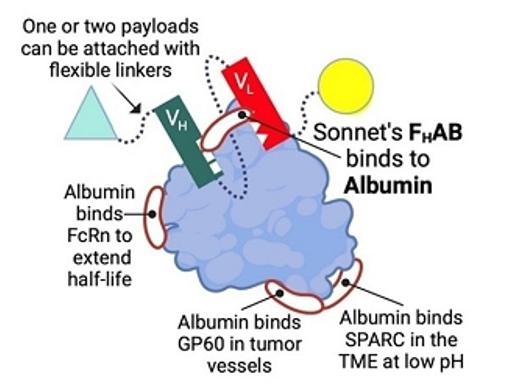
Sonnet is a clinical stage, oncology-focused biotechnology company with a proprietary platform for innovating biologic medicines of single- or bifunctional action. Known as FHAB® (Fully Human Albumin Binding), the technology utilizes a fully human single chain antibody fragment that binds to and “hitch-hikes” on human serum albumin (HSA) for transport to target tissues. Sonnet designed the FHAB construct to improve drug accumulation in tumors, as well as to extend the duration of activity in the body. FHAB development candidates are produced in a mammalian cell culture, which enables glycosylation and a biological structure similar to the natural cytokines in vivo. Sonnet believes its FHAB technology, for which it received a U.S. patent in June 2021, is a distinguishing feature of its biopharmaceutical platform that is well suited for future drug development across a range of human disease areas, including oncology, autoimmune, pathogenic, inflammatory, and hematological conditions. See the section titled “Information About Sonnet” for more information.
| 6 |
The Committed Facility
On October 22, 2025, we entered into the Purchase Agreement with Chardan establishing the Facility. Pursuant to and upon the terms and subject to the conditions and limitations set forth in the Purchase Agreement, beginning on the later of the Closing Date and the date the registration statement of which this prospectus forms a part is effective (the “Commencement Date”), we have the right from time to time at our option to direct Chardan to purchase up to $1.0 billion of shares of our Common Stock. Sales of our Common Stock to Chardan under the Purchase Agreement, and the timing of any sales, will be determined by us from time to time in our sole discretion and will depend on a variety of factors, including, among other things, market conditions, the trading price of our Common Stock and determinations by us regarding the use of proceeds from any sale of such Common Stock. The net proceeds from any sales under the Facility will depend on the frequency with, and prices at, which the shares of our Common Stock are sold to Chardan. To the extent we sell shares under the Purchase Agreement, we currently plan to use any proceeds therefrom for general corporate purposes, including potential purchases of HYPE Tokens.
The Purchase Agreement and the registration rights agreement, dated as of October 22, 2025, by and between Pubco and Chardan, and entered into in connection with the Purchase Agreement (the “Chardan Registration Rights Agreement”), contain customary registration rights, representations, warranties, conditions and indemnification obligations by each party. The representations, warranties and covenants contained in such agreements were made only for purposes of such agreements and as of specific dates, were solely for the benefit of the parties to such agreements and are subject to certain important limitations.
See the section titled “The Committed Facility” for more information.
The Transactions
The Transactions were consummated on December 2, 2025. On the Closing Date, and subject to the terms and conditions of the Transaction Agreement, (a) at the Rorschach Merger Effective Time, Rorschach Merger Sub merged with and into Rorschach, with Rorschach surviving the Rorschach Merger as a direct wholly owned subsidiary of Pubco, and (b) at the Company Merger Effective Time, Company Merger Sub merged with and into the Company, with the Company surviving the Company Merger as a direct wholly owned subsidiary of Pubco. As a result of the Rorschach Merger, each limited liability company interest of Rorschach issued and outstanding immediately prior to the Rorschach Merger Effective Time was canceled and the holder thereof received shares of Pubco Common Stock. As a result of the Company Merger, each share of Company Common Stock issued and outstanding immediately prior to the Company Merger Effective Time (excluding Dissenting Shares) was canceled and converted into the right to receive (i) one-fifth of one share of Pubco Common Stock and (ii) one CVR.
Pursuant to the Transaction Agreement, at or prior to the Closing, certain investors contributed HYPE to Rorschach, and certain investors may contribute cash to Rorschach (collectively, the “Contribution”), in each case pursuant to contribution agreements entered into between Rorschach and such investors (the “Contribution Agreements”). Subject to the terms and conditions of the Transaction Agreement, at the effective time of the Rorschach Merger, the equity holders of Rorschach immediately prior to the Closing received, in the aggregate, that number of shares of Pubco Common Stock equal to one-fifth of the aggregate amount of the Contribution divided by $1.25, except that one equity holder received, in lieu of shares of Pubco Common Stock otherwise issuable to it, shares of Pubco Series A Preferred Stock that are convertible into shares of Pubco Common Stock, subject to the terms and conditions thereof (including certain “blocker” provision). At the Closing, based on Contribution Agreements and Subscription Agreements entered concurrently with the signing of the Transaction Agreement, Pubco holds approximately $580 million in HYPE tokens (based on an agreed spot price of HYPE of $46.372, as used in the Transaction Agreement) and has cash of at least $300 million on its balance sheet (prior to payment of expenses related to the Transactions).
Also pursuant to the terms of the Transaction Agreement, at the Closing, Pubco issued to the Advisor (i) the Advisor Shares, in an amount equal to 5% of the shares of Pubco Common Stock issued and outstanding, on a fully-diluted, as converted basis, immediately following the Company Merger Effective Time and (ii) the Advisor Warrants to purchase a number of shares of Pubco Common Stock equal to, in the aggregate, 15% of the fully diluted number of outstanding shares of Pubco Common Stock immediately after Closing. The Advisor Warrants are exercisable for five years following the Closing, at an exercise price equal to (i) for one-third of the Advisor Warrants, $9.375, (ii) for one-third of the Advisor Warrants, $12.50 and (iii) for one-third of the Advisor Warrants, $18.75.
| 7 |
Immediately following the Closing, Rorschach and the other investors (including Chardan) own approximately 98.2% of the outstanding shares of Pubco Common Stock (assuming the conversion of all shares of Pubco Series A Preferred Stock issued in connection with the Transactions, without giving effect to the “blocker” provisions of the Pubco Series A Preferred Stock) and former Company Securityholders (including the investors in the Initial PIPE) own the remaining outstanding shares of Pubco Common Stock.
Advisory Relationships and Fees
Chardan acted as Rorschach’s exclusive merger and acquisition advisor with respect to the Business Combination and received a fee, payable in cash or equity, at Chardan’s option, equal to $4.0 million, which Chardan elected to receive in equity.
Post-Transactions Governance and Management
The business and affairs of Pubco are managed by or under the direction of the Pubco Board. The board of directors of Pubco was initially comprised of seven members, which include Robert Diamond as Chairman, Jeff Tuder, Eric Rosengreen, Thomas King, Larry Leibowitz, and Nailesh Bhatt and Albert Dyrness, two of the current board members of Sonnet. Following the Closing, on the Closing Date, the newly-appointed Pubco Board increased the size of the Pubco Board to eight members and re-appointed David Schamis to fill the newly-created vacancy. Additionally, the officers of Pubco are David Schamis as Chief Executive Officer and such other individuals as Rorschach may select. Following Closing and during the CVR Term, Raghu Rao remains the Chief Executive Officer of the Company, which operates as a wholly owned subsidiary of Pubco. See the section titled “Management of Pubco Following the Transactions” for additional information.
Certain Agreements Related to the Transactions
Initial PIPE Purchase Agreements
Concurrently with the execution of the Transaction Agreement, the Company entered into separate securities purchase agreements (the “PIPE Purchase Agreements”) with certain accredited investors pursuant to which the Company agreed to issue an aggregate of (i) 5,500 shares of the Company’s newly designated Series 5 Preferred Stock, stated value $1,000 per share, initially convertible at a conversion price of $1.25 per share, or 4,400,000 shares of Company Common Stock, and (ii) Initial PIPE Warrants to purchase up to 8,800,000 shares of Company Common Stock, for an offering price of $1,000 per share of Series 5 Preferred Stock and accompanying warrant, pursuant to a private placement in accordance with Section 4(a)(2) of the Securities Act. The Initial PIPE closed on July 15, 2025. The gross proceeds were $5.5 million from the Initial PIPE, before deducting offering expenses.
In addition, on June 30, 2025, Sonnet completed the Bridge Financing of convertible notes in the aggregate principal amount of $2.0 million. The investors in the Bridge Financing received warrants to purchase an aggregate of up to 865,052 shares of Company Common Stock (the “Bridge Financing Warrants”). On the closing date of the Initial PIPE, the notes issued in the Bridge Financing automatically converted into an aggregate of (i) 2,000 shares of Series 5 Preferred Stock, initially convertible at a conversion price of $1.25 per share, or 1,600,000 shares of Company Common Stock, and (ii) warrants to purchase up to 3,200,000 shares of Company Common Stock (together with the Initial PIPE Warrants, the “PIPE Warrants”). The Company intends to use the net proceeds from the Initial PIPE and the Bridge Financing for working capital and general corporate purposes, including the advancement of the Company’s current programs in connection with the planned future sale of the Company Legacy Assets (as defined in the CVR Agreement).
The Bridge Financing Warrants are exercisable immediately upon issuance at an exercise price equal to $1.156 per share, and will expire on the five-year anniversary of the date of issuance. A holder of the Bridge Financing Warrants will not have the right to exercise any portion of its Bridge Financing Warrants if the holder, together with its affiliates, would beneficially own in excess of 4.99% (or, at the election of the holder, 9.99%) of the number of shares of Company Common Stock outstanding immediately after giving effect to such exercise. A holder may increase or decrease the beneficial ownership limitation up to 9.99%, provided, however, that any increase in the beneficial ownership limitation will not be effective until 61 days following notice of such change to the Company.
| 8 |
The PIPE Warrants are exercisable immediately upon issuance at an exercise price equal to $1.25 per share, and will expire on the five-year anniversary of the date of issuance; provided, however, until Stockholder Approval (as defined in the PIPE Purchase Agreement) is obtained, the PIPE Warrants will only be exercisable and the Series 5 Preferred Stock will only be convertible, in the aggregate, into up to an aggregate of 666,212 shares of Company Common Stock, representing 19.99% of the number of shares of Company Common Stock outstanding immediately prior to the date of the PIPE Purchase Agreement, subject to adjustment. The exercise price of the PIPE Warrants may be adjusted for stock dividends and stock splits, subsequent rights offerings, pro rata distributions of dividends or the occurrence of a Fundamental Transaction (as defined in the Form of PIPE Warrant). A holder of PIPE Warrants will not have the right to exercise any portion of its PIPE Warrants if the holder, together with its affiliates, would beneficially own in excess of 4.99% (or, at the election of the holder, 9.99%) of the number of shares of Company Common Stock outstanding immediately after giving effect to such exercise. A holder may increase or decrease the beneficial ownership limitation up to 9.99%, provided, however, that any increase in the beneficial ownership limitation will not be effective until 61 days following notice of such change to the Company.
All Company Common Stock figures above will be subject to the five-for-one exchange ratio in the Transaction Agreement.
Subscription Agreements
Also concurrently with the execution of the Transaction Agreement, certain accredited investors (the “Subscribers”) entered into subscription agreements with the Company and Pubco (the “Subscription Agreements”), pursuant to which the Company agreed to issue, and the Subscribers agreed to purchase, immediately prior to the Closing, an aggregate of 243,787,992 shares of Company Common Stock at a purchase price of $1.25 per share, pursuant to a private placement in accordance with Section 4(a)(2) of the Securities Act (which shares will be converted into shares of Pubco Common Stock at the Closing, giving effect to the five-for-one exchange ratio in the Transaction Agreement). The gross proceeds were $300 million from the Closing PIPE, before deducting offering expenses. Pursuant to the terms of the Subscription Agreement, prior to the Closing, the parties agreed that neither the Company nor Pubco would enter into any agreement for the investment or contribution of cash by any additional investors or contributors on terms more favorable to such persons than the terms set forth in the Subscription Agreement or the Transaction Agreement as then in effect, unless, in any such case, the investors signatory to the Subscription Agreement have also been provided the opportunity to amend the terms of the Subscription Agreement to reflect such other terms. The Subscription Agreements provide that if the shares of Pubco Common Stock received by the Subscribers at Closing are “restricted securities” pursuant to Rule 144(a)(3) under the Securities Act or are otherwise not freely tradeable under the Securities Act immediately following the Closing, the Subscribers will be entitled to become a party to the Pubco Registration Rights Agreement (as defined below).
The consummation of the Closing PIPE was contingent upon, and occurred substantially concurrently with, the Closing and the satisfaction or waiver of customary closing conditions. On the Closing Date, the Closing PIPE was consummated.
Chardan acted as the Company’s and Rorschach’s exclusive advisor with respect to the Closing PIPE and receive a fee, payable in cash or equity at Chardan’s option, equal to up to 7.0% of the aggregate gross proceeds raised in connection with the Closing PIPE, which Chardan elected to receive in equity. The Company also agreed to reimburse Chardan for certain of its expenses in an amount up to $100,000.
| 9 |
Advisor Agreements
Pursuant to the Transaction Agreement, in connection with the Closing, Pubco and Rorschach Advisors LLC, a Delaware limited liability company (the “Advisor”), entered into an Advisor Rights Agreement (the “Advisor Rights Agreement”) and a Strategic Advisor Agreement (the “Advisory Agreement”). The Advisor Rights Agreement provides the Advisor certain rights with respect to Pubco, including, subject to the conditions set forth in the Advisor Rights Agreement, director nomination rights and information rights. Pursuant to the Advisory Agreement, the Advisor will provide technical advisory services to Pubco related to the digital asset ecosystem, including Hyperliquid and related digital assets, developments in digital asset industries, the selection of third-party vendors with respect to asset management and related digital asset services and other strategic advice regarding digital assets treasury operations for a term of five years. The Advisory Agreement provides that, unless otherwise agreed by Advisor and subject in all respects to applicable law, in the event that Pubco raises equity or equity-linked financing during the term, Advisor shall be entitled to receive grants of equity in the form of (a) shares of Pubco Common Stock equal to 5% of the number of shares of Pubco Common Stock issued or issuable pursuant to such financing and (b) warrants to purchase an aggregate number of shares of Pubco Common Stock equal to 15% of the number of shares of Pubco Common Stock issued or issuable pursuant to such financing, in substantially the same form as the Advisor Warrants, or as otherwise may be agreed by Pubco and Advisor. The Advisor shall also be entitled to receive such additional compensation, if any, as may be approved by the Pubco Board.
Contingent Value Rights Agreement
At the Closing, Pubco entered into the CVR Agreement with Continental Stock Transfer & Trust Company, as rights agent (“Rights Agent”), pursuant to which holders of Company Common Stock (not including the shares of Company Common Stock issued to the Subscribers pursuant to the Subscription Agreements) and Company In-The-Money Warrants, in each case, as of immediately prior to the Company Merger Effective Time, received one CVR for each then-outstanding share of Company Common Stock held by such stockholder (or, in the case of the Company In-The-Money Warrants, each share of Company Common Stock for which such Company In-The-Money Warrants is exercisable into as of such date). The CVR Payment (as defined in the CVR Agreement) will be payable upon the closing of a sale, license, transfer, disposition, divestiture or other monetization transaction (i.e., a royalty transaction) (or a series of transactions) and/or winding down of, or other disposition(s) of any the Company Legacy Assets (a “Company Legacy Transaction”), out of the net proceeds actually received by the Company in a Company Legacy Transaction, during the period beginning on the Closing Date and ending on the third anniversary of the date of the CVR Agreement (the “CVR Term”). The shares of Pubco Common Stock issuable in connection with the CVR Payment (the “CVR Shares”) are subject to certain deductions pursuant to the terms of the CVR Agreement.
The payment date for the CVR Shares will be within 10 business days after the rights agent receives the CVR Shares from Pubco upon the closing of a Company Legacy Transaction. In the event that a Company Legacy Transaction does not occur during the CVR Term or a Company Legacy Transaction does occur during the CVR Term but the amount of deductions payable pursuant to the terms of the CVR Agreement, including expenses related to the transaction, liabilities of the Company related to the Company’s outstanding warrants prior to the Closing and other expenses payable pursuant to the CVR Agreement, exceed the proceeds received pursuant to the Company Legacy Transaction, the holders of the CVRs will not receive any CVR Shares pursuant to the CVR Agreement. There can be no assurances that any holders of CVRs will receive any CVR Shares with respect thereto.
Until the earlier to occur of (a) the expiration of the CVR Term, and (b) the date on which Pubco and its affiliates have, whether before or after the Closing, paid or incurred costs, fees and expenses totaling an amount equal to (i) the $7,500,000 in Financings plus (ii) up to $3,000,000 in Interim Financing (if raised in accordance with the Transaction Agreement) in connection with the development of the Company Legacy Assets and/or the pursuit of a Company Legacy Transaction, Pubco will, and will cause its controlled affiliates to, use efforts and resources to develop, bring to market and sell the product candidates included in the Company Legacy Assets, consistent with the exercise of reasonable business judgment taking into account all relevant factors to, among others, (i) continue the development programs for the Company Legacy Assets and (ii) conduct a sale process (including engagement of advisors) with respect to a Company Legacy Transaction during the CVR Term; provided, that in the event the $7,500,000 in Financings and the $3,000,000 in Interim Financing is expended prior to the expiration of the CVR Term, then the Company will, until the earlier to occur of (A) one year thereafter and (B) the expiration of the CVR Term, be entitled to raise additional capital at the Company level or enter into a third-party licensing agreement or other strategic agreement, on terms reasonably acceptable to Pubco, in an effort to pursue a Company Legacy Transaction during the CVR Term.
| 10 |
Notwithstanding the foregoing, Pubco may, in its reasonable discretion, (i) during the CVR Term, determine that a Company Legacy Asset is not commercially viable and abandon further development and/or commercialization (in which case Pubco’s obligations set forth in paragraph above will immediately cease and be of no further force and effect), (ii) during the CVR Term, determine that a Company Legacy Transaction with respect to some or all of the Company Legacy Assets is not likely to occur during the CVR Term or at all and abandon further pursuit of a Company Legacy Transaction with respect to such Company Legacy Assets (in which case Pubco’s obligations set forth in paragraph above will immediately cease and be of no further force and effect with respect to such Company Legacy Assets and such Company Legacy Transaction), and (iii) following the expiration of the CVR Term without the execution and delivery of a definitive agreement for a Company Legacy Transaction, take any action in respect of the Company Legacy Assets. Notwithstanding anything contained therein to the contrary (but subject to the paragraph above), Pubco will have sole and absolute discretion and decision-making authority over whether to continue to invest, how much to invest in any of the Company Legacy Assets and whether and on what terms, if any, to enter into a Company Legacy Transaction.
The CVRs are not transferable, except in certain limited circumstances as will be provided in the CVR Agreement, will not be certificated or evidenced by any instrument and will not be listed for trading on any exchange.
Pubco Registration Rights Agreement
Pursuant to the Transaction Agreement, on the Closing Date, Pubco entered into a Registration Rights Agreement (the “Pubco Registration Rights Agreement”) with the Advisor and certain investors in Rorschach, pursuant to which, among other things, Pubco agreed to provide such holders with customary registration rights with respect to the shares of Pubco Common Stock to be owned by such holders following the Closing.
Implications of Being an Emerging Growth Company and Smaller Reporting Company
We are an “emerging growth company” as defined in Section 2(a)(19) of the Securities Act, as modified by the Jumpstart Our Business Startups Act (the “JOBS Act”), and a “smaller reporting company” as defined in Rule 12b-2 under the Exchange Act. As such, we are eligible for and intend to take advantage of certain exemptions from various reporting requirements applicable to other public companies that are not emerging growth companies and/or smaller reporting companies for as long as we continue to be an emerging growth company and/or smaller reporting company, including (i) the exemption from the auditor attestation requirements with respect to internal control over financial reporting under Section 404(b) of the Sarbanes-Oxley Act of 2002 (the “Sarbanes-Oxley Act”), (ii) the exemptions from say-on-pay, say-on-frequency and say-on-golden parachute voting requirements and (iii) reduced disclosure obligations regarding executive compensation in our periodic reports and proxy statements.
In addition, the JOBS Act provides that an emerging growth company can take advantage of an extended transition period for complying with new or revised accounting standards. This allows an emerging growth company to delay the adoption of certain accounting standards until those standards would otherwise apply to private companies. We have elected to use this extended transition period for complying with new or revised accounting standards that have different effective dates for public and private companies until the earlier of the date we (i) are no longer an emerging growth company or (ii) affirmatively and irrevocably opt out of the extended transition period provided in the JOBS Act. As a result, our financial statements may not be comparable to companies that comply with new or revised accounting pronouncements as of public company effective dates.
| 11 |
Summary of Risk Factors
Risks Related to the Facility
| ● | It is not possible to predict the actual number of shares of our Common Stock, if any, we will sell under the Purchase Agreement to Chardan, or the actual gross proceeds resulting from those sales or the dilution to you from those sales |
| ● | Investors who buy Common Stock from Chardan at different times will likely pay different prices. |
| ● | The sale or issuance of shares of our Common Stock to Chardan will result in additional outstanding shares and the resale of shares of our Common Stock by Chardan that it acquires pursuant to the Purchase Agreement, or the perception that such sales may occur, could cause the price of shares of our Common Stock to decrease. |
| ● | We may use proceeds from sales of our Common Stock made pursuant to the Purchase Agreement in ways with which you may not agree or in ways which may not yield a significant return. |
Risks Related to Hype and Hyperliquid
| ● | HYPE is a highly volatile asset, and fluctuations in the price of HYPE may influence our financial results and the market price of our listed securities. |
| ● | HYPE and other digital assets are novel assets and are subject to significant legal and regulatory uncertainty. |
| ● | Our HYPE treasury strategy subjects us to enhanced regulatory oversight. |
| ● | We plan to use a portion of our capital raised that is not required to provide working capital for our ongoing operations to acquire HYPE, which may adversely affect our financial results and the market price of our securities. |
| ● | If we were deemed to be an investment company under the Investment Company Act, applicable restrictions likely would make it impractical for us to continue segments of our business as currently contemplated. |
| ● | HYPE is created and transmitted through the operations of the peer-to-peer Hyperliquid network, a decentralized network of computers running software following the HYPE protocol. If the Hyperliquid network is disrupted or encounters any unanticipated difficulties, the value of HYPE could be negatively impacted. |
| ● | We face risks relating to the custody of our HYPE, including the loss or destruction of private keys required to access our HYPE and cyberattacks or other data loss relating to our HYPE, including smart contract related losses and vulnerabilities. |
| ● | Our historical financial statements do not reflect the potential variability in earnings that we may experience in the future relating to our HYPE holdings. |
| ● | Unrealized fair value gains on our HYPE holdings could cause us to become subject to the corporate alternative minimum tax under the Inflation Reduction Act of 2022. |
| ● | Due to the unregulated nature and lack of transparency surrounding the operations of many HYPE trading venues, HYPE trading venues may experience greater fraud, security failures or regulatory or operational problems than trading venues for more established asset classes, which may result in a loss of confidence in HYPE trading venues and adversely affect the value of our HYPE. |
Risks Related to the Transactions and Pubco Following Consummation of the Transactions
| ● | We have broad discretion in the use of a portion of the net proceeds from the PIPE Financing and you will not have the opportunity as of this process to assess whether such net proceeds are being used in a manner of which you approve. |
| ● | Completion of the Transactions may trigger change in control or other provisions in certain agreements to which Sonnet or any of its respective subsidiaries or joint ventures is a party. |
| ● | The Transactions have involved substantial costs and required substantial management resources. |
| ● | Pubco stockholders will experience dilution from the issuance of Pubco Common Stock, PIPE Warrants, and CVRs and may experience additional dilution in the future due to any exercise of existing warrants and any future issuances of equity securities in Pubco. |
| 12 |
Risks Related to the Business of Sonnet
| ● | We have a history of significant operating losses and expect to incur significant and increasing losses for the foreseeable future, and we may never achieve or maintain profitability. |
| ● | Our recurring losses from operations have raised substantial doubt regarding our ability to continue as a going concern. |
| ● | We will need substantial additional funding, and if we are unable to raise capital when needed, we could be forced to delay, reduce or eliminate our product discovery and development programs or commercialization efforts. |
| ● | We are substantially dependent on the success of our internal development programs and our product pipeline candidates may not successfully complete clinical trials, receive regulatory approval or be successfully commercialized. |
| ● | We are at an early stage in our development efforts, our product candidates represent a new category of medicines and may be subject to heightened regulatory scrutiny until they are established as a therapeutic modality. |
| ● | We may not satisfy The Nasdaq Capital Market’s requirements for continued listing of our common stock in the future. If we cannot satisfy these requirements, The Nasdaq Capital Market could delist our common stock. |
| ● | Even if we complete the necessary preclinical studies and clinical trials, the marketing approval process is expensive, time consuming and uncertain and may prevent us or any collaborators from obtaining approvals for the commercialization of some or all of our product candidates. As a result, we cannot predict when or if, and in which territories, we, or any collaborators, will obtain marketing approval to commercialize a product candidate. |
| ● | We face significant competition and if our competitors develop and market products that are more effective, safer or less expensive than the product candidates we develop, our commercial opportunities will be negatively impacted. |
| ● | The commercial success of any current or future product candidate will depend upon the degree of market acceptance by physicians, patients, payors and others in the medical community. |
| ● | For certain product candidates, we may depend on development and commercialization collaborators to develop and conduct clinical trials with, obtain regulatory approvals for, and if approved, market and sell product candidates. If such collaborators fail to perform as expected, the potential for us to generate future revenue from such product candidates would be significantly reduced and our business would be harmed. |
| ● | We will rely on third parties, including independent clinical investigators and CROs, to conduct and sponsor some of the clinical trials of our product candidates. Any failure by a third party to meet its obligations with respect to the clinical development of our product candidates may delay or impair our ability to obtain regulatory approval for our product candidates. |
| ● | If we are unable to obtain and maintain patent and other intellectual property protection for our products and product candidates, or if the scope of the patent and other intellectual property protection obtained is not sufficiently broad, our competitors could develop and commercialize products similar or identical to ours, and our ability to successfully commercialize our products and product candidates may be adversely affected. |
| ● | We expect to expand our organization, and as a result, we may encounter difficulties in managing our growth, which could disrupt our operations. |
| ● | We do not expect to pay cash dividends in the foreseeable future and therefore investors should not anticipate cash dividends on their investment. |
| 13 |
THE OFFERING
The summary below describes the principal terms of the offering. The “Description of Pubco Capital Stock” section of this prospectus contains a more detailed description of the Common Stock.
Any investment in the securities offered hereby is speculative and involves a high degree of risk. You should carefully consider the information set forth under “Risk Factors” beginning on page 15 of this prospectus.
| Issuer | Hyperliquid Strategies Inc | |
| Shares of Common Stock offered by the Selling Securityholder | Up to 160,000,000 shares of Common Stock that we may elect, in our sole discretion, to issue and sell to Chardan, from time to time from and after the Commencement Date (as defined herein) under the Purchase Agreement.
The actual number of shares of our Common Stock issued and outstanding will vary depending on the then current market price of shares of our Common Stock sold to Chardan under the Facility. | |
| Terms of the Offering | Chardan will determine when and how it will dispose of any shares of our Common Stock acquired under the Purchase Agreement that are registered under this prospectus for resale. | |
| Common Stock outstanding prior to the Offering | 127,025,563 shares. | |
| Common Stock outstanding immediately after the Offering | 287,025,563 shares, assuming the sale of 160,000,000 shares of our Common Stock under the Purchase Agreement. The actual number of shares issued will vary depending on the sales prices in this offering. | |
| Use of Proceeds | We will not receive any proceeds from the resale of shares of our Common Stock by Chardan. However, we may receive up to $1.0 billion in aggregate gross proceeds from Chardan under the Purchase Agreement in connection with sales of shares of our Common Stock to Chardan pursuant to the Purchase Agreement from time to time after the date of this prospectus. The actual proceeds we receive may be less than this amount (before being reduced for the discount to Chardan) depending on the number of shares of our Common Stock sold and the price at which the shares of our Common Stock are sold. We intend to use any proceeds from any sales of shares of our Common Stock to Chardan under the Facility for general corporate purposes, including potential purchases of HYPE Tokens. See “Use of Proceeds.” | |
| Conflicts of Interest | Chardan is a member of the Financial Industry Regulatory Authority, Inc. (“FINRA”) and is expected to act as an executing broker for the resale of shares of Common Stock in this offering. The receipt by Chardan of all the proceeds from resales of shares of Common Stock results in a “conflict of interest” under FINRA Rule 5121. Accordingly, such resales will be conducted in compliance with FINRA Rule 5121. To the extent that the shares of Common Stock do not have a “bona fide public market”, as defined in FINRA Rule 5121, a qualified independent underwriter will participate in the preparation of, and exercise the usual standards of “due diligence” with respect to, the registration statement. LifeSci has agreed to act as qualified independent underwriter for this offering and will receive a quarterly fee of $50,000 to be paid on the first business day of each quarter for so long as the Purchase Agreement remains in effect, up to an aggregate amount of $400,000 for doing so. Pursuant to FINRA Rule 5121, Chardan will not confirm resales of shares of Common Stock to any account over which it exercises discretionary authority without the prior written approval of the customer. See “Plan of Distribution (Conflicts of Interest).” | |
| Market for our Common Stock | Our Common Stock is listed on the Nasdaq Capital Market under the symbol “PURR”. | |
| Risk factors | Any investment in the securities offered hereby is speculative and involves a high degree of risk. You should carefully consider the information set forth under “Risk Factors” and elsewhere in this prospectus. |
The number of shares of our Common Stock that will be outstanding immediately after this offering gives effect to the consummation of the Business Combination pursuant to which Pubco issued approximately 127,025,563 shares of Common Stock at the Closing, assumes the sale and issuance by us of 160,000,000 shares of our Common Stock to Chardan pursuant to the Purchase Agreement and excludes:
| ● | 26,587,647 shares of Pubco Common Stock issuable upon the conversion of outstanding shares of Pubco Series A Preferred Stock (subject to certain blocker provisions); | |
| ● | 30,198,092 shares of Common Stock issuable upon the exercise of warrants outstanding immediately following the Closing, with a weighted average exercise price of $15.21 per share; and | |
| ● | 6,351,278 shares of Common Stock reserved for future issuance under the 2025 Equity Incentive Plan immediately following the Closing. |
Unless otherwise indicated, this prospectus reflects and assumes no issuances or exercises of any other outstanding shares, options or warrants after December 2, 2025.
| 14 |
RISK FACTORS
Investing in our securities involves a high degree of risk. We urge you to carefully consider all of the information contained in this prospectus. In particular, you should consider the risk factors below. These risks and uncertainties are not the only risks and uncertainties we face. Additional risks and uncertainties not currently known to us, or that we currently view as immaterial, may also impair our business. If any of the risks or uncertainties described below or any additional risks and uncertainties actually occur, our business, financial condition, results of operations and cash flow could be materially and adversely affected. As a result, you could lose all or part of your investment.
The following risk factors are classified into four sections for convenience: (i) “Risks Related to the Facility,” (ii) Risks Related to HYPE and Hyperliquid, (iii) “Risks related to the Transactions and Pubco Following the Consummation of the Transactions,” and (iv) “Risks related to the Business of Sonnet.” References in this section to “we,” “us” and “our” and related terms refer to Hyperliquid Strategies Inc and its consolidated subsidiaries or Sonnet Biotherapeutics Holdings, Inc. and its consolidated subsidiaries, as applicable.
Risks Related to the Facility
It is not possible to predict the actual number of shares of our Common Stock, if any, we will sell under the Purchase Agreement to Chardan, or the actual gross proceeds resulting from those sales or the dilution to you from those sales.
On October 22, 2025, we entered into the Purchase Agreement with Chardan, pursuant to which we may sell to Chardan up to $1.0 billion of shares of our Common Stock (the “Total Commitment”), upon the terms and subject to the conditions and limitations set forth in the Purchase Agreement. The shares of our Common Stock that may be issued under the Purchase Agreement may be sold by us to Chardan at our discretion from time to time until the earliest to occur of (i) the 36-month anniversary of the later of the effective date of the registration statement of which this prospectus forms a part and the Closing Date, (ii) the date on which Chardan has purchased the Total Commitment pursuant to the Purchase Agreement, (iii) the date on which our Common Stock fails to be listed or quoted on The Nasdaq Capital Market or any successor Principal Market (as defined in the Purchase Agreement), and (iv) the date on which, pursuant to or within the meaning of any bankruptcy law, we commence a voluntary case or any person commences a proceeding against us, a custodian is appointed for us or for all or substantially all of our property, or we make a general assignment for the benefit of our creditors (each date of such termination, an “Automatic Termination Event”).
We generally have the right to control the timing and amount of any sales of our Common Stock to Chardan under the Purchase Agreement. Sales of our Common Stock, if any, to Chardan under the Purchase Agreement will depend upon market conditions and other factors to be determined by us. We may ultimately decide to sell to Chardan all, some or none of the Common Stock that may be available for us to sell to Chardan pursuant to the Purchase Agreement. Accordingly, we cannot guarantee that we will be able to sell all of the Total Commitment or how much in proceeds we may obtain under the Purchase Agreement. If we cannot sell securities under the Facility, we may be required to utilize more costly and time-consuming means of accessing the capital markets, which could have a material adverse effect on our liquidity and cash position.
Because the purchase price per share of Common Stock to be paid by Chardan for the Common Stock that we may elect to sell to Chardan under the Purchase Agreement, if any, will fluctuate based on the market prices of our Common Stock at the time we elect to sell shares to Chardan pursuant to the Purchase Agreement, if any, and the purchase price that Chardan is required to purchase the shares of Common Stock under the Purchase Agreement and as described under “The Committed Equity Financing,” it is not possible for us to predict, as of the date of this prospectus and prior to any such sales, the number of shares of Common Stock that we will sell to Chardan under the Purchase Agreement, the purchase price per share that Chardan will pay for shares of Common Stock purchased from us under the Purchase Agreement, or the aggregate gross proceeds that we will receive from those purchases by Chardan under the Purchase Agreement.
| 15 |
We are registering 160,000,000 shares of our Common Stock under this prospectus. The actual number of shares of our Common Stock issuable will vary depending on the then current market price of shares of our Common Stock sold to Chardan in this offering and the number of shares of our Common Stock we ultimately elect to sell to Chardan under the Purchase Agreement. If it becomes necessary for us to issue and sell to Chardan under the Purchase Agreement more than the 160,000,000 shares of our Common Stock being registered for resale under this prospectus in order to receive aggregate gross proceeds equal to $1.0 billion under the Purchase Agreement, we must file with the SEC one or more additional registration statements to register under the Securities Act the resale by Chardan of any such additional shares of our Common Stock we wish to sell from time to time under the Purchase Agreement, which the SEC must declare effective, in each case before we may elect to sell any additional shares of our Common Stock under the Purchase Agreement.
Chardan is not obligated to buy any Common Stock under the Purchase Agreement if such shares, when aggregated with all other Common Stock then beneficially owned by Chardan and its affiliates (as calculated pursuant to Section 13(d) of the Exchange Act and Rule 13d-3 promulgated thereunder), would result in Chardan beneficially owning Common Stock in excess of 4.99% of our outstanding voting power or shares of Common Stock. Our inability to access a portion or the full amount available under the Purchase Agreement, in the absence of any other financing sources, could have a material adverse effect on our business or results of operation.
Investors who buy Common Stock from Chardan at different times will likely pay different prices.
Pursuant to the Purchase Agreement, the timing, price and number of shares of Common Stock sold to Chardan will vary depending on when we choose to sell shares, if any, to Chardan. If and when we elect to sell Common Stock to Chardan pursuant to the Purchase Agreement, after Chardan has acquired such Common Stock, Chardan may resell all, some or none of such shares at any time or from time to time in its sole discretion and at different prices. As a result, investors who purchase shares from Chardan in this offering at different times will likely pay different prices for those shares, and so may experience different levels of dilution and in some cases substantial dilution and different outcomes in their investment results. Investors may experience a decline in the value of the shares they purchase from Chardan in this offering as a result of future sales made by us to Chardan at prices lower than the prices such investors paid for their shares in this offering.
The sale or issuance of shares of our Common Stock to Chardan will result in additional outstanding shares and the resale of shares of our Common Stock by Chardan that it acquires pursuant to the Purchase Agreement, or the perception that such sales may occur, could cause the price of shares of our Common Stock to decrease.
On October 22, 2025, we entered into the Purchase Agreement with Chardan, pursuant to which Chardan agreed to purchase from us shares of Common Stock up to the amount of the Total Commitment, upon the terms and subject to the conditions and limitations set forth in the Purchase Agreement. The shares of our Common Stock issuable pursuant to the Purchase Agreement may be sold by us to Chardan at our sole discretion, subject to the satisfaction of certain conditions in the Purchase Agreement, from time to time, until the earliest to occur of (i) the 36-month anniversary of the later of the effectiveness of the registration statement of which this prospectus forms a part and the Closing Date, (ii) the date on which Chardan has purchased the Total Commitment pursuant to the Purchase Agreement, (iii) the date on which our Common Stock fails to be listed or quoted on The Nasdaq Capital Market or any successor Principal Market, and (iv) the date on which, pursuant to or within the meaning of any bankruptcy law, we commence a voluntary case or any person commences a proceeding against us, a custodian is appointed for us or for all or substantially all of our property, or we make a general assignment for the benefit of our creditors.] The purchase price for shares of our Common Stock that we may sell to Chardan under the Purchase Agreement will fluctuate based on the trading price of shares of our Common Stock. Depending on market liquidity at the time, sales of shares of our Common Stock may cause the trading price of shares of our Common Stock to decrease. We generally have the right to control the timing and amount of any future sales of shares of our Common Stock to Chardan. Additional sales of shares of our Common Stock, if any, to Chardan will depend upon market conditions and other factors to be determined by us. We may ultimately decide to sell to Chardan all, some or none of the additional shares of our Common Stock that may be available for us to sell pursuant to the Purchase Agreement. If and when we do sell shares of our Common Stock to Chardan, after Chardan has acquired shares of our Common Stock, Chardan may resell all, some or none of such shares of our Common Stock at any time or from time to time in its discretion. Therefore, sales to Chardan by us could result in substantial dilution to the interests of other holders of shares of our Common Stock. In addition, if we sell a substantial number of shares of our Common Stock to Chardan under the Purchase Agreement, or if investors expect that we will do so, the actual sales of shares of our Common Stock or the mere existence of our arrangement with Chardan may make it more difficult for us to sell equity or equity-related securities in the future at a time and at a price that we might otherwise wish to effect such sales.
| 16 |
We may use proceeds from sales of our Common Stock made pursuant to the Purchase Agreement in ways with which you may not agree or in ways which may not yield a significant return.
We will have broad discretion over the use of proceeds from sales of our Common Stock made pursuant to the Purchase Agreement, including for any of the purposes described in the section entitled “Use of Proceeds,” and you will not have the opportunity, as part of your investment decision, to assess whether the proceeds are being used appropriately. Because of the number and variability of factors that will determine our use of the net proceeds, their ultimate use may vary substantially from their currently intended use. While we expect to use the net proceeds from this offering as set forth in “Use of Proceeds,” we are not obligated to do so. The failure by us to apply these funds effectively could harm our business, and the net proceeds may be used for corporate purposes that do not increase our operating results or enhance the value of our Common Stock.
Risks Related to HYPE and Hyperliquid
HYPE is a highly volatile asset, and fluctuations in the price of HYPE may influence our financial results and the market price of our listed securities.
Our financial results and the market price of our listed securities would be adversely affected, and our business and financial condition would be negatively impacted, if the price of HYPE decreased substantially, including as a result of:
| ● | decreased user and purchaser confidence in HYPE, including due to the various factors described herein; | |
| ● | transactional activities such as (i) activities of highly active retail and institutional users, speculators and holders or (ii) actual or expected significant dispositions of HYPE by large holders, including the expected liquidation of digital assets seized by governments or associated with entities that have filed for bankruptcy protection, or associated with tokens vested by the Hyperliquid core team; | |
| ● | negative publicity, media or social media coverage, or sentiment due to events in or relating to, or perception of, HYPE, Hyperliquid or the broader digital assets industry; | |
| ● | changes in consumer preferences and the perceived value or prospects of HYPE or the utility of Hyperliquid; | |
| ● | competition from other blockchains, centralized exchanges or decentralized exchanges that exhibit comparable or better speed, security, scalability or energy efficiency, or that feature other more favored characteristics; | |
| ● | competition from other digital assets that feature other more favored characteristics, are backed by governments, including the U.S. government, or reserves of fiat currencies, or that represent ownership or security interests in physical assets; | |
| ● | a decrease in the price of other digital assets, to the extent the decrease in the price of such other digital assets may cause a decrease in the price of HYPE or adversely affect investor confidence in digital assets generally; | |
| ● | developments relating to the Hyperliquid blockchain, including (i) changes to the Hyperliquid blockchain that impact its security, speed, scalability, usability or value, such as changes to the cryptographic security protocol underpinning the Hyperliquid blockchain, changes to the maximum number of HYPE outstanding, changes to the mutability of transactions, changes relating to the size of blockchain blocks, changes to its number of validators, and similar changes; (ii) failures to make upgrades to the Hyperliquid blockchain and the Hyperliquid interface to adapt to security, technological, legal or other challenges; and (iii) changes to the Hyperliquid blockchain that introduce software bugs, security risks or other elements that adversely affect HYPE; | |
| ● | disruptions, failures, unavailability, or interruptions in services of venues for acquiring HYPE; |
| 17 |
| ● | the filing for bankruptcy protection by, liquidation of, or market concerns about the financial viability of digital asset custodians, trading venues, lending platforms, investment funds, or other digital asset industry participants; | |
| ● | regulatory, legislative, enforcement and judicial actions that adversely affect access to, functionality of or performance of Hyperliquid or associated products such as cryptocurrency perpetual futures, the price, ownership, transferability, trading volumes, legality or public perception of, HYPE, Hyperliquid or other Layer 1 blockchains, or that adversely affect the operations of or otherwise prevent digital asset custodians, trading venues, lending platforms or other digital assets industry participants from (i) accessing HYPE or Hyperliquid or associated products or (ii) operating in a manner that allows them to continue to deliver services to the digital assets industry; | |
| ● | transaction congestion and fees associated with processing transactions on the Hyperliquid network; | |
| ● | macroeconomic changes, such as changes in the level of interest rates and inflation, fiscal and monetary policies of governments, trade restrictions and fiat currency devaluations; | |
| ● | developments in mathematics or technology, including in digital computing, algebraic geometry and quantum computing, that could result in the cryptography used by the Hyperliquid blockchain becoming insecure or ineffective; and | |
| ● | changes in national and international economic and political conditions, including, without limitation, federal government policies, trade tariffs and trade disputes, and the adverse impacts attributable to global conflicts, including those between Russia and Ukraine and in the Middle East. |
Moreover, the price of our listed securities is likely to be volatile, and with the adoption of our new cryptocurrency treasury strategy, we expect to see additional volatility in our stock price following the Closing. In addition, if investors view the value of our listed securities as dependent upon or linked to the value or change in the value of our HYPE holdings or the availability of HYPE to be readily purchased in the United States or elsewhere, the price and/or availability of HYPE may significantly influence the market price of our listed securities. The price of HYPE has historically been, and is likely to continue to be, volatile. Since December 4, 2024 (the first date for which public information of the HYPE token price is available at TradingView.com) through November 28, 2025, the token price of HYPE, based on the price reported by TradingView.com as of 23:59 p.m. UTC on each day, has ranged from as low as $10.26 (April 6, 2025) to as high as $58.96 (September 18, 2025).
HYPE and other digital assets are novel assets and are subject to significant legal and regulatory uncertainty.
HYPE and other digital assets are relatively novel and are subject to significant legal and regulatory uncertainty, which could adversely impact their price. The application of state and federal securities laws and other laws and regulations to digital assets is evolving and unclear in certain respects, and it is possible that regulators in the United States or foreign countries may interpret or apply existing laws and regulations in a manner that adversely affects the operations or functionality of Hyperliquid, the price of HYPE or the ability of individuals or institutions such as us to own or transfer HYPE.
The U.S. federal government, states, regulatory agencies, and foreign countries may also enact new laws and regulations, or pursue regulatory, legislative, enforcement or judicial actions, that could materially impact the price of HYPE or the ability of individuals or institutions such as us to own or transfer HYPE. For example, within the past several years:
| ● | President Trump signed an Executive Order instructing a working group comprised of representatives from key federal agencies to evaluate measures that can be taken to provide regulatory clarity and certainty built on technology-neutral regulations for individuals and firms involved in digital assets, including through well-defined jurisdictional regulatory boundaries, and this working group submitted a report with regulatory and legislative proposals on July 30, 2025; |
| 18 |
| ● | in January 2025, the SEC announced the formation of a “Crypto Task Force,” which was created to provide clarity on the application of the federal securities laws to the crypto asset market and to recommend policy measures with respect to digital asset security status, registration and listing of digital asset-based investment vehicles, and digital asset custody, lending and staking; | |
| ● | in May 2025, the SEC issued a statement providing its view that certain staking activities on blockchain networks that use protocol staking activities do not involve the offer or sale of securities under the Securities Act or the Exchange Act; | |
| ● | in April and August 2024, Uniswap Labs and OpenSea, respectively, publicized that they had each received a Wells Notice from the SEC, notifying them that the SEC was planning to recommend legal action against them based on allegations that they operate as unregistered securities exchanges; however, in February 2025 each of Uniswap Labs and OpenSea announced that the SEC had closed their investigations without taking any enforcement action; | |
| ● | in November 2023, Binance Holdings Ltd. (“Binance”) and its then chief executive officer reached a settlement with the U.S. Department of Justice, the Commodity Futures Trading Commission, the U.S. Department of Treasury’s Office of Foreign Asset Control, and the Financial Crimes Enforcement Network to resolve a multi-year investigation by the agencies and a civil suit brought by the Commodity Futures Trading Commission, pursuant to which Binance agreed to, among other things, pay $4.3 billion in penalties across the four agencies and to discontinue its operations in the United States; | |
| ● | in November 2023, the SEC filed a complaint against Payward Inc. and Payward Ventures Inc., together known as Kraken, alleging, among other claims, that Kraken’s crypto trading platform was operating as an unregistered securities exchange, broker, dealer and clearing agency; | |
| ● | in June 2023, the SEC filed complaints against Binance and Coinbase, Inc. (“Coinbase”), and their respective affiliated entities, relating to, among other claims, assertions that each party was operating as an unregistered securities exchange, broker, dealer and clearing agency; | |
| ● | the European Union adopted Markets in Crypto Assets Regulation, a comprehensive digital asset regulatory framework for the issuance and use of digital assets, like HYPE; | |
| ● | in June 2023, the United Kingdom adopted and implemented the Financial Services and Markets Act 2023, which regulates market activities in “cryptoassets;” and | |
| ● | in China, the People’s Bank of China and the National Development and Reform Commission have outlawed cryptocurrency mining and declared all cryptocurrency transactions illegal within the country. |
While the complaint against Coinbase was dismissed in February 2025, the complaint against Payward Inc. and Payward Ventures Inc. was dismissed with prejudice in March 2025, and the complaint against Binance was dismissed on May 29, 2025, the SEC or other state, federal or foreign regulatory agencies may initiate similar actions in the future, which could materially impact the operations or functionality of Hyperliquid, the price of HYPE and our ability to own or transfer HYPE. For example, in April 2025, the State of Oregon brought a civil enforcement action against Coinbase for allegedly selling unregistered securities.
It is not possible to predict whether or when new laws will be enacted that change the legal framework governing digital assets or provide additional authorities to the SEC or other regulators, or whether or when any other federal, state or foreign legislative bodies will take any similar actions. It is also not possible to predict the nature of any such additional laws or authorities, how additional legislation or regulatory oversight might impact the ability of digital asset markets to function, the willingness of financial and other institutions to continue to provide services to the digital assets industry, or how any new laws or regulations, or changes to existing laws or regulations, might impact the value of digital assets generally and HYPE specifically. The consequences of any new law or regulation relating to digital assets and digital asset activities could adversely affect the market price of HYPE, as well as our ability to hold or transact in HYPE, and in turn adversely affect the market price of our listed securities.
| 19 |
Our HYPE treasury strategy subjects us to enhanced regulatory oversight.
There has been increasing focus on the extent to which digital assets can be used to launder the proceeds of illegal activities, fund criminal or terrorist activities, or circumvent sanctions regimes, including those sanctions imposed in response to the ongoing conflict between Russia and Ukraine. We intend to implement and maintain policies and procedures reasonably designed to promote compliance with applicable anti-money laundering (“AML”) and sanctions laws and regulations and to only acquire our HYPE through entities subject to anti-money laundering regulation and related compliance rules in the United States. Our initial HYPE transactions will be executed by working together with reputable digital asset trading service providers that have what we believe to be comprehensive and robust AML policies and procedures. In addition, we plan to adopt policies and procedures to help ensure AML compliance with respect to any potential HYPE transactions handled by us directly, including conducting comprehensive, enterprise-wide AML risk assessments, taking steps to identify investors and beneficial owners, performing ongoing sanctions screening, monitoring transactions for suspicious activities, providing training to employees and directors, and managing third-party service provider risks through due diligence and contractual requirements. Notwithstanding these planned efforts, if we are found to have purchased any of our HYPE from bad actors that have used HYPE to launder money or persons subject to sanctions, we may be subject to regulatory proceedings and any further transactions or dealings in HYPE by us may be restricted or prohibited.
A portion of our HYPE holdings may serve as collateral securing our outstanding indebtedness, and we may incur additional indebtedness or enter into other financial instruments in the future that may be collateralized by our HYPE holdings. We may also consider pursuing strategies to create income streams or otherwise generate funds using our HYPE holdings. These types of HYPE-related transactions are the subject of enhanced regulatory oversight. These and any other HYPE-related transactions we may enter into, beyond simply acquiring and holding HYPE, may subject us to additional regulatory compliance requirements and scrutiny, including under federal and state money services regulations, money transmitter licensing requirements and various commodity and securities laws and regulations.
Increased enforcement activity and changes in the regulatory environment, including evolving or changing interpretations and the implementation of new or varying regulatory requirements by the government or any new legislation affecting HYPE, as well as enforcement actions involving or impacting our trading venues, counterparties and custodians, may impose significant costs or significantly limit our ability to hold and transact in HYPE.
In addition, private actors that are wary of HYPE or the regulatory concerns associated with HYPE have in the past taken and may in the future take further actions that may have an adverse effect on our business or the market price of our listed securities. For example, it is possible that a financial institution could restrict customers from buying our securities if it were to determine that the value of our securities is closely tied to the performance of HYPE, signaling a reluctance to facilitate exposure to virtual currencies.
We plan to use a portion of our capital raised that is not required to provide working capital for our ongoing operations to acquire HYPE, which may adversely affect our financial results and the market price of our securities.
We plan to use a portion of our capital raised that is not required to provide working capital for our ongoing operations to acquire HYPE. The price of HYPE has been subject to dramatic price fluctuations and is highly volatile. Moreover, digital assets are relatively novel, and the application of securities laws and other regulations to such assets is unclear in many respects. It is possible that regulators may interpret laws in a manner that adversely affects the liquidity or value of our HYPE holdings. Further, the acquisition of large amounts of HYPE may become difficult or more costly, which would make it more difficult for us to implement our strategy. In addition, the application of generally accepted accounting principles in the United States with respect to digital assets remains uncertain in some respects, and any future changes in the manner in which we account for our HYPE holdings could have a material adverse effect on our financial results and the market price of our securities.
In addition, if investors view the value of our securities as dependent upon or linked to the value or change in the value of our HYPE holdings, the price of such digital assets may significantly influence the market price of our securities.
| 20 |
Absent federal regulations, there is a possibility that HYPE may be classified as a “security.” Any classification of HYPE as a “security” would subject us to additional regulation and could materially impact the operation of our business.
Neither the SEC nor any other U.S. federal or state regulator has publicly stated whether they believe that HYPE is a “security,” nor has any court addressed the status of HYPE under the U.S. federal securities laws or similar laws. Therefore, while (for the reasons discussed below) we believe that HYPE is not a “security” within the meaning of the U.S. federal securities laws, and registration of Pubco under the Investment Company Act of 1940, as amended (the “Investment Company Act”) is therefore not required under the applicable securities laws, a regulator or federal court may determine otherwise. Our belief, even if reasonable under the circumstances, would not preclude legal or regulatory action based on such a finding that HYPE is a “security” which could require us to register as an investment company under the Investment Company Act.
We have implemented a process for analyzing the U.S. federal securities law status of HYPE and other cryptocurrencies as guidance and case law evolve. As part of our U.S. federal securities law analytical process, we take into account a number of factors, including the various definitions of “security” under U.S. federal securities laws and federal court decisions interpreting the elements of these definitions, such as the U.S. Supreme Court’s decisions in the Howey and Reves cases, as well as court rulings, reports, orders, press releases, public statements, and speeches by the SEC Commissioners and SEC Staff providing guidance on when a digital asset or a transaction to which a digital asset may relate may be a security for purposes of U.S. federal securities laws. Our position that HYPE is not a “security” is premised, among other reasons, on our conclusion that HYPE does not meet the elements of the Howey test and thus is not a security nor bought and sold in securities transactions. Rather, we believe that HYPE is a commodity not subject to the U.S. securities laws.
We acknowledge, however, that the SEC, a court or another relevant entity could take a different view. Application of securities laws to the specific facts and circumstances of digital assets is complex, evolving and subject to change. Our conclusion, even if reasonable under the circumstances, would not preclude legal or regulatory action based on a finding that HYPE, or any other digital asset we might hold is a “security.” As such, we are at risk of enforcement proceedings and lawsuits against us or others, which could result in potential injunctions, cease-and-desist orders, fines and penalties if HYPE is determined by a regulatory body or a court to be a security or to be bought and sold in securities transactions. Such developments would adversely affect our business, results of operations, financial condition, and prospects.
Due to the complexity and uncertainty of applying the federal securities and similar laws to digital assets, as well as the fact that different companies doing business in the digital asset industry take varying approaches to analyzing the security status of digital assets, other companies may from time to time reach different conclusions from us on the security status of a particular digital asset. Although we anticipate that these differences will narrow over time, if competitors conclude that they can hold digital assets in ways that we do not permit, then they may have business and revenue opportunities that are not available to us.
If we were deemed to be an investment company under the Investment Company Act, applicable restrictions likely would make it impractical for us to continue segments of our business as currently contemplated.
The Investment Company Act is intended to protect investors (for example, by preventing insiders from managing investment companies to their benefit and to the detriment of public investors), and it requires an issuer primarily engaged in the business of investing, reinvesting or trading in securities to register as an investment company, unless a valid exemption applies. Under Sections 3(a)(1)(A) and (C) of the Investment Company Act, a company generally will be deemed to be an “investment company” if (i) it is or holds itself out as being engaged primarily, or proposes to engage primarily, in the business of investing, reinvesting, or trading in securities or (ii) it engages or proposes to engage in the business of investing, reinvesting, owning, holding, or trading in securities, and it owns or proposes to acquire investment securities having a value exceeding 40% of the value of its total assets (exclusive of U.S. government securities and cash items) on an unconsolidated basis.
| 21 |
We do not believe that we are an “investment company” as such term is defined in either Section 3(a)(1)(A) or Section 3(a)(1)(C) of the Investment Company Act since we believe HYPE is not an investment security. With respect to Section 3(a)(1)(A), we do not hold ourselves out as being engaged primarily or propose to engage primarily in the business of investing, reinvesting, or trading in securities within the meaning of such section. With respect to Section 3(a)(1)(C), we do not own or propose to acquire investment securities having a value exceeding 40% of the value of our total assets (exclusive of U.S. government securities and cash items) on an unconsolidated basis. Our stockholders will not have the regulatory protections provided to investors in investment companies.
HYPE and other digital assets, as well as new business models and transactions enabled by blockchain technologies, present novel interpretive questions under the Investment Company Act. There is a risk that assets or arrangements that we have concluded are not securities could be deemed to be securities by the SEC or another authority for purposes of the Investment Company Act, which would increase the percentage of securities held by us for Investment Company Act purposes. The SEC has requested information from a number of participants in the digital assets’ ecosystem, regarding the potential application of the Investment Company Act to their businesses. For example, in an action unrelated to Pubco, in February 2022, the SEC issued a cease-and-desist order under the Investment Company Act to BlockFi Lending LLC (“BlockFi”), in which the SEC alleged that BlockFi was operating as an unregistered investment company because it issued securities and also held more than 40% of its total assets, excluding cash, in investment securities, including the loans of digital assets made by BlockFi to institutional borrowers.
If we were deemed to be an investment company, Rule 3a-2 under the Investment Company Act is a safe harbor that provides a one-year grace period for transient investment companies that have a bona fide intent to be engaged primarily, as soon as is reasonably possible (in any event by the termination of such one-year period), in a business other than that of investing, reinvesting, owning, holding or trading in securities, with such intent evidenced by the company’s business activities and an appropriate resolution of its board of directors. The grace period is available not more than once every three years and runs from the earlier of (i) the date on which the issuer owns securities and/or cash having a value exceeding 50% of the issuer’s total assets on either a consolidated or unconsolidated basis or (ii) the date on which the issuer owns or proposes to acquire investment securities having a value exceeding 40% of the value of such issuer’s total assets (exclusive of U.S. government securities and cash items) on an unconsolidated basis. Accordingly, the grace period may not be available at the time that we seek to rely on Rule 3a-2; however, Rule 3a-2 is a safe harbor and we may rely on any exemption or exclusion from investment company status available to us under the Investment Company Act at any given time. Furthermore, maintaining our status as a non-investment company or reliance on Rule 3a-2 could require us to take actions to dispose of securities and/or acquire other assets, which dispositions or acquisitions could be required to take place under unfavorable market conditions and could result in the incurrence of losses, and could limit our ability to make certain investments or enter into joint ventures, or otherwise limit or change our service offerings and operations.
If we were to be deemed an investment company in the future, restrictions imposed by the Investment Company Act—including limitations on our ability to issue different classes of stock and equity compensation to directors, officers, and employees and restrictions on management, operations, and transactions with affiliated persons—likely would make it impractical for us to continue our business as contemplated, and would have a material adverse effect on our business, results of operations, financial condition, and prospects. In addition, if we were to become subject to the Investment Company Act, any violation of the Investment Company Act could subject us to material adverse consequences, including potentially significant regulatory penalties and the possibility that certain of our contracts would be deemed unenforceable. In such event, there would be no guarantee that we would be able to take actions to modify our operations to cease to be an investment company or to bring our operations into compliance with the Investment Company Act. Furthermore, any steps we are able to take to ensure future compliance with the Investment Company Act would not insulate us from liability for past violations. Any of these events could adversely affect our business, results of operations, financial condition, and prospects.
| 22 |
HYPE is created and transmitted through the operations of the peer-to-peer Hyperliquid network, a decentralized network of computers running software following the HYPE protocol. If the Hyperliquid network is disrupted or encounters any unanticipated difficulties, the value of HYPE could be negatively impacted.
If the Hyperliquid network is disrupted or encounters any unanticipated difficulties, then the processing of transactions on the Hyperliquid network may be disrupted, which in turn may prevent us from depositing or withdrawing HYPE from our accounts with our custodian or otherwise effecting HYPE transactions. Such disruptions could include, for example: the price volatility of HYPE; the insolvency, business failure, interruption, default, failure to perform, security breach, or other problems of participants, custodians or others; the closing of HYPE trading platforms due to fraud, failures, security breaches or otherwise; or network outages or congestion, power outages, or other problems or disruptions affecting the Hyperliquid network. For example, on July 29, 2025, Hyperliquid’s API servers experienced a significant spike in traffic, leading to the delay of orders being sent to the nodes for approximately 37 minutes. Hyperliquid has since resolved the issue and provided refunds to affected traders. While there was no hack or exploit, and the blockchain was unaffected, other digital asset networks have experienced more serious disruptions. If the Hyperliquid network is disrupted or encounters other unanticipated difficulties, the value of HYPE could be negatively impacted, which could adversely affect our business, results of operations, financial condition, and prospects.
In addition, digital asset validating operations can consume significant amounts of electricity, which may have a negative environmental impact and give rise to public opinion against allowing, or government regulations restricting, the use of electricity for validating operations. Additionally, validators may be forced to cease operations during an electricity shortage or power outage.
We face risks relating to the custody of our HYPE, including the loss or destruction of private keys required to access our HYPE and cyberattacks or other data loss relating to our HYPE, including smart contract related losses and vulnerabilities.
We plan to hold our HYPE with regulated custodians that have duties to safeguard our private keys. Our custodial services contracts will not restrict our ability to reallocate our HYPE among custodians, and our HYPE holdings may be concentrated with a single custodian. Initially, our HYPE will be held by Anchorage Digital Bank National Association (“Anchorage”), which is a qualified custodian as defined under the Investment Advisers Act of 1940. While Anchorage is a federally regulated entity, we will remain exposed to various risks as a result of our reliance on one or more third-party custodians to manage and hold our HYPE. In light of the significant amount of HYPE we anticipate that we will hold, we expect to continually seek to engage additional custodians to achieve a greater degree of diversification in the custody of our HYPE as the extent of potential risk of loss is dependent, in part, on the degree of diversification. However, multiple custodians may not be available or may utilize similar wallet infrastructure, cloud service providers or software systems, which could increase systemic technology risk.
If there is a decrease in the availability of digital asset custodians that we believe can safely custody our HYPE, for example, due to regulatory developments or enforcement actions that cause custodians to discontinue or limit their services, we may need to enter into agreements that are less favorable or take other measures to custody our HYPE, and our ability to seek a greater degree of diversification in the use of custodial services would be materially adversely affected. While we will conduct due diligence on our custodians and any smart contract platforms we may use, there can be no assurance that such diligence will uncover all risks, including operational deficiencies, hidden vulnerabilities or legal noncompliance.
Any insurance that may cover losses of our HYPE holdings may cover none or only a small fraction of the value of the entirety of our HYPE holdings, and there can be no guarantee that such insurance will be maintained as part of the custodial services we have or that such coverage will cover losses with respect to our HYPE. Furthermore, any such insurance that may be maintained by our custodians may be subject to aggregate limits and shared among all of such custodian’s customers, thereby reducing the coverage of losses with respect to our HYPE. In the event of a large-scale security incident, cyber attack, or other loss event affecting multiple customers, the total claims could exceed the policy’s aggregate limit, leading to pro-rated or insufficient payouts that may not fully compensate us for our losses. Furthermore, these policies may exclude certain risks, such as losses from market volatility, smart contract failures, or internal errors, which may increase our exposure. As a result, inadequate or shared insurance could lead to significant unrecovered losses, materially adversely affecting the value of our treasury, our financial condition and results of operations.
Moreover, our use of custodians exposes us to the risk that the HYPE our custodians hold on our behalf could be subject to insolvency proceedings and we could be treated as a general unsecured creditor of the custodian, inhibiting our ability to exercise ownership rights with respect to such HYPE. Any loss associated with such insolvency proceedings is unlikely to be covered by any insurance coverage we may maintain related to our HYPE. The legal framework governing digital asset ownership and rights in custodial or insolvency contexts remains uncertain and continues to evolve, which could result in unexpected losses, protracted recovery processes or adverse treatment in insolvency proceedings.
| 23 |
HYPE is controllable only by the possessor of both the unique public key and private key(s) relating to the local or online digital wallet in which the HYPE is held. While the Layer 1 blockchain ledger requires a public key relating to a digital wallet to be published when used in a transaction, private keys must be safeguarded and kept private in order to prevent a third party from accessing the HYPE held in such wallet. To the extent the private key(s) for a digital wallet are lost, destroyed, or otherwise compromised and no backup of the private key(s) is accessible, neither we nor our custodians will be able to access the HYPE held in the related digital wallet. Furthermore, we cannot provide assurance that our digital wallets, nor the digital wallets of our custodians held on our behalf, will not be compromised as a result of a cyberattack. The HYPE and blockchain ledger, as well as other digital assets and blockchain technologies, have been, and may in the future be, subject to security breaches, cyberattacks or other malicious activities.
As part of our treasury management strategy, we may engage in staking, restaking, validating or other permitted activities that involve the use of “smart contracts” or decentralized applications. The use of smart contracts or decentralized applications entails certain risks including risks stemming from the existence of an “admin key” or coding flaws that could be exploited, potentially allowing a bad actor to issue or otherwise compromise the smart contract or decentralized application, potentially leading to a loss of our HYPE. Like all software code, smart contracts are exposed to risk that the code contains a bug or other security vulnerability, which can lead to loss of assets that are held on or transacted through the contract or decentralized application. Smart contracts and decentralized applications may contain bugs, security vulnerabilities or poorly designed permission structures that could result in the irreversible loss of HYPE or other digital assets. Exploits, including those stemming from admin key misuse, admin key compromise, or protocol flaws, have occurred in the past and may occur in the future. Certain employees or vendors may also be vulnerable to physical or psychological coercion, commonly referred to as “wrench attacks,” as well as scams and social engineering tactics intended to obtain access to passwords or private cryptographic keys, in order to then effectuate the unauthorized transfer or theft of digital assets.
We may be subject to risks arising from incidental rights to passively receive additional benefits or digital assets arising from our HYPE holdings during events such as airdrops, hard forks or similar events.
As a holder of HYPE, we may receive incidental rights to passively receive additional benefits or digital assets during events such as airdrops, hard forks or similar events. While these events can create value for Pubco, such events may introduce risks, which could include security vulnerabilities, regulatory compliance issues, tax liabilities, and operational complexities. For example, airdrop events may cause increased levels of cyberattack, and in the event of a hard fork or similar blockchain event affecting the digital assets held in our treasury, such as the creation of a divergent chain, there is a risk that attacks, including replay attacks, could occur if the new chain does not implement adequate protection mechanisms. During an airdrop event, we will endeavor to ensure, and we expect that our custodian will endeavor to ensure, the legitimacy of the airdrop event through cross-checking of multiple sources, including official websites, and verify the accuracy of airdrop claim process details. Likewise, we will endeavor to evaluate and support only forks with robust security features, including replay protection. However, we cannot assure you that these efforts will be successful, in which case we could be exposed to significant financial losses, operational disruptions, liabilities and/or reputational harm.
Our historical financial statements do not reflect the potential variability in earnings that we may experience in the future relating to our HYPE holdings.
Because we only recently initiated our HYPE treasury strategy, our historical financial statements do not reflect the potential variability in earnings that we may experience in the future from holding or selling significant amounts of HYPE. The price of digital assets have historically been subject to dramatic price fluctuations and is highly volatile. In December 2023, the Financial Accounting Standards Board issued Accounting Standards Update 2023-08, Intangibles-Goodwill and Other-Crypto Assets (Subtopic 350-60): Accounting for and Disclosure of Crypto Assets (“ASU 2023-08”), which we have adopted.
ASU 2023-08 requires us to measure our HYPE holdings at fair value in our statement of financial position, and to recognize gains and losses from changes in the fair value of our HYPE in net income each reporting period. ASU 2023-08 also requires us to provide certain interim and annual disclosures with respect to our HYPE holdings. As a result, volatility in our earnings may be significantly more than what we experienced in prior periods.
| 24 |
Unrealized fair value gains on our HYPE holdings could cause us to become subject to the corporate alternative minimum tax under the Inflation Reduction Act of 2022.
The United States enacted the Inflation Reduction Act of 2022 (“IRA”) in August 2022. Unless an exemption applies, the IRA imposes a 15% corporate alternative minimum tax (“CAMT”) on a corporation with respect to an initial tax year and subsequent tax years, if the average annual adjusted financial statement income for any consecutive three-tax-year period preceding the initial tax year exceeds $1 billion. On September 12, 2024, the Department of Treasury and the Internal Revenue Service issued proposed regulations with respect to the application of the CAMT.
In connection with the implementation of our HYPE treasury strategy, we have adopted ASU 2023-08. ASU 2023-08 requires us to measure our HYPE holdings at fair value in our statement of financial position, with gains and losses from changes in the fair value of our HYPE recognized in net income each reporting period. When determining whether we are subject to CAMT and when calculating any related tax liability for an applicable tax year, the proposed regulations provide that, among other adjustments, our adjusted financial statement income must include this ratable amount in addition to any unrealized gains or losses reported in the applicable tax year.
Accordingly, as a result of the enactment of the IRA and our anticipated adoption of ASU 2023-08, unless the IRA is amended or the proposed regulations with respect to CAMT, when finalized, are revised to provide relief (or other interim relief is granted), we could become subject to the CAMT in future tax years. If we become subject to the CAMT, it could result in a material tax obligation that we would need to satisfy in cash, which could materially affect our financial results, including our earnings and cash flow, and our financial condition.
Due to the unregulated nature and lack of transparency surrounding the operations of many HYPE trading venues, HYPE trading venues may experience greater fraud, security failures or regulatory or operational problems than trading venues for more established asset classes, which may result in a loss of confidence in HYPE trading venues and adversely affect the value of our HYPE.
HYPE trading venues are relatively new and, in many cases, unregulated. Furthermore, there are many HYPE trading venues which do not provide the public with significant information regarding their ownership structure, management teams, corporate practices and regulatory compliance. As a result, the marketplace may lose confidence in HYPE trading venues, including prominent exchanges that handle a significant volume of HYPE trading and/or are subject to regulatory oversight, in the event one or more HYPE trading venues cease or pause for a prolonged period the trading of HYPE or other digital assets, or experience fraud, significant volumes of withdrawal, security failures or operational problems.
“Front-running” poses a significant risk in digital asset markets, where traders or automated bots exploit advance knowledge of pending large transactions, such as through visibility into blockchain mempools or order books, to execute trades ahead of others, thereby profiting at the expense of other participants and leading to unfavorable execution prices or slippage. The SEC and Department of Justice have addressed front-running in cryptocurrency contexts, including cases involving bots that manipulate trading activity on decentralized finance protocols or exploit algorithmic vulnerabilities, which can distort market fairness and increase costs for large buyers. Furthermore, security failures and operational problems at HYPE trading venues represent material risks; these include hacks, exploits, system outages, or smart contract vulnerabilities that may lead to substantial losses.
The SEC alleged as part of its June 5, 2023, complaint against Binance that Binance committed strategic and targeted “wash trading” through its affiliates to artificially inflate the volume of certain digital assets traded on its exchange. The SEC has also brought actions against individuals and digital asset market participants alleging that such persons artificially increased trading volumes in certain digital assets through wash trades, or repeated buying and selling of the same assets in fictitious transactions to manipulate their underlying trading price. Such reports and allegations may indicate that the HYPE market is significantly smaller than expected and that the United States makes up a significantly larger percentage of the HYPE market than is commonly understood. Any actual or perceived wash trading in the HYPE market, and any other fraudulent or manipulative acts and practices, could adversely affect the value of our HYPE.
| 25 |
Negative perception, a lack of stability in the broader digital currency markets and the closure, temporary shutdown or operational disruption of HYPE trading venues, lending institutions, institutional investors, institutional miners, custodians, or other major participants in the HYPE ecosystem, due to fraud, business failure, cybersecurity events, government-mandated regulation, bankruptcy, or for any other reason, may result in a decline in confidence in HYPE and the broader digital currency ecosystem and greater volatility in the price of HYPE. For example, in 2022, each of Celsius Network, Voyager Digital, Three Arrows Capital, FTX, and BlockFi filed for bankruptcy, following which digital assets significantly declined. In addition, in June 2023, the SEC announced enforcement actions against Coinbase and Binance, two providers of large trading venues for digital assets, which similarly was followed by a decrease in the market price of digital assets. These were followed in November 2023, by an SEC enforcement action against Payward Inc. and Payward Ventures Inc., together known as Kraken, another large trading venue for digital assets. While the complaint against Coinbase was dismissed in February 2025, the complaint against Payward Inc. and Payward Ventures Inc. was dismissed with prejudice in March 2025, and the complaint against Binance was dismissed on May 29, 2025, the SEC or other regulatory agencies may initiate similar actions in the future. For example, in April 2025, the State of Oregon brought a civil enforcement action against Coinbase for allegedly selling unregistered securities. As the price of our listed securities may be affected by the value of our HYPE holdings, the failure of a major participant in the digital currency ecosystem could have a material adverse effect on the market price of our listed securities.
The concentration of our HYPE holdings could enhance the risks inherent in our HYPE treasury strategy.
The concentration of our HYPE holdings limits the risk mitigation that we could achieve if we were to purchase a more diversified portfolio of treasury assets, and the absence of diversification enhances the risks inherent in our HYPE treasury strategy. Any future significant declines in the price of HYPE would have a more pronounced impact on our financial condition than if we used our cash to purchase a more diverse portfolio of assets.
The emergence or growth of other blockchains and associated digital assets, including those with significant private or public sector backing, could have a negative impact on the price of HYPE and adversely affect our business.
As a result of our HYPE treasury strategy, our assets are concentrated in our HYPE holdings. Accordingly, the emergence or growth of digital assets other than HYPE may have a material adverse effect on our financial condition. There are numerous alternative digital assets and many entities, including consortiums and financial institutions, are researching and investing resources into private or permissioned blockchains that do not use proof-of-stake consensus mechanism like the Hyperliquid network, or use different technical innovations that build upon or improve the proof-of-stake consensus mechanism. For example, in late 2022, the Ethereum network transitioned to a “proof-of-stake” mechanism for validating transactions that requires significantly less computing power than proof-of-work mining. The Ethereum network has completed another major upgrade since then and may undertake additional upgrades in the future. If improved mechanisms for validating transactions on blockchains are perceived as superior to proof-of-stake, those digital assets could gain market share relative to HYPE.
Proof-of-stake blockchains are a relatively recent innovation, and have not been subject to as widespread use or adoption over as long of a period of time as traditional proof-of-work blockchains.
Certain digital assets, such as Bitcoin, use a “proof-of-work” consensus algorithm. The genesis block on the Bitcoin blockchain was mined in 2009, and Bitcoin’s blockchain has been in operation since then. Many newer blockchains enabling smart contract functionality use a newer consensus algorithm known as “proof-of-stake.” While their proponents believe that they may have certain advantages, the “proof-of-stake” consensus mechanisms and governance systems underlying many newer blockchain protocols, including the Hyperliquid network, and their associated digital assets—including our HYPE holdings—have not been tested at scale over as long of a period of time or subject to as widespread use or adoption as, for example, Bitcoin’s proof-of-work consensus mechanism has. This could lead to these blockchains, and their associated digital assets, having undetected vulnerabilities, structural design flaws, suboptimal incentive structures for network participants (e.g., validators), technical disruptions, or a wide variety of other problems, any of which could cause these blockchains not to function as intended, lead to outright failure to function entirely causing a total outage or disruption of network activity, or to suffer other operational problems or reputational damage, leading to a loss of users or adoption or a loss in value of the associated digital assets, including our HYPE holdings. Over the long term, there can be no assurance that the proof-of-stake blockchain on which our HYPE holdings rely will achieve widespread scale or adoption or perform successfully; any failure to do so could negatively impact the price of HYPE and the value of our HYPE holdings.
| 26 |
The SEC may approve applications under Rule 19b-4 of the Exchange Act to list competing digital assets as exchange-traded products, which could reduce demand for, and the price of, HYPE and adversely impact the value of our HYPE holdings.
To date, the SEC has only approved applications under Rule 19b-4 of the Exchange Act to list spot digital asset exchange-traded products which hold Bitcoin and Ether. However, applications for competing digital assets have been filed and are currently pending, and there can be no guarantee the SEC will not one day approve any such application. If applications to list spot digital asset exchange-traded products, other than those which hold HYPE, are approved, to the extent such competing digital asset exchange-traded products come to represent a significant proportion of the demand for digital assets generally, demand for, and the price of, HYPE could be reduced.
Competition from the emergence or growth of other digital assets could have a negative impact on the price of HYPE and adversely affect the value of our HYPE holdings.
The digital asset market is highly competitive and rapidly evolving, with numerous alternative cryptocurrencies, blockchains, and decentralized finance (DeFi) platforms vying for market share in areas such as perpetual futures trading, staking, and on-chain liquidity provision, which are core to the Hyperliquid ecosystem and its HYPE token. As of October 4, 2025, HYPE was the eleventh largest digital asset by market capitalization, as tracked by CoinMarketCap.com, based on circulating market capitalization. As of October 4, 2025, the digital assets tracked by CoinMarketCap.com had a total market capitalization of approximately $4.19 trillion (including the approximately $16.5 billion market cap of HYPE, based on circulating market capitalization), as calculated using market prices and total available supply of each digital asset. HYPE faces competition from a wide range of digital assets, including Bitcoin and Ether. Existing or emerging competitors could attract users and developers away from the Hyperliquid ecosystem by providing superior technology, lower fees, faster transaction speeds or broader ecosystem integrations, potentially eroding Hyperliquid’s market position and leading to reduced trading volumes, staking participation, and overall demand. Many consortiums and financial institutions are also researching and investing resources into private or permissioned blockchain platforms rather than open platforms like the Hyperliquid network. As 99% of Hyperliquid’s revenues are currently allocated to the Assistance Fund for the repurchase of HYPE tokens, a decline in revenue could have a material impact on the demand for HYPE tokens. In addition, HYPE is supported by fewer trading platforms than more established digital assets, such as Bitcoin and Ether, which could impact its liquidity. In addition, the Hyperliquid network is in direct competition with other smart contract platforms, such as the Ethereum, Solana, Polkadot, Avalanche and Cardano networks. Competition from the emergence or growth of alternative digital assets or other smart contract platforms could have a negative impact on the demand for, and price of, HYPE, and thereby adversely affect the value of our HYPE holdings.
Investors may also invest in HYPE through means other than our securities, including through direct investments in HYPE and other financial vehicles, including securities backed by or linked to HYPE and digital asset treasury companies similar to us. Market and financial conditions, and other conditions beyond our control, may make it more attractive to gain exposure to HYPE through other vehicles, rather than our securities.
Commencement of vesting of a large number of HYPE tokens in November 2025 may cause increased price volatility and downward price pressure on the HYPE token.
Commencing in November 2025, approximately 238 million HYPE tokens (representing 23.8% of the total current supply) allocated to core contributors will begin vesting on a monthly basis following a one-year lockup period after the Token Generation Event on November 29, 2024. Specific information on the amounts that will be vested and unlocked on a monthly basis, and the duration of the vesting and unlocking period, is not known to us. The vesting and unlocking of substantial HYPE tokens may introduce significant additional HYPE token supply into the market, which in turn may lead to increased selling pressure as unlocked HYPE tokens become available for transfer or sale by recipients, resulting in heightened price volatility, downward pressure on the HYPE token’s market value, reduced liquidity, or dilution of our treasury holdings’ proportional ownership of HYPE tokens. If core contributors or their affiliates dispose of substantial amounts of vested HYPE tokens in a short period, particularly during periods of market instability or low trading volume, it could exacerbate these effects, materially adversely impacting the value of our HYPE token assets, our financial condition, and the value of our securities.
| 27 |
Competition from central bank digital currencies and emerging payments initiatives involving financial institutions could adversely affect the price of HYPE and other digital assets.
Central banks in various countries have introduced digital forms of legal tender (“CBDCs”). China’s CBDC project, known as Digital Currency Electronic Payment, has reportedly been tested in a live pilot program conducted in multiple cities in China. Central banks representing at least 130 countries have published retail or wholesale CBDC work ranging from research to pilot projects. Whether or not they incorporate blockchain or similar technology, CBDCs, as legal tender in the issuing jurisdiction, could have an advantage in competing with, or replace, HYPE and other cryptocurrencies as a medium of exchange or store of value. Central banks and other governmental entities have also announced cooperative initiatives and consortia with private sector entities, with the goal of leveraging blockchain and other technology to reduce friction in cross-border and interbank payments and settlement, and commercial banks and other financial institutions have also recently announced a number of initiatives of their own to incorporate new technologies, including blockchain and similar technologies, into their payments and settlement activities, which could compete with, or reduce the demand for, HYPE. As a result of any of the foregoing factors, the price of HYPE could decrease, which could adversely affect the value of our HYPE holdings.
Our HYPE holdings will be less liquid than our cash and cash equivalents and may not be able to serve as a source of liquidity for us to the same extent as cash and cash equivalents.
Historically, the cryptocurrency market has been characterized by significant volatility in price, limited liquidity and trading volumes compared to sovereign currencies markets, relative anonymity, a developing regulatory landscape, potential susceptibility to market abuse and manipulation, compliance and internal control failures at exchanges, and various other risks inherent in its entirely electronic, virtual form and decentralized network. During times of market instability, we may not be able to sell our HYPE at favorable prices or at all. As a result, our HYPE holdings may not be able to serve as a source of liquidity for us to the same extent as cash and cash equivalents.
Further, the HYPE we hold with our custodians and transact with our trade execution partners does not enjoy the same protections as are available to cash or securities deposited with or transacted by institutions subject to regulation by the Federal Deposit Insurance Corporation or the Securities Investor Protection Corporation.
Additionally, we may be unable to enter into term loans or other capital raising transactions collateralized by our unencumbered HYPE or otherwise generate funds using our HYPE holdings, including in particular during times of market instability or when the price of HYPE has declined significantly. If we are unable to sell our HYPE, enter into additional capital raising transactions, including capital raising transactions using HYPE as collateral, or otherwise generate funds using our HYPE holdings, or if we are forced to sell our HYPE at a significant loss, in order to meet our working capital requirements, our business and financial condition could be negatively impacted.
Risks Associated with Staking HYPE.
Our plans to stake HYPE involves inherent risks, including:
| ● | Liquidity Risks: The 1-day delegation lock-up and 7-day unstaking queue (for transfers from staking to spot accounts) limit immediate access to tokens. This delay serves as a security measure to deter rapid unstaking that could facilitate consensus attacks but may hinder liquidity during periods of market volatility. | |
| ● | Validator-Related Risks: Rewards may be interrupted if a delegated validator is jailed for poor performance, such as inadequate response to consensus messages. Jailing requires a quorum vote (more than two-thirds of total stake) and halts block production and rewards during the period. While automatic slashing (permanent token loss) is not currently implemented for most offenses, it may apply to severe malicious acts like double-signing. Concentration of stake with unreliable or malicious validators could compromise network security. |
| 28 |
| ● | Market and Economic Risks: The reward rate for staking is variable and decreases as total staked HYPE increases, potentially reducing staking rewards over time. HYPE token value is subject to significant fluctuations, as evidenced by a 20% surge in early 2025 amid ecosystem expansions, which could result in capital losses or opportunity costs. Staked tokens cannot be used for other activities, such as trading or DeFi lending, during lock-up periods. | |
| ● | Regulatory and Tax Risks: Staking rewards may be treated as taxable income in certain jurisdictions, and the evolving regulatory landscape for digital assets could impose restrictions, penalties, or reporting requirements on staking activities. The Protocol operates in a decentralized manner, but changes in securities laws, commodities laws, anti-money laundering regulations, or other governmental actions could adversely affect HYPE staking. | |
| ● | Technological and Operational Risks: Network upgrades, bugs, or external attacks could impact staking functionality. While the Protocol employs measures like HyperBFT consensus to mitigate these, no system is entirely risk-free. |
Our proposed staking program for HYPE tokens involves delegating to third-party validators on the Hyperliquid network, which exposes us to risks from on-chain penalty mechanisms that could result in lost rewards or, in severe cases, permanent token losses. Currently, automatic on-chain slashing is not implemented for standard staking activities in the Hyperliquid network, but penalties are enforced through a jailing system where validators failing to meet latency or response frequency requirements may be temporarily excluded from consensus participation upon a quorum of peer votes, preventing reward generation for delegators like us and imposing an opportunity cost through forgone yield. Slashing is reserved for malicious actions such as double-signing blocks. There is no information publicly available in relation to Hyperliquid network penalty percentages, triggers, or recovery processes.
Our staked HYPE holdings will be subject to a 7-day unstaking queue, which allows time for social interventions or additional penalties, while jailed validators can unjail after remediation subject to rate limits, but without any mechanism to recover lost rewards. These factors could lead to reduced staking yields, temporary illiquidity, or material financial impacts if our selected validators underperform or engage in misconduct, adversely affecting the overall value of our treasury holdings and our ability to generate expected income from staking activities. As of September 30, 2025, based on publicly available information, there have not been any incidents of slashing within the Hyperliquid network.
Pubco does not guarantee any specific staking rewards or benefits from staking HYPE, and past performance is not indicative of future results.
Risks Associated with Serving as a Validator.
Serving as a validator will expose us to substantial risks, including the following:
| ● | Operational Risks: Jailing for inadequate response latency or frequency, triggered by quorum votes, halts participation and rewards. Unjailing is possible but rate-limited. Automatic slashing is not implemented for most issues but may apply to malicious acts like double-signing. | |
| ● | Financial Risks: High self-delegation (10,000 HYPE) exposes validators to token volatility and opportunity costs. Low rewards (e.g., for bottom validators) may not cover hardware/operational expenses. Network centralization (e.g., 81% stake controlled by foundation nodes historically) increases vulnerability to attacks or collusion. | |
| ● | Technical and Security Risks: Node failures, closed-source code limitations, API dependencies, or bridge vulnerabilities (e.g., exposing $2.3 billion in assets) could lead to downtime, jailings, or exploits. Limited validator pools heighten centralization risks, and black markets for testnet tokens have emerged due to incentives. |
| 29 |
| ● | Regulatory and Tax Risks: Rewards may be taxable as income, and evolving digital asset regulations could impose restrictions or penalties. Lack of transparency or documentation may exacerbate compliance challenges. | |
| ● | Market and Economic Risks: Reward rates decrease with increased staking; HYPE value fluctuations could erode the value of staking rewards. Testnet participation requires substantial tokens, potentially fostering unfair practices. |
We do not guarantee any specific staking rewards from validator operations, and past performance is not indicative of future results.
Risks Related to the Transactions and Pubco Following the Consummation of the Transactions
We have broad discretion in the use of a portion of the net proceeds from the PIPE Financing and you will not have the opportunity as of this process to assess whether such net proceeds are being used in a manner of which you approve.
We have broad discretion over the use of a portion of the net proceeds from the PIPE Financing, and our management has significant flexibility in applying those funds. As a result, investors will not have the opportunity, as of the time of this offering, to assess or influence whether the net proceeds are being used in a manner that they consider appropriate or desirable. Our decisions regarding the use of proceeds may not improve our business, financial condition, or results of operations and could be used for purposes that do not yield a favorable return or that increase the risk profile of our company. The failure by management to apply these funds effectively could have a material adverse effect on our business, prospects, financial condition, and results of operations.
Completion of the Transactions may trigger change in control or other provisions in certain agreements to which Sonnet or any of its respective subsidiaries or joint ventures is a party.
The completion of the Transactions may trigger change in control or other provisions in certain agreements to which Sonnet or any of their respective subsidiaries or joint ventures is a party. If Sonnet is unable to negotiate waivers of those provisions, the counterparties may exercise their rights and remedies under such agreements, potentially terminate such agreements, or seek monetary damages. Even if Sonnet is able to negotiate waivers, the counterparties may require a fee for such waivers or seek to renegotiate such agreements on terms less favorable to Sonnet or the applicable subsidiary or joint venture.
The Transactions have involved substantial costs and will required substantial management resources.
The Transactions have involved significant costs and required the dedication of substantial management resources. Pubco has incurred a variety of expenses related to the completion of the Transactions, including legal, accounting, financial advisory, and other professional fees, as well as costs associated with integrating the businesses, systems, and operations of the merging entities. These expenses may be higher than anticipated and could adversely affect Pubco’s financial condition and results of operations.
In addition, the process of planning and implementing the Transactions has required significant attention from Pubco’s management and key personnel, which may have diverted their focus from the day-to-day operation of the business and the pursuit of other strategic opportunities. This diversion of resources could negatively impact Pubco’s ability to effectively manage its existing operations, respond to market developments, or achieve its business objectives. If the anticipated benefits of the Transactions are not realized in a timely manner, or at all, the costs and management resources expended in connection with the Transactions could have a material adverse effect on Pubco’s business, financial condition, and results of operations.
| 30 |
The Transactions may create disruption and uncertainty for employees.
Sonnet is dependent on the experience and industry knowledge of their respective officers and other key employees to execute their business plans. Pubco’s success after the Transactions will depend in part upon its ability to retain key management personnel and other key employees of Sonnet. Current and prospective employees of Sonnet may experience uncertainty about their roles within Pubco following the Transactions or other concerns regarding the timing and completion of the Transactions or the operations of Pubco following the Transactions, of which may have an adverse effect on the ability of Sonnet to retain or attract key management and other key personnel. If Sonnet is unable to retain personnel, including key management, who are critical to the future operations of the companies, Sonnet could face disruptions in its operations, loss of existing customers, loss of key information, expertise or know-how and unanticipated additional recruitment and training costs. In addition, the loss of key personnel could diminish the anticipated benefits of the Transactions. No assurance can be given that Pubco will be able to retain or attract key management personnel and other key employees to the same extent that Sonnet has previously been able to retain or attract its own employees.
The Company may be unable to integrate the businesses of Sonnet and Rorschach successfully or realize the anticipated benefits of the Transactions.
The Transactions involve the combination of two companies that currently operate as independent companies. The combination of two independent businesses is complex, costly and time consuming, and each of Sonnet and Rorschach will be required to devote significant management attention and resources to integrating the business practices and operations of Sonnet and Rorschach. Potential difficulties that Sonnet and Rorschach may encounter as part of the integration process include the following:
| ● | the inability to successfully combine the business of Sonnet and Rorschach in a manner that permits Pubco to achieve, on a timely basis, or at all, the enhanced revenue opportunities and cost savings and other benefits anticipated to result from the Transactions; | |
| ● | complexities associated with managing the combined businesses, including difficulty addressing possible differences in operational philosophies and the challenge of integrating complex systems, technology, networks and other assets of each of the companies in a seamless manner that minimizes any adverse impact on customers, suppliers, employees and other constituencies; | |
| ● | the assumption of contractual obligations with less favorable or more restrictive terms; and | |
| ● | potential unknown liabilities and unforeseen increased expenses or delays associated with the Transactions. |
| 31 |
In addition, prior to the Closing, Sonnet and Rorschach have operated independently. It is possible that the integration process could result in:
| ● | diversion of the attention of each company’s management; and | |
| ● | the disruption of, or the loss of momentum in, each company’s ongoing businesses or inconsistencies in standards, controls, procedures and policies. |
Any of these issues could adversely affect each company’s ability to maintain relationships with customers, suppliers, employees and other constituencies or achieve the anticipated benefits of the Transactions or could reduce each company’s earnings or otherwise adversely affect the business and financial results of Pubco following the Closing.
The trading price and volume of Pubco may be volatile following the Transactions.
The trading price and volume of Pubco Common Stock may be volatile following completion of the Transactions. The stock markets in general have experienced extreme volatility that has often been unrelated to the operating performance of particular companies. These broad market fluctuations may adversely affect the trading price of Pubco Common Stock. As a result, Rorschach members who received Pubco Common Stock may suffer a loss on their investment. Many factors may impair the market for Pubco Common Stock and the ability of investors to sell shares at an attractive price and could also cause the market price and demand for Pubco Common Stock to fluctuate substantially, which may negatively affect the price and liquidity of Pubco Common Stock. Many of these factors and conditions are beyond the control of Pubco or Pubco stockholders.
The unaudited pro forma combined financial statements and the unaudited forecasted financial information prepared by Sonnet, Rorschach and Pubco included in this prospectus are based on a number of preliminary estimates and assumptions and the actual results of operations, cash flows and financial position of Pubco after the Transactions may differ materially.
The unaudited pro forma information and the unaudited forecasted financial information in this prospectus is presented for illustrative purposes only, has been prepared based on available information and certain assumptions and estimates that Sonnet and Rorschach believe are reasonable, and is not necessarily indicative of what Sonnet’s actual financial position or results of operations would have been had the pro forma events been completed on the dates indicated. Further, Pubco’s actual results and financial position after the pro forma events occur may differ materially and adversely from the unaudited pro forma information included in this prospectus. The unaudited pro forma combined financial statements have been prepared with Pubco as the accounting acquirer under GAAP and reflect adjustments based upon preliminary estimates of the fair value of assets to be acquired and liabilities to be assumed.
Chardan initially advised both Sonnet and Rorschach, which may give rise to certain conflicts of interest.
Because Chardan initially advised both Sonnet and Rorschach in initial discussions related to the Business Combination, there is a risk that its advice during early discussions may not have been fully aligned with Sonnet’s best interests. For example, Chardan could have had a financial incentive to favor a transaction with Rorschach over alternative transactions. In addition, Chardan personnel advising Sonnet may have shared information or coordinated with Chardan personnel advising Rorschach in ways that would not have occurred if Rorschach had been represented by an independent advisor.
Pubco stockholders will experience dilution from the issuance of Pubco Common Stock, PIPE Warrants, and CVRs and may experience additional dilution in the future due to any exercise of existing warrants and any future issuances of equity securities in Pubco.
The percentage ownership of Pubco stockholders will be significantly diluted pursuant to the Transactions and related transactions and may be diluted in the future because of equity issuances for acquisitions, capital market transactions or otherwise, including, without limitation, equity awards that Pubco may grant to its directors, officers and employees. Such issuances may have a dilutive effect on Pubco’s earnings per share, which could adversely affect the market price of Pubco Common Stock.
| 32 |
It is expected that, from time to time after the closing of the Transactions, Pubco Board will grant additional equity awards to employees and directors of Pubco under Pubco’s compensation and employee benefit plans. These additional equity awards will have a dilutive effect on Pubco’s earnings per share, which could adversely affect the market price of Pubco Common Stock.
In addition, Pubco Charter authorizes Pubco to issue, without the approval of stockholders, one or more classes or series of preferred stock having such designations, powers, preferences and relative, participating, optional and other special rights, including preferences over Pubco Common Stock with respect to dividends and distributions, as Pubco Board generally may determine. The terms of one or more classes or series of preferred stock could dilute the voting power or reduce the value of Pubco Common Stock. For example, the repurchase or redemption rights or liquidation preferences that could be assigned to holders of preferred stock could affect the residual value of Pubco Common Stock.
The market price for the Common Stock of Pubco following the Closing may be affected by factors different from those that historically have affected or currently affect the Company Common Stock.
Following the Closing of the Transactions, the market price of the Pubco Common Stock may be influenced by a variety of factors that differ from those that have historically impacted or currently impact the Company Common Stock. The business operations, financial condition, and prospects of Pubco may differ significantly from those of Sonnet prior to the Transactions, and investors should be aware that the risks and uncertainties associated with Pubco may not be the same as those previously associated with Sonnet.
In addition, Pubco may be subject to new or additional risks as a result of the Transactions, including integration challenges, changes in management or business strategy, and exposure to new markets or regulatory environments. These factors, among others, could result in increased volatility or changes in the market price of Pubco Common Stock that may not have been present with the Company Common Stock prior to the Transactions.
Furthermore, the market’s perception of Pubco, its growth prospects, and its ability to achieve anticipated synergies or financial results may also impact the trading price of the Pubco Common Stock. As a result, the market price of Pubco Common Stock may fluctuate significantly and may be affected by factors unrelated to the historical performance of Company Common Stock, which could adversely affect the value of your investment.
The price of Pubco Common Stock may be volatile and fluctuate substantially, which could result in substantial losses for holders of Pubco Common Stock.
The stock market in general has experienced extreme volatility that has often been unrelated to the operating performance of particular companies. With the adoption of the new HYPE treasury strategy, we expect to see additional volatility. As a result of this volatility, you may not be able to sell your Pubco Common Stock. The market price for Pubco Common Stock may be influenced by many factors, including:
| ● | HYPE treasury strategy; |
| ● | the success of competitive products, services or technologies; |
| ● | regulatory or legal developments in the United States and other countries; |
| ● | the recruitment or departure of key personnel; |
| ● | actual or anticipated changes in estimates as to financial results, development timelines or recommendations by securities analysts; |
| ● | variations in our financial results or those of companies that are perceived to be similar to us; and |
| ● | general economic, industry and market conditions. |
| 33 |
Pubco management may invest or otherwise use the proceeds of any offering in ways with which you may not agree or in ways that may not yield a return.
Pubco’s management will have broad discretion in the application of the net proceeds from any offering and could use the proceeds in ways that do not improve its results of operations or enhance the value of Pubco Common Stock. The failure by Pubco’s management to apply these funds effectively could result in financial losses that could cause the price of Pubco Common Stock to decline and delay the development of additional products and services in pursuit of its new HYPE strategy. Pending its use, Pubco may invest the net proceeds in a manner that does not produce income or that loses value.
Pubco may use the net proceeds from any offering to purchase additional HYPE, the price of which has been, and will likely continue to be, highly volatile.
Pubco may use the net proceeds from any offering to purchase additional HYPE. HYPE is a highly volatile asset that, based on the price reported by TradingView.com as of 23:59 p.m. UTC on each day, has traded between $10.26 and $58.60 per HYPE on Hyperliquid since December 4, 2024 (the first date for which public information of the HYPE token price is available at TradingView.com) through October 14, 2025. More recently, during the third calendar quarter of 2025, HYPE traded between approximately $36.90 and $58.60 per HYPE. The ability to generate a return on investment from the net proceeds from any offering by Pubco will depend on whether there is appreciation in the value of HYPE following the purchases of HYPE with the net proceeds from any offering by Pubco. Future fluctuations in HYPE’s trading prices may result in Pubco’s converting HYPE purchased with the net proceeds from any offering into cash with a value substantially below the net proceeds from such an offering.
Pubco is not subject to legal and regulatory obligations that apply to investment companies such as mutual funds and exchange-traded funds, or to obligations applicable to investment advisers.
Mutual funds, exchange-traded funds and their directors and management are subject to extensive regulation as “investment companies” and “investment advisers” under U.S. federal and state law; this regulation is intended for the benefit and protection of investors. Pubco is not currently subject to, and does not otherwise voluntarily comply with, these laws and regulations. This means, among other things, that the execution of or changes to Pubco’s HYPE strategy, its use of leverage, the manner in which its HYPE is custodied, its ability to engage in transactions with affiliated parties and its operating and investment activities generally are not subject to the extensive legal and regulatory requirements and prohibitions that apply to investment companies and investment advisers. For example, although a significant change to Pubco’s treasury reserve policy would require the approval of Pubco’s board of directors, no stockholder or regulatory approval would be necessary. Consequently, Pubco’s board of directors has broad discretion over the investment, leverage and cash management policies it authorizes, whether in respect of its HYPE holdings or other activities Pubco may pursue, and has the power to change its current policies, including Pubco’s strategy of acquiring and holding HYPE.
If Pubco or its third-party service providers experience a security breach or cyberattack and unauthorized parties obtain access to its HYPE, or if Pubco’s private keys are lost or destroyed, or other similar circumstances or events occur, Pubco may lose some or all of its HYPE and its financial condition and results of operations could be materially adversely affected.
Substantially all of the HYPE Pubco will own will be held in custody accounts at U.S.-based institutional-grade digital asset custodians. Security breaches and cyberattacks are of particular concern with respect to Pubco’s HYPE. While we are not aware of any security breaches to the HYPE network, other blockchain-based cryptocurrencies and the entities that provide services to participants in the HYPE ecosystem have been, and the HYPE network may in the future be, subject to security breaches, cyberattacks, or other malicious activities. For example, in October 2021 it was reported that hackers exploited a flaw in the account recovery process and stole from the accounts of at least 6,000 customers of the Coinbase exchange, although the flaw was subsequently fixed and Coinbase reimbursed affected customers. Similarly, in November 2022, hackers exploited weaknesses in the security architecture of the FTX Trading digital asset exchange and reportedly stole over $400 million in digital assets from customers. A successful security breach or cyberattack could result in:
| ● | a partial or total loss of Pubco’s HYPE in a manner that may not be covered by insurance or the liability provisions of the custody agreements with the custodians who hold Pubco’s HYPE; |
| 34 |
| ● | harm to our reputation and brand; |
| ● | improper disclosure of data and violations of applicable data privacy and other laws; or |
| ● | significant regulatory scrutiny, investigations, fines, penalties, and other legal, regulatory, contractual and financial exposure. |
Further, any actual or perceived data security breach or cybersecurity attack directed at other companies with digital assets or companies that operate digital asset networks, regardless of whether Pubco is directly impacted, could lead to a general loss of confidence in the broader HYPE ecosystem or in the use of the HYPE network to conduct financial transactions, which could negatively impact Pubco.
Attacks upon systems across a variety of industries, including industries related to HYPE, are increasing in frequency, persistence, and sophistication, and, in many cases, are being conducted by sophisticated, well-funded and organized groups and individuals, including state actors. The techniques used to obtain unauthorized, improper or illegal access to systems and information (including personal data and digital assets), disable or degrade services, or sabotage systems are constantly evolving, may be difficult to detect quickly, and often are not recognized or detected until after they have been launched against a target. These attacks may occur on our systems or those of our third-party service providers or partners. Pubco may experience breaches of our security measures due to human error, malfeasance, insider threats, system errors or vulnerabilities or other irregularities. In particular, we expect that unauthorized parties will attempt to gain access to Pubco’s systems and facilities, as well as those of its partners and third-party service providers, through various means, such as hacking, social engineering, phishing and fraud. Threats can come from a variety of sources, including criminal hackers, hacktivists, state-sponsored intrusions, industrial espionage, and insiders. In addition, certain types of attacks could harm Pubco even if its systems are left undisturbed. For example, certain threats are designed to remain dormant or undetectable, sometimes for extended periods of time, or until launched against a target and Pubco may not be able to implement adequate preventative measures. Further, there has been an increase in such activities due to the increase in work-from-home arrangements. The risk of cyberattacks could also be increased by cyberwarfare in connection with the ongoing Russia-Ukraine and Israel-Hamas conflicts, or other future conflicts, including potential proliferation of malware into systems unrelated to such conflicts. Any future breach of Pubco’s operations or those of others in the HYPE industry, including third-party services on which Pubco relies, could materially and adversely affect Pubco’s financial condition and results of operations.
Sonnet stockholders experienced significant ownership and voting power dilution in connection with the Transactions and may not realize a benefit from the Transactions commensurate with that dilution.
Pursuant to the terms of the Transaction Agreement and upon the Closing, on a pro forma basis, immediately following the Closing, current equity holders of Sonnet (including the investors in the Initial PIPE) own approximately 1.8% of outstanding shares of Pubco Common Stock and Rorschach equity holders, collectively with the Subscribers own approximately 98.2% of outstanding shares of Pubco Common Stock (assuming the conversion of all shares of Pubco Series A Preferred Stock issued in connection with the Transactions, without giving effect to the “blocker” provisions of the Pubco Series A Preferred Stock).
Accordingly, the issuance of Pubco Common Stock to Rorschach stockholders in the Transactions have significantly reduced the ownership stake and relative voting power of each share of Company Common Stock held by current Sonnet stockholders. Consequently, following the Transactions, the ability of current Sonnet stockholders to influence Pubco management has been substantially reduced.
If Pubco is unable to realize the strategic and financial benefits currently anticipated from the Transactions, Sonnet stockholders will have experienced substantial dilution of their ownership interests in Sonnet without receiving the expected commensurate benefit or only receiving part of the commensurate benefit to the extent Pubco is able to realize only part of the expected strategic and financial benefits currently anticipated from the Transactions.
| 35 |
The intended benefits of the Transactions may not be realized.
The Transactions pose risks for Sonnet’s and Rorschach’s ongoing operations, including, among others:
| ● | that senior management’s attention may be diverted from management of the respective businesses, current operations and development; |
| ● | that there are significant costs and expenses associated with any undisclosed or potential liabilities; and |
| ● | that unforeseen difficulties may arise in integrating Sonnet’s and Rorschach’s businesses in Pubco. |
As a result of the foregoing and other factors, risks and characteristics, Pubco may be unable to realize the full strategic and financial benefits currently anticipated from the Transactions and Sonnet and Rorschach cannot assure you that the Transactions will be accretive to Sonnet or Rorschach equity holders in the near term or at all. Furthermore, if Sonnet or Rorschach equity holders fail to realize the intended benefits of the Transactions or they take longer than expected to achieve, the market price of Pubco Common Stock could decline to the extent that the market price reflects those anticipated benefits. Sonnet stockholders will have experienced substantial dilution of their ownership interests in Sonnet without receiving any commensurate benefit or only receiving part of the commensurate benefit to the extent Pubco is able to realize only part of the strategic and financial benefits currently anticipated from the Transactions.
Sonnet and Rorschach have incurred substantial expenses related to the Transactions.
Sonnet and Rorschach have incurred substantial fees and expenses in connection with the Transactions, including legal, accounting, financial advisory and other transaction fees and costs associated with the Transactions. In addition, Pubco may also incur significant integration-related fees and costs related to formulating and implementing integration plans, including facilities and systems consolidation costs and employment-related costs. Sonnet and Rorschach continue to assess the magnitude of these costs and additional unanticipated costs may be incurred in the Transactions and the integration of the two companies’ businesses.
Future sales and issuances of Pubco Common Stock or rights to purchase common stock, including pursuant to the Equity Incentive Plan, could result in dilution and could cause Pubco Common Stock price to fall.
Additional capital will be needed in the future to continue Pubco’s planned operations. To the extent Pubco raises additional capital by issuing equity securities, its stockholders may experience substantial dilution and some or all of Pubco’s financial measures on a per share basis could be reduced. Pubco may sell common stock, convertible securities or other equity securities in one or more transactions at prices and in a manner it determines from time to time. If Pubco sells common stock, convertible securities or other equity securities in more than one transaction, investors may be materially diluted by subsequent sales. These sales may also result in material dilution to Pubco’s existing stockholders and new investors could gain rights superior to existing stockholders. Moreover, as Pubco’s intention to issue additional equity securities becomes publicly known, Pubco’s share price may be materially adversely affected.
| 36 |
Pursuant to the Equity Incentive Plan, Pubco Board is authorized to grant stock options and other equity-based awards to its employees, directors and consultants, which equity-based awards would also cause dilution to its stockholders. If Pubco Board elects to increase the number of shares available for future grant by the maximum amount each year, stockholders may experience additional dilution, which could cause Pubco Common Stock to fall.
Sales of a substantial number of shares of the Common Stock by Pubco’s stockholders in the public market could cause Pubco Common Stock price to fall.
Sales of a substantial number of shares of Pubco Common Stock in the public market or the perception that these sales might occur could significantly reduce the market price of Pubco Common Stock and impair Pubco’s ability to raise adequate capital through the sale of additional equity securities.
Upon the Closing, Pubco had outstanding a total of approximately 127 million shares of Pubco Common Stock, all of which are expected to be freely tradable, without restriction, in the public market immediately following the Transactions, unless they are purchased by one of Pubco’s affiliates. In addition, approximately 26.6 million shares of Pubco Common Stock are issuable upon conversion of the shares of Pubco Series A Preferred Stock issued at the Closing.
Sales of these shares or perceptions that they will be sold, could cause the trading price of Pubco Common Stock to decline. Sonnet and Rorschach are unable to predict what effect, if any, market sales of securities held by significant stockholders, directors or officers of Pubco or the availability of these securities for future sale will have on the market price of Pubco Common Stock after the Transactions.
Failure by Pubco to comply with the continued listing standards of Nasdaq could result in a delisting of Pubco Common Stock.
If Pubco fails to satisfy the continued listing requirements of Nasdaq, such as the corporate governance requirements or the minimum closing bid price requirement, Nasdaq may take steps to delist Pubco Common Stock. Such a delisting would likely have a negative effect on the price of Pubco Common Stock and would impair your ability to sell or purchase Pubco Common Stock when you wish to do so. In the event of a delisting, Pubco can provide no assurance that any action taken by Pubco to restore compliance with listing requirements would allow Pubco Common Stock to become listed again, stabilize the market price or improve the liquidity of Pubco Common Stock, prevent Pubco Common Stock from dropping below the Nasdaq minimum bid price requirement or prevent future non-compliance with Nasdaq’s listing requirements. Upon a potential delisting from Nasdaq, if Pubco Common Stock is not then eligible for quotation on another market or exchange, trading of the shares could be conducted in the over-the-counter market or on an electronic bulletin board established for unlisted securities such as the Pink Sheets or the OTC Bulletin Board. In such event, it is likely that there would be significantly less liquidity in the trading of Pubco Common Stock, decreases in institutional and other investor demand for the shares, coverage by securities analysts, market making activity and information available concerning trading prices and volume and fewer broker dealers willing to execute trades in Pubco Common Stock. Also, it may be difficult for Pubco to raise additional capital if Pubco Common Stock is not listed on a major exchange. The occurrence of any of these events could result in a further decline in the market price of Pubco Common Stock and could have a material adverse effect on Pubco.
| 37 |
Pubco’s operating results may fluctuate significantly or fall below the expectations of investors or securities analysts, each of which may cause Pubco Common Stock price to fluctuate or decline.
It is expected that Pubco’s operating results will be subject to annual and quarterly fluctuations. Pubco’s net income and other operating results will be affected by numerous factors, including:
| ● | Pubco’s execution of any collaboration or similar arrangements and the timing of payments Pubco may make or receive under existing or future arrangements or the termination or modification of any such existing or future arrangements; |
| ● | the market price of digital assets, including Bitcoin; |
| ● | additions and departures of key personnel; |
| ● | strategic decisions by Pubco or its competitors, such as acquisitions, divestitures, spin-offs, joint ventures, strategic investments or changes in business strategy; and |
| ● | changes in general market and economic conditions. |
If Pubco’s operating results fall below the expectations of investors or securities analysts, the price of Pubco Common Stock could decline substantially. Furthermore, any fluctuations in Pubco’s operating results may, in turn, cause the price of its stock to fluctuate substantially.
Pubco will incur increased costs as a result of operating as a public company and its management team will be required to devote substantial time to compliance initiatives.
As a public company, Pubco will incur significant legal, accounting and other expenses that Rorschach did not incur as a private company. In addition, the Sarbanes-Oxley Act and rules subsequently implemented by the SEC and Nasdaq have imposed various requirements on public companies, including establishment and maintenance of effective disclosure and internal control over financial reporting and corporate governance practices. Pubco’s management and other personnel will need to devote time to these compliance initiatives. Moreover, these rules and regulations will increase Pubco’s legal and financial compliance costs and will make some activities more time-consuming and costly.
Pubco is subject to the reporting requirements of the Exchange Act, which requires, among other things, that Pubco file with the SEC annual, quarterly and current reports with respect to Pubco’s business and financial condition as well as other disclosure and corporate governance requirements. If Pubco is not able to comply with the requirements in a timely manner or at all, Pubco’s financial condition or the market price of Pubco Common Stock may be harmed.
Among other things, Rorschach’s management will be responsible for establishing and maintaining adequate internal control over financial reporting. Pubco’s compliance with these requirements will require that it incur substantial accounting and related expenses and expend significant management efforts. Pubco may need to hire additional accounting and financial staff to comply with public company regulations. The costs of hiring such staff may be material and there can be no assurance that such staff will be immediately available to Pubco.
Pursuant to Section 404 of the Sarbanes-Oxley Act, Pubco will be required to furnish a report by its management on its internal control over financial reporting, which may include an attestation report on internal control over financial reporting issued by its independent registered public accounting firm. To the extent that Pubco remains a “smaller reporting company”, it will not be required to include an attestation report on internal control over financial reporting issued by its independent registered public accounting firm. Following the Closing, Pubco will need to dedicate internal resources, potentially engage outside consultants, maintain a detailed work plan to assess and document the adequacy of internal control over financial reporting, continue steps to improve control processes as appropriate, validate through testing that controls are functioning as documented and implement a continuous reporting and improvement process for internal control over financial reporting. Despite such efforts, there is a risk that neither it nor its independent registered public accounting firm, if required, will be able to conclude that its internal control over financial reporting remains effective as required by Section 404. This could result in an adverse reaction in the financial markets due to a loss of confidence in the reliability of Pubco’s financial statements.
Moreover, if Pubco identifies deficiencies in its internal control over financial reporting that are deemed to be material weaknesses or if Pubco cannot provide reliable financial reports, prevent fraud and operate successfully as a public company, investors could lose confidence in the accuracy and completeness of Pubco’s financial reports, its reputation and operating results may be harmed, the market price of Pubco Common Stock could decline and Pubco could be subject to sanctions or investigations by Nasdaq, the SEC or other regulatory authorities.
| 38 |
The unaudited pro forma condensed combined financial information presented herein may not be representative of Pubco’s results after the Transactions.
The unaudited pro forma condensed combined financial information included in this prospectus has been presented for informational purposes only and is not necessarily indicative of the financial position or results of operations that actually would have occurred had the Transactions been completed as of the date indicated, nor is it indicative of Pubco’s future operating results or financial position. The unaudited pro forma condensed combined financial information has been derived from the historical financial statements of Sonnet and Rorschach and adjustments and assumptions have been made regarding Pubco after giving effect to the Transactions. The information upon which these adjustments and assumptions have been made is preliminary and these kinds of adjustments and assumptions are difficult to make with accuracy. Moreover, the unaudited pro forma condensed combined financial information does not reflect all costs that are expected to be incurred by Pubco as an operating company after the Transactions. The assumptions used in preparing the unaudited pro forma condensed combined financial information may not ultimately be accurate and other factors may affect Pubco’s results and financial condition following the Closing. The unaudited pro forma condensed combined financial information does not reflect the costs of integration activities contemplated as part of the Transactions. Accordingly, the unaudited pro forma condensed combined financial information included elsewhere in this prospectus does not reflect what Sonnet’s or Rorschach’s results or financial condition would have been had Sonnet and Rorschach been a consolidated entity during all periods presented.
Pubco is not expected to pay dividends on Pubco Common Stock and, consequently, your ability to achieve a return on your investment will depend on appreciation, if any, in the price of the common stock.
Rorschach has never declared or made any cash distribution to its equity holders. Sonnet has never declared or paid any cash dividend on Company Common Stock. The expectation is that Pubco will retain future earnings for the development, operation and expansion of Pubco’s business and it does not anticipate declaring or paying any cash dividends for the foreseeable future. There is no guarantee that shares of Pubco Common Stock will appreciate in value or even maintain the price at which stockholders have purchased their shares.
The Transactions have resulted in changes to the Sonnet Board and Pubco will pursue different strategies than Sonnet pursued independently.
Following the Closing, the Pubco Board consists of eight members, which is a change from the composition of the Sonnet Board prior to the Closing. Currently, it is anticipated that Pubco will continue to advance the business strategies of Rorschach.
Pubco management will have broad discretion in the use of the cash and cash equivalents of Pubco and may invest or spend the proceeds in ways with which you do not agree and in ways that may not increase the value of your investment.
Management of Pubco will have broad discretion over the use of the cash and cash equivalents of Pubco. You may not agree with these decisions and Pubco’s use of its cash and cash equivalents may not yield any return on your investment. Pubco’s management’s failure to apply these resources effectively could compromise its ability to pursue its growth strategy and Pubco might not be able to yield a significant return, if any, on its investment of these net proceeds. You will not have the opportunity to influence Pubco’s decisions on how to use its cash resources.
If equity research analysts do not publish research or reports or publish unfavorable research or reports, about Pubco, its business or its market, its stock price and trading volume could decline.
The trading market for Pubco Common Stock will be influenced by the research and reports that equity research analysts publish about it and its business. Equity research analysts may elect to not provide research coverage of Pubco after the Closing and such lack of research coverage may adversely affect the market price of Pubco Common Stock. In the event it does have equity research analyst coverage, Pubco will not have any control over the analysts or the content and opinions included in their reports. The price of Pubco Common Stock could decline if one or more equity research analysts downgrade the stock or issue other unfavorable commentary or research. If one or more equity research analysts cease coverage of Pubco or fail to publish reports on it regularly, demand for its Common Stock could decrease, which in turn could cause Pubco Common Stock price or trading volume to decline.
| 39 |
Risks Related to the Business of Sonnet
The following risk factors relate to the current and historical business of Sonnet, which are expected to constitute a small part of Pubco’s operations following the Closing. References in this section to “we,” “us” and “our” and related terms refer to Sonnet Biotherapeutics Holdings, Inc. and its consolidated subsidiaries.
Risks Related to Our Financial Position and Need for Additional Capital
We have a history of significant operating losses and expect to incur significant and increasing losses for the foreseeable future, and we may never achieve or maintain profitability.
We do not expect to generate revenue or profitability that is necessary to finance our operations in the short term. Our net losses for the fiscal years ended September 30, 2024 and 2023 were approximately $7.4 million and $18.8 million, respectively. As of March 31, 2025, we had an accumulated deficit of approximately $6.7 million.
To date, we have not commercialized any products or generated any revenues from the sale of products, and absent the realization of sufficient revenues from product sales, we may never attain profitability in the future. We have devoted substantially all of our financial resources and efforts to research and development, including preclinical studies and our clinical trials. Our net losses may fluctuate significantly from quarter to quarter and year to year. Net losses and negative cash flows have had, and will continue to have, an adverse effect on our stockholders’ (deficit) equity and working capital.
We anticipate that our expenses will increase if and as we:
| ● | continue to develop and conduct clinical trials with respect to our lead product candidate, SON-080, and our other product candidates; | |
| ● | initiate and continue research, preclinical and clinical development efforts for any future product candidates; | |
| ● | seek to discover and develop additional product candidates and further expand our clinical product pipeline; | |
| ● | seek marketing and regulatory approvals for any product candidates that successfully complete clinical trials; | |
| ● | require the manufacture of larger quantities of product candidates for clinical development and, potentially, commercialization; | |
| ● | maintain, expand and protect our intellectual property portfolio; | |
| ● | expand our research and development infrastructure, including hiring and retaining additional personnel, such as clinical, quality control and scientific personnel; | |
| ● | establish sales, marketing, distribution and other commercial infrastructure in the future to commercialize products for which we obtain marketing approval, if any; | |
| ● | add operational, financial and management information systems and personnel, including personnel to support our product development and commercialization and help us comply with our obligations as a public company; and | |
| ● | add equipment and physical infrastructure to support our research and development. |
| 40 |
Our ability to become and remain profitable depends on our ability to license our products and generate revenue. Generating product revenue will depend on our ability to obtain marketing approval for, and successfully commercialize, one or more of our product candidates.
Successful commercialization will require achievement of key milestones, including completing clinical trials of our product candidates, obtaining marketing approval for these product candidates, manufacturing, marketing and selling those products for which we, or any collaborators, may obtain marketing approval, satisfying any post-marketing requirements and obtaining reimbursement for our products from private insurance or government payors. Because of the uncertainties and risks associated with these activities, we are unable to accurately predict the timing and amount of revenues, and if or when we might achieve profitability. We and any collaborators may never succeed in these activities and, even if we do, or any collaborators do, we may never generate revenues that are large enough for us to achieve profitability. Even if we do achieve profitability, we may not be able to sustain or increase profitability on a quarterly or annual basis.
Our failure to become and remain profitable would depress the market price of our common stock and could impair our ability to raise capital, expand our business, diversify our product offerings or continue our operations. If we continue to suffer losses, investors may not receive any return on their investment and may lose their entire investment.
Our limited operating history may make it difficult for you to evaluate the success of our business to date and to assess our future viability.
Our business commenced operations in 2015. Our operations to date have been limited to financing and staffing our company, developing our technology, conducting preclinical research and early-stage clinical trials for our product candidates and pursuing strategic collaborations to advance our product candidates. We have not yet demonstrated an ability to successfully conduct late-stage clinical trials, obtain marketing approvals, manufacture a commercial-scale product, or arrange for a third party to do so on our behalf, or conduct sales and marketing activities necessary for successful product commercialization. Accordingly, you should consider our prospects in light of the costs, uncertainties, delays and difficulties frequently encountered by companies in the early stages of development, especially clinical-stage biopharmaceutical companies such as ours. Any predictions you make about our future success or viability may not be as accurate as they would be if we had a longer operating history or a history of successfully developing and commercializing pharmaceutical products.
We may encounter unforeseen expenses, difficulties, complications, delays and other known or unknown factors in achieving our business objectives. We will eventually need to transition from a company with a development focus to a company capable of supporting commercial activities. We may not be successful in such a transition.
We expect our financial condition and operating results to continue to fluctuate significantly from quarter to quarter and year to year due to a variety of factors, many of which are beyond our control. Accordingly, you should not rely upon the results of any quarterly or annual periods as indications of future operating performance.
Our recurring losses from operations have raised substantial doubt regarding our ability to continue as a going concern.
We have incurred recurring losses and negative cash flows from operations activities since inception and we expect to generate losses and negative cash flows from operations for the foreseeable future primarily due to research and development costs for our potential product candidates. As of September 30, 2024, we had cash of $0.1 million and stockholders’ deficit of $0.5 million. We believe our cash at September 30, 2024, together with the approximate $7.7 million received after September 30, 2024 through the sale of shares of our common stock and warrants through a combination of offerings, will fund our projected operations into July 2025. We also received $0.7 million from the R&D Tax Incentive Program in Australia and Alkem has also agreed to pay us a $1.0 million upfront non-refundable cash payment within 12 weeks of the effective date of the Alkem Agreement, of which $0.5 million has been paid.
Substantial additional financing will be needed by us to fund our operations. These factors raise substantial doubt about our ability to continue as a going concern. The accompanying consolidated financial statements have been prepared on a going concern basis, which contemplates the realization of assets and satisfaction of liabilities in the normal course of business. The consolidated financial statements do not include any adjustments that might result from the outcome of this uncertainty.
| 41 |
We will require additional capital in the future through equity or debt financings, partnerships, collaborations, or other sources to carry out our planned development activities. If additional capital is not secured when required, we may need to delay or curtail our operations until such funding is received. Various internal and external factors will affect whether and when our product candidates become approved for marketing and successful commercialization. The regulatory approval and market acceptance of our products candidates, length of time and cost of developing and commercializing these product candidates and/or failure of them at any stage of the approval process will materially affect our financial condition and future operations.
Operations since inception have consisted primarily of organizing us, securing financing, developing its technologies through performing research and development and conducting preclinical studies. We face risks associated with companies whose products are in development. These risks include the need for additional financing to complete its research and development, achieving its research and development objectives, defending its intellectual property rights, recruiting and retaining skilled personnel, and dependence on key members of management.
Our ability to continue as a going concern is dependent on our ability to raise additional equity or debt capital or spin-off non-core assets to raise additional cash. Should we be unable to raise sufficient additional capital, we may be required to undertake cost-cutting measures including delaying or discontinuing certain clinical activities.
The source, timing and availability of any future financing will depend principally upon market conditions, and, more specifically, on the progress of our clinical development programs. Funding may not be available when needed, at all, or on terms acceptable to us. Lack of necessary funds may require us, among other things, to delay, scale back or eliminate some or all of our planned clinical trials. These factors among others create a substantial doubt about our ability to continue as a going concern.
We will need substantial additional funding, and if we are unable to raise capital when needed, we could be forced to delay, reduce or eliminate our product discovery and development programs or commercialization efforts.
Developing pharmaceutical products, including conducting preclinical studies and clinical trials, is a very time-consuming, expensive and uncertain process that takes years to complete. For example, for the fiscal years ended September 30, 2024 and 2023, we used $8.6 million and $21.3 million, respectively, in net cash for our operating activities, substantially all of which related to research and development activities. We expect our expenses to increase in connection with our ongoing activities, particularly as we initiate new clinical trials of, initiate new research and preclinical development efforts for and seek marketing approval for, our current product candidates or any future product candidates. In addition, if we obtain marketing approval for any of our product candidates, we may incur significant commercialization expenses related to product sales, marketing, manufacturing and distribution to the extent that such sales, marketing, manufacturing and distribution are not the responsibility of a collaborator. Furthermore, as a result of the Business Combination, we will continue to incur significant costs associated with operating as a public company. Accordingly, we will need to obtain substantial additional funding in connection with our continuing operations. If we are unable to raise capital when needed or on attractive terms, we may be forced to delay, reduce or eliminate our research and development programs or any future commercialization efforts.
We will be required to expend significant funds in order to advance the development of the product candidates in our pipeline, as well as other product candidates we may seek to develop. In addition, while we may seek one or more collaborators for future development of our product candidates, we may not be able to enter into a collaboration for any of our product candidates for such indications on suitable terms, on a timely basis or at all. In any event, our existing cash will not be sufficient to fund all of the efforts that we plan to undertake or to fund the completion of development of any of our product candidates. Accordingly, we will be required to obtain further funding through public or private equity offerings, debt financings, collaborations and licensing arrangements or other sources. We do not have any committed external source of funds. Adequate additional financing may not be available to us on acceptable terms, or at all. Our failure to raise capital as and when needed would have a negative impact on our financial condition and our ability to pursue our business strategy.
| 42 |
Our estimate may prove to be wrong, and we could use our available capital resources sooner than we currently expect. Further, changing circumstances, some of which may be beyond our control, could cause us to consume capital significantly faster than we currently anticipate, and we may need to seek additional funds sooner than planned. Our future funding requirements, both short-term and long-term, will depend on many factors, including:
| ● | the scope, progress, timing, costs and results of clinical trials of, and research and preclinical development efforts for, our current and future product candidates; |
| ● | our ability to enter into, and the terms and timing of, any collaborations, licensing or other arrangements; |
| ● | our ability to identify one or more future product candidates for our pipeline; |
| ● | the number of future product candidates that we pursue and their development requirements; |
| ● | the outcome, timing and costs of seeking regulatory approvals; |
| ● | the costs of commercialization activities for any of our product candidates that receive marketing approval to the extent such costs are not the responsibility of any collaborators, including the costs and timing of establishing product sales, marketing, distribution and manufacturing capabilities; |
| ● | the receipt of marketing approval, revenue, if any, received from commercial sales of our current and future product candidates; |
| ● | our headcount growth and associated costs as we expand our research and development and establish a commercial infrastructure; |
| ● | the costs of preparing, filing and prosecuting patent applications, maintaining and protecting our intellectual property rights including enforcing and defending intellectual property related claims; and |
| ● | the costs of operating as a public company. |
Raising additional capital may cause dilution to our existing stockholders, restrict our operations or cause us to relinquish valuable rights.
We will seek additional capital through a combination of public and private equity offerings, debt financings, strategic partnerships and alliances, licensing arrangements or monetization transactions. To the extent that we raise additional capital through the sale of equity, convertible debt securities or other equity-based derivative securities, your ownership interest will be diluted and the terms may include liquidation or other preferences that adversely affect your rights as a stockholder.
Any indebtedness we incur would result in increased fixed payment obligations and could involve restrictive covenants, such as limitations on our ability to incur additional debt, limitations on our ability to acquire or license intellectual property rights and other operating restrictions that could adversely impact our ability to conduct our business. Furthermore, the issuance of additional securities, whether equity or debt, by us, or the possibility of such issuance, may cause the market price of our common stock to decline and existing stockholders may not agree with our financing plans or the terms of such financings. If we raise additional funds through strategic partnerships and alliances, licensing arrangements or monetization transactions with third parties, we may have to relinquish valuable rights to our technologies, or our product candidates, or grant licenses on terms unfavorable to us. Adequate additional financing may not be available to us on acceptable terms, or at all. If we are unable to raise additional funds when needed, we may be required to delay, limit, reduce or terminate our product development or future commercialization efforts or grant rights to develop and market product candidates that we would otherwise prefer to develop and market ourselves.
| 43 |
Risks Related to the Discovery, Development and Regulatory Approval of Our Product Candidates
We are substantially dependent on the success of our internal development programs and our product pipeline candidates may not successfully complete clinical trials, receive regulatory approval or be successfully commercialized.
Our future success will depend heavily on the success of our internal development programs and of product candidates from our pipeline program.
Our ability to successfully commercialize our pipeline and our other product candidates will depend on, among other things, our ability to:
| ● | successfully complete preclinical studies and clinical trials; | |
| ● | receive regulatory approvals from the U.S. Food and Drug Administration (“FDA”), the European Medicines Agency (“EMA”) and other similar regulatory authorities; | |
| ● | establish and maintain collaborations with third parties for the development and/or commercialization of our product candidates, or otherwise build and maintain strong development, sales, distribution and marketing capabilities that are sufficient to develop products and launch commercial sales of any approved products; | |
| ● | obtain coverage and adequate reimbursement from payors such as government health care systems and insurance companies and achieve commercially attractive levels of pricing; | |
| ● | secure acceptance of our product candidates from physicians, health care payors, patients and the medical community; | |
| ● | produce, through a validated process, in manufacturing facilities inspected and approved by regulatory authorities, including the FDA, sufficiently large quantities of our product candidates to permit successful commercialization; | |
| ● | manage our spending as expenses increase due to clinical trials and commercialization; and | |
| ● | obtain and enforce sufficient intellectual property rights for any approved products and product candidates. |
Of the large number of drugs in development in the pharmaceutical industry, only a small percentage result in the submission of a new drug application, or NDA, or biologics licensing application, or BLA, to the FDA and even fewer are approved for commercialization. Furthermore, even if we do receive regulatory approval to market our product candidates, any such approval may be subject to limitations on the indicated uses or patient populations for which we may market the product. Accordingly, even if we are able to obtain the requisite financing to continue to fund our development programs, we cannot assure you that our product candidates will be successfully developed or commercialized. If we are unable to develop, or obtain regulatory approval for, or, if approved, to successfully commercialize our product candidates, we may not be able to generate sufficient revenue to continue our business.
We are at an early stage in our development efforts, our product candidates represent a new category of medicines and may be subject to heightened regulatory scrutiny until they are established as a therapeutic modality.
Our pipeline product candidates represent a new therapeutic modality of including engaging a Fully Human Albumin Binding Domain to deliver therapeutic products. Our product candidates may not demonstrate in patients any or all of the pharmacological benefits we believe they may possess. We have not yet succeeded and may never succeed in demonstrating efficacy and safety for these or any other product candidates in clinical trials or in obtaining marketing approval thereafter.
Regulatory authorities do not have experience with our product candidate and may require evidence of safety and efficacy that goes beyond what we have included in our development plans. In such a case, development of our product candidates may be more costly or time-consuming than expected, and our candidate products may not prove to be viable.
If we are unsuccessful in our development efforts, we may not be able to advance the development of our product candidates, commercialize products, raise capital, expand our business or continue our operations.
| 44 |
Our product candidates and those of any collaborators will need to undergo preclinical and clinical trials that are time-consuming and expensive, the outcomes of which are unpredictable, and for which there is a high risk of failure. If preclinical or clinical trials of our or their product candidates fail to satisfactorily demonstrate safety and efficacy to the FDA, the EMA and any other comparable regulatory authority, additional costs may be incurred or delays experienced in completing, the development of these product candidates, or their development may be abandoned.
The FDA in the United States, the EMA in the European Union and the European Economic Area, and other comparable regulatory authorities in other jurisdictions must approve new product candidates before they can be marketed, promoted or sold in those territories. We have not previously submitted an IND or BLA to the FDA or similar drug approval filings to comparable foreign regulatory authorities for any of our product candidates. We must provide these regulatory authorities with data from preclinical studies and clinical trials that demonstrate that our product candidates are safe and effective for a specific indication before they can be approved for commercial distribution. We cannot be certain that our clinical trials for our product candidates will be successful or that any of our product candidates will receive approval from the FDA, the EMA or any other comparable regulatory authority.
Preclinical studies and clinical trials are long, expensive and unpredictable processes that can be subject to extensive delays. We cannot guarantee that any clinical trials will be conducted as planned or completed on schedule, if at all. It may take several years and require significant expenditures to complete the preclinical studies and clinical trials necessary to commercialize a product candidate, and delays or failure are inherently unpredictable and can occur at any stage. We may also be required to conduct additional clinical trials or other testing of our product candidates beyond the trials and testing that we contemplate, which may lead to us incurring additional unplanned costs or result in delays in clinical development. In addition, we may be required to redesign or otherwise modify our plans with respect to an ongoing or planned clinical trial, and changing the design of a clinical trial can be expensive and time consuming. An unfavorable outcome in one or more trials would be a major setback for our product candidates and for us. An unfavorable outcome in one or more trials may require us to delay, reduce the scope of or eliminate one or more product development programs, which could have a material adverse effect on our business, financial position, results of operations and future growth prospects.
Many of the factors that cause, or lead to, a delay in the commencement or completion of clinical trials may also ultimately lead to the denial of marketing approval for our product candidates. The FDA, EMA or any other comparable regulatory authority may disagree with our clinical trial design and our interpretation of data from clinical trials, or may change the requirements for approval even after it has reviewed and commented on the design for our clinical trials.
In connection with clinical trials of our product candidates, we face a number of risks, including risks that:
| ● | a product candidate is ineffective or inferior to existing approved products for the same indications; | |
| ● | a product candidate causes or is associated with unacceptable toxicity or has unacceptable side effects; | |
| ● | patients may die or suffer adverse effects for reasons that may or may not be related to the product candidate being tested; | |
| ● | the results may not confirm the positive results of earlier trials; | |
| ● | the results may not meet the level of statistical significance required by the FDA, the EMA or other relevant regulatory agencies to establish the safety and efficacy of our product candidates for continued trial or marketing approval; and | |
| ● | our collaborators may be unable or unwilling to perform under their contracts. |
Furthermore, we sometimes estimate for planning purposes the timing of the accomplishment of various scientific, clinical, regulatory and other product development objectives. These milestones may include our expectations regarding the commencement or completion of scientific studies, clinical trials, the submission of regulatory filings or commercialization objectives. From time to time, we may publicly announce the expected timing of some of these milestones, such as the completion of an ongoing clinical trial, the initiation of other clinical programs, the receipt of marketing approval or a commercial launch of a product. The achievement of many of these milestones may be outside of our control. All of these milestones are based on a variety of assumptions, which may cause the timing of achievement of the milestones to vary considerably from our estimates. If we fail to achieve milestones in the timeframes we expect, the commercialization of our product candidates may be delayed, we may not be entitled to receive certain contractual payments, which could have a material adverse effect on our business, financial position, results of operations and future growth prospects.
| 45 |
We may find it difficult to enroll patients in our clinical trials, which could delay or prevent us from proceeding with clinical trials of our product candidates.
Identifying and qualifying patients to participate in clinical trials of our product candidates is critical to our success. The timing of our clinical trials depends on our ability to recruit patients to participate as well as the completion of required follow-up periods. Patients may be unwilling to participate in our clinical trials because of negative publicity from adverse events related to novel therapeutic approaches, competitive clinical trials for similar patient populations, the existence of current treatments or for other reasons. Enrollment risks are heightened with respect to certain indications that we may target for one or more of our product candidates that may be rare diseases, which may limit the pool of patients that may be enrolled in our planned clinical trials. The timeline for recruiting patients, conducting trials and obtaining regulatory approval of our product candidates may be delayed, which could result in increased costs, delays in advancing our product candidates, delays in testing the effectiveness of our product candidates or termination of the clinical trials altogether.
We may not be able to identify, recruit and enroll a sufficient number of patients, or those with the required or desired characteristics, to complete our clinical trials in a timely manner. For example, due to the nature of the indications that we are initially targeting, patients with advanced disease progression may not be suitable candidates for treatment with our product candidates and may be ineligible for enrollment in our clinical trials. Therefore, early diagnosis in patients with our target diseases is critical to our success. Patient enrollment and trial completion is affected by factors including the:
| ● | size of the patient population and process for identifying subjects; | |
| ● | design of the trial protocol; | |
| ● | eligibility and exclusion criteria; | |
| ● | safety profile, to date, of the product candidate under study; | |
| ● | perceived risks and benefits of the product candidate under study; | |
| ● | perceived risks and benefits of our approach to treatment of diseases; | |
| ● | availability of competing therapies and clinical trials; | |
| ● | severity of the disease under investigation; | |
| ● | degree of progression of the subject’s disease at the time of enrollment; | |
| ● | proximity and availability of clinical trial sites for prospective subjects; | |
| ● | ability to obtain and maintain subject consent; | |
| ● | risk that enrolled subjects will drop out before completion of the trial; | |
| ● | patient referral practices of physicians; and | |
| ● | ability to monitor subjects adequately during and after treatment. |
| 46 |
In addition, clinical development for pilot scale feasibility study of SON-080 is currently planned to take place outside of the U.S. Our ability to successfully initiate, enroll and complete a clinical trial in any foreign country is subject to numerous risks unique to conducting business in foreign countries, including:
| ● | difficulty in establishing or managing relationships with academic partners or contract research organizations, or CROs, and physicians; | |
| ● | different standards for the conduct of clinical trials; | |
| ● | the absence in some countries of established groups with sufficient regulatory expertise for review of protocols related to our novel approach; | |
| ● | our inability to locate qualified local consultants, physicians and partners; and | |
| ● | the potential burden of complying with a variety of foreign laws, medical standards and regulatory requirements, including the regulation of pharmaceutical and biotechnology products and treatment. |
If we have difficulty enrolling a sufficient number of patients to conduct our clinical trials as planned, we may need to delay, limit or terminate ongoing or planned clinical trials, any of which would have an adverse effect on our business, financial condition, results of operations and prospects.
Results of preclinical studies and early clinical trials may not be predictive of results of future clinical trials.
The outcome of preclinical studies and early clinical trials may not be predictive of the success of later clinical trials, and interim results of clinical trials do not necessarily predict success in the results of completed clinical trials. Many companies in the pharmaceutical and biotechnology industries have suffered significant setbacks in late-stage clinical trials after achieving positive results in earlier development, and we could face similar setbacks. For example, the Phase IIa trial of SON-080 was conducted outside of the U.S., and the findings may not be replicated in future trials at global clinical trial sites in a later stage clinical trial conducted by us or our collaborators. The design of a clinical trial can determine whether its results will support approval of a product and flaws in the design of a clinical trial may not become apparent until the clinical trial is well advanced. We may be unable to design and execute a clinical trial to support marketing approval.
Preclinical and clinical data are often susceptible to varying interpretations and analyses. Many companies that believed their product candidates performed satisfactorily in preclinical studies and clinical trials have nonetheless failed to obtain marketing approval for the product candidates. Even if we, or any collaborators, believe that the results of clinical trials for our product candidates warrant marketing approval, the FDA or comparable foreign regulatory authorities may disagree and may not grant marketing approval of our product candidates.
In some instances, there can be significant variability in safety or efficacy results between different clinical trials of the same product candidate due to numerous factors, including changes in trial procedures set forth in protocols, differences in the size and type of the patient populations, changes in and adherence to the dosing regimen and other clinical trial protocols and the rate of dropout among clinical trial participants. If we fail to receive positive results in clinical trials of our product candidates, the development timeline and regulatory approval and commercialization prospects for our most advanced product candidates, and, correspondingly, our business and financial prospects would be negatively impacted.
| 47 |
Our current or future product candidates may cause undesirable side effects or have other properties when used alone or in combination with other approved products or investigational new drugs that could halt their clinical development, prevent their marketing approval, limit their commercial potential or result in significant negative consequences.
Undesirable or clinically unmanageable side effects could occur and cause us or regulatory authorities to interrupt, delay or halt clinical trials and could result in a more restrictive label or the delay or denial of marketing approval by the FDA or comparable foreign regulatory authorities. Results of our trials could reveal a high and unacceptable severity and prevalence of side effects or unexpected characteristics.
If unacceptable side effects arise in the development of our product candidates, we, the FDA or comparable foreign regulatory authorities, the Institutional Review Boards, or IRBs, or independent ethics committees at the institutions in which our studies are conducted, or the Data Safety Monitoring Board, or DSMB, could suspend or terminate our clinical trials or the FDA or comparable foreign regulatory authorities could order us to cease clinical trials or deny approval of our product candidates for any or all targeted indications. Treatment-related side effects could also affect patient recruitment or the ability of enrolled subjects to complete the trial, or result in potential product liability claims. In addition, these side effects may not be appropriately recognized or managed by the treating medical staff. We may be required to train medical personnel using our product candidates to understand the side effect profiles for our clinical trials and upon any commercialization of any of our product candidates. Inadequate training in recognizing or managing the potential side effects of our product candidates could result in patient injury or death. Any of these occurrences may prevent us from achieving or maintaining market acceptance of the affected product candidate and may harm our business, financial condition and prospects significantly.
Moreover, clinical trials of our product candidates are conducted in carefully defined sets of patients who have agreed to enter into clinical trials. Consequently, it is possible that our clinical trials may indicate an apparent positive effect of a product candidate that is greater than the actual positive effect, if any, or alternatively fail to identify undesirable side effects. If, following approval of a product candidate, we, or others, discover that the product is less effective than previously believed or causes undesirable side effects that were not previously identified, any of the following consequences could occur:
| ● | regulatory authorities may withdraw their approval of the product or seize the product; | |
| ● | we, or any collaborators, may need to recall the product, or be required to change the way the product is administered or conduct additional clinical trials; | |
| ● | additional restrictions may be imposed on the marketing of, or the manufacturing processes for, the particular product; | |
| ● | we may be subject to fines, injunctions or the imposition of civil or criminal penalties; | |
| ● | regulatory authorities may require the addition of labeling statements, such as a boxed warning or a contraindication; | |
| ● | we, or any collaborators, may be required to create a medication guide outlining the risks of the previously unidentified side effects for distribution to patients; | |
| ● | we, or any collaborators, could be sued and held liable for harm caused to patients; | |
| ● | the product may become less competitive; and | |
| ● | our reputation may suffer. |
If any of our current or future product candidates fail to demonstrate safety and efficacy in clinical trials or do not gain marketing approval, we will not be able to generate revenue and our business will be harmed. Any of these events could harm our business and operations, and could negatively impact the price of our common stock.
| 48 |
We may not be successful in our efforts to identify or discover additional product candidates.
Although we intend to explore other therapeutic opportunities in addition to the product candidates that we are currently developing, we may fail to identify other product candidates for clinical development for a number of reasons. For example, our research methodology may not be successful in identifying potential product candidates or those we identify may be shown to have harmful side effects or other characteristics that make them unmarketable or unlikely to receive regulatory approval. Additional product candidates will require additional, time-consuming development efforts prior to commercial sale, including preclinical studies, clinical trials and approval by the FDA and/or applicable foreign regulatory authorities. All product candidates are prone to the risks of failure that are inherent in pharmaceutical product development. If we fail to identify and develop additional potential product candidates, we may be unable to grow our business and our results of operations could be materially harmed.
We may expend our limited resources to pursue a particular product candidate or indication and fail to capitalize on product candidates or indications that may be more profitable or for which there is a greater likelihood of success.
Because we have limited financial and managerial resources, we intend to focus on developing product candidates for specific indications that we identify as most likely to succeed, in terms of both their potential for marketing approval and commercialization. As a result, we may forego or delay pursuit of opportunities with other product candidates or for other indications that may prove to have greater commercial potential.
Our resource allocation decisions may cause us to fail to capitalize on viable commercial products or profitable market opportunities. Our spending on current and future research and development programs and product candidates for specific indications may not yield any commercially viable product candidates. If we do not accurately evaluate the commercial potential or target market for a particular product candidate, we may relinquish valuable rights to that product candidate through collaboration, licensing or other royalty arrangements in cases in which it would have been more advantageous for us to retain sole development and commercialization rights to the product candidate.
We face potential product liability, and, if successful claims are brought against us, we may incur substantial liability and costs. If the use of our product candidates harms patients, or is perceived to harm patients even when such harm is unrelated to our product candidates, our regulatory approvals could be revoked or otherwise negatively impacted and we could be subject to costly and damaging product liability claims.
The use of our product candidates in clinical trials and the sale of any products for which we obtain marketing approval expose us to the risk of product liability claims. Product liability claims might be brought against us by patients, healthcare providers, pharmaceutical companies or others selling or otherwise coming into contact with our products. There is a risk that our product candidates may induce adverse events. If we cannot successfully defend against product liability claims, we could incur substantial liability and costs. In addition, regardless of merit or eventual outcome, product liability claims may result in:
| ● | the impairment of our business reputation; | |
| ● | the withdrawal of clinical trial participants; | |
| ● | substantial monetary awards to patients or other claimants; | |
| ● | costs due to related litigation; | |
| ● | the distraction of management’s attention from our primary business; | |
| ● | the inability to commercialize our product candidates; and | |
| ● | decreased demand for our product candidates, if approved for commercial sale. |
| 49 |
We intend to acquire product liability insurance coverage in light of our current clinical programs; however, we may not be able to maintain insurance coverage at a reasonable cost or in sufficient amounts to protect us against losses due to liability. We intend to expand our insurance coverage each time we commercialize an additional product; however, we may be unable to obtain product liability insurance on commercially reasonable terms or in adequate amounts. On occasion, large judgments have been awarded in class action lawsuits based on drugs or medical treatments that had unanticipated adverse effects. A successful product liability claim or series of claims brought against us could cause our stock price to decline and, if judgments exceed our insurance coverage, could adversely affect our results of operations and business.
Patients with the diseases targeted by certain of our product candidates, such as our lead indications in oncology, are often already in severe and advanced stages of disease and have both known and unknown significant pre-existing and potentially life-threatening health risks. During the course of treatment, patients may suffer adverse events, including death, for reasons that may be related to our product candidates. Such events could subject us to costly litigation, require us to pay substantial amounts of money to injured patients, delay, negatively impact or end our opportunity to receive or maintain regulatory approval to market our products, or require us to suspend or abandon our commercialization efforts. Even in a circumstance in which we do not believe that an adverse event is related to our products, the investigation into the circumstance may be time-consuming or inconclusive. These investigations may interrupt our sales efforts, delay our regulatory approval process, or impact and limit the type of regulatory approvals our product candidates receive or maintain. As a result of these factors, a product liability claim, even if successfully defended, could have a material adverse effect on our business, financial condition or results of operations.
We may seek designations for our product candidates with the FDA and other comparable regulatory authorities that are intended to confer benefits such as a faster development process or an accelerated regulatory pathway, but there can be no assurance that we will successfully obtain such designations. In addition, even if one or more of our product candidates are granted such designations, we may not be able to realize the intended benefits of such designations.
The FDA and other comparable regulatory authorities offer certain designations for product candidates that are intended to encourage the research and development of pharmaceutical products addressing conditions with significant unmet medical need. These designations may confer benefits such as additional interaction with regulatory authorities, a potentially accelerated regulatory pathway and priority review. There can be no assurance that we will successfully obtain such designation for any of our other product candidates. In addition, while such designations could expedite the development or approval process, they generally do not change the standards for approval. Even if we obtain such designations for one or more of our product candidates, there can be no assurance that we will realize their intended benefits.
For example, we may seek a Breakthrough Therapy Designation for one or more of our product candidates. A breakthrough therapy is defined as a therapy that is intended, alone or in combination with one or more other therapies, to treat a serious or life-threatening disease or condition, if preliminary clinical evidence indicates that the therapy may demonstrate substantial improvement over existing therapies on one or more clinically significant endpoints, such as substantial treatment effects observed early in clinical development. For therapies that have been designated as breakthrough therapies, interaction and communication between the FDA and the sponsor of the trial can help to identify the most efficient path for clinical development while minimizing the number of patients placed in ineffective control regimens. Therapies designated as breakthrough therapies by the FDA are also eligible for accelerated approval. Designation as a breakthrough therapy is within the discretion of the FDA. Accordingly, even if we believe one of our product candidates meets the criteria for designation as a breakthrough therapy, the FDA may disagree and instead determine not to make such designation. In any event, the receipt of a Breakthrough Therapy Designation for a product candidate may not result in a faster development process, review or approval compared to therapies considered for approval under conventional FDA procedures and does not assure ultimate approval by the FDA. In addition, even if one or more of our product candidates qualify as breakthrough therapies, the FDA may later decide that such product candidates no longer meet the conditions for qualification.
We may also seek Fast Track Designation for some of our product candidates. If a therapy is intended for the treatment of a serious or life-threatening condition and the therapy demonstrates the potential to address unmet medical needs for this condition, the therapy sponsor may apply for Fast Track Designation. The FDA has broad discretion whether or not to grant this designation, so even if we believe a particular product candidate is eligible for this designation, there can be no assurance that the FDA would decide to grant it. Even if we do receive Fast Track Designation, we may not experience a faster development process, review or approval compared to conventional FDA procedures, and receiving a Fast Track Designation does not provide assurance of ultimate FDA approval. The FDA may withdraw Fast Track Designation if it believes that the designation is no longer supported by data from our clinical development program.
| 50 |
We may seek priority review designation for one or more of our product candidates, but we might not receive such designation, and even if we do, such designation may not lead to a faster regulatory review or approval process.
If the FDA determines that a product candidate offers a treatment for a serious condition and, if approved, the product would provide a significant improvement in safety or effectiveness, the FDA may designate the product candidate for priority review. A priority review designation means that the goal for the FDA to review an application is six months, rather than the standard review period of ten months. We may request priority review for our product candidates. The FDA has broad discretion with respect to whether or not to grant priority review status to a product candidate, so even if we believe a particular product candidate is eligible for such designation or status, in particular if such product candidate has received a Breakthrough Therapy Designation, the FDA may decide not to grant it. Moreover, a priority review designation does not result in expedited development and does not necessarily result in expedited regulatory review or approval process or necessarily confer any advantage with respect to approval compared to conventional FDA procedures. Receiving priority review from the FDA does not guarantee approval within the six-month review cycle or at all.
Obtaining and maintaining marketing approval of our current and future product candidates in one jurisdiction does not mean that we will be successful in obtaining marketing approval of our current and future product candidates in other jurisdictions.
Obtaining and maintaining marketing approval of our current and future product candidates in one jurisdiction does not guarantee that we will be able to obtain or maintain marketing approval in any other jurisdiction, while a failure or delay in obtaining marketing approval in one jurisdiction may have a negative effect on the marketing approval process in others. For example, even if the FDA grants marketing approval of a product candidate, comparable regulatory authorities in foreign jurisdictions must also approve the manufacturing, marketing and promotion of the product candidate in those countries. Approval procedures vary among jurisdictions and can involve requirements and administrative review periods different from, and greater than, those in the United States, including additional preclinical studies or clinical trials as clinical studies conducted in one jurisdiction may not be accepted by regulatory authorities in other jurisdictions. In many jurisdictions outside the United States, a product candidate must be approved for reimbursement before it can be approved for sale in that jurisdiction. In some cases, the price that we intend to charge for our products is also subject to approval. We do not have experience in obtaining reimbursement or pricing approvals in international markets.
Obtaining marketing approvals and compliance with regulatory requirements could result in significant delays, difficulties and costs for us and could delay or prevent the introduction of our products in certain countries outside of the United States. If we fail to comply with the regulatory requirements in international markets and/or receive applicable marketing approvals, our target market will be reduced and our ability to realize the full market potential of our product candidates will be harmed.
The widespread outbreak of communicable diseases could materially and adversely affect our business, financial condition and results of operations.
We face risks related to health epidemics or outbreaks of communicable diseases, for example, the outbreak around the world of the highly transmissible and pathogenic coronavirus COVID-19. The outbreak of such communicable diseases could result in a widespread health crisis that could adversely affect general commercial activity and the economies and financial markets of many countries. Many countries around the world may impose quarantines and restrictions on travel and mass gatherings to slow the spread of communicable diseases and close non-essential businesses. Such events may result in a period of business, supply and drug product manufacturing disruption, and in reduced operations, any of which could materially affect our business, financial condition and results of operations.
| 51 |
A pandemic or outbreak could result in difficulty securing clinical trial site locations, CROs, and/or trial monitors and other critical vendors and consultants supporting the trial. In addition, outbreaks or the perception of an outbreak near a clinical trial site location could impact our ability to enroll patients. These situations could cause delays in our clinical trial plans and could increase expected costs, all of which could have a material adverse effect on our business and its financial condition. In particular, manufacturing of our pipeline products may be delayed by related supply chain issues, specifically supply of raw materials, including media, resins, and analytical kits, compounded by international shipping delays.
While the potential economic impact brought by, and the duration of the widespread outbreak of communicable diseases may be difficult to assess or predict, a widespread pandemic could result in significant disruption of global financial markets, reducing our ability to access capital, which could in the future negatively affect our liquidity. In addition, a recession or market correction resulting from the spread of any communicable disease could materially affect our business and the value of our common stock.
An outbreak may also affect the ability of our staff and the parties we work with to carry out our non-clinical, clinical, and drug manufacturing activities. We rely or may in the future rely on clinical sites, investigators and other study staff, consultants, independent contractors, contract research organizations and other third-party service providers to assist us in managing, monitoring and otherwise carrying out our nonclinical studies and clinical trials. We also rely or may in the future rely on consultants, independent contractors, contract manufacturing organizations, and other third-party service providers to assist us in managing, monitoring and otherwise carrying out our Active Pharmaceutical Ingredients (APIs) production, formulation, and drug manufacturing activities. A widespread pandemic would affect the ability of any of these external people, organizations, or companies to devote sufficient time and resources to our programs or to travel to perform work for us.
Potential negative impacts of the widespread outbreak of communicable diseases on the conduct of current or future clinical studies include delays in gaining feedback from regulatory agencies, starting new clinical studies, and recruiting subjects to studies that are enrolling. The potential negative impacts also include inability to have study visits at study sites, incomplete collection of safety and efficacy data, and higher rates of drop-out of subjects from ongoing studies, delays in site entry of study data into the data base, delays in monitoring of study data because of restricted physical access to study sites, delays in site responses to queries, delays in data-base lock, delays in data analyses, delays in time to top-line data, and delays in completing study reports. New communicable disease disruptions or restrictions could have the potential to negatively impact our non-clinical studies, clinical trials, and drug manufacturing activities.
Risks Related to Commercialization of Our Product Candidates and Other Regulatory Compliance Matters
Even if we complete the necessary preclinical studies and clinical trials, the marketing approval process is expensive, time consuming and uncertain and may prevent us or any collaborators from obtaining approvals for the commercialization of some or all of our product candidates. As a result, we cannot predict when or if, and in which territories, we, or any collaborators, will obtain marketing approval to commercialize a product candidate.
The process of obtaining marketing approvals, both in the United States and abroad, is lengthy, expensive and uncertain. It may take many years, if approval is obtained at all, and can vary substantially based upon a variety of factors, including the type, complexity and novelty of the product candidates involved. Securing marketing approval requires the submission of extensive preclinical and clinical data and supporting information to regulatory authorities for each therapeutic indication to establish the product candidate’s safety and efficacy. Securing marketing approval also requires the submission of information about the product manufacturing process to, and inspection of manufacturing facilities by, the regulatory authorities. The FDA or other regulatory authorities may determine that our product candidates are not safe and effective, only moderately effective or have undesirable or unintended side effects, toxicities or other characteristics that preclude our obtaining marketing approval or prevent or limit commercial use. Any marketing approval we ultimately obtain may be limited or subject to restrictions or post-approval commitments that render the approved product not commercially viable.
| 52 |
In addition, changes in marketing approval policies during the development period, changes in or the enactment or promulgation of additional statutes, regulations or guidance or changes in regulatory review for each submitted product application, may cause delays in the approval or rejection of an application. Regulatory authorities have substantial discretion in the approval process and may refuse to accept any application or may decide that our data are insufficient for approval and require additional preclinical, clinical or other studies. Varying interpretations of the data obtained from preclinical and clinical testing could delay, limit or prevent marketing approval of a product candidate. We cannot commercialize a product until the appropriate regulatory authorities have reviewed and approved the product candidate. Even if our product candidates demonstrate safety and efficacy in clinical trials, the regulatory agencies may not complete their review processes in a timely manner, or we may not be able to obtain regulatory approval. Additional delays may result if an FDA Advisory Committee or other regulatory authority recommends non-approval or restrictions on approval. In addition, we may experience delays or rejections based upon additional government regulation from future legislation or administrative action, or changes in regulatory agency policy during the period of product development, clinical trials and the review process. Any marketing approval we ultimately obtain may be limited or subject to restrictions or post-approval commitments that render the approved product commercially unviable.
Moreover, principal investigators for our clinical trials may serve as scientific advisors or consultants to us from time to time and receive compensation in connection with such services. Under certain circumstances, we may be required to report some of these relationships to the FDA or other regulatory authority. The FDA or other regulatory authority may conclude that a financial relationship between us and a principal investigator has created a conflict of interest or otherwise affected interpretation of the study. The FDA or other regulatory authority may therefore question the integrity of the data generated at the applicable clinical trial site and the utility of the clinical trial itself may be jeopardized. This could result in a delay in approval, or rejection, of our marketing applications by the FDA or other regulatory authority, as the case may be, and may ultimately lead to the denial of marketing approval of one or more of our product candidates.
In addition, regulatory agencies may not approve the labeling claims that are necessary or desirable for the successful commercialization of our product candidates. For example, regulatory agencies may approve a product candidate for fewer or more limited indications than requested or may grant approval subject to the performance of post-marketing studies. Regulators may approve a product candidate for a smaller patient population, a different drug formulation or a different manufacturing process, than we are seeking. If we are unable to obtain necessary regulatory approvals, or more limited regulatory approvals than we expect, our business, prospects, financial condition and results of operations may suffer.
Any delay in obtaining or failure to obtain required approvals could negatively impact our ability to generate revenue from the particular product candidate, which likely would result in significant harm to our financial position and adversely impact the price of our common stock.
We currently have no marketing, sales or distribution infrastructure with respect to our product candidates. If we are unable to develop our sales, marketing and distribution capability on our own or through collaborations with marketing partners, we will not be successful in commercializing our product candidates.
We currently have no marketing, sales or distribution capabilities and have limited sales or marketing experience within our organization. If one or more of our product candidates is approved, we intend either to establish a sales and marketing organization with technical expertise and supporting distribution capabilities to commercialize that product candidate, or to outsource this function to a third party. There are risks involved with either establishing our own sales and marketing capabilities and entering into arrangements with third parties to perform these services.
Recruiting and training an internal commercial organization is expensive and time consuming and could delay any product launch. Some or all of these costs may be incurred in advance of any approval of any of our product candidates. If the commercial launch of a product candidate for which we recruit a sales force and establish marketing capabilities is delayed or does not occur for any reason, we would have prematurely or unnecessarily incurred these commercialization expenses. This may be costly and our investment would be lost if we cannot retain or reposition our sales and marketing personnel. In addition, we may not be able to hire a sales force in the United States or other target market that is sufficient in size or has adequate expertise in the medical markets that we intend to target.
| 53 |
Factors that may inhibit our efforts to commercialize our product candidates on our own include:
| ● | the inability to recruit, train and retain adequate numbers of effective sales and marketing personnel; | |
| ● | the inability of sales personnel to obtain access to physicians or persuade adequate numbers of physicians to prescribe any future product that we may develop; | |
| ● | the lack of complementary treatments to be offered by sales personnel, which may put us at a competitive disadvantage relative to companies with more extensive product lines; and | |
| ● | unforeseen costs and expenses associated with creating an independent sales and marketing organization. |
If we enter into arrangements with third parties to perform sales, marketing and distribution services, our product revenue or the profitability to us from these revenue streams is likely to be lower than if we were to market and sell any product candidates that we develop ourselves. In addition, we may not be successful in entering into arrangements with third parties to sell and market our product candidates or may be unable to do so on terms that are favorable to us. We likely will have little control over such third parties and any of them may fail to devote the necessary resources and attention to sell and market our product candidates effectively. If we do not establish sales and marketing capabilities successfully, either on our own or in collaboration with third parties, we may not be successful in commercializing our product candidates.
The market opportunities for any current or future product candidate we develop, if and when approved, may be limited to those patients who are ineligible for established therapies or for whom prior therapies have failed, and therefore may be small.
Cancer therapies are sometimes characterized as first-line, second-line, or third-line, and the FDA often approves new therapies initially only for third-line use. When cancer is detected early enough, first-line therapy, usually chemotherapy, hormone therapy, surgery, radiation therapy, immunotherapy or a combination of these, is sometimes adequate to cure the cancer or prolong life without a cure. Second- and third-line therapies are administered to patients when prior therapy is not effective. We may initially seek approval of our product candidates we develop as a therapy for patients who have received one or more prior treatments. Subsequently, for those products that prove to be sufficiently beneficial, if any, we would expect to seek approval potentially as a first-line therapy, but there is no guarantee that product candidates we develop, even if approved, would be approved for first-line therapy, and, prior to any such approvals, we may have to conduct additional clinical trials.
The number of patients who have the cancers we are targeting may turn out to be lower than expected. Additionally, the potentially addressable patient population for our current programs or future product candidates may be limited, if and when approved. Even if we obtain significant market share for any product candidate, if and when approved, if the potential target populations are small, we may never achieve profitability without obtaining marketing approval for additional indications, including use as first- or second-line therapy.
| 54 |
Even if we receive marketing approval of a product candidate, we will be subject to ongoing regulatory obligations and continued regulatory review, which may result in significant additional expense and we may be subject to penalties if we fail to comply with regulatory requirements or experience unanticipated problems with our products, if approved.
Any marketing approvals that we receive for any current or future product candidate may be subject to limitations on the approved indicated uses for which the product may be marketed or the conditions of approval, or contain requirements for potentially costly post-market testing and surveillance to monitor the safety and efficacy of the product candidate. The FDA may also require a Risk Evaluation and Mitigation Strategy, or REMS, as a condition of approval of any product candidate, which could include requirements for a medication guide, physician communication plans or additional elements to ensure safe use, such as restricted distribution methods, patient registries and other risk minimization tools. If the FDA or a comparable foreign regulatory authority approves a product candidate, the manufacturing processes, labeling, packaging, distribution, adverse event reporting, storage, advertising, promotion, import and export and record keeping for the product candidate will be subject to extensive and ongoing regulatory requirements. These requirements include, among others, prohibitions on the promotion of an approved product for uses not included in the product’s approved labeling, submissions of safety and other post-marketing information and reports, registration, as well as continued compliance with current Good Manufacturing Practice, or cGMP, and Good Clinical Practice, or GCP, for any clinical trials that we conduct post-approval. Later discovery of previously unknown problems with any approved candidate, including adverse events of unanticipated severity or frequency, or with our third-party manufacturers or manufacturing processes, or failure to comply with regulatory requirements, may result in, among other things:
| ● | restrictions on the labeling, distribution, marketing or manufacturing of the product, withdrawal of the product from the market, or product recalls; | |
| ● | untitled and warning letters, or holds on clinical trials; | |
| ● | refusal by the FDA to approve pending applications or supplements to approved applications we filed or suspension or revocation of license approvals; | |
| ● | requirements to conduct post-marketing studies or clinical trials; | |
| ● | restrictions on coverage by third-party payors; | |
| ● | fines, restitution or disgorgement of profits or revenues; | |
| ● | suspension or withdrawal of marketing approvals; | |
| ● | product seizure or detention, or refusal to permit the import or export of the product; and | |
| ● | injunctions or the imposition of civil or criminal penalties. |
The FDA’s and other regulatory authorities’ policies may change and additional government regulations may be enacted that could prevent, limit or delay marketing approval of a product. We cannot predict the likelihood, nature or extent of government regulation that may arise from future legislation or administrative action, either in the United States or abroad. If we are slow or unable to adapt to changes in existing requirements or the adoption of new requirements or policies, or if we are not able to maintain regulatory compliance, we may lose any marketing approval that we may have obtained and we may not achieve or sustain profitability.
We face significant competition and if our competitors develop and market products that are more effective, safer or less expensive than the product candidates we develop, our commercial opportunities will be negatively impacted.
The life sciences industry is highly competitive. We are currently developing therapeutics that will compete, if approved, with other products and therapies that currently exist, are being developed or will in the future be developed, some of which we may not currently be aware.
We have competitors both in the United States and internationally, including major multinational pharmaceutical companies, established biotechnology companies, specialty pharmaceutical companies, universities and other research institutions. Many of our competitors have significantly greater financial, manufacturing, marketing, product development, technical and human resources than we do. Large pharmaceutical companies, in particular, have extensive experience in clinical testing, obtaining marketing approvals, recruiting patients and manufacturing pharmaceutical products. These companies also have significantly greater research and marketing capabilities than we do and may also have products that have been approved or are in late stages of development, and collaborative arrangements in our target markets with leading companies and research institutions. Established pharmaceutical companies may also invest heavily to accelerate discovery and development of novel compounds or to in-license novel compounds that could make the product candidates that we develop obsolete. Mergers and acquisitions in the pharmaceutical and biotechnology industries may result in even more resources being concentrated among a smaller number of our competitors. As a result of all of these factors, our competitors may succeed in obtaining patent protection and/or marketing approval or discovering, developing and commercializing products in our field before we do.
| 55 |
There is a large number of companies developing or marketing treatments for cancer, including many major pharmaceutical and biotechnology companies. These treatments consist both of small molecule drug products, such as traditional chemotherapy, as well as novel immunotherapies. For example, a number of multinational companies as well as large biotechnology companies, including Astellas Pharma Inc., AstraZeneca, Pfizer, Eli Lilly, Gilead Sciences, Immunity Bio, GlaxoSmithKline plc, Xilio and Werewolf Therapeutics are developing programs for the targets that we are exploring for our pipeline programs.
Our commercial opportunities could be reduced or eliminated if our competitors develop and commercialize products that are safer, more effective, have fewer or less severe effects, are more convenient, have a broader label, are marketed more effectively, are reimbursed or are less expensive than any products that we may develop. Our competitors also may obtain FDA, EMA or other marketing approval for their products more rapidly than we may obtain approval for ours, which could result in our competitors establishing a strong market position before we are able to enter the market. Even if the product candidate we develop achieve marketing approval, they may be priced at a significant premium over competitive products if any have been approved by then, resulting in reduced competitiveness.
Smaller and other early stage companies may also prove to be significant competitors. These third parties compete with us in recruiting and retaining qualified scientific and management personnel, establishing clinical trial sites and patient registration for clinical trials, as well as in acquiring technologies complementary to, or necessary for, our programs. In addition, the biopharmaceutical industry is characterized by rapid technological change. If we fail to stay at the forefront of technological change, we may be unable to compete effectively. Technological advances or products developed by our competitors may render our product candidates obsolete, less competitive or not economical.
The commercial success of any current or future product candidate will depend upon the degree of market acceptance by physicians, patients, payors and others in the medical community.
We have never commercialized a product, and even if we obtain any regulatory approval for our product candidates, the commercial success of our product candidates will depend in part on the medical community, patients, and payors accepting our product candidates as effective, safe and cost-effective. Any product that we bring to the market may not gain market acceptance by physicians, patients, payors and others in the medical community. Physicians are often reluctant to switch their patients from existing therapies even when new and potentially more effective or convenient treatments enter the market. Further, patients often acclimate to the therapy that they are currently taking and do not want to switch unless their physicians recommend switching products or they are required to switch therapies due to lack of reimbursement for existing therapies.
The degree of market acceptance of these product candidates, if approved for commercial sale, will depend on a number of factors, including:
| ● | the potential efficacy and potential advantages over alternative treatments; | |
| ● | the frequency and severity of any side effects, including any limitations or warnings contained in a product’s approved labeling; | |
| ● | the frequency and severity of any side effects resulting from follow-up requirements for the administration of our product candidates; | |
| ● | the relative convenience and ease of administration; | |
| ● | the willingness of the target patient population to try new therapies and of physicians to prescribe these therapies; | |
| ● | the strength of marketing and distribution support and timing of market introduction of competitive products; | |
| ● | publicity concerning our products or competing products and treatments; and | |
| ● | sufficient third-party insurance coverage and adequate reimbursement. |
Even if a product candidate displays a favorable efficacy and safety profile in preclinical studies and clinical trials, market acceptance of the product, if approved for commercial sale, will not be known until after it is launched. Our efforts to educate the medical community and payors on the benefits of our product candidates may require significant resources and may never be successful. Such efforts to educate the marketplace may require more resources than are required by the conventional technologies marketed by our competitors, particularly due to the novelty of our Sonnet approach. If these products do not achieve an adequate level of acceptance, we may not generate significant product revenue and may not become profitable.
| 56 |
If the market opportunities for our product candidates are smaller than we believe they are, our product revenues may be adversely affected and our business may suffer.
We currently focus our research and product development on treatments for oncology indications and our product FHAB candidates are designed to target solid tumors. Our understanding of both the number of people who have these diseases, as well as the subset of people with these diseases who have the potential to benefit from treatment with our product candidates, are based on estimates. These estimates may prove to be incorrect and new studies may reduce the estimated incidence or prevalence of these diseases. Patient identification efforts also influence the ability to address a patient population. If efforts in patient identification are unsuccessful or less impactful than anticipated, we may not address the entirety of the opportunity we are seeking.
The insurance coverage and reimbursement status of newly-approved products is uncertain. Failure to obtain or maintain adequate coverage and reimbursement for any of our product candidates, if approved, could limit our ability to market those products and decrease our ability to generate revenue.
We expect the cost of our product candidates to be substantial, when and if they achieve market approval. The availability and extent of reimbursement by governmental and private payors is essential for most patients to be able to afford expensive treatments. Sales of our product candidates will depend substantially, both domestically and abroad, on the extent to which the costs of our product candidates will be paid by private payors, such as private health coverage insurers, health maintenance, managed care, pharmacy benefit and similar healthcare management organizations, or reimbursed by government health care programs, such as Medicare and Medicaid. We may not be able to provide data sufficient to gain acceptance with respect to coverage and reimbursement. If reimbursement is not available, or is available only at limited levels, we may not be able to successfully commercialize our product candidates, even if approved. Even if coverage is provided, the approved reimbursement amount may not be high enough to allow us to establish or maintain pricing sufficient to realize a sufficient return on our investment.
There is significant uncertainty related to the insurance coverage and reimbursement of newly approved products. In the United States, the principal decisions about coverage and reimbursement for new medicines are typically made by the Centers for Medicare & Medicaid Services, or CMS, an agency within the U.S. Department of Health and Human Services, as the CMS decides whether and to what extent a new medicine will be covered and reimbursed under Medicare. Private payors tend to follow CMS to a substantial degree. It is difficult to predict what CMS will decide with respect to coverage and reimbursement for novel products such as ours, as there is no body of established practices and precedents for these new products. Coverage and reimbursement by a third-party payor may depend upon a number of factors, including the third-party payor’s determination that use of a product is: (1) a covered benefit under its health plan; (2) safe, effective and medically necessary; (3) appropriate for the specific patient; (4) cost-effective; and (5) neither experimental nor investigational. In the United States, no uniform policy of coverage and reimbursement for products exists among third-party payors. As a result, the coverage determination process is often a time-consuming and costly process that will require us to provide scientific and clinical support for the use of our products to each payor separately, with no assurance that coverage and adequate reimbursement will be applied consistently or obtained in the first instance. Even if we obtain coverage for a given product, the resulting reimbursement payment rates might not be adequate for us to achieve or sustain profitability or may require co-payments that patients find unacceptably high. Third-party payors may limit coverage to specific drug products on an approved list, also known as a formulary, which might not include all of the approved drugs for a particular indication.
| 57 |
Additionally, third-party payors may not cover, or provide adequate reimbursement for, long-term follow-up evaluations required following the use of product candidates. Patients are unlikely to use our product candidates unless coverage is provided and reimbursement is adequate to cover a significant portion of the cost of our product candidates. Because our product candidates may have a higher cost of goods than conventional therapies, and may require long-term follow-up evaluations, the risk that coverage and reimbursement rates may be inadequate for us to achieve profitability may be greater. There is significant uncertainty related to insurance coverage and reimbursement of newly approved products. It is difficult to predict at this time what third-party payors will decide with respect to the coverage and reimbursement for our product candidates.
Moreover, increasing efforts by governmental and third-party payors in the United States and abroad to cap or reduce healthcare costs may cause such organizations to limit both coverage and the level of reimbursement for newly approved products and, as a result, they may not cover or provide adequate payment for our product candidates. There has been increasing legislative and enforcement interest in the United States with respect to specialty drug pricing practices. Specifically, there have been several recent U.S. Congressional inquiries and proposed federal and state legislation designed to, among other things, bring more transparency to drug pricing, reduce the cost of prescription drugs under Medicare, review the relationship between pricing and manufacturer patient programs, and reform government program reimbursement methodologies for drugs. We expect to experience pricing pressures in connection with the sale of any of our product candidates due to the trend toward managed healthcare, the increasing influence of health maintenance organizations, cost containment initiatives and additional legislative changes.
Outside the United States, certain countries, including a number of member states of the European Union, set prices and reimbursement for pharmaceutical products, or medicinal products, as they are commonly referred to in the European Union. These countries have broad discretion in setting prices and we cannot be sure that such prices and reimbursement will be acceptable to us or our collaborators. If the regulatory authorities in these jurisdictions set prices or reimbursement levels that are not commercially attractive for us or our collaborators, our revenues from sales by us or our collaborators, and the potential profitability of our drug products, in those countries would be negatively affected. An increasing number of countries are taking initiatives to attempt to reduce large budget deficits by focusing cost-cutting efforts on pharmaceuticals for their state-run health care systems. These international price control efforts have impacted all regions of the world, but have been most drastic in the European Union. Additionally, some countries require approval of the sale price of a product before it can be lawfully marketed. In many countries, the pricing review period begins after marketing or product licensing approval is granted. To obtain reimbursement or pricing approval in some countries, we, or any collaborators, may be required to conduct a clinical trial that compares the cost-effectiveness of our product to other available therapies. As a result, we might obtain marketing approval for a product in a particular country, but then may experience delays in the reimbursement approval of our product or be subject to price regulations that would delay our commercial launch of the product, possibly for lengthy time periods, which could negatively impact the revenues we are able to generate from the sale of the product in that particular country.
Moreover, efforts by governments and payors, in the United States and abroad, to cap or reduce healthcare costs may cause such organizations to limit both coverage and level of reimbursement for new products approved and, as a result, they may not cover or provide adequate reimbursement for our product candidates. There has been increasing legislative and enforcement interest in the United States with respect to specialty drug practices. Specifically, there have been several recent U.S. Congressional inquiries and proposed federal and state legislation designed to, among other things, bring more transparency to drug pricing, reduce the cost of prescription drugs under Medicare, review the relationship between pricing and manufacturer patient programs, and reform government program reimbursement methodologies for drugs. We expect to experience pricing pressures in connection with the sale of any of our product candidates, due to the trend toward managed healthcare, the increasing influence of health maintenance organizations and additional legislative changes. The downward pressure on healthcare costs in general, particularly prescription drugs and other treatments, has become very intense. As a result, increasingly high barriers are being erected to the entry of new products. If reimbursement of our products is unavailable or limited in scope or amount, or if pricing is set at unsatisfactory levels, our business could be harmed.
| 58 |
If the FDA or comparable foreign regulatory authorities approve generic versions of any of our product candidates that receive marketing approval, or such authorities do not grant such products appropriate periods of data exclusivity before approving generic versions of such products, the sales of such products could be adversely affected.
In the United States, manufacturers may seek approval of biosimilar versions of biologics approved by the FDA under a BLA through submission of abbreviated biologic license applications, or ABLAs. In support of an ABLA, a biosimilar manufacturer generally must show that its product is similar to the original biologic product. Biosimilar products may be less costly to bring to market than the original biologic and companies that produce biosimilar products are sometimes able to offer them at lower prices. Thus, following the introduction of a biosimilar product, a significant percentage of the sales of the original biologic may be lost to the biosimilar product, and the price of the original biologic product may be lowered.
The FDA may not accept for review or approve an ABLA for a biosimilar product until any applicable period of non-patent exclusivity for the original biologic has expired. The Public Health Service (PHS) Act provides a period of twelve years of non-patent exclusivity for a biologic approved under a BLA.
Competition that our products may face from biosimilar versions of our products could negatively impact our future revenue, profitability and cash flows and substantially limit our ability to obtain a return on our investments in those product candidates.
We may be subject, directly or indirectly, to federal and state healthcare fraud and abuse laws, false claims laws health information privacy and security laws, and other health care laws and regulations. If we are unable to comply, or have not fully complied, with such laws, we could face substantial penalties.
If we obtain FDA approval for any of our product candidates and begin commercializing those products in the United States, our operations will be directly, or indirectly through our prescribers, customers and purchasers, subject to various federal and state fraud and abuse laws and regulations, including, without limitation, the federal Health Care Program Anti-Kickback Statute, or Anti-Kickback Statute, the federal civil and criminal False Claims Act and Physician Payments Sunshine Act and regulations. These laws will impact, among other things, our proposed sales, marketing and educational programs. In addition, we may be subject to patient privacy laws by both the federal government and the states in which we conduct our business. The laws that will affect our operations include, but are not limited to:
| ● | the Anti-Kickback Statute, which prohibits, among other things, persons or entities from knowingly and willfully soliciting, receiving, offering or paying any remuneration (including any kickback, bribe or rebate), directly or indirectly, overtly or covertly, in cash or in kind, to induce, or in return for, either the referral of an individual, or the purchase, lease, order, arrangement, or recommendation of any good, facility, item or service for which payment may be made, in whole or in part, under a federal healthcare program, such as the Medicare and Medicaid programs. “Remuneration” has been interpreted broadly to include anything of value. A person or entity does not need to have actual knowledge of the Anti-Kickback Statute or specific intent to violate it to have committed a violation. In addition, the government may assert that a claim including items or services resulting from a violation of the Anti-Kickback Statute constitutes a false or fraudulent claim for purposes of the federal False Claims Act, or FCA, or federal civil money penalties. The Anti-Kickback Statute has been interpreted to apply to arrangements between pharmaceutical manufacturers on the one hand and prescribers, purchasers, and formulary managers on the other. There are a number of statutory exceptions and regulatory safe harbors protecting some common activities from prosecution; | |
| ● | the federal civil and criminal false claims laws and civil monetary penalty laws, including the FCA, which impose criminal and civil penalties against individuals or entities for, among other things: knowingly presenting, or causing to be presented, to the federal government, claims for payment that are false or fraudulent; knowingly making, using or causing to be made or used, a false statement of record material to a false or fraudulent claim or obligation to pay or transmit money or property to the federal government. Manufacturers can be held liable under the FCA even when they do not submit claims directly to government payors if they are deemed to “cause” the submission of false or fraudulent claims. The FCA also permits a private individual acting as a “whistleblower” to bring actions on behalf of the federal government alleging violations of the FCA and to share in any monetary recovery; | |
| ● | the beneficiary inducement provisions of the CMP Law, which prohibits, among other things, the offering or giving of remuneration, which includes, without limitation, any transfer of items or services for free or for less than fair market value (with limited exceptions), to a Medicare or Medicaid beneficiary that the person knows or should know is likely to influence the beneficiary’s selection of a particular supplier of items or services reimbursable by a federal or state governmental program; |
| 59 |
| ● | the federal Health Insurance Portability and Accountability Act of 1996, or HIPAA, which created new federal criminal statutes that prohibit a person from knowingly and willfully executing, or attempting to execute, a scheme to defraud any healthcare benefit program or obtain, by means of false or fraudulent pretenses, representations or promises, any of the money or property owned by, or under the custody or control of, any healthcare benefit program, regardless of the payor (e.g., public or private) and knowingly and willfully falsifying, concealing or covering up by any trick or device a material fact or making any materially false, fictitious, or fraudulent statements or representations in connection with the delivery of, or payment for, healthcare benefits, items or services relating to healthcare matters; similar to the Anti-Kickback Statute, a person or entity does not need to have actual knowledge of the statute or specific intent to violate it in order to have committed a violation; | |
| ● | HIPAA, as amended by the Health Information Technology for Economic and Clinical Health Act of 2009, and their respective implementing regulations, which impose requirements on certain healthcare providers, health plans, and healthcare clearinghouses, known as covered entities, as well as their respective business associates, individuals and entities that perform services on their behalf that involve the use or disclosure of individually identifiable health information, relating to the privacy, security and transmission of individually identifiable health information; | |
| ● | the U.S. federal transparency requirements under the Patient Protection and Affordable Care Act, as amended by the Health Care and Education Reconciliation Act, or collectively, ACA, including the provision commonly referred to as the Physician Payments Sunshine Act, which requires applicable manufacturers of drugs, devices, biologics and medical supplies for which payment is available under Medicare, Medicaid or the Children’s Health Insurance Program (with certain exceptions) to report annually to CMS information related to payments or other transfers of value made to physicians (defined to include doctors, dentists, optometrists, podiatrists and chiropractors) and teaching hospitals, as well as ownership and investment interests held by the physicians described above and their immediate family members. Beginning in 2022, applicable manufacturers also will be required to report information regarding payments and transfers of value provided to physician assistants, nurse practitioners, clinical nurse specialists, certified nurse anesthetists, and certified nurse-midwives; | |
| ● | federal government price reporting laws, which require us to calculate and report complex pricing metrics in an accurate and timely manner to government programs; and | |
| ● | federal consumer protection and unfair competition laws, which broadly regulate marketplace activities and activities that potentially harm consumers. |
Additionally, we are subject to state and foreign equivalents of each of the healthcare laws and regulations described above, among others, some of which may be broader in scope and may apply regardless of the payer. Many U.S. states have adopted laws similar to the Anti-Kickback Statute and False Claims Act, and may apply to our business practices, including, but not limited to, research, distribution, sales or marketing arrangements and claims involving healthcare items or services reimbursed by non-governmental payors, including private insurers. In addition, some states have passed laws that require pharmaceutical companies to comply with the April 2003 Office of Inspector General Compliance Program Guidance for Pharmaceutical Manufacturers and/or the Pharmaceutical Research and Manufacturers of America’s Code on Interactions with Healthcare Professionals. Several states also impose other marketing restrictions or require pharmaceutical companies to make marketing or price disclosures to the state. There are ambiguities as to what is required to comply with these state requirements and if we fail to comply with an applicable state law requirement we could be subject to penalties. Finally, there are state and foreign laws governing the privacy and security of health information, many of which differ from each other in significant ways and often are not preempted by HIPAA, thus complicating compliance efforts.
| 60 |
Because of the breadth of these laws and the narrowness of the statutory exceptions and regulatory safe harbors available, it is possible that some of our business activities could be subject to challenge under one or more of such laws. Law enforcement authorities are increasingly focused on enforcing fraud and abuse laws, and it is possible that some of our practices may be challenged under these laws. Efforts to ensure that our current and future business arrangements with third parties, and our business generally, will comply with applicable healthcare laws and regulations will involve substantial costs. If our operations, including our arrangements with physicians and other healthcare providers, some of whom receive stock options as compensation for services provided, are found to be in violation of any of such laws or any other governmental regulations that apply to us, we may be subject to penalties, including, without limitation, administrative, civil and criminal penalties, damages, fines, disgorgement, contractual damages, reputational harm, diminished profits and future earnings, the curtailment or restructuring of our operations, exclusion from participation in federal and state healthcare programs (such as Medicare and Medicaid), additional reporting requirements and/or oversight if we become subject to a corporate integrity agreement or similar agreement to resolve allegations of non-compliance with these laws, and individual imprisonment, any of which could adversely affect our ability to operate our business and our financial results. Any action for violation of these laws, even if successfully defended, could cause a pharmaceutical manufacturer to incur significant legal expenses and divert management’s attention from the operation of the business. Prohibitions or restrictions on sales or withdrawal of future marketed products could materially affect business in an adverse way.
Healthcare legislative reform measures and constraints on national budget social security systems may have a material adverse effect on our business and results of operations.
Payors, whether domestic or foreign, or governmental or private, are developing increasingly sophisticated methods of controlling healthcare costs and those methods are not always specifically adapted for new technologies such as those we are developing. In both the United States and certain foreign jurisdictions, there have been a number of legislative and regulatory changes to the health care system that could impact our ability to sell our products profitably. In particular, in the United States, the ACA was enacted in 2010 which, among other things, subjects biologic products to potential competition by lower-cost biosimilars; addresses a new methodology by which rebates owed by manufacturers under the Medicaid Drug Rebate Program are calculated for drugs that are inhaled, infused, instilled, implanted or injected; increases the minimum Medicaid rebates owed by most manufacturers under the Medicaid Drug Rebate Program; extends the Medicaid Drug Rebate program to utilization of prescriptions of individuals enrolled in Medicaid managed care organizations; subjects manufacturers to new annual fees and taxes for certain branded prescription drugs; and provides incentives to programs that increase the federal government’s comparative effectiveness research.
Since its enactment, there have been judicial, Congressional and executive challenges to certain aspects of the ACA. While Congress has not passed comprehensive repeal legislation, two bills affecting the implementation of certain taxes under the ACA have been signed into law. The Tax Cuts and Jobs Act of 2017, or TCJA, includes a provision repealing, effective January 1, 2019, the tax-based shared responsibility payment imposed by the ACA on certain individuals who fail to maintain qualifying health coverage for all or part of a year that is commonly referred to as the “individual mandate.” Additionally, on January 22, 2018, President Trump signed a continuing resolution on appropriations for fiscal year 2018 that delayed the implementation of certain ACA-mandated fees, including the so-called “Cadillac” tax on certain high cost employer-sponsored insurance plans, the annual fee imposed on certain high cost employer-sponsored insurance plans, the annual fee imposed on certain health insurance providers based on market share, and the medical device exercise tax on non-exempt medical devices. Further, the Bipartisan Budget Act of 2018, or BBA, among other things, amends the ACA, effective January 1, 2019, to increase from 50 percent to 70 percent the point-of-sale discount that is owed by pharmaceutical manufacturers who participate in Medicare Part D and to close the coverage gap in most Medicare drug plans, commonly referred to as the “donut hole.” More recently, in July 2018, CMS published a final rule permitting further collections and payments to and from certain ACA qualified health plans and health insurance issuers under the ACA risk adjustment program in response to the outcome of federal district court litigation regarding the method CMS uses to determine this risk adjustment. Congress also could consider additional legislation to repeal or replace other elements of the ACA. Thus, the full impact of the ACA, any law repealing or replacing elements of it, and the political uncertainty surrounding any repeal or replacement legislation on our business remains unclear.
On June 17, 2021, the U.S. Supreme Court dismissed the most recent judicial challenge to the ACA brought by several states without specifically ruling on the constitutionality of the ACA. Prior to the Supreme Court’s decision, President Biden issued an executive order to initiate a special enrollment period from February 15, 2021 through August 15, 2021 for purposes of obtaining health insurance coverage through the ACA marketplace. The executive order also instructed certain governmental agencies to review and reconsider their existing policies and rules that limit access to healthcare, including among others, reexamining Medicaid demonstration projects and waiver programs that include work requirements, and policies that create unnecessary barriers to obtaining access to health insurance coverage through Medicaid or the ACA. It is unclear how other healthcare reform measures of the Biden administration or other efforts, if any, to challenge, repeal or replace the ACA will impact our business.
| 61 |
In addition, other legislative changes have been proposed and adopted in the United States since the ACA was enacted. In August 2011, the Budget Control Act of 2011, among other things, created measures for spending reductions by Congress. A Joint Select Committee on Deficit Reduction, tasked with recommending a targeted deficit reduction of at least $1.5 trillion for the years 2013 through 2021, was unable to reach required goals, thereby triggering the legislation’s automatic reduction to several government programs. This includes aggregate reductions of Medicare payments to providers of 2% per fiscal year, which went into effect in April 2013, and due to subsequent legislative amendments, including the BBA, will remain in effect through 2027 unless additional Congressional action is taken. In January 2013, the American Taxpayer Relief Act of 2012, was signed into law, which, among other things, further reduced Medicare payments to several providers, including hospitals and cancer treatment centers, and increased the statute of limitations period for the government to recover overpayments to providers from three to five years.
Also, there has been heightened governmental scrutiny recently over the manner in which drug manufacturers set prices for their marketed products, which has resulted in several Congressional inquiries and proposed and enacted federal and state legislation designed to, among other things, bring more transparency to product pricing, review the relationship between pricing and manufacturer patient programs, and reform government program reimbursement methodologies for drug products. In August 2022, the Inflation Reduction Act of 2022, or the IRA, was signed into law. The IRA includes several provisions that may impact our business if we ultimately have approved drugs. Provisions that may impact our business include a $2,000 out-of-pocket cap for Medicare Part D beneficiaries, the imposition of new manufacturer financial liability on most drugs in Medicare Part D, permitting the U.S. government to negotiate Medicare Part B and Part D pricing for certain high-cost drugs and biologics without generic or biosimilar competition, requiring companies to pay rebates to Medicare for drug prices that increase faster than inflation, and delaying the rebate rule that would require pass through of pharmacy benefit manager rebates to beneficiaries. In August 2023, the government selected the first 10 drugs to be put through the Medicare drug price negotiation program, which is currently subject to several constitutional challenges. The outcomes of most of these challenges on the IRA, and the effect of the IRA on our business and the healthcare industry in general, are not yet known.
There have been, and likely will continue to be, legislative and regulatory proposals at the foreign, federal and state levels directed at broadening the availability of healthcare and containing or lowering the cost of healthcare. We cannot predict the initiatives that may be adopted in the future. The continuing efforts of these governments and other payors to contain or reduce costs of healthcare and/or impose price controls may adversely affect:
| ● | the demand for our product candidates, if we obtain regulatory approval; | |
| ● | our ability to set a price that we believe is fair for our products; | |
| ● | our ability to generate revenue and achieve or maintain profitability; | |
| ● | the level of taxes that we are required to pay; and | |
| ● | the availability of capital. |
Any denial in coverage or reduction in reimbursement from Medicare or other government programs may result in a similar denial or reduction in payments from private payors, which may adversely affect our future profitability.
| 62 |
We are subject to the U.S. Foreign Corrupt Practices Act of 1977, as amended, or the FCPA, and other anti-corruption laws, as well as export control laws, import and customs laws, trade and economic sanctions laws and other laws governing our operations.
Our operations are subject to anti-corruption laws, including the FCPA, the U.S. domestic bribery statute contained in 18 §201, the U.S. Travel Act, and other anti-corruption laws that apply in countries where we do business. The Bribery Act, the FCPA and these other laws generally prohibit us and our employees and intermediaries from authorizing, promising, offering, or providing, directly or indirectly, improper or prohibited payments, or anything else of value, to government officials or other persons to obtain or retain business or gain some other business advantage. Under the Bribery Act, we may also be liable for failing to prevent a person associated with us from committing a bribery offense. We and our commercial partners operate in a number of jurisdictions that pose a high risk of potential Bribery Act or FCPA violations, and we participate in collaborations and relationships with third parties whose corrupt or illegal activities could potentially subject us to liability under the Bribery Act, FCPA or local anti-corruption laws, even if we do not explicitly authorize or have actual knowledge of such activities. In addition, we cannot predict the nature, scope or effect of future regulatory requirements to which our international operations might be subject or the manner in which existing laws might be administered or interpreted.
We are also subject to other laws and regulations governing our international operations, including regulations administered by the governments of the United Kingdom and the United States, and authorities in the European Union, including applicable export control regulations, economic sanctions and embargoes on certain countries and persons, anti-money laundering laws, import and customs requirements and currency exchange regulations, collectively referred to as the Trade Control laws.
There is no assurance that we will be completely effective in ensuring our compliance with all applicable anti-corruption laws, including the Bribery Act, the FCPA or other legal requirements, including Trade Control laws. If we are not in compliance with the Bribery Act, the FCPA and other anti-corruption laws or Trade Control laws, we may be subject to criminal and civil penalties, disgorgement and other sanctions and remedial measures, and legal expenses, which could have an adverse impact on our business, financial condition, results of operations and liquidity. Likewise, any investigation of any potential violations of the Bribery Act, the FCPA, other anti-corruption laws or Trade Control laws by United Kingdom, United States or other authorities could also have an adverse impact on our reputation, our business, results of operations and financial condition.
Recently enacted and future policies and legislation may increase the difficulty and cost for us to obtain marketing approval of and commercialize our product candidates and may affect the reimbursement made for any product candidate for which we receive marketing approval.
Legislative and regulatory actions affecting government prescription drug procurement and reimbursement programs occur relatively frequently. In the United. States, for example, the Patient Protection and Affordable Care Act (“PPACA”) was enacted in 2010 to expand healthcare coverage and made significant changes to drug reimbursement. Other legislative changes that affect the pharmaceutical industry have been proposed and adopted in the United States since PPACA was enacted. For example, the Inflation Reduction Act of 2022 included, among other things, a provision that authorizes Centers for Medicare and Medicaid Services (“CMS”) to negotiate a “maximum fair price” for a limited number of high-cost, single-source drugs every year, and another provision that requires drug companies to pay rebates to Medicare if prices rise faster than inflation. Complying with any new legislation could be time-intensive and expensive, resulting in a material adverse effect on our business.
In addition, many states have proposed or enacted legislation that seeks to indirectly or directly regulate pharmaceutical drug pricing, such as by requiring biopharmaceutical manufacturers to publicly report proprietary pricing information or to place a maximum price ceiling on pharmaceutical products purchased by state agencies. For example, in 2017, California’s governor signed a prescription drug price transparency state bill into law, requiring prescription drug manufacturers to provide advance notice and explanation for price increases of certain drugs that exceed a specified threshold. Both Congress and state legislatures are considering various bills that would reform drug purchasing and price negotiations, allow greater use of utilization management tools to limit Medicare Part D coverage, facilitate the import of lower-priced drugs from outside the United States and encourage the use of generic drugs. Such initiatives and legislation may cause added pricing pressures on our products.
Changes to the Medicaid program at the federal or state level could also have a material adverse effect on our business. Proposals that could impact coverage and reimbursement of our products, including giving states more flexibility to manage drugs covered under the Medicaid program and permitting the re-importation of prescription medications from Canada or other countries, could have a material adverse effect by limiting our products’ use and coverage. Furthermore, state Medicaid programs could request additional supplemental rebates on our products as a result of an increase in the federal base Medicaid rebate. To the extent that private insurers or managed care programs follow Medicaid coverage and payment developments, they could use the enactment of these increased rebates to exert pricing pressure on our products, and the adverse effects may be magnified by their adoption of lower payment schedules.
| 63 |
We cannot predict the likelihood, nature or extent of government regulation that may arise from future legislation or administrative or executive action, either in the United States or abroad. We expect that additional state and federal health care reform measures will be adopted in the future, any of which could limit the amounts that federal and state governments will pay for health care products and services. Moreover, the Biden administration, including the Secretary of the United States Department of Human and Health Services, has indicated that lowering prescription drug prices is a priority, but we do not yet know what steps the administration will take or whether such steps will be successful.
Other proposed regulatory actions affecting manufacturers could have a material adverse effect on our business. It is difficult to predict the impact, if any, of any such proposed legislative and regulatory actions or resulting state actions on the use and reimbursement of our products in the United States, but our results of operations may be adversely affected.
If we fail to comply with environmental, health and safety laws and regulations, we could become subject to fines or penalties or incur costs that could have a material adverse effect on the success of our business.
We are subject to numerous environmental, health and safety laws and regulations, including those governing laboratory procedures and the handling, use, storage, treatment and disposal of hazardous materials and wastes. Our operations involve the use of hazardous and flammable materials, including chemicals and biological materials. Our operations also produce hazardous waste products. We generally contract with third parties for the disposal of these materials and wastes. We cannot eliminate the risk of contamination or injury from these materials. In the event of contamination or injury resulting from our use of hazardous materials, we could be held liable for any resulting damages, and any liability could exceed our resources. We also could incur significant costs associated with civil or criminal fines and penalties. Furthermore, environmental laws and regulations are complex, change frequently and have tended to become more stringent. We cannot predict the impact of such changes and cannot be certain of our future compliance. In addition, we may incur substantial costs in order to comply with current or future environmental, health and safety laws and regulations. These current or future laws and regulations may impair our research, development or production efforts. Failure to comply with these laws and regulations also may result in substantial fines, penalties or other sanctions.
Although we maintain workers’ compensation insurance to cover us for costs and expenses we may incur due to injuries to our employees resulting from the use of hazardous materials or other work-related injuries, this insurance may not provide adequate coverage against potential liabilities. In addition, we may incur substantial costs in order to comply with current or future environmental, health and safety laws and regulations. These current or future laws and regulations may impair our research, development or production efforts. Failure to comply with these laws and regulations also may result in substantial fines, penalties or other sanctions or liabilities, which could materially adversely affect our business, financial condition, results of operations and prospects.
Risks Related to Our International Operations
As one of our subsidiaries, Relief, is based outside of the United States, we are subject to economic, political, regulatory and other risks associated with international operations.
As Relief Therapeutics SA (“Relief”) is based in Switzerland, our business is subject to risks associated with conducting business outside of the United States. Many of our suppliers and clinical trial relationships are located outside the United States. Accordingly, our future results could be harmed by a variety of factors, including:
| ● | economic weakness, including inflation, or political instability in particular non-U.S. economies and markets; | |
| ● | differing and changing regulatory requirements for product approvals; |
| 64 |
| ● | differing jurisdictions could present different issues for securing, maintaining or obtaining freedom to operate in such jurisdictions; | |
| ● | potentially reduced protection for intellectual property rights; | |
| ● | difficulties in compliance with different, complex and changing laws, regulations and court systems of multiple jurisdictions and compliance with a wide variety of foreign laws, treaties and regulations; | |
| ● | changes in non-U.S. regulations and customs, tariffs and trade barriers; | |
| ● | changes in non-U.S. currency exchange rates of the pound sterling, U.S. dollar, euro and currency controls; | |
| ● | trade protection measures, import or export licensing requirements or other restrictive actions by governments; | |
| ● | differing reimbursement regimes and price controls in certain non-U.S. markets; | |
| ● | negative consequences from changes in tax laws; | |
| ● | compliance with tax, employment, immigration and labor laws for employees living or traveling abroad, including, for example, the variable tax treatment in different jurisdictions of options granted under our share option schemes or equity incentive plans; | |
| ● | workforce uncertainty in countries where labor unrest is more common than in the United States; | |
| ● | litigation or administrative actions resulting from claims against us by current or former employees or consultants individually or as part of class actions, including claims of wrongful terminations, discrimination, misclassification or other violations of labor law or other alleged conduct; | |
| ● | difficulties associated with staffing and managing international operations, including differing labor relations; | |
| ● | production shortages resulting from any events affecting raw material supply or manufacturing capabilities abroad; and | |
| ● | business interruptions resulting from geo-political actions, including war and terrorism, or natural disasters including earthquakes, typhoons, floods and fires. |
European data collection is governed by restrictive regulations governing the use, processing, and cross-border transfer of personal information.
The collection and use of personal health data in the European Union was governed by the provisions of the Data Protection Directive, and which, as of May 25, 2018, has been superseded by the GDPR. These directives impose several requirements relating to the consent of the individuals to whom the personal data relates, the information provided to the individuals, notification of data processing obligations to the competent national data protection authorities and the security and confidentiality of the personal data. The Data Protection Directive and GDPR also impose strict rules on the transfer of personal data out of the European Union to the United States. Failure to comply with the requirements of the Data Protection Directive, the GDPR, and the related national data protection laws of the European Union Member States may result in fines and other administrative penalties. While the Data Protection Directive did not apply to organizations based outside the EU, the GDPR has expanded its reach to include any business, regardless of its location, that provides goods or services to residents in the EU. This expansion would incorporate any potential clinical trial activities in EU member states. The GDPR imposes strict requirements on controllers and processors of personal data, including special protections for “sensitive information” which includes health and genetic information of data subjects residing in the EU. GDPR grants individuals the opportunity to object to the processing of their personal information, allows them to request deletion of personal information in certain circumstances, and provides the individual with an express right to seek legal remedies in the event the individual believes his or her rights have been violated. Further, the GDPR imposes strict rules on the transfer of personal data out of the European Union to the United States or other regions that have not been deemed to offer “adequate” privacy protections. Failure to comply with the requirements of the GDPR and the related national data protection laws of the European Union Member States, which may deviate slightly from the GDPR, may result in fines of up to 4% of global revenues, or € 20,000,000, whichever is greater. As a result of the implementation of the GDPR, we may be required to put in place additional mechanisms ensuring compliance with the new data protection rules.
| 65 |
Risks Related to Our Dependence on Third Parties
For certain product candidates, we may depend on development and commercialization collaborators to develop and conduct clinical trials with, obtain regulatory approvals for, and if approved, market and sell product candidates. If such collaborators fail to perform as expected, the potential for us to generate future revenue from such product candidates would be significantly reduced and our business would be harmed.
For certain products candidates, we depend, or will depend, on our development and commercial collaborators to develop, conduct clinical trials of, and, if approved, commercialize product candidates.
Our current collaborations and any future collaborations that we enter into are subject to numerous risks, including:
| ● | collaborators have significant discretion in determining the efforts and resources that they will apply to the collaborations; | |
| ● | collaborators may not perform their obligations as expected or fail to fulfill their responsibilities in a timely manner, or at all; | |
| ● | collaborators may not pursue development and commercialization of any product candidates that achieve regulatory approval or may elect not to continue or renew development or commercialization programs based on preclinical studies or clinical trial results, changes in the collaborators’ strategic focus or available funding or external factors, such as an acquisition, that divert resources or create competing priorities; | |
| ● | collaborators may delay preclinical studies or clinical trials, provide insufficient funding for clinical trials, stop a preclinical study or clinical trial or abandon a product candidate, repeat or conduct new clinical trials or require a new formulation of a product candidate for clinical testing; | |
| ● | we may not have access to, or may be restricted from disclosing, certain information regarding product candidates being developed or commercialized under a collaboration and, consequently, may have limited ability to inform our stockholders about the status of such product candidates; | |
| ● | collaborators could independently develop, or develop with third parties, products that compete directly or indirectly with our product candidates if the collaborators believe that competitive products are more likely to be successfully developed or can be commercialized under terms that are more economically attractive than ours; | |
| ● | the collaborations may not result in product candidates to develop and/or preclinical studies or clinical trials conducted as part of the collaborations may not be successful; | |
| ● | product candidates developed with collaborators may be viewed by our collaborators as competitive with their own product candidates or products, which may cause collaborators to stop commercialization of our product candidates; | |
| ● | a collaborator with marketing and distribution rights to one or more of our product candidates that achieve regulatory approval may not commit sufficient resources to the marketing and distribution of any such product candidate; and | |
| ● | collaborators may not properly maintain or defend our intellectual property rights or may use our proprietary information in such a way as to invite litigation that could jeopardize or invalidate our intellectual property or proprietary information or expose us to potential litigation. |
| 66 |
In addition, certain collaboration and commercialization agreements provide our collaborators with rights to terminate such agreements, which rights may or may not be subject to conditions, and which rights, if exercised, would adversely affect our product development efforts and could make it difficult for us to attract new collaborators. In that event, we would likely be required to limit the size and scope of efforts for the development and commercialization of such product candidates or products; we would likely be required to seek additional financing to fund further development or identify alternative strategic collaborations; our potential to generate future revenue from royalties and milestone payments from such product candidates or products would be significantly reduced, delayed or eliminated; and it could have an adverse effect on our business and future growth prospects. Our rights to recover tangible and intangible assets and intellectual property rights needed to advance a product candidate or product after termination of a collaboration may be limited by contract, and we may not be able to advance a program post- termination.
If conflicts arise with our development and commercialization collaborators or licensors, they may act in their own self-interest, which may be adverse to the interests of our company.
We may in the future experience disagreements with our development and commercialization collaborators or licensors. Conflicts may arise in our collaboration and license arrangements with third parties due to one or more of the following:
| ● | disputes with respect to milestone, royalty and other payments that are believed due under the applicable agreements; | |
| ● | disagreements with respect to the ownership of intellectual property rights or scope of licenses; | |
| ● | disagreements with respect to the scope of any reporting obligations; | |
| ● | unwillingness on the part of a collaborator to keep us informed regarding the progress of its development and commercialization activities, or to permit public disclosure of these activities; and | |
| ● | disputes with respect to a collaborator’s or our development or commercialization efforts with respect to our products and product candidates. |
Conflicts with our development and commercialization collaborators or licensors could materially adversely affect our business, financial condition or results of operations and future growth prospects.
We will rely on third parties, including independent clinical investigators and CROs, to conduct and sponsor some of the clinical trials of our product candidates. Any failure by a third party to meet its obligations with respect to the clinical development of our product candidates may delay or impair our ability to obtain regulatory approval for our product candidates.
We will be relying upon and plan to continue to rely upon third parties, including independent clinical investigators, academic partners, regulatory affairs consultants and third-party CROs, to conduct our preclinical studies and clinical trials, including in some instances sponsoring such clinical trials, and to engage with regulatory authorities and monitor and manage data for our ongoing preclinical and clinical programs. Given the breadth of clinical therapeutic areas for which we believe our product candidates may have utility, we intend to continue to rely on external service providers rather than build internal regulatory expertise.
Any of these third parties may terminate their engagements with us under certain circumstances. We may not be able to enter into alternative arrangements or do so on commercially reasonable terms. In addition, there is a natural transition period when a new contract research organization begins work. As a result, delays would likely occur, which could negatively impact our ability to meet our expected clinical development timelines and harm our business, financial condition and prospects.
| 67 |
We remain responsible for ensuring that each of our preclinical studies and clinical trials is conducted in accordance with the applicable protocol and legal, regulatory and scientific standards, and our reliance on these third parties does not relieve us of our regulatory responsibilities. We and our third-party contractors and CROs are required to comply with GCP requirements, which are regulations and guidelines enforced by the FDA, the Competent Authorities of the Member States of the European Economic Area, or EEA, and comparable foreign regulatory authorities for all of our products in clinical development. Regulatory authorities enforce these GCP requirements through periodic inspections of trial sponsors, principal investigators and trial sites. If we fail to exercise adequate oversight over any of our academic partners or CROs or if we or any of our academic partners or CROs do not successfully carry out their contractual duties or obligations, fail to meet expected deadlines, or if the quality or accuracy of the clinical data they obtain is compromised due to the failure to adhere to our clinical protocols or regulatory requirements, or for any other reasons, the clinical data generated in our clinical trials may be deemed unreliable and the FDA, the EMA or comparable foreign regulatory authorities may require us to perform additional clinical trials before approving our marketing applications. We cannot assure you that upon a regulatory inspection of us, our academic partners or our CROs or other third parties performing services in connection with our clinical trials, such regulatory authority will determine that any of our clinical trials complies with GCP regulations. In addition, our clinical trials must be conducted with product produced under applicable CGMP regulations. Our failure to comply with these regulations may require us to repeat clinical trials, which would delay the regulatory approval process.
Furthermore, the third parties conducting clinical trials on our behalf are not our employees, and except for remedies available to us under our agreements with such contractors, we cannot control whether or not they devote sufficient time, skill and resources to our ongoing development programs. These contractors may also have relationships with other commercial entities, including our competitors, for whom they may also be conducting clinical trials or other drug development activities, which could impede their ability to devote appropriate time to our clinical programs. If these third parties, including clinical investigators, do not successfully carry out their contractual duties, meet expected deadlines or conduct our clinical trials in accordance with regulatory requirements or our stated protocols, we may not be able to obtain, or may be delayed in obtaining, marketing approvals for our product candidates. If that occurs, we will not be able to, or may be delayed in our efforts to, successfully commercialize our product candidates.
In addition, with respect to investigator-sponsored trials that may be conducted, we would not control the design or conduct of these trials, and it is possible that the FDA or EMA will not view these investigator-sponsored trials as providing adequate support for future clinical trials or market approval, whether controlled by us or third parties, for any one or more reasons, including elements of the design or execution of the trials or safety concerns or other trial results. We expect that such arrangements will provide us certain information rights with respect to the investigator-sponsored trials, including access to and the ability to use and reference the data, including for our own regulatory submissions, resulting from the investigator-sponsored trials. However, we would not have control over the timing and reporting of the data from investigator-sponsored trials, nor would we own the data from the investigator- sponsored trials. If we are unable to confirm or replicate the results from the investigator-sponsored trials or if negative results are obtained, we would likely be further delayed or prevented from advancing further clinical development.
Further, if investigators or institutions breach their obligations with respect to the clinical development of our product candidates, or if the data proves to be inadequate compared to the firsthand knowledge we might have gained had the investigator-sponsored trials been sponsored and conducted by us, then our ability to design and conduct any future clinical trials ourselves may be adversely affected. Additionally, the FDA or EMA may disagree with the sufficiency of our right of reference to the preclinical, manufacturing or clinical data generated by these investigator-sponsored trials, or our interpretation of preclinical, manufacturing or clinical data from these investigator-sponsored trials. If so, the FDA or EMA may require us to obtain and submit additional preclinical, manufacturing, or clinical data.
| 68 |
We intend to rely on third parties to manufacture product candidates, which increases the risk that we will not have sufficient quantities of such product candidates or products or such quantities at an acceptable cost, which could delay, prevent or impair our development or commercialization efforts.
We do not own or operate manufacturing facilities for the production of clinical or commercial supplies of the product candidates that we are developing or evaluating in our development programs. We have limited personnel with experience in drug manufacturing and lack the resources and the capabilities to manufacture any of our product candidates on a clinical or commercial scale. We rely on third parties for supply of our product candidates, and our strategy is to outsource all manufacturing of our product candidates and products to third parties.
In order to conduct clinical trials of product candidates, we will need to have them manufactured in potentially large quantities. Our third- party manufacturers may be unable to successfully increase the manufacturing capacity for any of our product candidates in a timely or cost- effective manner, or at all. In addition, quality issues may arise during scale-up activities and at any other time. For example, ongoing data on the stability of our product candidates may shorten the expiry of our product candidates and lead to clinical trial material supply shortages, and potentially clinical trial delays. If these third-party manufacturers are unable to successfully scale up the manufacture of our product candidates in sufficient quality and quantity, the development, testing and clinical trials of that product candidate may be delayed or infeasible, and regulatory approval or commercial launch of that product candidate may be delayed or not obtained, which could significantly harm our business.
Our use of new third-party manufacturers increases the risk of delays in production or insufficient supplies of our product candidates as we transfer our manufacturing technology to these manufacturers and as they gain experience manufacturing our product candidates. Even after a third-party manufacturer has gained significant experience in manufacturing our product candidates or even if we believe we have succeeded in optimizing the manufacturing process, there can be no assurance that such manufacturer will produce sufficient quantities of our product candidates in a timely manner or continuously over time, or at all.
We may be delayed if we need to change the manufacturing process used by a third party. Further, if we change an approved manufacturing process, then we may be delayed if the FDA or a comparable foreign authority needs to review the new manufacturing process before it may be used.
We operate an outsourced model for the manufacture of our product candidates, and contract with good manufacturing practice, or GMP, licensed pharmaceutical contract development and manufacturing organizations. While we have engaged several third-party vendors to provide clinical and non-clinical supplies and fill-finish services, we do not currently have any agreements with third-party manufacturers for long-term commercial supplies. In the future, we may be unable to enter into agreements with third-party manufacturers for commercial supplies of any product candidate that we develop, or may be unable to do so on acceptable terms. Even if we are able to establish and maintain arrangements with third-party manufacturers, reliance on third- party manufacturers entails risks, including:
| ● | reliance on third-parties for manufacturing process development, regulatory compliance and quality assurance; | |
| ● | limitations on supply availability resulting from capacity and scheduling constraints of third-parties; | |
| ● | the possible breach of manufacturing agreements by third-parties because of factors beyond our control; and | |
| ● | the possible termination or non-renewal of the manufacturing agreements by the third-party, at a time that is costly or inconvenient to us. |
Third-party manufacturers may not be able to comply with cGMP requirements or similar regulatory requirements outside the United States. Our failure, or the failure of our third-party manufacturers, to comply with applicable requirements could result in sanctions being imposed on us, including fines, injunctions, civil penalties, delays, suspension or withdrawal of approvals, license revocation, seizures or recalls of product candidates or products, operating restrictions and/or criminal prosecutions, any of which could significantly and adversely affect supplies of our product candidates. In addition, some of the product candidates we intend to develop, including SON-080, use toxins or other substances that can be produced only in specialized facilities with specific authorizations and permits, and there can be no guarantee that we or our manufacturers can maintain such authorizations and permits. These specialized requirements may also limit the number of potential manufacturers that we can engage to produce our product candidates, and impair any efforts to transition to replacement manufacturers.
| 69 |
Our future product candidates and any products that we may develop may compete with other product candidates and products for access to manufacturing facilities. There are a limited number of manufacturers that operate under cGMP requirements that might be capable of manufacturing for us.
If the third parties that we engage to supply any materials or manufacture product for our preclinical tests and clinical trials should cease to continue to do so for any reason, we likely would experience delays in advancing these tests and trials while we identify and qualify replacement suppliers or manufacturers and we may be unable to obtain replacement supplies on terms that are favorable to us. In addition, if we are not able to obtain adequate supplies of our product candidates or the substances used to manufacture them, it will be more difficult for us to develop our product candidates and compete effectively.
Our current and anticipated future dependence upon others for the manufacture of our product candidates may adversely affect our future profit margins and our ability to develop product candidates and commercialize any products that receive marketing approval on a timely and competitive basis.
Our reliance on third parties requires us to share our trade secrets, which increases the possibility that a competitor will discover them or that our trade secrets will be misappropriated or disclosed.
Because we rely on third parties to manufacture our product candidates, and because we collaborate with various organizations and academic institutions on the development of our product candidates, we must, at times, share trade secrets with them. We seek to protect our proprietary technology in part by entering into confidentiality agreements and, if applicable, material transfer agreements, collaborative research agreements, consulting agreements or other similar agreements with our collaborators, advisors, employees and consultants prior to beginning research or disclosing proprietary information. These agreements typically limit the rights of the third parties to use or disclose our confidential information, such as trade secrets.
Despite the contractual provisions employed when working with third parties, the need to share trade secrets and other confidential information increases the risk that such trade secrets become known by our competitors, are inadvertently incorporated into the technology of others, or are disclosed or used in violation of these agreements. Given that our proprietary position is based, in part, on our know-how and trade secrets, a competitor’s discovery of our trade secrets or other unauthorized use or disclosure would impair our competitive position and may have a material adverse effect on our business.
In addition, these agreements typically restrict the ability of our collaborators, advisors, employees and consultants to publish data potentially relating to our trade secrets. Our academic collaborators typically have rights to publish data, provided that we are notified in advance and may delay publication for a specified time in order to secure our intellectual property rights arising from the collaboration. In other cases, publication rights are controlled exclusively by us, although in some cases we may share these rights with other parties. Despite our efforts to protect our trade secrets, our competitors may discover our trade secrets, either through breach of these agreements, independent development or publication of information including our trade secrets in cases where we do not have proprietary or otherwise protected rights at the time of publication. A competitor’s discovery of our trade secrets would impair our competitive position and have an adverse impact on our business.
| 70 |
Risks Related to Our Intellectual Property
If we are unable to obtain and maintain patent and other intellectual property protection for our products and product candidates, or if the scope of the patent and other intellectual property protection obtained is not sufficiently broad, our competitors could develop and commercialize products similar or identical to ours, and our ability to successfully commercialize our products and product candidates may be adversely affected.
Our ability to compete effectively will depend, in part, on our ability to maintain the proprietary nature of our technology and manufacturing processes. We rely on research, manufacturing and other know-how, patents, trade secrets, license agreements and contractual provisions to establish our intellectual property rights and protect our products and product candidates. These legal means, however, afford only limited protection and may not adequately protect our rights. As of December 17, 2024, our intellectual property portfolio includes 20 total pending patent applications and issued patents, inclusive of 5 issued patents in the U.S., Japan, China, Russia and New Zealand, and 9 PCT applications within the 5007 patent family - also, 9 pending provisional applications covering formulations, manufacturing processes and methods of use.
In certain situations and as considered appropriate, we have sought, and we intend to continue to seek to protect our proprietary position by filing patent applications in the United States and, in at least some cases, one or more countries outside the United States relating to current and future products and product candidates that are important to our business. However, we cannot predict whether the patent applications currently being pursued will issue as patents, or whether the claims of any resulting patents will provide us with a competitive advantage or whether we will be able to successfully pursue patent applications in the future relating to our current or future products and product candidates. Moreover, the patent application and approval process is expensive and time-consuming. We may not be able to file and prosecute all necessary or desirable patent applications at a reasonable cost or in a timely manner. Furthermore, we, or any future partners, collaborators, or licensees, may fail to identify patentable aspects of inventions made in the course of development and commercialization activities before it is too late to obtain patent protection on them. Therefore, we may miss potential opportunities to seek additional patent protection. It is possible that defects of form in the preparation or filing of patent applications may exist, or may arise in the future, for example with respect to proper priority claims, inventorship, claim scope, or requests for patent term adjustments. If we fail to establish, maintain or protect such patents and other intellectual property rights, such rights may be reduced or eliminated. If there are material defects in the form, preparation, prosecution or enforcement of our patents or patent applications, such patents may be invalid and/or unenforceable, and such applications may never result in valid, enforceable patents.
Even if they are unchallenged, our patents and patent applications, if issued, may not provide us with any meaningful protection or prevent competitors from designing around our patent claims by developing similar or alternative technologies or therapeutics in a non-infringing manner. For example, a third party may develop a competitive therapy that provides benefits similar to one or more of our product candidates but that falls outside the scope of our patent protection. If the patent protection provided by the patents and patent applications we hold or pursue with respect to our product candidates is not sufficiently broad to impede such competition, our ability to successfully commercialize our product candidates could be negatively affected.
As discussed under the heading “Information About Sonnet”, our PCT patent application having international patent application number PCT/US2018/00085 received an application filing date of February 20, 2018, which is four days after the one year anniversary of the filing date of U.S. provisional patent applications U.S. 62/459,975 and U.S. 62/459,981 to which the PCT patent application claims a priority benefit due to a computer issue at the PCT receiving office. Despite the restoration of the priority benefit to the filing date of U.S. provisional patent applications (U.S. 62/459,975 and U.S. 62/459,981) by the PCT, some countries in which national stage patent applications were filed from this PCT patent application did not accept this restoration including Canada, and the restoration procedure is pending in Brazil. In the event that priority is not restored, prior art may be available to these patent applications that may otherwise not be available to other patent applications filed from PCT/US2018/00085. This could affect the scope or breadth of the patent claims we are pursuing in Brazil, Canada, Hong Kong and India, or could result in no ability to receive patents in these countries.
Other parties, many of whom have substantially greater resources and have made significant investments in competing technologies, have developed or may develop technologies that may be related or competitive with our approach, and may have filed or may file patent applications and may have been issued or may be issued patents with claims that overlap or conflict with our patent applications, either by claiming the same compositions, formulations or methods or by claiming subject matter that could dominate our patent position. In addition, the laws of foreign countries may not protect our rights to the same extent as the laws of the United States. As a result, any patents we may obtain in the future may not provide us with adequate and continuing patent protection sufficient to exclude others from commercializing products similar to our products and product candidates.
| 71 |
The patent position of biotechnology and pharmaceutical companies generally is highly uncertain. No consistent policy regarding the breadth of claims allowed in biotechnology and pharmaceutical patents has emerged to date in the United States or in many foreign jurisdictions. In addition, the determination of patent rights with respect to pharmaceutical compounds commonly involves complex legal and factual questions, which has in recent years been the subject of much litigation. As a result, the issuance, scope, validity, enforceability and commercial value of our patent rights are highly uncertain. Our competitors may also seek approval to market their own products similar to or otherwise competitive with our products. Alternatively, our competitors may seek to market generic versions of any approved products by submitting ANDAs to the FDA in which they claim that our patents are invalid, unenforceable or not infringed. In these circumstances, we may need to defend or assert our patents, or both, including by filing lawsuits alleging patent infringement. In any of these types of proceedings, a court or other agency with jurisdiction may find our patents invalid or unenforceable, or that our competitors are competing in a non-infringing manner. Thus, even if we have valid and enforceable patents, these patents still may not provide protection against competing products or processes sufficient to achieve our business objectives.
In the future, one or more of our products and product candidates may be in-licensed from third parties. Accordingly, in some cases, the availability and scope of potential patent protection is limited based on prior decisions by our licensors or the inventors, such as decisions on when to file patent applications or whether to file patent applications at all. Our failure to obtain, maintain, enforce or defend such intellectual property rights, for any reason, could allow third parties, in particular, other established and better financed competitors having established development, manufacturing and distribution capabilities, to make competing products or impact our ability to develop, manufacture and market our products and product candidates, even if approved, on a commercially viable basis, if at all, which could have a material adverse effect on our business.
In addition to patent protection, we expect to rely heavily on trade secrets, know-how and other unpatented technology, which are difficult to protect. Although we seek such protection in part by entering into confidentiality agreements with our vendors, employees, consultants and others who may have access to proprietary information, we cannot be certain that these agreements will not be breached, adequate remedies for any breach would be available, or our trade secrets, know-how and other unpatented proprietary technology will not otherwise become known to or be independently developed by our competitors. If we are unsuccessful in protecting our intellectual property rights, sales of our products may suffer and our ability to generate revenue could be severely impacted.
Issued patents covering our products and product candidates could be found invalid or unenforceable if challenged in court or in administrative proceedings. We may not be able to protect our trade secrets in court.
If we initiate legal proceedings against a third-party to enforce a patent covering one of our products or product candidates, should such a patent issue, the defendant could counterclaim that the patent covering our product or product candidate is invalid or unenforceable. In patent litigation in the United States, defendant counterclaims alleging invalidity or unenforceability are commonplace. Grounds for a validity challenge could be an alleged failure to meet any of several statutory requirements, including lack of novelty, obviousness, written description or non- enablement. Grounds for an unenforceability assertion could be an allegation that someone connected with prosecution of the patent withheld information material to patentability from the USPTO, or made a misleading statement, during prosecution. Third parties also may raise similar claims before administrative bodies in the United States or abroad, even outside the context of litigation. Such mechanisms include re- examination, post grant review, inter partes review and equivalent proceedings in foreign jurisdictions. An adverse determination in any of the foregoing proceedings could result in the revocation or cancellation of, or amendment to, our patents in such a way that they no longer cover our products or product candidates. The outcome following legal assertions of invalidity and unenforceability is unpredictable. With respect to the validity question, for example, we cannot be certain that there is no invalidating prior art, of which the patent examiner and we were unaware during prosecution. If a defendant or third party were to prevail on a legal assertion of invalidity or unenforceability, we could lose at least part, and perhaps all, of the patent protection on one or more of our products and product candidates. Such a loss of patent protection could have a material adverse impact on our business.
In addition, our trade secrets may otherwise become known or be independently discovered by competitors. Competitors and other third parties could purchase our products and product candidates and attempt to replicate some or all of the competitive advantages we derive from our development efforts, willfully infringe, misappropriate or otherwise violate our intellectual property rights, design around our protected technology or develop their own competitive technologies that fall outside of our intellectual property rights. If any of our trade secrets were to be lawfully obtained or independently developed by a competitor or other third party, we would have no right to prevent them, or those to whom they communicate it, from using that technology or information to compete with us. If our trade secrets are not adequately protected or sufficient to provide an advantage over our competitors, our competitive position could be adversely affected, as could our business. Additionally, if the steps taken to maintain our trade secrets are deemed inadequate, we may have insufficient recourse against third parties for misappropriating our trade secrets.
| 72 |
We may be subject to claims challenging the inventorship or ownership of the patents and other intellectual property.
We may be subject to claims that former employees, collaborators or other third parties have an ownership interest in the patents and intellectual property that we own or that we may own or license in the future. While it is our policy to require our employees and contractors who may be involved in the development of intellectual property to execute agreements assigning such intellectual property to us, we may be unsuccessful in executing such an agreement with each party who in fact develops intellectual property that we regard as our own or such assignments may not be self-executing or may be breached. We could be subject to ownership disputes arising, for example, from conflicting obligations of employees, consultants or others who are involved in developing our products or product candidates. Litigation may be necessary to defend against any claims challenging inventorship or ownership. If we or fail in defending any such claims, we may have to pay monetary damages and may lose valuable intellectual property rights, such as exclusive ownership of, or right to use, intellectual property, which could adversely impact our business, results of operations and financial condition.
Obtaining and maintaining patent protection depends on compliance with various procedural, document submission, fee payment and other requirements imposed by governmental patent agencies, and our patent protection could be reduced or eliminated for non- compliance with these requirements.
Periodic maintenance fees, renewal fees, annuity fees and various other governmental fees on patents and applications are required to be paid to the USPTO and various governmental patent agencies outside of the United States in several stages over the lifetime of the patents and applications. The USPTO and various non-U.S. governmental patent agencies require compliance with a number of procedural, documentary, fee payment and other similar provisions during the patent application process and after a patent has issued.
There are situations in which non- compliance can result in abandonment or lapse of the patent or patent application, resulting in partial or complete loss of patent rights in the relevant jurisdiction. The terms of one or more licenses that we enter into the future may not provide us with the ability to maintain or prosecute patents in the portfolio, and must therefore rely on third parties to do so.
If we do not obtain patent term extension and data exclusivity for our products and product candidates, our business may be materially harmed.
Patents have a limited lifespan. In the United States, if all maintenance fees are timely paid, the natural expiration of a patent is generally 20 years from its earliest U.S. non-provisional filing date. Various extensions may be available, but the life of a patent, and the protection it affords, is limited. Even if patents covering our product candidates are obtained, once the patent life has expired for a product candidate, we may be open to competition from competitive products. Given the amount of time required for the development, testing and regulatory review of new product candidates, patents protecting such candidates might expire before or shortly after such candidates are commercialized. As a result, our patent portfolio may not provide us with sufficient rights to exclude others from commercializing products similar or identical to ours.
In the future, if we obtain an issued patent covering one of our present or future product candidates, depending upon the timing, duration and specifics of any FDA marketing approval of such product candidates, such patent may be eligible for limited patent term extension under the Drug Price Competition and Patent Term Restoration Act of 1984, or Hatch-Waxman Amendments. The Hatch-Waxman Amendments permit a patent extension term of up to five years as compensation for patent term lost during the FDA regulatory review process. A patent term extension cannot extend the remaining term of a patent beyond a total of 14 years from the date of product approval, only one patent may be extended and only those claims covering the approved drug, a method for using it or a method for manufacturing it may be extended. A patent may only be extended once and only based on a single approved product. However, we may not be granted an extension because of, for example, failure to obtain a granted patent before approval of a product candidate, failure to exercise due diligence during the testing phase or regulatory review process, failure to apply within applicable deadlines, failure to apply prior to expiration of relevant patents or otherwise our failure to satisfy applicable requirements. A patent licensed to us by a third party may not be available for patent term extension. Moreover, the applicable time period or the scope of patent protection afforded could be less than we request. If we are unable to obtain patent term extension or the term of any such extension is less than we request, our competitors may obtain approval of competing products following our patent expiration, and our revenue could be reduced, possibly materially.
| 73 |
Changes in patent law in the United States and other jurisdictions could diminish the value of patents in general, thereby impairing our ability to protect our products and product candidates.
Changes in either the patent laws or the interpretation of the patent laws in the United States or other jurisdictions could increase the uncertainties and costs surrounding the prosecution of patent applications and the enforcement or defense of issued patents. On September 16, 2011, the Leahy-Smith America Invents Act, or the Leahy-Smith Act, was signed into law. When implemented, the Leahy-Smith Act included several significant changes to U.S. patent law that impacted how patent rights could be prosecuted, enforced and defended. In particular, the Leahy-Smith Act also included provisions that switched the United States from a “first-to-invent” system to a “first-to-file” system, allowed third- party submission of prior art to the USPTO during patent prosecution and set forth additional procedures to attack the validity of a patent by the USPTO administered post grant proceedings. Under a first-to-file system, assuming the other requirements for patentability are met, the first inventor to file a patent application generally will be entitled to the patent on an invention regardless of whether another inventor had made the invention earlier. The USPTO developed new regulations and procedures governing the administration of the Leahy-Smith Act, and many of the substantive changes to patent law associated with the Leahy-Smith Act, and in particular, the first to file provisions, only became effective on March 16, 2013. It remains unclear what, if any, impact the Leahy-Smith Act will have on the operation of our business. However, the Leahy-Smith Act and its implementation could increase the uncertainties and costs surrounding the prosecution of our patent applications and the enforcement or defense of our issued patents, all of which could have a material adverse effect on our business.
In addition, the patent positions of companies in the development and commercialization of biologics and pharmaceuticals are particularly uncertain. Recent rulings from the U.S. Court of Appeals for the Federal Circuit and the U.S. Supreme Court have narrowed the scope of patent protection available in certain circumstances and weakened the rights of patent owners in certain situations. This combination of events has created uncertainty with respect to the validity and enforceability of patents, once obtained. Depending on future actions by the U.S. Congress, the federal courts, and the USPTO, the laws and regulations governing patents could change in unpredictable ways that could have a material adverse effect on our existing patent portfolio and our ability to protect and enforce our intellectual property in the future.
We cannot assure you that our efforts to seek patent protection for one or more of our products and product candidates will not be negatively impacted by the decisions described above, rulings in other cases or changes in guidance or procedures issued by the USPTO. We cannot fully predict what impact courts’ decisions in historical and future cases may have on the ability of life science companies to obtain or enforce patents relating to their products in the future. These decisions, the guidance issued by the USPTO and rulings in other cases or changes in USPTO guidance or procedures could have a material adverse effect on our existing patent rights and our ability to protect and enforce our intellectual property in the future.
We may not be able to protect our intellectual property rights throughout the world.
Filing, prosecuting, maintaining, defending and enforcing patents on products and product candidates in all countries throughout the world would be prohibitively expensive, and our intellectual property rights in some countries outside the United States could be less extensive than those in the United States. The requirements for patentability may differ in certain countries, particularly in developing countries; thus, even in countries where we do pursue patent protection, there can be no assurance that any patents will issue with claims that cover our products. There can be no assurance that we will obtain or maintain patent rights in or outside the United States under any future license agreements. In addition, the laws of some foreign countries do not protect intellectual property rights to the same extent as federal and state laws in the United States. Consequently, we may not be able to prevent third parties from practicing our inventions in all countries outside the United States, even in jurisdictions where we pursue patent protection, or from selling or importing products made using our inventions in and into the United States or other jurisdictions. Competitors may use our technologies in jurisdictions where we have not pursued and obtained patent protection to develop their own products and, further, may export otherwise infringing products to territories where we have patent protection, but enforcement is not as strong as that in the United States. These products may compete with our products and product candidates and our patents or other intellectual property rights may not be effective or sufficient to prevent them from competing.
| 74 |
Many companies have encountered significant problems in protecting and defending intellectual property rights in foreign jurisdictions. The legal systems of certain countries, particularly certain developing countries, do not favor the enforcement of patents, trade secrets and other intellectual property protection, particularly those relating to biotechnology and pharmaceutical products, which could make it difficult for us to stop the infringement of our patents or marketing of competing products in violation of our proprietary rights generally. For example, many foreign countries have compulsory licensing laws under which a patent owner must grant licenses to third parties. Proceedings to enforce our patent rights, even if obtained, in foreign jurisdictions could result in substantial costs and divert our efforts and attention from other aspects of our business, could put our patents at risk of being invalidated or interpreted narrowly and our patent applications at risk of not issuing and could provoke third parties to assert claims against us. We may not prevail in any lawsuits that we initiate and the damages or other remedies awarded, if any, may not be commercially meaningful. While we intend to protect our intellectual property rights in major markets for our products, we cannot ensure that we will be able to initiate or maintain similar efforts in all jurisdictions in which we may wish to market our products. Accordingly, our efforts to enforce our intellectual property rights around the world may be inadequate to obtain a significant commercial advantage from the intellectual property that we develop.
If we are sued for infringing intellectual property rights of third parties, such litigation could be costly and time consuming and could prevent or delay us from developing or commercializing our product candidates.
Our commercial success depends, in part, on our ability to develop, manufacture, market and sell our product candidates without infringing the intellectual property and other proprietary rights of third parties. Third parties may have U.S. and non-U.S. issued patents and pending patent applications relating to compounds, methods of manufacturing compounds and/or methods of use for the treatment of the disease indications for which we are developing our product candidates. If any third-party patents or patent applications are found to cover our product candidates or their methods of use or manufacture, we and our collaborators or sublicensees may not be free to manufacture or market our product candidates as planned without obtaining a license, which may not be available on commercially reasonable terms, or at all. We may also be required to indemnify our collaborators or sublicensees in such an event.
There is a substantial amount of intellectual property litigation in the biotechnology and pharmaceutical industries, and we may become party to, or threatened with, litigation or other adversarial proceedings regarding intellectual property rights with respect to our products candidates, including interference and post-grant proceedings before the USPTO. There may be third-party patents or patent applications with claims to materials, formulations, methods of manufacture or methods for treatment related to the composition, use or manufacture of our product candidates. We cannot guarantee that any of our patent searches or analyses including, but not limited to, the identification of relevant patents, the scope of patent claims or the expiration of relevant patents are complete or thorough, nor can we be certain that we have identified each and every patent and pending application in the United States and abroad that is relevant to or necessary for the commercialization of our product candidates in any jurisdiction. Because patent applications can take many years to issue, there may be currently pending patent applications which may later result in issued patents that our product candidates may be accused of infringing. In addition, third parties may obtain patents in the future and claim that use of our technologies infringes upon these patents. Accordingly, third parties may assert infringement claims against us based intellectual property rights that exist now or arise in the future. The outcome of intellectual property litigation is subject to uncertainties that cannot be adequately quantified in advance. The pharmaceutical and biotechnology industries have produced a significant number of patents, and it may not always be clear to industry participants, including us, which patents cover various types of products or methods of use or manufacture. The scope of protection afforded by a patent is subject to interpretation by the courts, and the interpretation is not always uniform. If we were sued for patent infringement, we would need to demonstrate that our product candidates, products or methods either do not infringe the patent claims of the relevant patent or that the patent claims are invalid or unenforceable, and we may not be able to do this. Proving invalidity is difficult. For example, in the United States, proving invalidity requires a showing of clear and convincing evidence to overcome the presumption of validity enjoyed by issued patents. Even if we are successful in these proceedings, we may incur substantial costs and the time and attention of our management and scientific personnel could be diverted in pursuing these proceedings, which could significantly harm our business and operating results. In addition, we may not have sufficient resources to bring these actions to a successful conclusion.
| 75 |
If we are found to infringe a third party’s intellectual property rights, we could be forced, including by court order, to cease developing, manufacturing or commercializing the infringing product candidate or product. Alternatively, we may be required to obtain a license from such third party in order to use the infringing technology and continue developing, manufacturing or marketing the infringing product candidate or product.
However, we may not be able to obtain any required license on commercially reasonable terms or at all. Even if we were able to obtain a license, it could be non-exclusive, thereby giving our competitors access to the same technologies licensed to us; alternatively or additionally it could include terms that impede or destroy our ability to compete successfully in the commercial marketplace. In addition, we could be found liable for monetary damages, including treble damages and attorneys’ fees if we are found to have willfully infringed a patent. A finding of infringement could prevent us from commercializing our product candidates or force us to cease some of our business operations, which could harm our business. Claims that we have misappropriated the confidential information or trade secrets of third parties could have a similar negative impact on our business.
We may be subject to claims by third parties asserting that our employees or we have misappropriated their intellectual property, or claiming ownership of what we regard as our own intellectual property.
Many of our current and former employees, including our senior management, were previously employed at universities or at other biotechnology or pharmaceutical companies, including some which may be competitors or potential competitors. Some of these employees may be subject to proprietary rights, non-disclosure and non- competition agreements, or similar agreements, in connection with such previous employment. Although we try to ensure that our employees do not use the proprietary information or know-how of others in their work for us, we may be subject to claims that we or these employees have used or disclosed intellectual property, including trade secrets or other proprietary information, of any such third party. Litigation may be necessary to defend against such claims. If we fail in defending any such claims, in addition to paying monetary damages, we may lose valuable intellectual property rights or personnel or sustain damages. Such intellectual property rights could be awarded to a third party, and we could be required to obtain a license from such third party to commercialize our technology or products. Such a license may not be available on commercially reasonable terms or at all. Even if we are successful in defending against such claims, litigation could result in substantial costs and be a distraction to management.
In addition, while we typically require our employees, consultants and contractors who may be involved in the development of intellectual property to execute agreements assigning such intellectual property to us, we may be unsuccessful in executing such an agreement with each party who in fact develops intellectual property that we regard as our own, which may result in claims by or against us related to the ownership of such intellectual property. If we fail in prosecuting or defending any such claims, in addition to paying monetary damages, we may lose valuable intellectual property rights. Even if we are successful in prosecuting or defending against such claims, litigation could result in substantial costs and be a distraction to our senior management and scientific personnel.
We may become involved in lawsuits to protect or enforce our patents and other intellectual property rights, which could be expensive, time-consuming and unsuccessful.
Competitors may infringe our patents, trademarks, copyrights or other intellectual property. To counter infringement or unauthorized use, we may be required to file infringement claims, which can be expensive and time consuming and divert the time and attention of our management and scientific personnel. In addition, our patents may become, involved in inventorship, priority, or validity disputes. To counter or defend against such claims can be expensive and time-consuming, and our adversaries may have the ability to dedicate substantially greater resources to prosecuting these legal actions than we can. Any claims we assert against perceived infringers could provoke these parties to assert counterclaims against us alleging that we infringe their patents, in addition to counterclaims asserting that our patents are invalid or unenforceable, or both.
| 76 |
In an infringement proceeding, a court may decide that a patent is invalid or unenforceable, or may refuse to stop the other party from using the technology at issue on the grounds that our patents do not cover the technology in question. Accordingly, despite our efforts, we may not be able to prevent third parties from infringing upon or misappropriating intellectual property rights we own or control. An adverse result in any litigation proceeding could put one or more of our owned or in-licensed patents at risk of being invalidated or interpreted narrowly. Further, because of the substantial amount of discovery required in connection with intellectual property litigation, there is a risk that some of our confidential information could be compromised by disclosure during this type of litigation.
Even if resolved in our favor, the court may decide not to grant an injunction against further infringing activity and instead award only monetary damages, which may or may not be an adequate remedy. Litigation or other legal proceedings relating to intellectual property claims may cause us to incur significant expenses and could distract our personnel from their normal responsibilities. In addition, there could be public announcements of the results of hearings, motions, or other interim proceedings or developments, and if securities analysts or investors perceive these results to be negative, it could have a substantial adverse effect on the price of our common stock. Such litigation or proceedings could substantially increase our operating losses and reduce the resources available for development activities or any future sales, marketing, or distribution activities.
We may not have sufficient financial or other resources to conduct such litigation or proceedings adequately. Some of our competitors may be able to sustain the costs of such litigation or proceedings more effectively than we can because of their greater financial resources and more mature and developed intellectual property portfolios. Uncertainties resulting from the initiation and continuation of patent litigation or other proceedings could have a material adverse effect on our ability to compete in the marketplace.
If we fail to comply with our obligations under any future intellectual property licenses with third parties, we could lose license rights that are important to our business.
In connection with our efforts to build our product candidate pipeline, we may enter into license agreements in the future. We expect that such license agreements will impose, various diligence, milestone payment, royalty, insurance and other obligations on us. If we fail to comply with our obligations under these licenses, our licensors may have the right to terminate these license agreements, in which event we might not be able to market any product that is covered by these agreements, or our licensors may convert the license to a non-exclusive license, which could negatively impact the value of the product candidate being developed under the license agreement. Termination of these license agreements or reduction or elimination of our licensed rights may also result in our having to negotiate new or reinstated licenses with less favorable terms.
If our trademarks and trade names are not adequately protected, then we may not be able to build name recognition in our marks of interest and our business may be adversely affected.
Our trademarks or trade names may be challenged, infringed, circumvented or declared generic or determined to be infringing on other marks. We rely on both registration and common law protection for our trademarks. We may not be able to protect our rights to these trademarks and trade names or may be forced to stop using these names, which we need for name recognition by potential partners or customers in our markets of interest. During trademark registration proceedings, we may receive rejections. Although we would be given an opportunity to respond to those rejections, we may be unable to overcome such rejections. In addition, in the USPTO and in comparable agencies in many foreign jurisdictions, third parties are given an opportunity to oppose pending trademark applications and to seek to cancel registered trademarks. Opposition or cancellation proceedings may be filed against our trademarks, and our trademarks may not survive such proceedings. If we are unable to establish name recognition based on our trademarks and trade names, we may not be able to compete effectively and our business may be adversely affected.
Risks Related to Employee Matters and Managing Growth
We only have a limited number of employees to manage and operate our business.
As of September 30, 2024, we had 13 full-time employees. Additionally, we utilize independent contractors and other third parties to assist with various aspects of our business. Our focus on the development of our product candidates requires us to optimize cash utilization and to manage and operate our business in a highly efficient manner. We cannot assure you that we will be able to hire or retain adequate staffing levels to develop our product candidates or run our operations or to accomplish all of the objectives that we otherwise would seek to accomplish.
| 77 |
Our future success depends on our ability to retain key employees, consultants and advisors and to attract, retain and motivate qualified personnel.
We are highly dependent on principal members of our executive team and key employees, the loss of whose services may adversely impact the achievement of our objectives. While we have entered into employment agreements with certain of our executive officers, any of them could leave our employment at any time. We do not maintain “key person” insurance policies on the lives of these individuals or the lives of any of our other employees. The loss of the services of one or more of our current employees might impede the achievement of our research, development and commercialization objectives. Furthermore, replacing executive officers or other key employees may be difficult and may take an extended period of time because of the limited number of individuals in our industry with the breadth of skills and experience required to develop, gain marketing approval of and commercialize products successfully.
Recruiting and retaining other qualified employees, consultants and advisors for our business, including scientific and technical personnel, will also be critical to our success. There is currently a shortage of skilled executives in our industry, which is likely to continue. As a result, competition for skilled personnel is intense and the turnover rate can be high. We may not be able to attract and retain personnel on acceptable terms given the competition among numerous pharmaceutical and biotechnology companies for individuals with similar skill sets. In addition, failure to succeed in preclinical or clinical trials may make it more challenging to recruit and retain qualified personnel.
In addition, we rely on consultants and advisors, including scientific and clinical advisors, to assist us in formulating our research and development and commercialization strategy. Our consultants and advisors may be employed by other entities and may have commitments under consulting or advisory contracts with those entities that may limit their availability to us. If we are unable to continue to attract and retain highly qualified personnel, our ability to develop and commercialize our product candidates will be limited.
The inability to recruit or the loss of the services of any executive, key employee, consultant or advisor may impede the progress of our research, development and commercialization objectives.
Our employees, independent contractors, consultants, collaborators and contract research organizations may engage in misconduct or other improper activities, including non-compliance with regulatory standards and requirements, which could cause significant liability for us and harm our reputation.
We are exposed to the risk that our employees, independent contractors, consultants, collaborators and contract research organizations may engage in fraudulent conduct or other illegal activity. Misconduct by those parties could include intentional, reckless and/or negligent conduct or disclosure of unauthorized activities to us that violates: (1) FDA regulations or similar regulations of comparable non-U.S. regulatory authorities, including those laws requiring the reporting of true, complete and accurate information to such authorities, (2) manufacturing standards, (3) federal and state healthcare fraud and abuse laws and regulations and similar laws and regulations established and enforced by comparable non-U.S. regulatory authorities, and (4) laws that require the reporting of financial information or data accurately. In particular, sales, marketing and business arrangements in the healthcare industry are subject to extensive laws and regulations intended to prevent fraud, misconduct, kickbacks, self- dealing, bribery and other abusive practices. These laws and regulations restrict or prohibit a wide range of pricing, discounting, marketing and promotion, sales commission, customer incentive programs and other business arrangements. Employee or collaborator misconduct could also involve the improper use of, including trading on, information obtained in the course of clinical trials, which could result in regulatory sanctions and serious harm to our reputation. While we have a code of conduct and business ethics, it is not always possible to identify and deter misconduct, and the precautions we take to detect and prevent this activity may not be effective in controlling unknown or unmanaged risks or losses or in protecting us from governmental investigations or other actions or lawsuits stemming from a failure to be in compliance with such laws, standards or regulations. If any such actions are instituted against us, and we are not successful in defending ourselves or asserting our rights, those actions could have a significant impact on our business and results of operations, including the imposition of civil, criminal and administrative penalties, damages, monetary fines, possible exclusion from participation in Medicare, Medicaid and other federal healthcare programs, additional reporting requirements and/or oversight if we become subject to a corporate integrity agreement or similar agreement to resolve allegations of non-compliance with these laws, imprisonment, contractual damages, reputational harm, diminished profits and future earnings, and curtailment of our operations, any of which could have a material adverse effect on our ability to operate our business and our results of operations.
| 78 |
We expect to expand our organization, and as a result, we may encounter difficulties in managing our growth, which could disrupt our operations.
We expect to experience significant growth in the number of our employees and the scope of our operations, particularly in the areas of drug manufacturing, regulatory affairs and sales, marketing and distribution, as well as to support our public company operations. To manage these growth activities, we must continue to implement and improve our managerial, operational and financial systems, expand our facilities and continue to recruit and train additional qualified personnel. Our management may need to devote a significant amount of its attention to managing these growth activities. Moreover, our expected growth could require us to relocate to geographic areas beyond those where we have been historically located. For example, we maintain an office in Princeton, New Jersey, at which many of our finance, management and administrative personnel work. Due to our limited financial resources and the limited experience of our management team in managing a company with such anticipated growth, we may not be able to effectively manage the expansion or relocation of our operations, retain key employees, or identify, recruit and train additional qualified personnel. Our inability to manage the expansion or relocation of our operations effectively may result in weaknesses in our infrastructure, give rise to operational mistakes, loss of business opportunities, loss of employees and reduced productivity among remaining employees. Our expected growth could also require significant capital expenditures and may divert financial resources from other projects, such as the development of additional product candidates. If we are unable to effectively manage our expected growth, our expenses may increase more than expected, our ability to generate revenues could be reduced and we may not be able to implement our business strategy, including the successful commercialization of our product candidates.
Risks Related to Company Common Stock
The market price of Company Common Stock may be significantly volatile.
The market price for Company Common Stock may be volatile and subject to wide fluctuations in response to factors including the following:
| ● | actual or anticipated fluctuations in our quarterly or annual operating results; | |
| ● | changes in financial or operational estimates or projections; | |
| ● | conditions in markets generally; | |
| ● | changes in the economic performance or market valuations of companies similar to ours; and | |
| ● | general economic or political conditions in the United States or elsewhere. |
In particular, the market prices of biotechnology companies like ours have been highly volatile due to factors, including, but not limited to:
| ● | any delay or failure to conduct a clinical trial for our product or receive approval from the FDA and other regulatory agencies; | |
| ● | developments or disputes concerning a company’s intellectual property rights; | |
| ● | technological innovations of such companies or their competitors; | |
| ● | changes in market valuations of similar companies; | |
| ● | announcements by such companies or their competitors of significant contracts, acquisitions, strategic partnerships, joint ventures, capital commitments, new technologies, or patents; and | |
| ● | failure to complete significant transactions or collaborate with vendors in manufacturing a product. |
The securities market has from time to time experienced significant price and volume fluctuations that are not related to the operating performance of particular companies. These market fluctuations may also materially and adversely affect the market price of shares of Company Common Stock.
| 79 |
We may not satisfy Nasdaq’s requirements for continued listing of Company Common Stock in the future. If we cannot satisfy these requirements, Nasdaq could delist our common stock.
The Company Common Stock is listed on The Nasdaq Capital Market under the symbol “SONN.” To continue to be listed on The Nasdaq Capital Market, we are required to satisfy a number of conditions. We have been in non-compliance with the listing requirements of the Nasdaq Capital Market in the past, including the $1.00 minimum bid price and stockholders’ equity requirements, and we cannot assure you that we will be able to satisfy The Nasdaq Capital Market listing requirements in the future. If we are delisted from The Nasdaq Capital Market, trading in shares of Company Common Stock may be conducted, if available, on the “OTC Bulletin Board Service” or, if available, via another market. In the event of such delisting, an investor would likely find it significantly more difficult to dispose of, or to obtain accurate quotations as to the value of the shares of Company Common Stock, and our ability to raise future capital through the sale of the shares of Company Common Stock or other securities convertible into or exercisable for Company Common Stock could be severely limited. This could have a long-term impact on our ability to raise future capital through the sale of Company Common Stock.
On August 5, 2024, we received a letter from the Staff of The Nasdaq Stock Market indicating that, based upon our non-compliance with the Bid Price Requirement, the Staff had determined to delist our securities from The Nasdaq Capital Market unless we timely request a hearing before the Panel. The letter stated that the Nasdaq Listing Rules require listed securities to maintain a minimum bid price of $1.00 per share and, based upon the closing bid price of Company Common Stock for the last 30 consecutive business days, we no longer meet this requirement. Because we effected one or more reverse stock splits over the prior two-year period with a cumulative ratio of 250 shares or more to one, the Staff did not grant additional time for us to regain compliance with the Bid Price Requirement. On August 28, 2024, we received notice from The Nasdaq Stock Market that the Panel had granted us the Exception to effect a reverse stock split of Company Common Stock once approved by our stockholders, and regain compliance with the $1.00 minimum bid price requirement for continued listing on The Nasdaq Capital Market under the Bid Price Requirement. In the event we failed to regain compliance with the Bid Price Requirement by October 15, 2024, our securities would have been delisted from The Nasdaq Capital Market. The Exception was granted following the Panel’s review of an expired review questionnaire submitted by us to Nasdaq on August 19, 2024. At our annual meeting of stockholders held on September 12, 2024, our stockholders approved an amendment to the Certificate of Incorporation and to effect a reverse stock split of our issued and outstanding shares of Company Common Stock, at a specific ratio, ranging from one-for-two (1:2) to one-for-twelve (1:12), at any time prior to the one-year anniversary date of the Annual Meeting, with the exact ratio to be determined by our Board of Directors (the “Board”). On September 25, 2024, we filed a Certificate of Amendment to our Certificate of Incorporation, as amended, with the Secretary of State of the State of Delaware, effected at 12:01 a.m. Eastern Time on September 30, 2024, a one-for-eight (1:8) reverse stock split of our issued and outstanding shares of Company Common Stock. On October 16, 2024, we received a letter from The Nasdaq Stock Market stating that because our shares had a closing bid price above $1.00 per share for 11 consecutive trading days, the Company Common Stock had regained compliance with the Bid Price Requirement of $1.00 per share for continued listing on The Nasdaq Capital Market, as set forth in Nasdaq Listing Rule 5550(a)(2). However, we are still subject to a mandatory panel monitor for a period of one year from October 16, 2024. If, within that one-year monitoring period, the Staff finds us again out of compliance with the Minimum Bid Price Requirement, notwithstanding Nasdaq Listing Rule 5810(c)(2), then the Staff will issue a delist determination letter and we will have an opportunity to request a new hearing with the initial Panel or a newly convened Panel if the initial Panel is unavailable.
| 80 |
We do not expect to pay cash dividends in the foreseeable future and therefore investors should not anticipate cash dividends on their investment.
Our Board does not intend to pay cash dividends in the foreseeable future but instead intends to retain any and all earnings to finance the growth of the business. To date, we have not paid any cash dividends and there can be no assurance that cash dividends will ever be paid on Company Common Stock.
We will incur significant costs and devote substantial management time as a result of operating as a public company, and we expect those costs to increase.
As a public company, we will incur significant legal, accounting and other expenses. For example, we are required to comply with certain of the requirements of the Sarbanes-Oxley Act and the Dodd-Frank Wall Street Reform and Consumer Protection Act, as well as rules and regulations subsequently implemented by the SEC, including the establishment and maintenance of effective disclosure and financial controls and changes in corporate governance practices. We expect that compliance with these requirements will increase our legal and financial compliance costs and will make some activities more time consuming and costly. In addition, we expect that our management and other personnel will need to divert attention from operational and other business matters to devote substantial time to these public company requirements. In particular, we expect to incur significant expenses and devote substantial management effort toward ensuring compliance with the requirements of Section 404 of the Sarbanes-Oxley Act. We currently do not have an internal audit function, and we have contracted for additional accounting and financial staff and may need to hire or contract for additional accounting and financial staff in the future with appropriate public company experience and technical accounting knowledge.
There may be limitations on the effectiveness of our internal controls, and a failure of our control systems to prevent error or fraud may materially harm our company.
We are required, pursuant to Section 404 of the Sarbanes-Oxley Act, to furnish a report by our management on, among other things, the effectiveness of our internal control over financial reporting. This assessment will need to include disclosure of any material weaknesses identified by our management in our internal control over financial reporting. A material weakness is a deficiency, or combination of deficiencies, in internal control over financial reporting such that there is a reasonable possibility that a material misstatement of annual or interim consolidated financial statements will not be prevented or detected on a timely basis.
Effective internal control over financial reporting is necessary for us to provide reliable and timely financial reports and, together with adequate disclosure controls and procedures, are designed to reasonably detect and prevent fraud. Any failure to implement required new or improved controls, or difficulties encountered in their implementation could cause us to fail to meet our reporting obligations. Undetected material weaknesses in our internal control over financial reporting could lead to financial statement restatements and require us to incur the expense of remediation.
Moreover, we do not expect that disclosure controls or internal control over financial reporting will prevent all error and all fraud. A control system, no matter how well designed and operated, can provide only reasonable, not absolute, assurance that the control system’s objectives will be met. Further, the design of a control system must reflect the fact that there are resource constraints and the benefits of controls must be considered relative to their costs. Because of the inherent limitations in all control systems, no evaluation of controls can provide absolute assurance that all control issues and instances of fraud, if any, have been detected. Failure of our control systems to detect or prevent error or fraud could materially adversely impact us.
Any of the foregoing occurrences, should they come to pass, could negatively impact the public perception of our company, which could have a negative impact on our stock price.
We may be unable to complete our analysis of our internal controls over financial reporting in a timely manner, or these internal controls may not be determined to be effective, which may adversely affect investor confidence in our company and, as a result, the value of Company Common Stock.
We may not be able to complete our evaluation and testing of our internal control over financial reporting. During the evaluation and testing process, if we identify one or more material weaknesses in our internal control over financial reporting, we will be unable to assert that our internal controls are effective.
If we are unable to assert that our internal control over financial reporting is effective, or, if applicable, our independent registered public accounting firm is unable to express an opinion on the effectiveness of our internal controls, we could lose investor confidence in the accuracy and completeness of our financial reports, which would cause the price of Company Common Stock to decline, and we may be subject to investigation or sanctions by the SEC. We will also be required to disclose changes made in our internal control and procedures on a quarterly basis.
| 81 |
Anti-takeover provisions under Delaware law, as well as the Pubco Charter and Pubco Bylaws, could make an acquisition of the combined company more difficult and may prevent attempts by the combined company stockholders to replace or remove the combined company management.
Because the combined company will be incorporated in Delaware, it is governed by the provisions of Section 203 of the Delaware General Corporation Law, or the DGCL, which prohibits stockholders owning in excess of 15% of the outstanding combined company voting stock from merging or combining with the combined company. Although we believe these provisions collectively will provide for an opportunity to receive higher bids by requiring potential acquirers to negotiate with the combined company’s board of directors, they would apply even if the offer may be considered beneficial by some stockholders.
In addition, the Pubco Charter and Pubco Bylaws include the following provisions:
| ● | specifying that special meetings of stockholders may be called only by, the chairman of the Pubco Board, the chief executive officer and the directors entitled to cast a majority of the votes of Pubco Board; | |
| ● | providing for a staggered board of directors divided into three classes with each class serving staggered three-year terms; | |
| ● | authorizing the Pubco Board to create and issue one or more additional series of preferred stock; | |
| ● | prohibiting stockholder action by written consent; and | |
| ● | establishing advance notice requirements for nominations for election to the board of directors or for proposing matters that can be acted on by stockholders at stockholders’ meetings. |
These provisions may frustrate or prevent any attempts by the combined company’s stockholders to replace or remove then current management by making it more difficult for stockholders to replace members of the board of directors, which is responsible for appointing the members of management.
Director and officer liability is limited.
As permitted by Delaware law, our bylaws limit the liability of our directors for monetary damages for breach of a director’s fiduciary duty except for liability in certain instances. As a result of our bylaw provisions and Delaware law, stockholders may have limited rights to recover against directors for breach of fiduciary duty.
General Risk Factors
Cyber-attacks or other failures in telecommunications or information technology systems could result in information theft, data corruption and significant disruption of our business operations.
We utilize information technology, or IT, systems and networks to process, transmit and store electronic information in connection with our business activities. As use of digital technologies has increased, cyber incidents, including deliberate attacks and attempts to gain unauthorized access to computer systems and networks, have increased in frequency and sophistication. These threats pose a risk to the security of our systems and networks, the confidentiality and the availability and integrity of our data.
The Company Common Stock could be further diluted as the result of the issuance of additional shares of Company Common Stock, convertible securities, warrants or options.
In the past, we have issued Company Common Stock, convertible securities (such as convertible notes) and warrants in order to raise capital. We have also issued Company Common Stock as compensation for services and incentive compensation for our employees, directors and certain vendors. As of December 17, 2024, we have 9,175 shares of Company Common Stock reserved for issuance underlying restricted stock units, 7,977 shares of Company Common Stock subject to restricted stock awards granted but not yet issued, and 5,792,019 shares of Company Common Stock reserved for issuance upon the exercise of outstanding warrants. We may increase the shares reserved for these purposes in the future. Our issuance of additional Company Common Stock, convertible securities, options and warrants could affect the rights of our stockholders, could reduce the market price of Company Common Stock or could result in adjustments to exercise prices of outstanding warrants (resulting in these securities becoming exercisable for, as the case may be, a greater number of shares of Company Common Stock), or could obligate us to issue additional shares of Company Common Stock to certain of our stockholders.
Shares eligible for future sale may adversely affect the market.
From
time to time, certain of our stockholders may be eligible to sell all or some of their shares of Company Common Stock by means of ordinary
brokerage transactions in the open market pursuant to Rule 144 promulgated under the Securities Act, subject to certain limitations.
In general, pursuant to Rule 144, stockholders who have been non-affiliates for the preceding three months may sell shares of Company
Common Stock freely after six months subject only to the current public information requirement. Affiliates may sell shares of Company
Common Stock after six months subject to the Rule 144 volume, manner of sale, current public information and notice requirements. Any
substantial sales Company Common Stock pursuant to Rule 144 may have a material adverse effect on the market price of Company Common
Stock.
| 82 |
THE COMMITTED EQUITY FINANCING
On October 22, 2025, we entered into the Purchase Agreement with Chardan establishing the Facility. Pursuant to and upon the terms and subject to the conditions and limitations set forth in the Purchase Agreement, beginning on the later of the Closing Date and the date the registration statement of which this prospectus forms a part is effective (the “Commencement Date”), we have the right from time to time at our option to direct Chardan to purchase up to $1.0 billion of shares of our Common Stock. Sales of our Common Stock to Chardan under the Purchase Agreement, and the timing of any sales, will be determined by us from time to time in our sole discretion and will depend on a variety of factors, including, among other things, market conditions, the trading price of our Common Stock and determinations by us regarding the use of proceeds from any sale of such Common Stock. The net proceeds from any sales under the Facility will depend on the frequency with, and prices at, which the Common Stock are sold to Chardan. To the extent we sell shares under the Purchase Agreement, we currently plan to use any proceeds therefrom for general corporate purposes, including potential purchases of HYPE Tokens.
In accordance with our obligations under the Purchase Agreement, we have filed the registration statement of which this prospectus forms a part in order to register the resale by Chardan of up to 160,000,000 Purchase Shares, consisting of shares of Common Stock that we may elect, in our sole discretion, to issue and sell to Chardan, from time to time from and after the Commencement Date upon the terms and subject to the conditions and limitations of the Purchase Agreement. Unless earlier terminated, the Purchase Agreement will remain in effect until the earliest to occur of (i) the 36-month anniversary of the later of the effective date of the registration statement of which this prospectus forms a part and the Closing Date, (ii) the date on which Chardan has purchased the Total Commitment pursuant to the Purchase Agreement, (iii) the date on which our Common Stock fails to be listed or quoted on The Nasdaq Capital Market or any successor market, and (iv) the date on which, pursuant to or within the meaning of any bankruptcy law, we commence a voluntary case or any person commences a proceeding against us, a custodian is appointed for us or for all or substantially all of our property, or we make a general assignment for the benefit of our creditors (the “Termination Provisions”).
Although the Purchase Agreement provides that we may sell up to an aggregate of $1.0 billion of our shares of our Common Stock to Chardan, only 160,000,000 shares of our Common Stock are being registered for resale under the registration statement that includes this prospectus. If it becomes necessary for us to issue and sell to the Selling Securityholder under the Purchase Agreement more shares than are being registered for resale under this prospectus in order to receive aggregate gross proceeds equal to $1.0 billion under the Purchase Agreement, we must first file with the SEC one or more additional registration statements to register under the Securities Act the resale by the Selling Securityholder of any such additional shares of our Common Stock we wish to sell from time to time under the Purchase Agreement, which the SEC must declare effective, in each case, before we may elect to sell any additional shares of our Common Stock to the Selling Securityholder under the Purchase Agreement.
Chardan is not obligated to buy any Common Stock under the Purchase Agreement if such shares, when aggregated with all other Common Stock then beneficially owned by Chardan and its affiliates (as calculated pursuant to Section 13(d) of the Exchange Act and Rule 13d-3 promulgated thereunder), would result in Chardan beneficially owning Common Stock in excess of 4.99% of our outstanding voting power or shares of Common Stock (the “Beneficial Ownership Limitation”).
The Purchase Agreement and the registration rights agreement, dated as of October 22, 2025, by and between Pubco and Chardan, and entered into in connection with the Purchase Agreement (the “Chardan Registration Rights Agreement”), contain customary registration rights, representations, warranties, conditions and indemnification obligations by each party. The representations, warranties and covenants contained in such agreements were made only for purposes of such agreements and as of specific dates, were solely for the benefit of the parties to such agreements and are subject to certain important limitations.
| 83 |
VWAP Purchase, Intraday VWAP Purchases and Off-Hour Purchases of Shares of Common Stock Under the Purchase Agreement
From and after the Commencement Date, we will have the right, at any time we do not have material non-public information, but not the obligation, from time to time at our sole discretion, until the earliest to occur of the Termination Provisions, to direct Chardan to purchase an amount of shares of our Common Stock equal to the applicable VWAP Purchase Share Amount, at the applicable VWAP Purchase Price (as defined herein) therefor on such VWAP Purchase Date (as defined in the Purchase Agreement) in accordance with the Purchase Agreement (each such purchase, a “VWAP Purchase”) by delivering written notice to Chardan (such notice, a “VWAP Purchase Notice”) on any trading day, so long as all shares of Common Stock subject to all prior VWAP Purchases by Chardan have been delivered to Chardan as required by the Purchase Agreement.
In addition to the regular VWAP Purchases described above, from and after the Commencement Date, we will also have the right, at any time we do not have material non-public information, but not the obligation, from time to time at our sole discretion, until the earliest to occur of the Termination Provisions, to offer to Chardan the right to or, in certain circumstances, to direct Chardan, to purchase, on any trading day we select as the Purchase Date (including the same Purchase Date on which an earlier regular VWAP Purchase was effected by us (as applicable), although we are not required to effect an earlier regular VWAP Purchase on such Purchase Date in order to effect an Intraday VWAP Purchase on such Purchase Date), up to an amount of shares of our Common Stock equal to the applicable Intraday VWAP Purchase Share Amount (as defined in the Purchase Agreement) at the applicable VWAP Purchase Price therefor on such VWAP Purchase Date in accordance with the Purchase Agreement (each such purchase, an “Intraday VWAP Purchase”) by delivering a written notice to Chardan (each such notice, an “Intraday VWAP Purchase Notice”) to Chardan prior to 3:00 p.m., New York City time, on any trading day.
We may, in our sole discretion, timely deliver one Intraday VWAP Purchase Notice to Chardan on a single Purchase Date to effect an Intraday VWAP Purchase on such same Purchase Date, so long as all shares of Common Stock subject to all prior VWAP Purchases and all prior Intraday VWAP Purchases effected by us under the Purchase Agreement have been received by Chardan prior to the time we deliver to Chardan a new Intraday VWAP Purchase Notice to effect an Intraday VWAP Purchase on the same Purchase Date as a regular VWAP Purchase. The terms and limitations that will apply to each Intraday VWAP Purchase effected on the same Purchase Date will be the same as those applicable to any earlier regular VWAP Purchase (as applicable) effected on the same Purchase Date as such Intraday VWAP Purchase, and the per share purchase price for the shares of Common Stock that we elect to sell to Chardan in each Intraday VWAP Purchase effected on the same Purchase Date as an earlier regular VWAP Purchase (as applicable) effected on such Purchase Date will be calculated in the same manner as in the case of such earlier regular VWAP Purchase (as applicable) effected on the same Purchase Date as such Intraday VWAP Purchase, with the exception that the Intraday VWAP Purchase Period for each Intraday VWAP Purchase will begin and end at different times (and may vary in duration) during the regular trading session on such Purchase Date, in each case as determined in accordance with the Purchase Agreement.
In addition to the regular VWAP Purchases and Intraday VWAP Purchases described above, from and after the Commencement Date, we have the right, at any time we do not have material non-public information, but not the obligation, from time to time at our sole discretion, until the earliest to occur of the Termination Provisions, to offer Chardan the right to purchase shares of our Common Stock outside of market hours (i.e., prior to market open and/or following market close) (an “Off-Hour Sale”) by delivering a notice to Chardan (an “Off-Hour Sale Notice”) specifying the number of shares of our Common Stock being offered to Chardan (the “Off-Hour Offered Amount”), which may be calculated as (a) a percentage (not to exceed 20%) of volume of trading until a specified time (which may not be beyond the next market open), (b) a fixed number of shares of Common Stock or (c) an approximate dollar value for shares of Common Stock offered through the Off-Hour Sale. Chardan may accept the Off-Hour Sale Notice in whole or in part, subject to the limitations described below.
The maximum number of shares of Common Stock that Chardan is required to purchase on any one trading day pursuant to a VWAP Purchase Notice, an Intraday VWAP Purchase Notice or an Off-Hour Sale Notice, as applicable, under the Purchase Agreement, is equal to the lesser of:
| ● | a number of shares of Common Stock which, when aggregated with all other shares of Common Stock then beneficially owned by Chardan and its affiliates (as calculated pursuant to Section 13(d) of the Exchange Act and Rule 13d-3 promulgated thereunder), would result in the beneficial ownership by Chardan of more than the Beneficial Ownership Limitation; and |
| 84 |
| ● | a number of shares of Common Stock which would result in the total aggregate VWAP Purchase Price to be paid by Chardan in any VWAP Purchase, together with, if applicable, any Intraday VWAP Purchase and any Off-Hour Sale, made on one purchase date, exceeding $5.0 million; and | |
| ● | a number of shares of Common Stock equal to (a) twenty percent (20%) multiplied by (b) the total number (or volume) of shares of Common Stock traded on The Nasdaq Capital Market (or successor Principal Market) during the applicable VWAP Purchase Period, Intraday VWAP Purchase Period or Off-Hour Sale Period (as applicable) on the applicable VWAP Purchase Date for such VWAP Purchase, Intraday VWAP Purchase or Off-Hour Sale; and | |
| ● | the VWAP Purchase Share Amount (for a VWAP Purchase), the Intraday VWAP Purchase Share Amount (for an Intraday VWAP Purchase) or the Off-Hour Offered Amount (for an Off-Hour Sale). |
The per share purchase price for the Common Stock that we elect to sell to Chardan in (i) a VWAP Purchase or Intraday VWAP Purchase, if any, will be equal to ninety-seven percent (97.5%) of the VWAP on such VWAP Purchase Date for such VWAP Purchase or Intraday VWAP Purchase, or (ii) Off-Hour VWAP Purchase on such VWAP Purchase Date if any, will be equal to ninety-five percent (95.0%) of the VWAP over the Off-Hour VWAP Purchase Period(such price, the “VWAP Purchase Price”), subject to certain adjustments.
The Purchase Agreement defines “VWAP” as, for the Common Stock for a specified period, the dollar volume-weighted average price for the Common Stock on the Principal Market, for such period, as reported by Bloomberg through its “VWAP” function. All such determinations shall be appropriately adjusted for any sales of shares of Common Stock through certain block transactions, any reorganization, non-cash dividend, stock split, reverse stock split, stock combination, recapitalization or other similar transaction during such period. There is no upper limit on the price per share that Chardan could be obligated to pay for Common Stock we elect to sell to Chardan in any VWAP Purchase, Intraday VWAP Purchase or Off-Hour Sale under the Purchase Agreement.
At or prior to (x) 5:30 p.m., New York City time, on the VWAP Purchase Date for each VWAP Purchase and each Intraday VWAP Purchase, if applicable, (y) 9:30 p.m. New York City time, on the VWAP Purchase Date for each Off-Hour VWAP Purchase in connection with an Off-Hour Sale Notice delivered before 8:00 p.m., New York City time, and (z) 5:30 p.m. New York City time, on the VWAP Purchase Date for each Off-Hour VWAP Purchase in connection with an Off-Hour Sale Notice delivered before 8:00 a.m., New York City time, Chardan will provide us and our transfer agent with a written confirmation for such VWAP Purchase, Intraday VWAP Purchase or Off-Hour Sale setting forth, among other things, the applicable VWAP Purchase Price for such trading day, the total number of shares of Common Stock being purchased by Chardan in such VWAP Purchase, Intraday VWAP Purchase or Off-Hour Sale, the total aggregate VWAP Purchase Price to be paid by Chardan for such VWAP Purchase, Intraday VWAP Purchase or Off-Hour Sale, the VWAP Purchase Period, Intraday VWAP Purchase Period (if applicable) and Off-Hour Sale Period (if applicable), and, if Chardan is purchasing a number of shares of Common Stock less than the VWAP Purchase Share Amount, Intraday VWAP Purchase Share Amount or Off-Hour Offered Amount, Chardan’s calculation of the VWAP Purchase Commitment Amount (as defined in the Purchase Agreement).
The Common Stock purchased by Chardan in an applicable VWAP Purchase, Intraday VWAP Purchase or Off-Hour Sale shall be delivered to Chardan not later than 1:00 p.m., New York City time, on the trading day immediately following the applicable VWAP Purchase Date for such VWAP Purchase, Intraday VWAP Purchase or Off-Hour Sale (the “VWAP Purchase Share Delivery Date”). The payment for, against delivery of, Common Stock purchased by Chardan in a VWAP Purchase, Intraday VWAP Purchase or Off-Hour Sale under the Purchase Agreement is required to be fully settled not later than 5:00 p.m., New York City time, on the trading day immediately following the applicable VWAP Purchase Share Delivery Date for such VWAP Purchase, Intraday VWAP Purchase or Off-Hour Sale, as set forth in the Purchase Agreement.
| 85 |
Conditions Precedent to Commencement and Each VWAP Purchase and Intraday VWAP Purchase
Our right to commence delivering VWAP Purchase Notices, Intraday VWAP Purchase Notices and Off-Hour Sale Notices under the Purchase Agreement and Chardan’s obligation to accept VWAP Purchase Notices, Intraday VWAP Purchase Notices and Off-Hour Sale Notices that are timely delivered by us under the Purchase Agreement and to purchase shares of our Common Stock in VWAP Purchases, Intraday VWAP Purchases and Off-Hour Sale under the Purchase Agreement, are subject to the initial satisfaction, at the Commencement Date, of the conditions precedent thereto set forth in the Purchase Agreement, which conditions include, among others, the following:
| ● | the accuracy in all material respects of the representations and warranties of Pubco included in the Purchase Agreement; | |
| ● | us having performed, satisfied and complied in all material respects with all covenants, agreements and conditions required by the Purchase Agreement and the Chardan Registration Rights Agreement to be performed, satisfied or complied with by us; | |
| ● | the registration statement that includes this prospectus having been declared (or deemed) effective under the Securities Act, and Chardan being able to utilize this prospectus to resell all of the Common Stock included in this prospectus; | |
| ● | the absence of any material misstatement or omission in the registration statement that includes this prospectus; | |
| ● | this prospectus and all reports, schedules, registrations, forms, statements, information and other documents required to have been filed by Pubco with the SEC pursuant to the reporting requirements of the Exchange Act having been filed with the SEC; | |
| ● | the Common Stock not having been suspended by the SEC, the Principal Market or FINRA and there not having been imposed any suspension of, or restriction on, accepting additional deposits of Common Stock by the depository; | |
| ● | no condition, occurrence, state of facts or event constituting a Material Adverse Effect (as such term is defined in the Purchase Agreement) shall have occurred and be continuing; | |
| ● | shares of Common Stock issuable pursuant to the Facility were submitted for listing on Nasdaq; | |
| ● | customary compliance with laws and bankruptcy-related conditions; | |
| ● | the receipt by Chardan of customary legal opinions, auditor comfort letters and bring-down legal opinions, as required under the Purchase Agreement; and | |
| ● | the consummation of the Business Combination. |
Termination of the Purchase Agreement
Unless earlier terminated as provided in the Purchase Agreement, the Purchase Agreement will terminate automatically on the earliest to occur of:
| ● | the 36-month anniversary of the later of the effective date of the registration statement of which this prospectus forms a part and the Closing Date; | |
| ● | the date on which Chardan has purchased the Total Commitment pursuant to the Purchase Agreement; | |
| ● | the date on which our Common Stock fails to be listed or quoted on The Nasdaq Capital Market or any successor market; and | |
| ● | the date on which, pursuant to or within the meaning of any bankruptcy law, we commence a voluntary case or any person or entity commences a proceeding against us, a custodian is appointed for us or for all or substantially all of our property, or we make a general assignment for the benefit of our creditors. |
| 86 |
We have the right to terminate the Purchase Agreement at any time after the one-year anniversary of the Commencement Date, at no cost or penalty, upon ten (10) trading days’ prior written notice to Chardan (other than payment of any remaining amounts due for the commitment fee described below or other payments to Chardan). We and Chardan may also terminate the Purchase Agreement at any time by mutual written consent. Chardan also has the right to terminate the Purchase Agreement upon ten (10) trading days’ prior written notice to us, but only upon the occurrence of certain customary events as listed in the Purchase Agreement. No termination of the Purchase Agreement by us or by Chardan will become effective prior to the second trading day immediately following the date on which any pending (or not fully settled) VWAP Purchase, Intraday VWAP Purchase or Off-Hour Sale has been fully settled in accordance with the terms and conditions of the Purchase Agreement, and will not affect any of our respective rights and obligations under the Purchase Agreement with respect to any pending (or not fully settled) VWAP Purchase, Intraday VWAP Purchase or Off-Hour Sale, and both we and Chardan have agreed to complete our respective obligations with respect to any such pending (or not fully settled) VWAP Purchase, Intraday VWAP Purchase or Off-Hour Sale under the Purchase Agreement. Furthermore, no termination of the Purchase Agreement will affect our or Chardan’s respective rights or obligations under the Chardan Registration Rights Agreement, which will survive any termination of the Purchase Agreement.
In connection with the execution of the Purchase Agreement, we agreed to pay Chardan a commitment fee consisting of (i) $125,000 payable on the later of the date of the closing of the transactions contemplated by the Transaction Agreement and the Commencement Date, (ii) $250,000 payable once we have received an aggregate of $25.0 million in proceeds from sales of our Common Stock under the Facility and (iii) $625,000 payable once we have received an aggregate of $50.0 million in proceeds from sales of our Common Stock under the Facility (collectively, the “Commitment Fee”). We also paid Chardan a documentation fee equal to $25,000 (the “Documentation Fee”) as consideration in connection with the preparation of the Purchase Agreement.
No Short-Selling or Hedging by Chardan
Chardan has agreed that neither it nor any entity managed or controlled by it, will engage in, directly or indirectly, any (i) “short sale” (as such term is defined in Rule 200 of Regulation SHO of the Exchange Act) of the Common Stock or (ii) hedging transaction, which, with respect to items (i) and (ii), establishes a net short position with respect to the Common Stock, during the term of the Purchase Agreement.
Effect of Sales of our Common Stock under the Purchase Agreement on our Stockholders
The Common Stock being registered for resale in this offering may be issued and sold by us to Chardan from time to time at our discretion over a period until the earliest to occur of the Termination Provisions. The resale by Chardan of a significant quantity of shares registered for resale in this offering at any given time, or the perception that these sales may occur, could cause the market price of our Common Stock to decline and to be highly volatile. Sales of our Common Stock, if any, to Chardan under the Purchase Agreement will be determined by us in our sole discretion, subject to the satisfaction of certain conditions in the Purchase Agreement, and will depend upon market conditions and other factors. We may ultimately decide to sell to Chardan all, some or none of the Common Stock that may be available for us to sell to Chardan pursuant to the Purchase Agreement. If we elect to sell Common Stock to Chardan pursuant to the Purchase Agreement, after Chardan has acquired such shares, Chardan may resell all, some or none of such Common Stock at any time or from time to time in its discretion and at different prices. As a result, investors who purchase Common Stock from Chardan in this offering at different times will likely pay different prices for those shares of Common Stock, and so may experience different levels of dilution and in some cases substantial dilution and different outcomes in their investment results. See “Risk Factors — Risks Related to the Facility — Investors who buy Common Stock from Chardan at different times will likely pay different prices.”
Investors may experience a decline in the value of the Common Stock they purchase from Chardan in this offering as a result of future sales made by us to Chardan at prices lower than the prices such investors paid for their shares in this offering. In addition, if we sell a substantial number of shares of Common Stock to Chardan under the Purchase Agreement, or if investors expect that we will do so, the actual sales of Common Stock or the mere existence of our arrangement with Chardan may make it more difficult for us to sell equity or equity-related securities in the future at a time and at a price that we might otherwise wish to effect such sales.
| 87 |
Because the purchase price per share to be paid by Chardan for the Common Stock that we may elect to sell to Chardan under the Purchase Agreement, if any, will fluctuate based on the market prices of our Common Stock during the applicable period for each VWAP Purchase, Intraday VWAP Purchase or Off-Hour Sale made pursuant to the Purchase Agreement, if any, as of the date of this prospectus it is not possible for us to predict the number of shares of Common Stock that we will sell to Chardan under the Purchase Agreement, the actual purchase price per share to be paid by Chardan for those shares of Common Stock, or the actual gross proceeds to be raised by us from those sales, if any. Assuming all of the 160,000,000 shares of our Common Stock offered for resale by Chardan under this prospectus (and any additional prospectuses included in any one or more additional registration statements filed with the SEC under the Registration Rights Agreement) were issued and outstanding as of the date of the Closing of the Business Combination, such shares would represent approximately 50.8% of total number of shares of our Common Stock outstanding after such issuance. The actual number of shares of our Common Stock issuable will vary depending on the then current market price of shares of our Common Stock sold to Chardan in this offering.
The number of shares of Common Stock ultimately offered by Chardan for resale under this prospectus (and any additional prospectuses included in any one or more additional registration statements filed with the SEC under the Registration Rights Agreement) is dependent upon the number of shares of Common Stock, if any, we ultimately sell to Chardan under the Purchase Agreement. Further, if and when we elect to sell shares of Common Stock to Chardan pursuant to the Purchase Agreement, after Chardan has acquired such shares, Chardan may resell all, some or none of such shares of Common Stock at any time or from time to time in its discretion and at different prices.
The issuance of our shares of Common Stock to Chardan pursuant to the Purchase Agreement will not affect the rights or privileges of our existing stockholders, except that the economic and voting interests of each of our existing stockholders will be diluted. Although the number of shares of Common Stock that our existing stockholders own will not decrease, the shares of Common Stock owned by our existing stockholders will represent a smaller percentage of our total outstanding shares of Common Stock after any such issuance.
For illustrative purposes only, and based on an assumed trading price of $21.55, which is five times the closing price of the Sonnet common stock of $4.31 on October 14, 2025 (which was so adjusted to reflect the five-for-one exchange ratio in the Transaction Agreement), resulting in an assumed VWAP Purchase Price of $21.01 (which is equal to 97.5% of the assumed trading price), the aggregate purchase price for all 160,000,000 Purchase Shares being registered for resale under this prospectus to Chardan under the Purchase Agreement would be $3.36 billion. Actual purchase prices for the sale of Purchase Shares issued and sold to Chardan under the Facility will be based on the actual VWAP Purchase Price of our Common Stock after the closing of the Transactions and therefore may not be indicative of the assumed trading price used to estimate certain equity consideration amounts in connection with the Transactions. In addition, the number of shares of our Common Stock offered by this prospectus may not cover all the shares of our Common Stock we ultimately may sell to Chardan under the Purchase Agreement. We have included only those shares of our Common Stock being offered for resale by Chardan under this prospectus, without regard to the Beneficial Ownership Limitation.
Chardan Registration Rights Agreement
The Chardan Registration Rights Agreement provides that no later than the 10th business day following the signing of the Purchase Agreement, Pubco will file a registration statement covering the Purchase Shares, and have such registration statement declared effective as promptly as practicable but no later than the earlier of (x) the 90th calendar day following the filing thereof if the SEC notifies us that it will “review” such registration statement, (y) the 10th calendar day after the date Pubco is notified by the SEC that such registration statement will not be “reviewed” or will not be subject to further review and (z) 20th calendar day following the filing of such registration statement if the SEC remains closed at such time and no delaying amendment with respect to such registration statement has been filed. The registration statement of which this prospectus forms a part was filed to satisfy Pubco’s obligations under the Chardan Registration Rights Agreement.
| 88 |
USE OF PROCEEDS
All of the shares of our Common Stock offered by Chardan will be solely for Chardan’s account. We will not receive any of the proceeds from these sales. We may receive up to $1.0 billion in aggregate gross proceeds from Chardan under the Purchase Agreement in connection with sales of our shares of our Common Stock to Chardan pursuant to the Purchase Agreement from time to time after the date of this prospectus. However, the actual proceeds we receive may be less than this amount (before being reduced for the discount to Chardan) depending on the number of shares of our Common Stock sold and the price at which the shares of our Common Stock are sold.
We intend to use any net proceeds from any sales of shares of our Common Stock to Chardan under the Facility for general corporate purposes, including potential purchases of HYPE Tokens. We will have broad discretion in the way we use these proceeds. See “Risk Factors — Risks Related to the Facility — We may use proceeds from sales of our Common Stock made pursuant to the Purchase Agreement in ways with which you may not agree or in ways which may not yield a significant return.”
Chardan will pay any underwriting fees, discounts, selling commissions, stock transfer taxes and certain legal expenses incurred by Chardan in disposing of its shares of Common Stock, and we will bear all other costs, fees and expenses incurred in effecting the registration of such securities covered by this prospectus, including, without limitation, all registration and filing fees, Nasdaq listing fees and fees and expenses of our counsel and our independent registered public accountants.
| 89 |
DETERMINATION OF OFFERING PRICE
We cannot currently determine the price or prices at which the shares of our Common Stock may be sold by Chardan under this prospectus.
| 90 |
MARKET INFORMATION FOR COMMON STOCK
Market Information
Our Common Stock is listed on the Nasdaq Capital Market under the symbol “PURR”.
Dividend Policy
Rorschach has never declared or made any cash distribution to its equity holders. Sonnet has never declared or paid any cash dividend on Company Common Stock. The payment of cash dividends in the future will be dependent upon our revenues and earnings, if any, capital requirements and general financial condition, as well as the applicable provisions of our certificate of incorporation, bylaws and applicable law. The payment of any cash dividends will be within the discretion of our board of directors at such time. Our ability to declare dividends will also be limited by restrictive covenants pursuant to any debt financing agreements then in effect. In addition, the expectation is that we will retain future earnings for the development, operation and expansion of our business and we do not anticipate declaring or paying any cash dividends for the foreseeable future.
See “Risk Factors—Risks Related to the Transactions and Pubco Following the Consummation of the Transactions—Pubco is not expected to pay dividends on Pubco Common Stock and, consequently, your ability to achieve a return on your investment will depend on appreciation, if any, in the price of the common stock.”
| 91 |
UNAUDITED PRO FORMA CONDENSED COMBINED FINANCIAL STATEMENTS
The unaudited pro forma condensed combined financial statements and related notes and disclosures contained in this prospectus were prepared as of and for the periods presented based on information available to the Company as of the date of the registration statement of which this prospectus forms a part was initially filed and have not been updated to reflect the closing of the Transactions.
On July 11, 2025 Sonnet entered into the Transaction Agreement with Rorschach, Pubco, TBS Merger Sub Inc., a Delaware corporation and wholly owned subsidiary of Pubco and Rorschach Merger Sub, LLC, a Delaware limited liability company and wholly owned subsidiary of Pubco. The Transaction Agreement, as amended on September 22, 2025, provides that Rorschach Merger Sub will merge with and into Rorschach, with Rorschach surviving the Rorschach Merger as a direct wholly owned subsidiary of Pubco and immediately following the Rorschach Merger, the Company Merger Sub will merge with and into Sonnet, with Sonnet surviving the Company Merger as a direct wholly owned subsidiary of Pubco. The preliminary accounting conclusion reached for the Rorschach Merger is that the transaction is accounted for as a reorganization of entities under common control and for the Company Merger is that the transaction is accounted for as an asset acquisition as further described below.
Rorschach was formed on June 13, 2025 for the purpose of completing the Acquisition pursuant to the Transaction Agreement and has no business operations as of the closing of the Transaction Agreement and related transactions. On July 2, 2025, Rorschach acquired all of the issued and outstanding stock in Hyperliquid Strategies Inc (“Pubco” or “HSI”) for no consideration. On July 8, 2025, Pubco issued 100 shares of common stock to Rorschach for no consideration.
Pubco is a new holding and operating company that was formed to pursue a business strategy of acquiring HYPE tokens (“HYPE”), the native digital asset of the Hyperliquid decentralized protocol (the “Protocol” or “Hyperliquid”). As part of the Acquisition described above, Pubco is the legal acquirer. The pro forma Pubco company intends to implement a leading HYPE treasury strategy using the net cash proceeds and approximately 12.6 million HYPE tokens contributed in connection with the Acquisition.
All share numbers reflected in the pro forma financial information are after giving effect to the five-for-one exchange ratio in the Transaction Agreement. Proportionate adjustments are made to the per share exercise price and the number of shares issuable upon the exercise or vesting of all restricted stock units and warrants outstanding.
For the Company Merger, the following exchange of Sonnet securities outstanding will take place:
| ● | Each share of Company Common Stock, issued and outstanding immediately prior to the Company Merger Effective Time other than Dissenting Shares will be canceled and converted into the right to receive (a) one-fifth of one share of Pubco Common Stock, and (b) one CVR; | |
| ● | Each Company Unvested RSA outstanding immediately prior to the Company Merger Effective Time, together with the award agreement representing each such Company Unvested RSA, will be assumed by Pubco and be converted into the right to receive (a) one-fifth of one restricted share of Pubco Common Stock, subject to the same terms and conditions (including applicable vesting, expiration and forfeiture provisions) that applied to the corresponding Company Unvested RSA immediately prior to the Company Merger Effective Time and (b) one CVR; | |
| ● | Each Company Vested RSU outstanding immediately prior to the Company Merger Effective Time will be canceled and converted into the right to receive the Per Share Company Merger Consideration; | |
| ● | Each Company Unvested RSU issued and outstanding immediately prior to the Company Merger Effective Time will be assumed by Pubco and converted into a restricted share unit representing the right to receive (a) one-fifth of one share of Pubco Common Stock, having the same terms and conditions as the Company Unvested RSUs, including the applicable vesting and issuance schedule as in effect on the date of the Transaction Agreement and (b) one CVR; | |
| ● | Each Company In-The-Money Warrant outstanding immediately prior to the Company Merger Effective Time will be (a) canceled and converted into the right to receive, for each share of Company Common Stock the holder of such Company In-the-Money Warrant would have received had such Company In-The-Money Warrant been exercised in full in accordance with its terms immediately prior to the Company Merger Effective Time, the Per Share Company Merger Consideration or (b) entitle the holder of such Company In-The-Money Warrant to such other consideration that such holder is entitled to receive pursuant to the terms of such holder’s Company In-The-Money Warrant; |
| 92 |
| ● | Each Company Out-Of-The-Money Warrant outstanding and unexercised immediately prior to the Company Merger Effective Time will (a) cease to represent a Company Out-Of-The-Money Warrant in respect of shares of Company Common Stock and will be assumed by Pubco and automatically converted into a warrant to acquire the same number of shares of Pubco Common Stock, subject to the same terms and conditions as were applicable to the applicable Company Out-Of-The-Money Warrant immediately prior to the Company Merger Effective Time, with the right to receive, for each share of Company Common Stock the holder of such Company Out-Of-The-Money Warrant would have received had such Company Out-Of-The-Money Warrant been exercised in full in accordance with its terms immediately prior to the Company Merger Effective Time, the Per Share Company Merger Consideration or (b) entitle the holder of such Company Out-Of-The-Money Warrant to such other consideration that such holder is entitled to receive pursuant to the terms of such holder’s Company Out-Of-The-Money Warrant; and |
| ● | All shares of Company Common Stock held in the treasury of the Company shall be canceled without any conversion thereof and no payment or distribution will be made with respect thereto (collectively, the “Sonnet Consideration”). |
Pursuant to the Transaction Agreement, at or prior to the closing of the Business Combination, certain investors will enter into contribution agreements (the “Contribution Agreements”) with Rorschach to contribute at least $200.0 million in HYPE Tokens Value, and certain investors may contribute cash to Rorschach (collectively, the “Contribution”). Subject to the terms and conditions of the Transaction Agreement, at the effective time of the Rorschach Merger, the equity holders of Rorschach immediately prior to the Closing will receive, in the aggregate, that number of shares of Pubco Common Stock equal to one-fifth of the aggregate amount of the Contribution divided by $1.25 (“Rorschach Consideration”). In addition, pursuant to the Subscription Agreements, certain investors have agreed to purchase, immediately prior to the Closing, shares of Company Common Stock at a purchase price of $1.25 per share, which shares of Company Common Stock will convert into shares of Pubco Common Stock on a five-for-one basis at the effective time of the Company Merger. Pursuant to the terms of the Transaction Agreement, the amount of cash proceeds to the Sonnet at the Closing from the Subscription Agreements, the Contribution Agreements and the Initial PIPE must equal at least $50.0 million, and the aggregate value of HYPE tokens contributed by Rorschach at the Closing must equal at least $200.0 million. At the Closing, pursuant to Contribution Agreements and Subscription Agreements entered into concurrently with the signing of the Transaction Agreement, investors committed to contribute $304.7 million in cash and 12.6 million HYPE tokens with an aggregate fair value of $489.7 million, which amounts exceed the amounts required pursuant to the conditions of the Transaction Agreement. If, notwithstanding such commitments, less than $200.0 million in HYPE Tokens Value were to be contributed as part of the Rorschach Consideration, then additional cash and cash equivalents would be required to contributed by Rorschach to address any shortfall in the HYPE Tokens Value. The condition would be triggered if less than 4,312,948.5 HYPE tokens (which would represent $200.0 million in HYPE Tokens Value based on the agreed valuation of $46.372 per HYPE token) would be contributed out of the 12,577,957 HYPE tokens committed under the Contribution Agreements. The Company’s HYPE tokens are carried, for financial statement purposes, at fair value as required by U.S. generally accepted accounting principles (“GAAP”) specifically ASC 350-60-35-1. The Company determined the fair value of HYPE based on the price provided by the Digital Asset Market (defined below) that the Company considers its principal market as of 12:00 a.m., New York time, on October 15, 2025 which was $38.93 per HYPE token. “Digital Asset Market” means a “Brokered Market,” “Dealer Market,” “Principal-to-Principal Market” or “Exchange Market,” as each such term is defined in the Financial Accounting Standards Board (“FASB”) Accounting Standards Codification (“ASC”) Master Glossary.
Advisor Transaction Fees
Pursuant to the terms of the Transaction Agreement at the Closing, Pubco will issue to the Advisor (i) Advisor Shares equal to 5% of the shares of Pubco Common Stock issued and outstanding, on a fully-diluted, as converted basis, immediately following the Company Merger Effective Time and (ii) Advisor Warrants to purchase a number of shares of Pubco Common Stock equal to, in the aggregate, 15% of the fully diluted number of outstanding shares of Pubco Common Stock immediately after Closing. The Advisor Warrants will be exercisable for five years following the Closing, at an exercise price (after giving effect to the five-for-one exchange ratio in the Transaction Agreement) equal to (i) for one-third of the Advisor Warrants, $9.38, (ii) for one-third of the Advisor Warrants, $12.50 and (iii) for one-third of the Advisor Warrants, $18.75. The estimated instruments to be issued to the Advisor at Closing and as reflected in this pro forma financial information are the following: (i) 7,888,617 shares of Pubco Common Stock as Advisor Shares, (ii) 27,842,176 as Advisor Warrants to purchase shares of Pubco Common Stock. The Advisor Shares and Advisor Warrants have been treated as transaction costs and have been allocated between the transactions as further described below.
| 93 |
Chardan acted as Rorschach’s exclusive merger and acquisition advisor with respect to the Acquisition and is entitled to receive a fee payable in cash or equity, at Chardan’s option, equal to $4.0 million (“Chardan Sonnet Fee”). The number of shares issuable to Chardan are $4.0 million divided by $6.25 per share for Pubco Common Stock shares issuable of 640,000. For purposes of this pro forma financial information, it has been assumed that Chardan will elect the fee payable to be settled in Pubco Common Stock and this amount has been fully allocated to the Sonnet Acquisition.
Chardan is entitled to a fee for services performed with respect to the Closing PIPE that is payable in cash or equity, at Chardan’s option, equal to $9.64 million (“Chardan Closing PIPE Fee”). The number of shares issuable to Chardan are $9.64 million divided by $6.25 per share for Pubco Common Stock shares issuable of 1,542,240. For purposes of this pro forma financial information, it has been assumed that Chardan will elect the fee payable to be settled in Pubco Common Stock and this amount has been fully allocated to the Closing PIPE.
Chardan’s committed equity facility
On October 22, 2025, Pubco entered into the Purchase Agreement with Chardan establishing the three-year standing equity facility (“Equity Facility”). As part of the Equity Facility, Pubco has the right from time to time at its option, to sell to Chardan up to $1.0 billion in aggregate gross purchase price of shares of Pubco Common Stock. Pubco will not sell any Purchase Shares to Chardan, and no sales of shares of Pubco Common Stock will be made by Chardan under the Equity Facility, until after the Closing of the Transactions. Pubco has preliminarily concluded that the Equity Facility is liability classified. In connection with the execution of the Purchase Agreement, Pubco is estimated to incur approximately $1.46 million of the transaction costs, comprised of committed fees paid to Chardan and the Company’s estimated legal fees, that will be expensed upon execution.
Unaudited Pro Forma Condensed Combined Financial Statements
The unaudited pro forma condensed combined financial statements have been prepared for informational purposes only and are not necessarily indicative of what Pubco’s condensed financial position or results of operations actually would have been had the Acquisition been consummated on or prior to June 30, 2025. In addition, the unaudited pro forma condensed combined financial statements do not purport to project the future financial position or operating results of Pubco.
The unaudited pro forma condensed combined financial information is based on the assumptions and adjustments made by Pubco and Sonnet management that are described in the accompanying notes. Accordingly, the pro forma adjustments are preliminary, subject to further revision as additional information becomes available and additional analyses are performed and have been made solely for the purpose of providing unaudited pro forma condensed combined financial information. The unaudited pro forma condensed combined financial information does not give effect to the potential impact of current financial conditions, regulatory matters, operating efficiencies or other savings or expenses that may be associated with the integration of Sonnet and Rorschach into Pubco, does not purport to represent the actual results of operations that Pubco, Sonnet, and Rorschach would have achieved had the Acquisition closed during the periods presented and is not intended to project the future results of operations that the combined company (“Post-Closing Pubco”) may achieve after the Acquisition.
During preparation of the unaudited pro forma condensed combined financial information, Pubco management performed a preliminary analysis of Sonnet, Rorschach and Pubco accounting policies and is not aware of any material differences between accounting policies, and accordingly, this unaudited pro forma condensed combined financial information assumes no material differences in accounting policies. Following the closing of the Acquisition, management of Post-Closing Pubco will conduct a final review of Sonnet and Rorschach accounting policies in order to determine if differences in accounting policies require adjustment or reclassification of Sonnet and Rorschach results of operations or adjustment or reclassification of Sonnet and Rorschach assets or liabilities to conform to Pubco’s accounting policies and classifications. As a result of this review, Post-Closing Pubco management may identify differences that, when conformed, could differ, perhaps materially, from these unaudited pro forma condensed combined financial statements.
| 94 |
The following unaudited pro forma condensed combined financial information has been prepared in accordance with Article 11 of Regulation S-X under the Securities Act of 1933, as amended (“Securities Act”), and combines the historical consolidated financial position and consolidated results of operations of Pubco and the financial position and results of operations of Sonnet and Rorschach, adjusted to give effect to the following transactions:
| ● | Reorganization of entities under common control related to Rorschach and Pubco; | |
| ● | Acquisition of Sonnet by Pubco as further described herein; | |
| ● | Issuance of Pubco Common Stock pursuant to the Closing PIPE; | |
| ● | Issuance of Advisor Shares and Advisor Warrants; | |
| ● | Execution of the Equity Facility and payment of the associated transaction costs; and | |
| ● | The pro forma effects of certain assumptions and adjustments described in “Notes to the Unaudited Pro Forma Condensed Combined Financial Information” below. |
The following unaudited pro forma condensed combined statements of operations for the nine months ended June 30, 2025 and for the year ended September 30, 2024, combines the historical statements of operations of Pubco, Sonnet, and Rorschach, giving effect to the Acquisition, the Closing PIPE, and related transactions as if they had occurred on October 1, 2023. The unaudited pro forma condensed combined balance sheet data assumes that the Acquisition, the Closing PIPE, and related transactions occurred on June 30, 2025 and combines the historical balance sheets of Pubco, Sonnet, and Rorschach as of such date (or as of July 2, 2025 for Pubco, due to it being created after June 30, 2025).
The following unaudited pro forma condensed combined financial information, including the notes thereto, should be read in conjunction with the separate historical financial statements of Pubco, Sonnet, and Rorschach and their respective management’s discussion and analysis of financial condition and results of operations incorporated by reference or included elsewhere in this prospectus.
| 95 |
Unaudited Pro Forma Condensed Combined Balance Sheet
As of June 30, 2025
(in thousands)
| HSI Historical Adjusted (Note 3) | ROR Historical Adjusted (Note 3) | SONN Historical Adjusted (Note 3) | Transaction Accounting Adjustments (Note 4) | Pro Forma Combined | |||||||||||||||||
| Assets | |||||||||||||||||||||
| Current assets: | |||||||||||||||||||||
| Cash | $ | - | $ | - | $ | 19,023 | $ | (152 | ) | A | $ | 319,173 | |||||||||
| 300,887 | C | ||||||||||||||||||||
| (585 | ) | E | |||||||||||||||||||
| Prepaid expenses and other current assets | - | - | 401 | - | 401 | ||||||||||||||||
| Incentive tax receivable | - | - | 597 | - | 597 | ||||||||||||||||
| Total current assets | - | - | 20,021 | 300,150 | 320,171 | ||||||||||||||||
| Property and equipment, net | - | - | 13 | - | 13 | ||||||||||||||||
| Operating lease right-of-use asset | - | - | 65 | - | 65 | ||||||||||||||||
| Other assets | - | - | 486 | - | 486 | ||||||||||||||||
| Intangible asset | - | - | - | 800 | A | 800 | |||||||||||||||
| Digital assets | - | - | - | 489,660 | C | 489,660 | |||||||||||||||
| Total Assets | $ | - | $ | - | $ | 20,585 | $ | 790,610 | $ | 811,195 | |||||||||||
| Liabilities and stockholders’ equity (deficit) | |||||||||||||||||||||
| Current liabilities: | |||||||||||||||||||||
| Accounts payable | $ | - | $ | - | $ | 3,750 | $ | - | $ | 3,750 | |||||||||||
| Accounts payable and accrued expenses | 2 | 597 | - | 875 | 1,474 | ||||||||||||||||
| Accrued expenses and other current liabilities | - | - | 1,283 | - | 1,283 | ||||||||||||||||
| Current portion of operating lease liability | - | - | 69 | - | 69 | ||||||||||||||||
| Total current liabilities | 2 | 597 | 5,102 | 875 | 6,576 | ||||||||||||||||
| Warrant liabilities | - | - | 32,815 | (32,815 | ) | B | - | ||||||||||||||
| Total liabilities | 2 | 597 | 37,917 | (31,940 | ) | 6,576 | |||||||||||||||
| Stockholders’ equity (deficit): | |||||||||||||||||||||
| Sonnet Preferred stock | - | - | 1,429 | (1,429 | ) | B | - | ||||||||||||||
| Sonnet Common stock | - | - | - | - | B | - | |||||||||||||||
| Sonnet Additional paid-in capital | - | - | 136,835 | (136,835 | ) | B | - | ||||||||||||||
| Pubco Common stock | - | - | - | - | A | 14 | |||||||||||||||
| 14 | C | ||||||||||||||||||||
| Pubco Additional paid-in capital | - | - | - | 153,157 | A | 943,690 | |||||||||||||||
| 790,533 | C | ||||||||||||||||||||
| (712,139 | ) | D | |||||||||||||||||||
| 712,139 | D | ||||||||||||||||||||
| Accumulated deficit | (2 | ) | (597 | ) | (155,596 | ) | (137,026 | ) | A | (139,085 | ) | ||||||||||
| 155,596 | B | ||||||||||||||||||||
| (1,460 | ) | E | |||||||||||||||||||
| Total stockholders’ equity (deficit) | (2 | ) | (597 | ) | (17,332 | ) | 822,550 | 804,619 | |||||||||||||
| Total liabilities and stockholders’ equity (deficit) | $ | - | $ | - | $ | 20,585 | $ | 790,610 | $ | 811,195 | |||||||||||
See accompanying notes to the unaudited pro forma condensed combined financial statements.
| 96 |
Unaudited Pro Forma Condensed Combined Statement of Operations
For Nine Months Ended June 30, 2025
(In thousands, except per share data)
HSI Historical | ROR Historical | SONN Historical | Transaction Accounting Adjustments (Note 4) | Pro Forma Combined | |||||||||||||||||
| Collaborative revenue | $ | - | $ | - | $ | 1,000 | $ | - | $ | 1,000 | |||||||||||
| Operating expenses | |||||||||||||||||||||
| Research and development | - | - | 6,197 | - | 6,197 | ||||||||||||||||
| General and administrative | - | - | 5,689 | - | 5,689 | ||||||||||||||||
| Total operating expenses | - | - | 11,886 | - | 11,886 | ||||||||||||||||
| Loss from operations | - | - | (10,886 | ) | - | (10,886 | ) | ||||||||||||||
| Other income | - | - | 720 | - | 720 | ||||||||||||||||
| Foreign currency gain (loss) | - | - | (104 | ) | - | (104 | ) | ||||||||||||||
| (Loss) income before provisions for income taxes | - | - | (10,270 | ) | - | (10,270 | ) | ||||||||||||||
| Provision for income taxes | - | - | (158 | ) | - | (158 | ) | ||||||||||||||
| Net (loss) income | $ | - | $ | - | $ | (10,428 | ) | $ | - | $ | (10,428 | ) | |||||||||
| Per share information | |||||||||||||||||||||
| Net (loss) income per share, diluted | $ | - | $ | - | $ | - | $ | - | $ | (0.07 | ) | ||||||||||
| Weighted average shares outstanding, basic and diluted | - | - | - | 154,766,328 | AA | 154,766,328 | |||||||||||||||
See accompanying notes to the unaudited pro forma condensed combined financial statements.
| 97 |
Unaudited Pro Forma Condensed Combined Statement of Operations
For the Year Ended September 30, 2024
(In thousands, except per share data)
HSI Historical Adjusted | ROR Historical Adjusted | SONN Historical | Transaction Accounting Adjustments (Note 4) | Pro Forma Combined | |||||||||||||||||
| Collaborative revenue | $ | - | $ | - | $ | 19 | $ | - | $ | 19 | |||||||||||
| Operating expenses: | |||||||||||||||||||||
| Acquired in-process research and development | - | - | - | 137,026 | BB | 137,026 | |||||||||||||||
| Research and development | - | - | 5,737 | - | 5,737 | ||||||||||||||||
| General and administrative | - | - | 6,131 | 1,460 | DD | 7,591 | |||||||||||||||
| Formation and operating costs | 597 | 597 | |||||||||||||||||||
| Total operating expenses | - | 597 | 11,868 | 138,486 | 150,951 | ||||||||||||||||
| Loss from operations | - | (597 | ) | (11,849 | ) | (138,486 | ) | (150,932 | ) | ||||||||||||
| Foreign exchange gain (loss) | - | - | 84 | - | 84 | ||||||||||||||||
| Other income | - | - | 4,328 | - | 4,328 | ||||||||||||||||
| Net loss | $ | - | $ | (597 | ) | $ | (7,437 | ) | $ | (138,486 | ) | $ | (146,520 | ) | |||||||
| Per share information: | |||||||||||||||||||||
| Net loss per share, basic and diluted | $ | - | $ | - | $ | - | $ | (0.95 | ) | ||||||||||||
| Weighted average shares outstanding, basic and diluted | - | - | - | 154,766,328 | CC | 154,766,328 | |||||||||||||||
See accompanying notes to the unaudited pro forma condensed combined financial statements.
| 98 |
NOTES TO UNAUDITED PRO FORMA CONDENSED COMBINED
FINANCIAL INFORMATION
1. Basis of Presentation
The unaudited pro forma condensed combined financial information was prepared on the basis that the Business Combination is accounted for as an asset acquisition of Sonnet by Pubco (“Acquisition”) under accounting principles generally accepted in the United States. In accordance with the Financial Accounting Standards Board’s Accounting Standards Codification (“ASC”) Topic 805, Business Combinations, Pubco first evaluated the initial screen test to determine if substantially all of the fair value of the gross assets acquired of Sonnet and Rorschach is concentrated in a single asset or a group of similar assets. Pubco concluded that substantially all of the fair value of the gross assets being acquired of Sonnet is concentrated in the in-process research and development (“IPR&D”) asset and that substantially all of the fair value of the gross assets being acquired of Rorschach is concentrated in HYPE Tokens. Accordingly, Pubco will account for the Transactions as asset acquisition of Sonnet and Rorschach. Under the asset acquisition method of accounting, consideration is allocated to the assets acquired and liabilities assumed on a relative fair value basis, no goodwill is recorded, and all direct acquisition costs are included in the total consideration transferred. The excess consideration paid to Sonnet stockholders over the fair value of Sonnet’s net assets acquired will be allocated to the acquired IPR&D and subsequently expensed.
The unaudited pro forma condensed combined financial information was prepared on the basis that Rorschach and Pubco are entities under common control and that a reorganization takes place concurrently with the completion of the Transaction. HYPE Tokens acquired as part of the Rorschach Merger will be recognized as indefinite intangible assets. Pubco has preliminarily concluded that the Equity Facility is liability classified and has estimated to incur approximately $1.46 million of transaction costs that are expensed in the pro forma financial information upon execution. Pubco will record any associated forward liability when purchases are made under the Equity Facility in future reporting periods during the one-year term. No amounts related to the Equity Facility forward liability have been recorded in the unaudited pro forma condensed combined financial information.
All share numbers reflected in the pro forma financial information are after giving effect to the five-for-one exchange ratio in the Transaction Agreement. Proportionate adjustments are made to the per share exercise price and the number of shares issuable upon the exercise or vesting of all restricted stock units and warrants outstanding.
The pro forma adjustments reflecting the consummation of the Acquisition, the Closing PIPE, Equity Facility and related transactions are based on certain currently available information, assumptions and methodologies that Pubco believes are reasonable under the circumstances. The information, assumptions and methodologies used to determine the pro forma adjustments, which are described in these notes, may change as additional information becomes available and is evaluated by Pubco. Therefore, it is likely that the actual adjustments will differ from the pro forma adjustments, and it is possible that the difference may be material. Pubco believes that its assumptions and methodologies provide a reasonable basis for presenting all of the significant effects of the Acquisition, the Closing PIPE, and related transactions based on information available to Pubco management as of the date of this prospectus and that the pro forma adjustments give appropriate effect to those assumptions and methodologies and are properly applied in the unaudited pro forma condensed combined financial information.
2. Estimated Consideration and Preliminary Purchase Price Allocation
Estimated Consideration
The preliminary fair value of the total consideration for the Sonnet Acquisition is comprised of the following components (in thousands):
| Equity consideration paid to equity holders of Sonnet | $ | 112,503 | ||
| CVR contingent consideration | - | |||
| Estimated direct transaction costs | 40,806 | |||
| Total Sonnet consideration | $ | 153,309 |
| 99 |
The preliminary fair value of the consideration transferred was calculated based on the following assumptions for the Sonnet Acquisition:
| ● | Equity consideration: This is comprised of the following two components: 1) $56.9 million related to 2,639,471 shares of Pubco Common Stock (including RSUs) expected to be issued to the pre-Acquisition equity holders of Sonnet, which is based on the number of shares of Pubco Common Stock outstanding (after giving effect to the five-for-one exchange ratio in the Amended Transaction Agreement ) and the closing stock price of Sonnet Common stock on the Nasdaq Global Market on October 14, 2025, which was $21.55 per share after giving effect to the five-for-one exchange ratio in the Amended Transaction Agreement; and 2) $55.6 million of warrants to purchase Pubco Common Stock to the pre-Acquisition equity holders of Sonnet, which have been valued using a Black-Scholes option pricing model based on assumptions as of October 14, 2025. Pubco warrants are preliminarily concluded to be equity classified. |
| ● | CVR contingent consideration: As of the closing of the Transactions, the estimated fair value related to the CVR is nominal as the probability of the occurrence of a Company Legacy Transaction is determined to be remote. |
| ● | Estimated direct transaction costs: This amount represents the estimated legal and advisory transaction costs to be incurred by Pubco through the closing of the Acquisition. This amount is comprised of $0.2 million of transaction costs to be paid in cash and $40.6 million of transaction costs related to the allocated Advisor Shares and Advisor Warrants. |
The allocated Advisor Shares and Advisor Warrants were measured at fair value and allocated between the Sonnet Acquisition (4%) and the Closing PIPE (96%) based on the proportion of the shares to be issued in each transaction as compared to the total Pubco shares issued at the Closing. The fair value of the Advisor Shares was determined using the closing stock price of Sonnet common stock on the Nasdaq Global Market on October 14, 2025, which was $21.55 per share (after giving effect to the five-for-one exchange ratio in the Transaction Agreement), and the Advisor Warrants have been valued using the Black-Scholes option pricing model based on assumptions as of October 14, 2025. The Advisor Shares and Advisor Warrants allocated to the Sonnet Acquisition is $26.9 million.
For the Chardan Sonnet Fee, Chardan is entitled to receive a fee payable in cash or equity, at the Chardan’s option, equal to $4.0 million. This fee has been entirely allocated to the Sonnet Acquisition and the number of shares issuable to Chardan are $4.0 million divided by $6.25 per share for Pubco Common Stock shares issuable of 640,000 (after giving effect to the five-for-one exchange ratio in the Transaction Agreement). For purposes of the pro forma financial information, it has been assumed that Chardan will elect the fee payable to be settled in Pubco Common Stock. This fee payable in Pubco Common Stock is estimated to be $13.8 million using the Sonnet stock price as of October 14, 2025.
Preliminary Purchase Price Allocation
Fair value of the Historical Adjusted net assets of Sonnet acquired are as follows (in thousands):
| Cash | $ | 19,023 | ||
| Prepaid expenses and other current assets | 401 | |||
| Incentive tax receivable | 597 | |||
| Property and equipment, net | 13 | |||
| Operating lease right-of-use asset | 65 | |||
| Other assets | 486 | |||
| Total Tangible Assets acquired | $ | 20,585 | ||
| Liabilities assumed: | ||||
| Accounts payable | $ | 3,750 | ||
| Accrued expenses and other current liabilities | 1,283 | |||
| Current portion of operating lease liability | 69 | |||
| Total Liabilities assumed: | $ | 5,102 | ||
| Net Tangible Assets acquired | 15,483 | |||
| Intangible Assets acquired: | ||||
| Assembled workforce | $ | 800 | ||
| In-process research and development | 137,026 | |||
| Total Net Assets acquired: | $ | 153,309 |
| 100 |
The above allocation of the purchase price is preliminary, and the purchase price allocated to IPR&D will fluctuate until the closing date of the Acquisition. Any changes in the total consideration based on fluctuations in the number of shares of Pubco Common Stock outstanding or the trading price of Sonnet common stock will be allocated to IPR&D based on the nature of the assets and liabilities acquired.
Reorganization of entities under common control
Rorschach and Pubco were formed to facilitate the Transactions and are entities under common control upon formation and through the closing of the Transaction. Concurrent with the closing of the Transaction, a reorganization will take place and the Closing PIPE will take place, with Rorschach receiving the following consideration from investors (in thousands):
| Cash | $ | 304,735 | ||
| Digital Assets | 489,660 | |||
| Total Closing PIPE consideration | $ | 794,395 |
As part of the Closing PIPE, investors committed to contribute $304.7 million in cash and 12.6 million HYPE tokens with an aggregate fair value of $489.7 million. The Company determined the fair value of HYPE based on the price provided by the Digital Asset Market that the Company considers its principal market as of 12:00 a.m., New York time, on October 15, 2025 which was $38.93 per HYPE token.
Digital Asset Fair Value Sensitivity
As part of the Closing PIPE, investors committed to contribute HYPE tokens. The digital asset fair value fluctuates based on changes to the HYPE token price and is calculated as the estimated HYPE token price multiplied by the committed 12,577,957 HYPE tokens as part of the Closing PIPE. The following tables provides a summary of the impact to changes in the HYPE token price on the estimated fair value of the Digital Asset Fair Value:
| Estimated HYPE Token Price | Digital Asset Fair Value | |||||
| $ | 60.00 | $ | 754,677 | |||
| $ | 50.00 | $ | 628,898 | |||
| $ | 38.93 | $ | 489,660 | |||
| $ | 30.00 | $ | 377,339 | |||
| $ | 20.00 | $ | 251,559 | |||
| 101 |
3. Historical Adjusted Financial Information
The Sonnet Historical Adjusted Pro Forma Balance Sheet as of June 30, 2025, has been adjusted to reflect significant financing transactions that occurred subsequent to June 30, 2025, through the date of this Form S-1 filing, as described in the following table:
Sonnet Historical | Bridge Financing Adjustment | Initial PIPE Financing Adjustment | Conversion of Bridge Financing Adjustment | Warrant Exercises Adjustment | Sonnet Historical Adjusted | |||||||||||||||||||
| A | B | C | D | |||||||||||||||||||||
| Assets | ||||||||||||||||||||||||
| Current assets: | ||||||||||||||||||||||||
| Cash | $ | 321 | $ | 2,002 | $ | 5,500 | $ | - | $ | 11,200 | $ | 19,023 | ||||||||||||
| Prepaid expenses and other current assets | 401 | - | - | - | - | 401 | ||||||||||||||||||
| Incentive tax receivable | 597 | - | - | - | - | 597 | ||||||||||||||||||
| Total current assets | 1,319 | 2,002 | 5,500 | - | 11,200 | 20,021 | ||||||||||||||||||
| Property and equipment, net | 13 | - | - | - | - | 13 | ||||||||||||||||||
| Operating lease right-of-use asset | 65 | - | - | - | - | 65 | ||||||||||||||||||
| Deferred offering costs | 172 | (172 | ) | - | ||||||||||||||||||||
| Other assets | 486 | - | - | - | - | 486 | ||||||||||||||||||
| Total Assets | $ | 2,055 | $ | 2,002 | $ | 5,328 | $ | - | $ | 11,200 | $ | 20,585 | ||||||||||||
| Liabilities and stockholders’ equity (deficit) | ||||||||||||||||||||||||
| Current liabilities: | ||||||||||||||||||||||||
| Accounts payable | $ | 3,750 | $ | - | $ | - | $ | - | $ | - | $ | 3,750 | ||||||||||||
| Accrued expenses and other current liabilities | 1,283 | - | - | - | - | 1,283 | ||||||||||||||||||
| Current portion of operating lease liability | 69 | - | - | - | - | 69 | ||||||||||||||||||
| Convertible notes payable | - | 1,429 | - | (1,429 | ) | - | - | |||||||||||||||||
| Total current liabilities | 5,102 | 1,429 | - | (1,429 | ) | - | 5,102 | |||||||||||||||||
| Warrant liabilities | - | - | 32,815 | - | 32,815 | |||||||||||||||||||
| Total liabilities | 5,102 | 1,429 | 32,815 | (1,429 | ) | - | 37,917 | |||||||||||||||||
| Stockholders’ equity (deficit): | ||||||||||||||||||||||||
| Sonnet Preferred stock | - | - | - | 1,429 | - | 1,429 | ||||||||||||||||||
| Sonnet Common stock | - | - | - | - | - | - | ||||||||||||||||||
| Sonnet Additional paid-in capital | 125,062 | 573 | - | 11,200 | 136,835 | |||||||||||||||||||
| Accumulated deficit | (128,109 | ) | - | (27,487 | ) | - | - | (155,596 | ) | |||||||||||||||
| Total stockholders’ equity (deficit) | (3,047 | ) | 573 | (27,487 | ) | 1,429 | 11,200 | (17,332 | ) | |||||||||||||||
| Total liabilities and stockholders’ equity (deficit) | $ | 2,055 | $ | 2,002 | $ | 5,328 | $ | - | $ | 11,200 | $ | 20,585 | ||||||||||||
A – This reflects the convertible note and warrants financing completed on July 1, 2025 for total cash proceeds of $2.0 million. The Bridge Financing Warrants have been preliminary concluded to be equity-classified. The financing proceeds were allocated between the convertible notes and the Bridge Financing Warrants based on their relative fair values. The initial fair value of the Bridge Financing Warrants to purchase 865,052 shares of Sonnet common stock (which warrants will be converted into or become exercisable for an aggregate of 173,010 shares of Pubco Common Stock at the Closing, reflecting the five-for-one exchange ratio in the Transaction Agreement) is estimated to be $0.8 million, determined using a Black-Scholes pricing model with assumptions as of July 1, 2025.
B – This reflects the Initial PIPE financing of Series 5 Convertible Preferred Stock and warrants to purchase shares of Sonnet common stock of 8,800,000 (which warrants will be converted into or become exercisable for an aggregate of 1,760,000 shares of Pubco Common Stock at the Closing, reflecting the five-for-one exchange ratio in the Transaction Agreement). These Initial PIPE Warrants have been preliminarily concluded to be liability classified as there are certain provisions that fail the indexation guidance. The initial fair value of the Initial PIPE Warrants is estimated to be $32.8 million using a Black-Scholes pricing model based on assumptions as of October 14, 2025. All proceeds received have been allocated to the liability classified warrants and no remaining amount is allocated to the Series 5 Convertible Preferred Stock. Upon closing of the Transaction, the Company is expected to obtain shareholder approval to approve the exercise of these warrants. This is expected to result in the Company classifying the replacement Pubco warrants as equity-classified.
| 102 |
C – This reflects the conversion of the Bridge Financing convertible notes into Series 5 Convertible Preferred Stock and warrants to purchase 3,200,000 shares of Sonnet common stock upon closing of the Initial PIPE financing (which warrants will be converted into or become exercisable for an aggregate of 640,000 shares of Pubco Common Stock at the Closing, reflecting the five-for-one exchange ratio in the Transaction Agreement). The Company issued 2,000 of Series 5 Convertible Preferred Stock at a stated value $1,000 per share.
D – This reflects the proceeds received from the exercise of Sonnet warrants for total proceeds of $11.2 million from July 1, 2025 through October 14, 2025.
Certain outstanding Sonnet warrants contain provisions that allow the holder to require cash settlement upon the occurrence of a fundamental transaction. The Company is not able to assess the likelihood of any of the historical Sonnet warrants to be cash settled at the option of the holders and as such has not reflected any cash settlement of these options in the Adjusted Pro Forma Balance Sheet. However, if cash settlement were to be elected by the holder, the total cash payable related to the historical Sonnet warrants would be approximately $5.1 million based on assumptions as of October 14, 2025. The Mergers would be deemed to be a fundamental transaction requiring cash settlement at the option of the holder.
4. Transaction Accounting Adjustments
Adjustments included in the column under the heading “Transaction Accounting Adjustments” are primarily based on information contained in the Transaction Agreement, and other related agreements.
Pro forma adjustments included in the unaudited pro forma condensed combined balance sheets as of June 30, 2025:
| (A) | Represents the estimated asset acquisition purchase consideration of $153.3 million that is comprised of (i) $0.2 million of estimated direct transaction costs to be incurred through the closing date of the Acquisitions and paid in cash (ii) $40.6 million of transaction costs allocated to the Acquisitions related to the issuance of Advisor Shares, Advisor Warrants, and Chardan Sonnet Fee and (iii) $112.5 million of equity consideration issued as Pubco Common Stock and Pubco warrants.
The consideration allocated to assembled workforce of $0.8 million was reflected as intangible asset and the consideration allocated to the IPR&D asset of $137.0 million was reflected in accumulated deficit. The equity consideration was estimated using the closing price of Sonnet common stock on the Nasdaq Global Market on October 14, 2025 of $21.55 per share (after giving effect to the five-for-one exchange ratio in the Transaction Agreement) and an estimate of 2,639,471 shares to be issued to the pre-Acquisition equity holders of Sonnet at the closing of the Acquisitions (including unvested RSUs to be issued). | |
| (B) | Represents the elimination of Sonnet’s historical equity balances that includes common stock, additional-paid-in-capital and accumulated deficit and Sonnet’s warrant liabilities. These warrants are initially classified as liabilities. Upon receiving shareholder approval and closing of the Transaction, the replacements warrants issued by Pubco will meet the indexation and equity classification criteria, be reclassified to equity, and therefore have been eliminated in this pro forma adjustment. | |
| (C) | Represents the proceeds of $794.4 million from the Closing PIPE and the Pubco equity issued to Rorschach equity holders. At the issuance of Closing PIPE, 142,080,000 shares of Pubco Common Stock will be issued to investors for $794.4 million that is comprised of cash proceeds of $304.7 million and Hype tokens with an estimated fair value of $489.7 million that is calculated as 12.6 million HYPE tokens based on a fair value of $38.93 per token as of 12:00 a.m., New York time on October 15, 2025.
Further, this adjustment represents the associated transaction costs allocated to the Closing PIPE to be paid in cash which is $3.9 million. |
| 103 |
| (D) | Represents the associated transaction costs allocated to the Closing PIPE of $712.1 million allocated to the Closing PIPE for Advisor Shares, Advisor Warrants, and the Chardan Closing PIPE Fee. | |
The allocated Advisor Shares and Advisor Warrants were measured at fair value and allocated between the Sonnet Acquisition (4%) and Closing PIPE (96%) based on the proportion of the shares to be issued in each transaction as compared to the total Pubco shares issued. The fair value of the Advisor Shares was determined using the closing stock price of Sonnet Common stock on the Nasdaq Global Market on October 14, 2025, which was $21.55 per share (after giving effect to the five-for-one exchange ratio in the Transaction Agreement), and the Advisor Warrants have been valued using the Black-Scholes option pricing model based on assumptions as of October 14, 2025. The allocated Advisor Shares and Advisor Warrants allocated to the Closing PIPE is $678.9 million.
For the Chardan Closing PIPE Fee, Chardan is entitled to a fee for services performed with respect to the Closing PIPE that is payable in cash or equity, at the Chardan’s option, equal to $33.2 million based on the number of shares issuable to Chardan equal to $9.64 million divided by $6.25 per share for Pubco Common Stock shares(after giving effect to the five-for-one exchange ratio in the Transaction Agreement), or 1,542,240 shares of Pubco valued at $21.55 per share. For purposes of this pro forma financial information, it has been assumed that Chardan will elect the fee payable to be settled in Pubco Common Stock and this amount has been fully allocated to the Closing PIPE. This fee payable in Pubco Common Stock is estimated to be $33.2 million using the Sonnet stock price as of October 14, 2025. | ||
| (E) | Represents transaction costs paid in connection with the execution of the Equity Facility of $1.46 million that are comprised of committed fees paid to Chardan and Pubco estimated legal fees that will be expensed since the preliminary accounting conclusion is that Equity Facility is liability classified. Of this amount, $0.59 million will be paid in cash upon execution and $0.87 million will be accrued and paid subsequent to execution. |
The pro forma combined accumulated deficit balance is inclusive of historical Rorschach accumulated deficit of $0.6 million, the IPR&D expense of $137.0 million, and the Equity Facility transaction cost of $1.46 million.
Pro forma adjustments included in the unaudited pro forma condensed combined statement of operations for nine months ended June 30, 2025:
| (AA) | The weighted average shares outstanding for the period have been adjusted to give effect to the issuance of Pubco Common Stock in connection with the Acquisitions as of October 1, 2023, which includes (i) 2,615,471 shares expected to be issued to the pre-Acquisitions equity holders of Sonnet (excluding RSUs not yet vested) and including 1,200,000 shares to be issued to the Initial PIPE investors, (ii) 142,080,000 shares issuable upon the Closing PIPE (including 48,757,598 shares related to the cash contribution agreements and 93,322,402 shares related to the HYPE contribution agreements), (iii) 2,182,240 shares issuable to Chardan for the Chardan Sonnet Fee and Chardan Closing PIPE Fee, and (iv) 7,888,617 shares expected to be issued in connection with the Advisor Agreement. As the combined company is in a net loss position, any adjustment for potentially dilutive shares would be anti-dilutive, and as such basic and diluted loss per share are the same. |
Pro forma adjustments included in the unaudited pro forma condensed combined statement of operations for the year ended September 30, 2024:
| (BB) | Represents the immediate expensing of the acquired Sonnet IPR&D asset in the Acquisitions. | |
| (CC) | The weighted average shares outstanding for the period have been adjusted to give effect to the issuance of Pubco Common Stock in connection with the Acquisitions as of October 1, 2023, which includes (i) 2,615,471 shares expected to be issued to the pre-Acquisition equity holders of Sonnet (excluding RSUs not yet vested and including 1,200,000 shares to be issued to the Initial PIPE investors), (ii) 142,080,000 shares issuable upon the Closing PIPE (including 48,757,598 shares related to the cash contribution agreements and 93,322,402 shares related to the HYPE contribution agreements), (iii) 2,182,240 shares issuable to Chardan for the Chardan Sonnet Fee and Chardan Closing PIPE Fee, and (iv) 7,888,617 shares expected to be issued in connection with the Advisor Agreement. As the combined company is in a net loss position, any adjustment for potentially dilutive shares would be anti-dilutive, and as such basic and diluted loss per share are the same. | |
| (DD) | Represents the expensing of transaction costs incurred in connection with the execution of the Equity Facility within general and administrative expense since the preliminary accounting conclusion is the Equity Facility is liability classified. |
5. Net Loss per Share
For the unaudited pro forma condensed combined statements of operations, the Acquisitions, the Closing PIPE, and related transactions are being reflected as if such transactions had occurred as of October 1, 2023. The weighted average shares outstanding for the pro forma basic and diluted net loss per share have been adjusted to give effect to the issuance of common stock in connection with the Acquisitions as of October 1, 2023.
The unaudited pro forma condensed combined financial information has been prepared for nine months ended June 30, 2025 and for the year ended September 30, 2024 (in thousands, except share and per share amounts):
Nine Months Ended June 30, 2025 | Year Ended September 30, 2024 | |||||||
| Pro forma net loss | $ | (10,428 | ) | $ | (146,520 | ) | ||
| Weighted-average number of shares outstanding used to compute pro forma net loss per share, basic and diluted | 154,766,328 | 154,766,328 | ||||||
| Pro forma net loss per share, basic and diluted | $ | (0.07 | ) | $ | (0.95 | ) | ||
The unaudited pro forma diluted net loss per share excludes the outstanding 30,824,182 warrants to purchase shares of the Pubco Common Stock and 24,000 of unvested restricted stock units because including these would have had an anti-dilutive effect for the nine months ended June 30, 2025 and the year ended September 30, 2024.
| 104 |
DESCRIPTION OF PUBCO CAPITAL STOCK
The following summary of the terms of the capital stock of Pubco is not meant to be complete and is qualified in its entirety by reference to Pubco Charter and Pubco Bylaws.
General
The Pubco Charter provides that the total authorized shares of capital stock of 2,100,000,000 Pubco consists of shares, divided into two classes, one class consisting of 2,000,000,000 shares of common stock of Pubco, par value $0.01 per share and the second class consisting of 100,000,000 shares, par value $0.01 per share, of preferred stock. Immediately following the Closing, there were 127,025,563 shares of Pubco Common Stock outstanding and 166,172.8 shares of Pubco Series A preferred stock, par value $0.01 per share (the “Pubco Series A Preferred Stock”) initially convertible into an aggregate of 26,587,647 shares of Pubco Common Stock (subject to certain blocker provisions).
Common Stock
Under the Pubco Charter, the holders of Pubco Common Stock are entitled to one vote for each share held of record on all matters on which stockholders are generally entitled to vote. Pubco Charter also provides, however, that notwithstanding the foregoing, the holders of Pubco Common Stock are not entitled to vote on any amendment to Pubco Charter that relates solely to the terms of any outstanding series of Pubco preferred stock if the holders of such series are entitled, separately or together with the holders of another series, to vote thereon pursuant to Pubco Charter.
Subject to the preferential rights of the holders of any series of preferred stock, holders of Pubco Common Stock will be entitled to receive dividends when and as declared by Pubco Board out of funds legally available therefore for distribution to stockholders and to share ratably in the assets legally available for distribution to stockholders in the event of the liquidation or dissolution, whether voluntary or involuntary, of Pubco.
Preferred Stock
Pursuant to a certificate of designation filed by Pubco with the Secretary of State of the State of Delaware on the Closing Date (the “Pubco Series A Certificate of Designation”), Pubco designated up to 200,000 shares of Pubco preferred stock as Pubco Series A Preferred Stock, with each share of Pubco Series A Preferred Stock having a stated value equal to $1,000 (the “Stated Value”). Each share of Pubco Series A Preferred Stock will be convertible, at the option of the holder, into that number of shares of Pubco Common Stock determined by dividing the Stated Value by $6.25 (the “Conversion Price”). The Conversion Price may be adjusted pursuant to the Certificate of Designations for stock dividends and stock splits, subsequent rights offerings, pro rata distributions of dividends or the occurrence of certain fundamental transaction described in the Certificate of Designation. A holder of Pubco Series A Preferred Stock will not have the right to convert any portion of its Pubco Series A Preferred Stock if the holder, together with its affiliates, would beneficially own in excess of 4.99% (or, at the election of the holder, 9.99%) of the number of shares of Pubco Common Stock outstanding immediately after giving effect to such conversion.
The shares of Pubco Series A Preferred Stock are not redeemable by Pubco and not entitled to receive dividends, except that if dividends are paid on the Pubco Common Stock then Pubco would be required to pay a dividend on the Pubco Series A Preferred Stock on a pro rata basis with the Pubco Common Stock determined on an as-converted basis. The Pubco Series A Preferred Stock has no voting rights, except as required by the Pubco Charter, applicable law and with respect to any vote to approve a fundamental transaction (in which case each holder of Pubco Series A Preferred Stock would be entitled to a number of votes equal to the number of whole shares of Pubco Common Stock into which such holder’s shares of Pubco Series A Preferred Stock were convertible).
Upon any liquidation, dissolution or winding-up of Pubco, whether voluntary or involuntary, the then holders of the Pubco Series A Preferred Stock would be entitled to participate with the holders of Pubco Common Stock then outstanding, pro rata as a single class on an as-converted basis.
Pubco Board is authorized by Pubco Charter without stockholder approval, to create and issue one or more additional series of preferred stock with dividend, liquidation, conversion, voting or other rights that could adversely affect the voting power or other rights of the holders of Pubco Common Stock. The issuance of one or more additional series of preferred stock could have the effect of restricting dividends on Pubco Common Stock, diluting the voting power of Pubco Common Stock, diluting the liquidation rights of Pubco Common Stock, or delaying or preventing a change in control of Pubco, all without further action by Pubco stockholders.
Certain Anti-Takeover Provisions of Delaware Law and Pubco Charter and Pubco Bylaws
Certain provisions of the DGCL and Pubco Charter and Pubco Bylaws could make it more difficult to acquire Pubco by means of a tender offer, a proxy contest or otherwise, or to remove incumbent officers and directors. These provisions, summarized below, are intended to discourage coercive takeover practices and inadequate takeover bids and to encourage persons seeking to acquire control of Pubco to first negotiate with Pubco Board. Pubco believes that the benefits of these provisions outweigh the disadvantages of discouraging certain takeover or acquisition proposals because, among other things, negotiation of these proposals could result in an improvement of their terms and enhance the ability of Pubco Board to maximize stockholder value.
Provisions of the DGCL
Pubco is subject to the provisions of Section 203 of the DGCL regulating corporate takeovers. In general, Section 203 prohibits a publicly held Delaware corporation from engaging in a “business combination” with an “interested stockholder” (which generally is defined to include any person that owns 15% or more of a corporation’s voting stock) for a period of three years following the date on which the person became an “interested stockholder” unless:
| ● | prior to the date the person becomes an interested stockholder, the board of directors of the corporation approved either the business combination or the transaction which resulted in the stockholder becoming an interested stockholder; |
| ● | upon consummation of the transaction which resulted in the stockholder becoming an interested stockholder, the interested stockholder owned at least 85% of the voting stock of the corporation outstanding at the time the transaction commenced, excluding for purposes of determining the voting stock outstanding, but not the outstanding voting stock owned by the interested stockholder, those shares owned (i) by persons who are directors and also officers and (ii) employee stock plans in which employee participants do not have the right to determine confidentially whether shares held subject to the plan will be tendered in a tender or exchange offer; or |
| ● | at or subsequent to such time, the business combination is approved by the board of directors of the corporation and authorized at an annual or special meeting of stockholders, and not by consent in lieu of a meeting, by the affirmative vote of at least sixty-six and two-thirds percent (66 2/3%) of the outstanding voting stock that is not owned by the interested stockholder. |
| 105 |
Generally, a business combination includes a merger, asset or stock sale, or other transaction or series of transactions together resulting in a financial benefit to the interested stockholder. An interested stockholder is a person who, together with affiliates and associates, owns or, within three years prior to the determination of interested stockholder status, owned 15% or more of a corporation’s outstanding voting stock.
Pubco Charter and Pubco Bylaws Provisions
Pubco Charter and Pubco Bylaws include a number of provisions that could deter hostile takeovers or delay or prevent changes in control of Pubco, including the following:
| ● | Special Meetings of Stockholders. Pubco A&R Organizational Documents provide that special meetings of Pubco stockholders may be called only by, the chairman of the board, the chief executive officer and the directors entitled to cast a majority of the votes of Pubco Board. |
| ● | Stockholder Advance Notice Procedures. Pubco A&R Organizational Documents provide that stockholders seeking to present proposals before an annual meeting of stockholders or to nominate candidates for election as directors at an annual meeting of stockholders or a special meeting of stockholders at which directors will be elected must provide timely notice in writing and also comply with the specific requirements as to the form and content of a stockholder’s notice. These provisions may delay or preclude stockholders from bringing matters before an annual meeting of Pubco stockholders or from making nominations for directors at an annual meeting of stockholders or a special meeting of stockholders at which directors will be elected, which could delay or deter takeover attempts or changes in Pubco Board. |
| ● | Exclusive Forum. Pubco A&R Organizational Documents provide that unless Pubco consents in writing to the selection of an alternative forum, the Court of Chancery of the State of Delaware is the sole and exclusive forum for (i) any derivative action or proceeding brought on behalf of Pubco, (ii) any action asserting a claim of breach of a fiduciary duty owed by any current or former director, officer, employee, agent or stockholder of Pubco to Pubco or Pubco’s stockholders, (iii) any action asserting a claim arising pursuant to any provision of the DGCL, (iv) any action asserting a claim, including a claim in the right of Pubco, as to which the DGCL confers jurisdiction upon the Court of Chancery or (v) any action asserting a claim governed by the internal affairs doctrine; provided, however, in the event that the Court of Chancery lacks jurisdiction over such action, the sole and exclusive forum for such action will be another state or federal court located within the State of Delaware, in all cases, subject to such court having personal jurisdiction over the indispensable parties. |
| ● | No Action by Consent in Lieu of a Meeting. Pubco Charter provides that any action required or permitted to be taken by Pubco stockholders at a meeting must be effected at a duly constituted annual or special meetings of the stockholders and not by consent in lieu of a meeting. |
| ● | Undesignated Preferred Stock. Because Pubco Board has the authority under Pubco Charter to create and issue one or more additional series of preferred stock and thereby to establish the preferences and rights of the shares of each such series of preferred stock, it may afford holders of any additional series of preferred stock preferences, powers, and rights, including voting and dividend rights, senior to the rights of holders of Pubco Common Stock, which could adversely affect the holders of Pubco Common Stock and could discourage a takeover of Pubco even if a change of control of Pubco would be beneficial to the interests of Pubco stockholders. |
These and other provisions contained in Pubco Charter and Pubco Bylaws are expected to discourage coercive takeover practices and inadequate takeover bids. These provisions are also designed to encourage persons seeking to acquire control of Pubco to first negotiate with Pubco Board. However, these provisions could delay or discourage transactions involving an actual or potential change in control of Pubco, including transactions in which stockholders might otherwise receive a premium for their shares over then current prices. Such provisions could also limit the ability of stockholders to remove current management or approve transactions that stockholders may deem to be in their best interests.
Transfer Agent and Registrar
The transfer agent and registrar for Pubco Common Stock is Continental Stock Transfer & Trust Company.
Nasdaq Listing
Pubco Common Stock is traded on the Nasdaq Stock Market, LLC under the symbol “PURR.”
| 106 |
INFORMATION ABOUT SONNET
References in this section to “we,” “us” and “our” and related terms refer to Sonnet Biotherapeutics Holdings, Inc. and its consolidated subsidiaries.
Overview
Sonnet is a clinical stage, oncology-focused biotechnology company with a proprietary platform for innovating biologic medicines of single- or bifunctional action. Known as FHAB® (Fully Human Albumin Binding), the technology utilizes a fully human single chain antibody fragment that binds to and “hitch-hikes” on human serum albumin (HSA) for transport to target tissues. We designed the FHAB construct to improve drug accumulation in tumors, as well as to extend the duration of activity in the body. FHAB development candidates are produced in a mammalian cell culture, which enables glycosylation and a biological structure similar to the natural cytokines in vivo. We believe our FHAB technology, for which we received a U.S. patent in June 2021, is a distinguishing feature of our biopharmaceutical platform that is well suited for future drug development across a range of human disease areas, including oncology, autoimmune, pathogenic, inflammatory, and hematological conditions.
Our current internal pipeline development activities are focused on cytokines, a class of cell signaling proteins that, among other important functions, serve as potent immunomodulatory agents. Working both independently and synergistically, specific cytokines have shown the ability to modulate the activation and maturation of immune cells that fight cancer and pathogens. However, cytokines on their own do not preferentially accumulate in specific tissues and are quickly eliminated from the body. The conventional approach to achieving a treatment effect with cytokine therapy typically requires the administration of high and frequent doses. This can result in a reduced treatment effect accompanied by the potential for systemic toxicity, which poses challenges to the therapeutic application of this class of drugs.
We have built an efficient R&D platform that includes a network of outsourced vendors to help remediate expenses and improve execution timelines. Most of the vendors are strategic collaborators that offer us a preferred status with negotiated costs. The major advantages of this approach include optimized direct investment into projects with expenses that can be rapidly scaled up or down depending on the number of projects. The cost advantages of our platform start at the vendor network selection process, with CMC being one of the most expensive components of the initial drug development step. We have chosen a strategic CMC collaborator in India and have negotiated the cost to be significantly less than the expense incurred from a similar US- or European-based vendor. We have conducted three of our four clinical trials in Australia, one of which is ongoing (SB221). Running clinical trials there offers a substantial cost reduction relative to US trials via the Australian government’s R&D tax credit program. We are also coordinating the Indian and Australian execution of various aspects of our programs with top R&D vendors from the US, England, Germany, and Switzerland, with the objective of directing the bulk of our operating expense infrastructure towards our drug development pipeline.
| 107 |
Pipeline
We have a pipeline of therapeutic compounds focused primarily on oncology indications of high unmet medical need.
| ● | Our lead proprietary asset, SON-1010, is a fully human single-chain version of Interleukin 12 (IL-12), covalently linked to the FHAB construct, for which we are pursuing clinical development in solid tumors. We have completed a non-human primate (NHP) toxicity study, conducted under current Good Laboratory Practices (cGLP), and have successfully manufactured both liquid and lyophilized forms of the drug product for clinical use. In March 2022, the FDA cleared our Investigational New Drug (IND) application for SON-1010. This allowed us to initiate a U.S. clinical trial (SB101) in oncology patients with solid tumors during the second calendar quarter of 2022. In September 2021, we created a wholly-owned Australian subsidiary, SonnetBio Pty Ltd (“Subsidiary”), for the purpose of conducting certain clinical trials. We received approval and initiated a clinical study (SB102) of SON-1010 in Australian healthy volunteers during the third calendar quarter of 2022. Interim safety and tolerability data from the SB101 and SB102 studies were reported in April 2023 and the data from SB102 was published in February 2024. We announced the topline safety data from SB101 and completion of dose escalation in December 2024, at the maximum tolerated dose tested to date as 1200 ng/kg. Clinical benefit, defined as stable disease (SD) for at least 4 months, was seen in 48% of the patients overall and in 83% at the highest dose, including one patient who had a partial response (PR) to SON-1010. In January 2023, we announced a collaboration agreement with Roche for the clinical evaluation of SON-1010 in combination with atezolizumab (Tecentriq®). We have entered into a Master Clinical Trial and Supply Agreement (MCSA) with Roche, along with ancillary Quality and Safety Agreements, to study the safety and efficacy of the combination of SON-1010 and atezolizumab in a platinum-resistant ovarian cancer (PROC) patient setting. Further, we and Roche will provide SON-1010 and atezolizumab, respectively, for use in the Phase 1b/ 2a combination safety, dose-escalation, and preliminary efficacy study (SB221). That trial consists of a modified 3+3 design in Part 1 that combines dose-escalation of SON-1010 in six steps with a fixed dose of atezolizumab. Clinical benefit in PROC is being studied in an expansion group to help establish the recommended Phase 2 dose (RP2D). On August 4, 2025, we announced a second PR at that dose in PROC, as well as the addition of a seventh dose level cohort using SON-1010 at a 25% higher dose combined with the same fixed dose of atezolizumab in PROC to consider using that dose as the RP2D. That second patient with the PR had a complete response (CR) at the most recent scan. Part 2 of the study will be used to investigate SON-1010 in combination with atezolizumab versus the standard of care (SOC) for PROC in a randomized comparison to show proof-of-concept (POC) in a larger population. As part of our ongoing cost-cutting strategy, all antiviral development with SON-1010 has been suspended. SB101 is our open-label, adaptive-design dose-escalation study to assess the safety, tolerability, and PK/PD of SON-1010 monotherapy administered to patients with advanced solid tumors. On September 18, 2024, we announced the completion of dose-escalation enrollment in SB101. On February 13, 2025, we announced the addition of an expansion cohort in SB101 that uses SON-1010 monotherapy with trabectedin (Yondelis®), and on March 26, 2025, the successful completion of the first safety review of that cohort. We expect to report topline efficacy data from this combination in the second half of calendar year 2025. Primary outcome measures for the study are to evaluate the safety and tolerability of SON-1010. Overall, we have dosed 99 patients and healthy volunteers with SON-1010 to date in these three Phase 1 studies. |
| ● | We acquired the global development rights to a fully human version of Interleukin 6 (IL-6), in April 2020. We refer to this candidate as SON-080, for its target indications of Chemotherapy-Induced Peripheral Neuropathy (CIPN) and Diabetic Peripheral Neuropathy (DPN). Our CIPN Phase 1b/2a clinical trial, SB211, was started in October 2022 but has been terminated. Enrollment of the first nine randomized patients in the first portion of SB211 study was completed, which allowed the DSMB to complete its review of the preliminary blinded safety data during the first calendar quarter of 2024. In May 2021, we entered into a license agreement with New Life Therapeutics Pte., Ltd (“New Life”) of Singapore (the “New Life Agreement”), pursuant to which we agreed to be jointly responsible with New Life for developing SON-080 in DPN with the objective of evaluating an ex-US pilot efficacy study after analyzing the CIPN safety data. On December 2, 2024, New Life provided written notice to us of New Life’s intention to exercise its Give Back Option (as defined herein) under the New Life Agreement, subject to the negotiation and mutual agreement of the terms of such Give Back Option by us and New Life, as the latter elected to move its business in a different direction. In addition, on October 8, 2024, we signed a licensing agreement with an India-based company, Alkem Laboratories Limited (“Alkem”), providing it with the right to develop and commercialize SON-080 in DPN and/or CIPN in India (the “Alkem Agreement”). |
| ● | SON-1210 (IL12-FHAB-IL15), our lead bifunctional compound, combines the FHAB construct with single-chain IL-12 and fully human Interleukin 15 (IL-15). This compound is being developed for solid tumor indications, including pancreatic and colorectal cancer. In February 2023, we announced the successful completion of two IND-enabling toxicology studies with SON-1210 in NHPs. In August 2024, we announced a clinical collaboration agreement to commence an investigator-initiated and funded Phase 1/2a study of SON-1210 in combination with chemotherapy for the treatment of pancreatic ductal adenocarcinoma (PDAC). We are prepared to initiate commercial development of SON-1210, pending the outcome of any partnering activity. |
In our discovery pipeline, we are investigating:
| 108 |
| ● | June 13, 2024, we announced the generation and in vitro characterization of two novel drug candidates, SON-1411 (IL18BPR-FHAB-IL12) and SON-1400 (IL18BPR-FHAB), each containing a modified version of recombinant human interleukin-18 (IL-18BPR = Binding Protein Resistant) linked to the FHAB. SON-1411 is a proprietary bifunctional fusion protein consisting of IL-18BPR combined with single-chain wild-type IL-12, each linked to our FHAB platform, which will replace SON-1410 as a development candidate. SON-1400 is a monofunctional fusion protein comprising the same IL-18BPR domain linked to the FHAB. IL-18 can regulate both innate and adaptive immune responses through its effects on natural killer (NK) cells, monocytes, dendritic cells, T cells, and B cells. IL-18 acts synergistically with other pro-inflammatory cytokines to promote interferon-γ (IFN-γ) production by NK cells and T cells. Systemic administration of IL-18 has been shown to have anti-tumor activity in several animal models. Moreover, tumor-infiltrating lymphocytes (TILs) express more IL-18 receptors than other T cells. However, IL-18 clinical trials have shown that, although it is well tolerated, IL-18 has poor efficacy in the treatment of cancers, most likely due in large part to the high co-expression of IL-18 binding protein (IL-18BP) in the TME. In particular, IL-18BP serves as a “decoy receptor” that binds to IL-18 with much higher affinity, compared with the IL-18Rc complex, thereby causing a negative feedback loop with IL-18 and inhibiting IL-18-mediated TIL activation. Thus, there exists a potential for the discovery of IL-18 variant compositions that could harness the therapeutic potential of IL-18 for the treatment of cancers. Our strategy for amino acid modifications to rIL-18 was based on a compilation of literature review, 3D X-ray crystallography structures, and computer modeling analysis. Subsequently, certain IL-18 variant sequences were synthesized, engineered into expression constructs and manufactured at small scale in either CHO cell culture or E. coli. Highly purified milligram quantities of SON-1411 or SON-1400 were analyzed in vitro for IL-18Rc or IL-18BP binding activities, respectively, using the HEK-Blue™ and Bright-Glo Luciferase™ IL-18Rc reporter assays. In vitro results for at least one variant of IL-18 showed equivalent binding to the IL-18 Rc, compared to the wild-type IL-18 reference molecule, concomitant with no or reduced binding to IL-18BP. |
| ● | SON-3015 (anti-IL6-FHAB-anti-TGFβ), a bifunctional combination of anti-IL6 and anti-Tumor Growth Factor beta (TGFβ) was being developed for tumor and bone metastases. The early-stage bifunctional drug has been generated and has been stored for future use with in vivo mouse xenograft studies. We elected to place the SON-3015 development program on hold for expense reduction purposes. |
We face numerous challenges and uncertainties with respect to the development and commercialization of our therapeutic compounds, including our FHAB technology. Please see “Risk Factors” contained elsewhere in this prospectus, and the sections entitled “Risk Factors” in the documents incorporated by reference into this prospectus.
Lead Clinical Programs Update
SON-1010: Targeted Immune Activation Cancer Therapy, Turning ‘Cold’ Tumors ‘Hot’, Initially Targeting Solid Tumors and PROC
Phase 1 Trial (SB101 Trial): Advanced Solid Tumors (Monotherapy)
This first-in-human study is primarily designed to evaluate the safety, tolerability, PK, and PD of multiple ascending doses of SON-1010 in cancer patients and is being conducted at several sites across the United States. We recently completed dose escalation in the Phase 1 SB101 clinical trial of SON-1010 (IL12-FHAB) in adult patients with advanced solid tumors and are expanding that study using SON-1010 monotherapy with trabectedin in certain types of soft-tissue sarcoma (STS). We reported that results of SON-1010 at the highest dose have been formally evaluated by the Safety Review Committee. We announced topline safety data and the completion of dose escalation in December 2024, at a dose of 1200 ng/kg. Clinical benefit, defined as stable disease for at least 4 months, was seen in 48% of the patients overall and in 83% at the highest dose, including one patient who had a partial response to SON-1010.
Phase 1b/2a Trial (SB221 Trial): Advanced Solid Tumors and PROC (Combo with Atezolizumab)
A global Phase 1b/2a multicenter, dose-escalation and randomized proof-of-concept study is being performed to assess the safety, tolerability, PK, PD, and efficacy of SON-1010 administered subcutaneously (SC) in combination with atezolizumab given intravenously (IV) (in collaboration with Genentech, a member of the Roche Group). This study was recently expanded to add a higher dose of SON-1010 in combination with atezolizumab. Enrollment remains ongoing and an update on safety and topline efficacy in that trial is expected in the second half of calendar year 2025.
| 109 |
Program Highlights:
| ● | PK data reveals about 10-fold extended half-life for SON-1010 compared with rhIL-12 and suggests tumor targeting by the FHAB domain based on target-mediated drug disposition analysis. |
| ● | A controlled, dose-related, and sustained IFNγ response to SON-1010 has been seen that may allow improved efficacy, compared to the many studies that have used rhIL-12 since the late 1990’s. |
| ● | The SON-1010 trials have collectively enrolled 99 subjects, with 5 of 6 patients at the highest dose (83%) achieving clinical benefit with SON-1010 monotherapy (defined as stable disease at 4 months). Two patients with PROC had a partial response to SON-1010 at the highest dose used to date in combination with atezolizumab, and another SB221 cohort is currently being enrolled at a 25% higher dose of SON-1010. |
| ● | Patients have received up to 24 cycles of SON-1010 as monotherapy and up to 19 cycles of SON-1010 with atezolizumab without dose-limiting toxicity at any dose level. |
| ● | Toxicity is minimized in both trials with the use of a ‘desensitizing’ first dose that takes advantage of the known tachyphylaxis associated with rhIL-12, which allows higher maintenance doses and potential improvements in efficacy. |
| ● | A favorable safety profile has been seen in every context with no dose-related safety signals. |
| ● | Dose escalation has been evaluated up to 1200 ng/kg; a 25% higher dose cohort is currently being enrolled to help prepare for Phase 2. |
Upcoming Milestones:
| ● | Phase 1: Solid Tumors (Monotherapy) | |||
| ○ | H2 calendar year 2025: Topline efficacy data in STS with trabectedin | |||
| ● | Phase 1b/2a: PROC (Combo with Atezolizumab) | |||
| ○ | H2 calendar year 2025: Safety & topline efficacy data | |||
SON-080: Low dose of rhIL-6 for CIPN and DPN
Phase 1b/2a Trial (SB211 Trial): CIPN
The SB211 study is a double-blind, randomized, controlled trial of SON-080 conducted at two sites in Australia in patients with persistent CIPN using a new proprietary version of recombinant human Interleukin-6 (rhIL-6) that builds upon previous work with atexakin alfa. The goal of the Phase 1b portion of the SB211 study was to confirm safety and tolerability before continued development in Phase 2. As announced in March 2024, a DSMB reviewed the unblinded safety and tolerability of SON-080 in the first nine patients and concluded that the symptoms were tolerable in the initial patients and the study could proceed to Phase 2.
In October 2024, we entered into the Alkem Agreement for the research, development, manufacturing, marketing, and commercialization of our SON-080 molecule for the treatment of DPN in India as well as the manufacturing, marketing, and commercialization of SON-080 for CIPN and autonomic neuropathy in India. Alkem will conduct all clinical trials it believes appropriate to obtain regulatory approval in India of SON-080 for the treatment of DPN.
| 110 |
Phase 1b Data Highlights:
| ● | SON-080 was demonstrated to be well-tolerated in a small group of patients with CIPN at both 20 µg and 60 µg/dose, which was about 10-fold lower than the therapeutic MTD for IL-6 established in previous clinical evaluations. |
| ● | Pain and quality of life survey results suggest the potential for rapid improvement of peripheral neuropathy symptoms and post-dosing durability with both doses, compared to placebo controls. |
Upcoming Milestones:
| ● | Subsequent to the partnership established with Alkem, preparations are being made in support of their initiation of a Phase 2 clinical trial in DPN, a mechanistically synergistic and larger, high-value indication with unmet medical need. |
SON-1210: Proprietary, Bifunctional Version of Human Interleukins 12 (IL-12) and 15 (IL-15), Configured Using Our FHAB Platform, in Combination with Chemotherapy for the Treatment of Advanced Solid Tumors and Metastatic Pancreatic Cancer
As previously announced, we successfully completed two IND-enabling toxicology studies of SON-1210 in non-human primates (NHPs), which demonstrated no overt toxicity in the GLP study apart from the expected and mild, on-target changes in hematology and clinical chemistry parameters that resolved completely within 14 to 21 days post-dosing. A significant increase in interferon gamma (IFNγ), which was controlled and prolonged, was noted as early as one day following administration, with no apparent increase in other proinflammatory cytokines. IFNγ is a well-known pharmacodynamic biomarker that is required for anti-tumor efficacy in preclinical models. Other signs of cytokine imbalance, or uncontrolled increase of pro-inflammatory cytokines (including TNF-α, IL-1β, and IL-6) were notably absent from all dose levels tested in the study.
In August 2024, we entered into the Sarcoma Agreement with the Sarcoma Oncology Center to conduct an investigator-initiated Phase 1/2a clinical study to evaluate SON-1210 in combination with several chemotherapeutic agents including but not limited to NALIRIFOX® (the combination of liposomal irinotecan, 5-fluorouracil/leucovorin, and oxaliplatin) for the specific treatment of metastatic PDAC. The NALIRIFOX regimen is U.S. FDA-approved for the treatment of metastatic pancreatic cancer in the front-line and refractory settings.
Upcoming Milestones:
| ● | H2 calendar year 2025: IND submission |
| ● | H2 calendar year 2025: 1st patient dosed in the investigator-initiated Phase 1/2a study |
Overall Corporate Strategy
Our goal is to rapidly advance our pipeline and leverage our therapeutic FHAB platform to become a leader in the discovery, development, and commercialization of biologic drugs. Since our founding, we have remained focused on rapidly progressing pipeline candidates towards the clinic, while also working to establish collaborations with suitable partners. As partnership conversations evolve, we intend to prioritize our expense allocation on assets with the greatest strategic interest. To this end, we reduced operating expenses during fiscal year 2024 and intend to negotiate a licensing deal that will help fund future pipeline expansion. As one example of a project in its early stages that was announced in April 2022, SON-1010 is currently being studied as monotherapy with trabectedin in STS and as an immunotherapy in combination with atezolizumab in patients with PROC, both representing indications with significant unmet medical need.
FHAB program advancement: SON-1010 is being used as monotherapy in STS and has entered Phase 1b/2a clinical development to establish the RP2D and to assess clinical benefit in PROC. Regarding our first bifunctional candidate, SON-1210, two IND-enabling toxicology studies in NHPs have been successfully completed. We are about to initiate the first clinical trial to study dose escalation of SON-1210 monotherapy and its use in combination with NALIRIFOX in patients with PDAC.
| 111 |
Progress SON-080 into the next phase of clinical development: SON-080 is a fully human version of low dose IL-6 being studied for chemotherapy-induced peripheral neuropathy (CIPN). IL-6 has successfully been studied in Phase 1 and Phase 2 clinical trials in cancer patients and we initiated a pilot efficacy Phase 1b/2a study in CIPN patients during the second half of 2022 (SB211). The first portion of SB211 to assess primarily the safety of SON-080 administration was successfully completed.
Manufacturing platform: Our compounds are produced using an industry standard mammalian cell (Chinese Hamster Ovary (CHO)) host cell line that allows for rapid scale-up and commercial manufacturing using state-of-the-art manufacturing processes and technologies. The mammalian cell culture system enables glycosylation and a similar biological structure to the natural cytokines in vivo, which reduces the chance of immunogenicity. The manufacture of cytokines for clinical applications, namely their production and purification, poses distinct technical challenges. To this end, we have developed a proprietary continuous intensive perfusion manufacturing process, including a proprietary FHAB-binding ligand for efficient down-stream processing, as well as stable lyophilized formulations, for which we are seeking intellectual property protection for certain of these manufacturing and downstream process development steps.
Regulatory strategy: We believe that our drug candidates are significantly differentiated from existing cytokine therapies and represent potential breakthroughs in biopharmaceutical drug development. We will endeavor to seek breakthrough therapy designations with regulatory agencies, which could potentially lead to accelerated clinical development timelines.
Pipeline licensing opportunities: We are pursuing partnering opportunities with leading biopharmaceutical companies for the development and commercialization of our pipeline assets.
FHAB technology expansion: We are exploring FHAB technology licenses with external partners interested in expanding its therapeutic deployment in these and other indications, which we believe could lead to the platform’s application in other areas, such as vaccines, antibody drug conjugates (ADC’s), and as a supplement to chimeric antigen receptor (CAR) T-cell technology in vivo. As soon as supportive data are available, provisional patents will be filed to secure exclusivity with FHAB in these fields.
The FHAB Technology
Our proprietary FHAB technology was engineered to address several important shortcomings of existing approaches to biopharmaceutical drug development. We designed the FHAB domain as a plug-and-play, modular construct for innovating new chemical entities that could be readily reconfigured for different therapeutic payloads. As is the case with all biologic drugs, dose level and frequency of administration are critical variables that often times present barriers to the development process. After injection, large molecule therapeutics, including peptides, proteins, fusion proteins, antibodies, and the like, must remain intact and be capable of reaching their designated targets inside the body, without exceeding specific toxicity thresholds. Finally, they must also be produced using commercially attractive means.
Our platform technology was designed to harness HSA as a therapeutic shuttling molecule. HSA is naturally present in the bloodstream and is the predominant protein in blood plasma. Albumin is a source of energy for inflamed, hypermetabolic tissues, including tumors. Due to the active need for nutrients, cancer cells overexpress albumin-binding proteins such as the ‘Secreted Protein Acidic and Rich in Cysteine’ (SPARC) and gp60 (albondin glycoprotein).
Pursuant to a Discovery Collaboration Agreement, dated July 23, 2012, and to an Amendment of Discovery Collaboration Agreement, dated May 7, 2019 (together, the “Collaboration Agreement”), XOMA (US) LLC (“XOMA”) granted us a non-exclusive, non-transferrable license and/or right to use certain materials, technologies and information related to the discovery, optimization, and development of antibody fragments and related proteins and to develop and commercialize products thereunder (each, a “Product”). The Collaboration Agreement included a license to use a fully human bacteriophage library that was designed to generate fully human single-chain antibody variable fragments (scFv) comprising a full repertoire of human heavy and light chains for use in panning biological sequences for specific functions. Applying stringent criteria, we panned millions of scFv binders to HSA to generate our FHAB, which binds to HSA, a globular protein having three major functional domains. It is known that albumin domains 1 and 3 are involved in the binding to FcRn. This allowed us to select and characterize scFv binders that are specific to domain 2, a foundational aspect of our FHAB platform.
| 112 |
We are obligated to make contingent milestone payments to XOMA totaling $3.75 million on a Product-by-Product basis upon the achievement of certain development and approval milestones related to a Product. To that point, the next projected clinical development milestone of $750K is expected to be initiation of enrollment of a Product (i.e., SON-1010) in a Phase 2 Trial. We have also agreed to pay XOMA low single-digit royalties on net sales of Products sold by us. Royalties on each Product are payable on a country-by-country basis until the later of (i) twelve (12) years after the First Commercial Sale (as defined in the Collaboration Agreement), and (ii) the date of expiration of the last valid claim in the last-to-expire of the issued patents covered by the Collaboration Agreement. The Collaboration Agreement may be terminated by either party for cause and contains customary indemnification provisions.
Our FHAB has demonstrated a high binding affinity to serum albumin across species (human, mouse and cynomolgus monkey), with little-to-no immunogenicity, and retains the benefits of neonatal FcRn-mediated recycling of albumin for extending serum half-life. Unlike monoclonal antibodies (mAbs), this binding occurs without invoking ADCC (antibody-dependent cellular cytotoxicity) or CDC (complement-dependent cytotoxicity). The FHAB construct physically binds serum albumin (Figure 1) through an ionic, hydrophobic mechanism, which we believe offers a distinct advantage over technologies that rely on chemical, covalent binding. Once broken, a covalent bond cannot reform, whereas our FHAB is designed with the ability to bind, unbind and rebind to albumin in dynamic equilibrium. As albumin also binds to the albumin receptors gp60 and SPARC, FHAB leverages innate biological mechanisms for targeted delivery to and accumulation of the therapeutic payload in the tumor microenvironment.
Preclinical radiolabeling studies have validated the tumor targeting attributes of the FHAB construct, where accumulation was demonstrated in tumors compared to the same construct without FHAB, and was transient in liver, kidney, and other organs, as expected. Importantly, radiolabeled FHAB also demonstrated measurable accumulation in the draining lymph nodes. These findings have important implications for therapeutic applications of any mono- (ILx-FHAB) or bifunctional (ILx-FHAB-ILy) molecules demonstrating enhanced tumor targeting and accumulation, as well as the potential for improved efficacy.
Another unique advantage of our FHAB is its linker design (Figure 1) that is used for attaching one or two large molecule therapeutic payloads for single or bifunctional activity. Our G4S (glycine, serine) peptide linkers are flexible, while being long enough to prevent steric hindrance and can assume a rod-like configuration for enhanced penetration of tight tissue matrices. In addition to maintaining distance between the therapeutic functional domains, our linkers are fully human and non-immunogenic across the linker structure, including at the payload binding region. In bifunctional constructs, the orientation of the therapeutic payloads can be manipulated to improve potential treatment effects as well as potential production levels in mammalian cell culture.
Figure 1: Our FHAB binds to a unique site on albumin without interfering with its physiologic functions. Albumin is the most abundant protein in human serum, primarily due to binding to the FcRn, which extends the half-life. Tumor vessels have abundant FcRn and GP60 receptors that provide targeting of the FHAB. SPARC is present in the tumor microenvironment of many solid tumors, enhancing the retention of the FHAB complex in the tumor.
| 113 |
As a final key design component, FHAB is produced in mammalian cell culture, specifically Chinese Hamster Ovary (CHO) cells, which enables glycosylation for reducing or potentially eliminating immunogenicity. Using CHO, we have created several different genetic fusion constructs with various low molecular weight therapeutic proteins (e.g., recombinant cytokines or antibodies, such as IL-12, IL-15, IL-18, anti-IL-6, and anti-TGFβ). Recombinant therapeutic proteins, including cytokines, have shown great therapeutic potential and are quite potent but can lack tissue specificity, which can lead to toxicity. Due to their small size (< 50 kDa), cytokines also suffer from a shorter circulation half-life (minutes-to-hours versus 21 days for albumin) compared to monoclonal antibodies. In mouse and NHP models, FHAB-derived compounds have demonstrated substantially greater serum half-lives, improved tissue accumulation, and have marked tumor reduction activity when compared to their respective naked recombinant cytokines.
In summary, our FHAB technology underpins a modular, versatile scaffold that can be customized to yield a broad array of multi-targeted therapeutic candidates. Relative to existing albumin binding technologies, FHAB is differentiated by possessing a linear, rod-like shape designed for better target tissue penetration, a fully human design to reduce immunogenicity, mammalian glycosylation, and FcRn binding for longer serum half-life. Importantly, FHAB-derived therapeutics have the potential for targeted delivery to tumor and lymphatic tissue, reduced toxicity, and wider therapeutic windows, with the added benefit of utilizing a tailored single- or bifunctional mechanism of action.
Expanded Applications of the FHAB Technology:
Immunotherapy: We believe that our FHAB platform can innovate biologic drugs that target specific tissues while also increasing therapeutic half-life. As the FHAB construct is designed to enable the simultaneous deployment of two synergistic immunotherapy compounds, we envision a path to previously untapped immunotherapeutic advancements.
Drug Conjugation: With the FHAB technology, various drug compounds can be linked to the FHAB scaffold in combinations that extend beyond our first-wave pipeline of cytokines, which presents opportunities for development across myriad disease areas.
Vaccines: Vaccine developers are seeking to improve vaccine efficiency by conjugating vaccines to natural carriers, such as albumin. We believe the FHAB platform, with its modular scaffold structure, could be an efficient vehicle for delivering vaccines to lymph nodes, improving penetration and presentation, and extending half-life.
CAR T-cell Therapy: CAR T-cell therapy involves genetically modifying a patient’s own T cells to recognize cancer cells for more effectively targeting and killing tumors. We believe our targeted constructs utilizing interleukins could be systemically co-administered to enhance CAR T-cell efficacy.
| 114 |
Pipeline Overview
The following table summarizes information about pipeline programs where we have disclosed specific target indications:
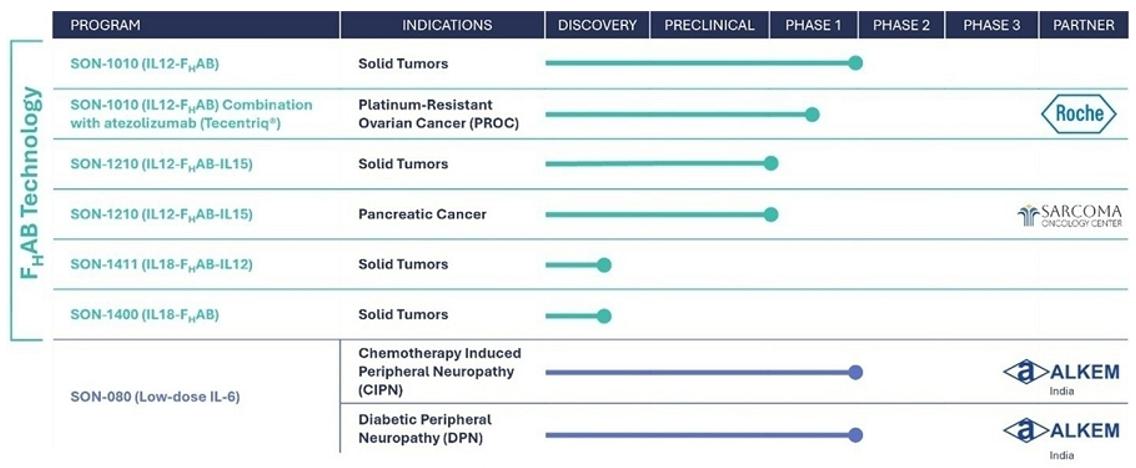
SON-1010
IL-12 is a circulating cytokine that has been shown to exert multiple effects on innate and adaptive immunity. These immune functions are critical in attacking cancer cells and pathogens. IL-12 is a heterodimeric cytokine produced by dendritic cells, monocytes, and macrophages, also known as antigen presenting cells (APCs). IL-12 has been shown to induce interferon gamma (IFN-ɣ) secretion by T cells and natural killer (NK) cells, promote the expansion and survival of activated T and NK cells, supplement the cytolytic activity of cytotoxic T cells, support the differentiation of Th1 helper-effector cells and enhance antibody dependent cellular cytotoxicity (ADCC). IL-12 has also been shown to stimulate in vitro antitumor activity of lymphocytes from patients with cancer and in vivo anti-tumor activity in murine tumor models of melanoma, colon carcinoma, mammary carcinoma, and sarcoma.
Preclinical Studies in Mice
Initially, the murine version of SON-1010 (mIL12-FHAB) demonstrated a larger reduction of tumor growth preclinically compared to recombinant mIL-12 without FHAB (naked/standalone IL-12) in a mouse model of melanoma. Figure 2, from this mouse melanoma study, illustrates a 30-to-50-fold increase in tumor reduction with mIL12-FHAB compared to standalone mIL-12.
| 115 |
Furthermore, in the same model, mIL12-FHAB accumulated in tumors in higher concentrations and remained in the serum, spleen, and tumor significantly longer than mIL-12 without FHAB, potentially enabling less frequent administration and at lower doses.
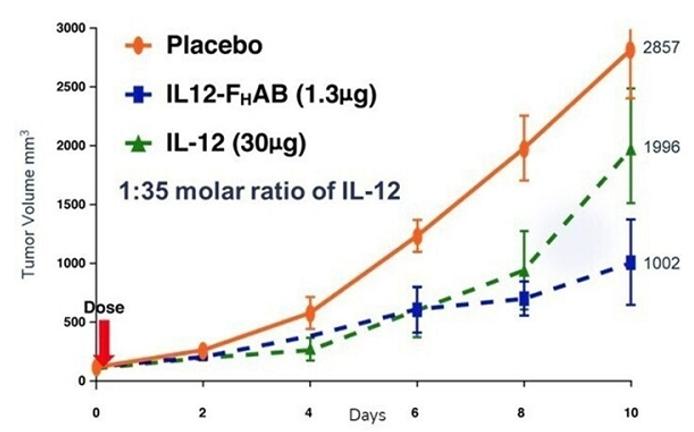
Figure 2: The molar equivalent for IL-12 (0.9µg) is IL12-FHAB (1.3 µg) and they have similar bioactivity in vitro; however, in vivo, IL12- FHAB is approximately 35-fold more potent than IL-12 (at day 10, 1.3µg IL12-FHAB > IL-12 30µg).
In another preclinical study using the B16F10 tumor model, mIL12-FHAB demonstrated an improved dose response versus recombinant murine IL-12, along with increased survival duration (Figure 3 and Figure 4). Results from this study suggest that mIL12-FHAB may have a greater effect on reducing tumor volume and extending survival versus standalone mIL-12.
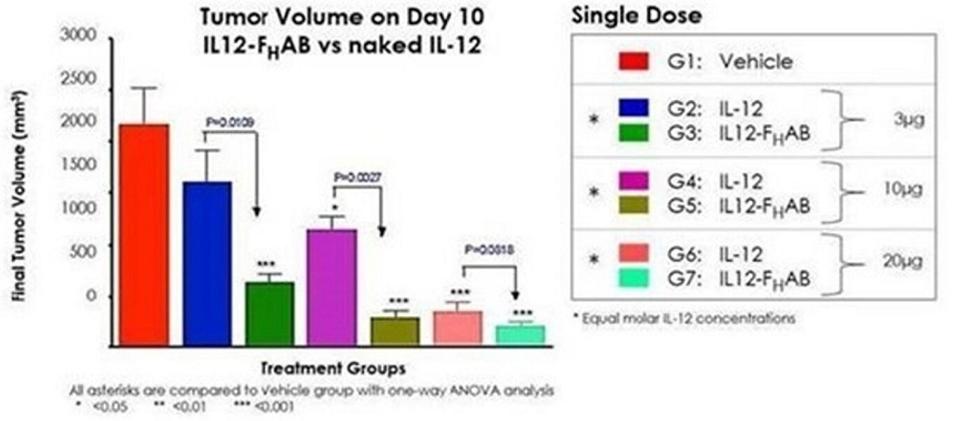
Figure 3: Analysis of tumor volumes shows dose-dependent decreases in tumors in both mIL-12 and mIL12-FHAB-treated mice, as compared to vehicle control. IL12-FHAB-treated mice showed statistically significant decreases in tumor volumes when analyzed against equimolar-dosed, mIL-12-treated mice. Results suggest IL-12 anti-tumor activity is potentially enhanced with the extension of serum half-life by FHAB linkage.
| 116 |
In Figure 4, a Kaplan-Meier analysis was performed to compare survival between animals treated with either mIL12-FHAB or mIL-12. These data illustrate a correlation between the decrease in tumor growth (Figure 3) and an increase in survival duration (Figure 4). In this study, the slower growth of tumors in animals treated with mIL12-FHAB correlated with a longer survival time, as compared to more rapid tumor growth observed with naked mIL-12 treatment. Survivability at the lowest doses of mIL12-FHAB (3µg) was equivalent to the highest dose of mIL-12 (30µg). All doses of mIL12-FHAB showed a 50% survival increase over vehicle at 14 and 17.5 days.
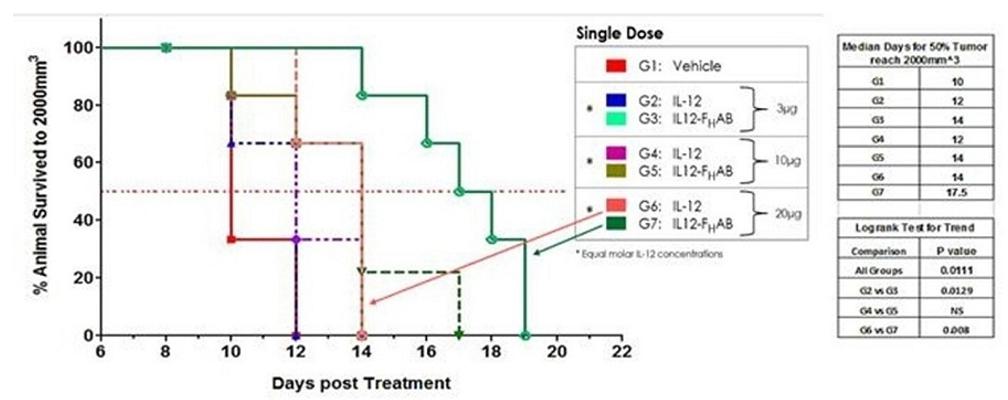
Figure 4: Kaplan-Meier evaluation of mouse B16F tumor survivability shows an increase in survival with IL12- FHAB treatment. Doses of 10µg and 20µg of standalone mIL-12 exhibited 50% survival at 2 and 4 days over vehicle control (10 days). All doses of IL12- FHAB showed 50% survival over vehicle at 14 and 17.5 days. Survivability at the lowest doses of IL12- FHAB were equivalent to highest dose standalone IL-12
Nonhuman Primate Studies of SON-1010
We have completed in vitro pharmacology studies of affinity and binding kinetics that demonstrate species cross-reactivity of SON-1010 in serum albumin for hamster, rat, cynomolgus monkey and human. The results show that SON-1010 displays species specificity to cynomolgus monkey and human subjects, which will guide species selection for further preclinical toxicology work. A humanized mouse model (SCID) study designed to evaluate PK/PD and dose response was completed. This work informed our decision about dosing in a nonhuman primate (NHP) study.
In February 2021, we announced the successful completion of a NHP non-GLP repeat-dose toxicology study of SON-1010, the data from which were used to inform the design of the cGLP toxicity study in preparation for IND submission. The objectives of the non-GLP study were to evaluate the toxicity of SON-1010 in a repeat dose regimen at several dose levels and to gather critical data for the design of further IND-enabling safety and toxicity studies. The study included both intravenous (IV) and SC routes of administration with a total of two injections given 14 days apart. The highest dosage rate utilized in this study was greater than 50 times the anticipated clinical level of exposure to patients. Study results included:
| ● | Repeat dosing by IV and SC routes of administration was tolerated at both dose levels examined. As is typically observed with IL-12 administration, the white blood cell count dropped, and liver enzymes (ALT and AST) were elevated. These were transient effects that returned to baseline within 7 days following the second dose. |
| ● | SON-1010-related changes in the physiological observations, body weight, pathology, cytokines and immunophenotyping were seen, all of which were consistent with those on-target effects previously observed in single dose studies. |
| ● | A significant increase in IFN-γ levels, a key pleiotropic cytokine associated with anti-tumor activity, was observed following the initial dose of SON-1010 with lower IFN-γ levels observed following the second dose. This trend follows the published data from other studies of IL-12 in both humans and NHPs. Signs of cytokine imbalance, or uncontrolled increase of pro-inflammatory cytokines, including TNF-α, IL-1β, and IL-6 were notably absent from all dose levels tested in the study. |
| 117 |
| ● | Pharmacokinetic analysis indicated a mean serum half-life of approximately 40 hours in animals administered SON-1010 via SC injection. This is consistent with data from the previously conducted dose escalation phase of the study, which demonstrates a substantial improvement in half-life compared to the 13-19-hour half-life of naked, recombinant human IL-12. |
| ● | These results build on those from the work with the B16F10 mouse model of melanoma, where the mouse version of SON-1010 showed a 30-fold reduction in the dosage required to achieve a similar therapeutic effect compared to mouse IL-12. Taken together, we believe the observed extended half-life, improved therapeutic window and reduced dosing requirement, made possible by our FHAB technology, represent key advantages of SON-1010 as a potential immune oncology therapeutic. |
In May 2021, we announced the successful completion of a cGLP repeat-dose study of SON-1010 in NHPs. The objectives of the study were to evaluate the toxicity of SON-1010 in NHP using a subcutaneous (SC), repeat-dose regimen at three different dose levels versus untreated controls and to evaluate the potential reversibility of any adverse findings. Study results included:
| ● | The No Observed Adverse Event Level (NOAEL) following repeated administration in NHP was more than 50 times the anticipated equivalent human clinical dose with no evidence of cytokine release syndrome. |
| ● | Pharmacokinetic (PK) analysis of serum samples confirmed an enhanced profile of IL12-FHAB over recombinant human IL-12, with a half-life around 40 hours in NHP. |
| ● | A significant increase in IFN-γ, a key pleiotropic cytokine associated with anti-tumor mechanisms, was observed following dosing with IL12-FHAB. |
| ● | SON-1010 related changes in clinical observations, body weight, clinical pathology, cytokines, and immunophenotyping were seen, all of which were consistent with on-target effects previously observed in nonhuman primates. |
| ● | By Day 38, all study subjects recovered to baseline (pre-study) laboratory values. |
| ● | Repeat dosing administration was tolerated at all dose levels examined. |
Biodistribution Studies
In September 2023, we announced the completion of two independent in vivo proof-of-concept (POC) studies to show the biodistribution of interleukin-FHAB molecules to the tumor microenvironment (TME), using labs with expertise in radiolabeling biologics and in vivo biodistribution analysis. The labs employed different radiolabeling methodologies (99mTc or 89Zr) for mIL-12 and mIL12-FHAB, either with or without a polyhistidine tag (His-Tag). The two studies were completed using the B16F10 mouse melanoma model to measure the accumulation of radiolabeled product and tumor volume inhibition over various time points. Both studies indicated that mIL12-FHAB had significantly higher tumor accumulation, 2.5-4.7 times higher on average at the longer time points, and increased retention when compared to mIL-12. Accumulation was demonstrated in tumors compared to normal mice, and was transient in liver, kidney, and other organs, as expected. Importantly, radiolabeled mIL12-FHAB also demonstrated measurable accumulation in the draining lymph nodes. Overall, these findings have important implications for therapeutic applications of any mono- (ILx-FHAB) or bi-functional (ILx-FHAB-ILy) molecules demonstrating enhanced tumor targeting and accumulation, as well as the potential for improved efficacy that could lead to a variety of drug candidates.
Manufacturing Development
Manufacturing work on the master cell bank expressing SON-1010, formulation development, and process development activities have all been completed, in addition to drug product presentation (liquid or lyophilized). Multiple cGMP drug product lots have been successfully manufactured and provide inventory for ongoing clinical trials.
SON-1010 in the Clinic
We initiated the first-in-human (FIH), Phase 1 trial (SB101) to assess maximum dose for adult patients with advanced solid tumors and platinum-resistant ovarian cancer (PROC) in April 2022 and we presented initial data from the study at AACR in April 2023. More patients will be enrolled in the expansion portion of the study to confirm a recommended Phase 2 dose (RP2D). The very first patient dosed, with an aggressive endometrial sarcoma, had substantial tumor shrinkage with complete resolution of her ascites at one point, and was clinically and radiographically stable for nearly two years. Dosing in the first 3 cohorts was initially performed every 4 weeks but was subsequently done every 3 weeks in the latter cohorts to enhance safety at higher doses. On September 18, 2024, we announced the completion of dose-escalation enrollment in our Phase 1 SB101 clinical trial of SON-1010 in adult patients with advanced solid tumors. We went on to add an expansion cohort using SON-1010 monotherapy with trabectedin in STS and announced the first safety review on March 26, 2025. We expect to report topline efficacy data from this trial in the second half of calendar year 2025.
We started a single-ascending dose (SAD) Phase 1 clinical study (SB102) in Australian healthy volunteers in July 2022 to carefully study the PK and PD without interference from the impact of chemotherapy. Data from the SB102 study were reported during the calendar first quarter of 2023 and were published in February 2024. Typical dose-related increases were seen with SON-1010 in the serum using a validated electrochemiluminescence assay (Meso Scale Diagnostics (MSD)) after SC administration. Mean serum concentration versus time profiles following the single SC injection of SON-1010 are presented for the first week. Between the SON-1010 lowest- (50 ng/kg) and highest- (300 ng/kg) dose cohorts (a 6x escalation in dose), the serum Cmax increased by 4.5x, and the time to reach that (Tmax) was approximately 11 h. This was associated with a corresponding 4.5× increase in the exposure area under the concentration time curve (AUC) from time zero to the time of last observable concentration (AUC0-t), and the shape of the curves indicated typical two-compartment elimination kinetics (Figure 5). The mean T½ across all dose cohorts was 104 h, and the serum concentrations for the majority of the participants remained above the lower limit of quantitation (LLOQ) for 336 h. The mean Cmax value increased in a less than proportional manner between dose cohorts, yielding nonlinear PK.
| 118 |
The MSD assay was also used to study repeat dosing in patients with advanced solid tumors in study SB101, including dose escalation up to the same maximum dose used in SB102. Interestingly, the SON-1010 concentration curves, compared with a single dose in healthy volunteers showed an atypically dissimilar contour (Figure 5). Single-compartment elimination kinetics were noted in patients with cancer, compared to the two-compartment elimination kinetics observed in the healthy volunteers. The unusual PK results comparing these two clinical studies suggest the potential for an improved local immune response due to accumulation in the TME in patients, which could make SON-1010 more effective than prior efforts with systemic immunotherapy using rIL-12. The dose relationship also suggests target-mediated drug disposition (TMDD), perhaps due to the retention of SON-1010 caused by albumin binding to SPARC and its slow release from the tumor tissue.
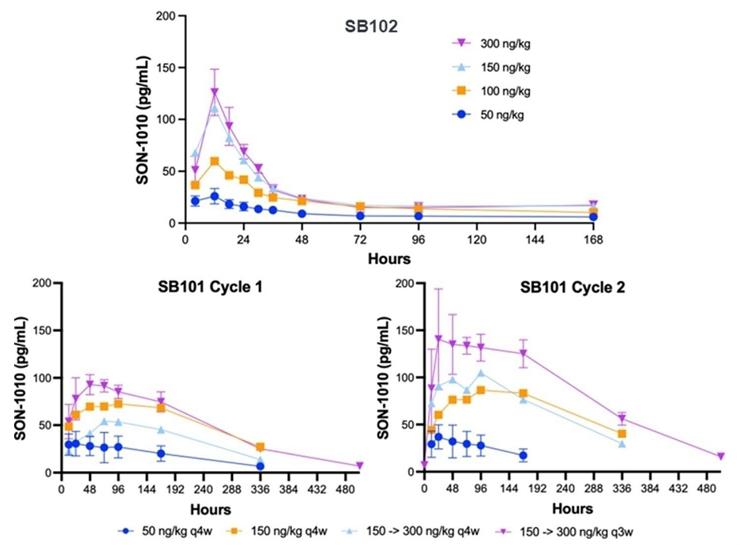
Figure 5: SON-1010 levels were assessed frequently after dosing, then followed at the times indicated in each study. Subjects in study SB102 received a single dose, while patients in study SB101 were administered a fixed dose of SON-1010 (in the first two groups) or a desensitizing first dose followed by a higher maintenance dose (in the last two groups) in the next cycle. Error bars (geometric mean CV%) are shown for the lowest and highest groups, respectively.
Among the cytokine PD responses, the observed increases in IFN-ɣ were most pronounced and were dose-related, controlled, and prolonged. SON-1010 induced IFN-ɣ in all active-drug subjects, which peaked at 24 to 48 hours then returned to baseline after 2 weeks (Figure 6). IFN-ɣ was the most prominent cytokine responding. The mean Cmax value disproportionately increased between the wide range of doses tested, peaking at 977 pg/mL in the highest dose cohort (300 ng/kg). The time taken to achieve maximal IFN-ɣ blood concentrations varied greatly between cohorts and did not correlate with the dose, with the mean time required to peak ranging from 28.8 to 85.0 hours. The AUC0-t also increased disproportionately following the cohort doses and rose to 106,000 h*pg/mL in the highest-dose cohort. However, the partial areas under the concentration-time curve from time zero to 24 h, 48 h, and 168 h increased in a dose-dependent manner. The Cmax and AUC PK parameters in SB101 were similar after the second dose compared to the first dose in SB102, while the IFN-ɣ PD parameters of Cmax and AUC were suppressed in SB101, presumably by induction of the intracellular suppressors of cytokine signaling (SOCS) proteins.
| 119 |
There were small transient increases in IL-6, IL-8, IL-10, and TNF-α after dosing but no consistent pattern was seen with IL-1β, IL-2, or IL-4, and there was no evidence of cytokine release syndrome (CRS). Safety was consistent with what has been reported previously; adverse events have generally been mild/moderate, transient in nature, and have all been tolerable.
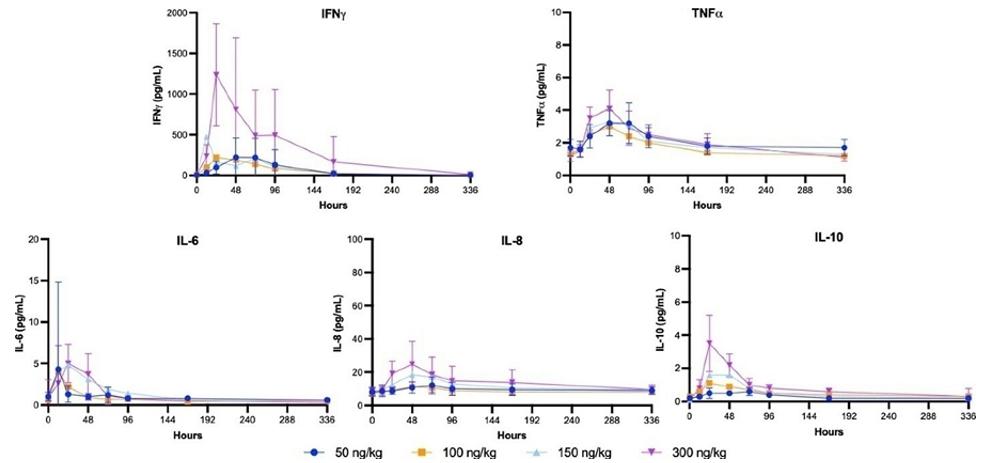
Figure 6: Cytokine levels were assessed frequently after dosing for PD, then followed on the days indicated for the rest of the SB102 study.
A Phase 1b/2a trial (SB221) of SON-1010 in combination with atezolizumab is in progress. This trial is a multicenter, dose-escalation, and randomized proof-of-concept study being conducted in the US and Australia that targets platinum-resistant ovarian cancer (PROC). The goal is to assess the safety, tolerability, PK, PD, and efficacy of SON-1010 administered subcutaneously (SC) in combination with atezolizumab given intravenously (IV). SON-1010 has been safe and tolerable at all doses tested to date and a higher dose cohort (E7) was recently added. Adverse events have generally been mild/moderate and transient in nature, with no study discontinuations for safety reasons. In addition, adverse effects have been less numerous and less intense with subsequent doses.
Safety in both of the active cancer trials has been reviewed by their respective Safety Review Committees at each step during dose escalation. Both trials use a ‘desensitizing’ first dose to take advantage of the known tachyphylaxis with rhIL-12, which minimizes toxicity and allows higher maintenance doses. No dose-limiting toxicities or related serious adverse events have occurred to date. The safety and toxicity profile that has developed is typical for a Phase 1 oncology trial, with the majority of adverse events (AEs) being reported as mild. All have been transient, with no evidence of cytokine release syndrome. Of the 63 cancer patients dosed to date and evaluable for follow-up at the latest cutoff, 38 (60%) had stable disease at their first follow-up scan, 28 of whom were progressing at study entry. At four months follow-up, 26 of 48 evaluable patients remained stable at the second CT scan, suggesting clinical benefit of SON-1010 in 54% of the patients overall, including 2 with PRs and 1 with a CR. A total of 13 of the 17 evaluable patients (76%) had clinical benefit at the 1200 ng/kg dose.
SON-080 for Chemotherapy Induced Peripheral Neuropathy
Through our pipeline expansion efforts, we have identified IL-6 as a cytokine with important biological properties when delivered as a standalone molecule. Our lead clinical stage asset, SON-080, is the native human version of IL-6 that is also manufactured in Chinese Hamster Ovary (CHO) cells. A previous version of recombinant IL-6 has been studied in Phase 1 and Phase 2 clinical trials in cancer patients with thrombocytopenia and in healthy volunteers. Our comparable version has advanced to the next stage of development in chemotherapy-induced peripheral neuropathy (CIPN), a common side effect of treatment with antineoplastic agents in cancer. CIPN is a debilitating condition that manifests itself as pain, numbness and tingling in the extremities. It has been reported in as many as 70% of patients undergoing specific cancer regimens and is a leading cause of patients prematurely aborting chemotherapy. In animal experiments designed to replicate the clinical symptoms of CIPN, recombinant IL-6 presented disease-modifying characteristics, including the potential to repair damaged nerves.
| 120 |
Based on the preclinical work, we believe that SON-080 can potentially regenerate damaged nerves, thereby addressing not only the pain-related symptoms, but also the profound discomfort and motor disability CIPN patients often experience. In the nervous system, IL-6 has exhibited neurotrophic-like properties, inducing anti-apoptotic gene expression, protecting neurons from toxic injuries, and promoting nerve regeneration and remyelination. IL-6 has demonstrated the potential to elicit nerve regrowth and to re-establish both normal nerve function (Figure 7) and sensations (Figure 6) in various preclinical models of CIPN induced by cisplatin, taxol, or vincristine. Activity from treatment with SON-080 was also observed in preclinical models of type 2 diabetic neuropathy, outlining the potential for benefit in DPN, and other diseases affecting the nervous system or other organs. This broad activity suggests that the SON-080 mechanism of action might not be restricted to a given class of chemotherapeutic drugs and could elicit a universal neuroprotective-neurorestorative response. Additionally, preclinical data point to the potential of SON-080 to elicit both preventive and curative activity in neuropathies (Figure 8). This introduces the possibility of treating cancer survivors who still suffer from neuropathies, a population representing between 10% and 60% of the 14 million cancer survivors in the US.
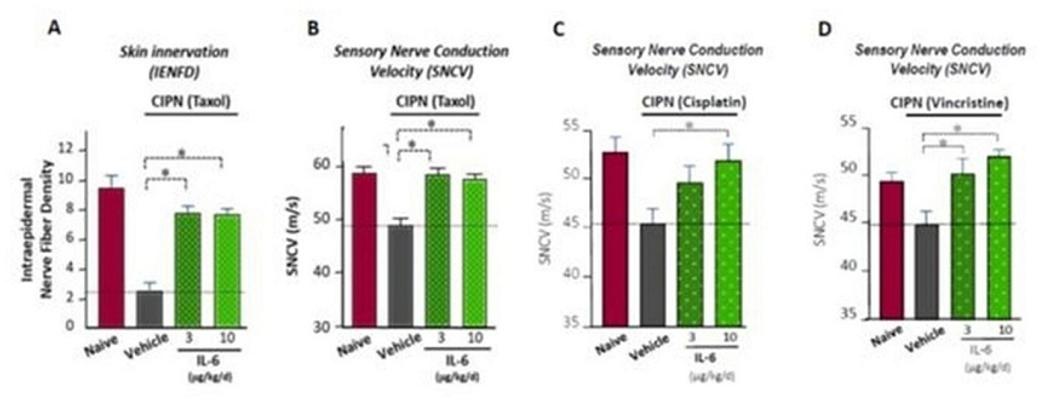
Figure 7: Activity of IL-6 on neuropathy induced by taxol or cisplatin in rats measured at the histological (IENFD) or physiological (SNCV) levels.
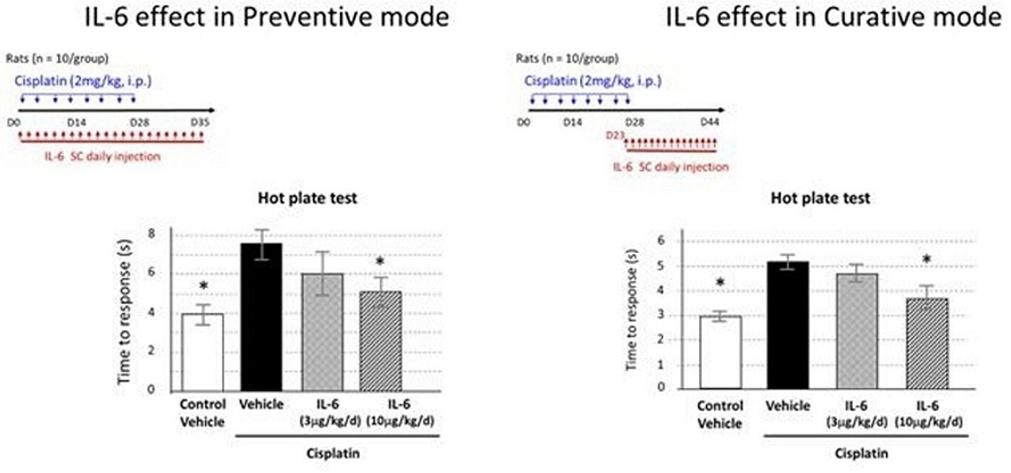
Figure 8: Data show preventive and curative activity potentiating restoration of normal sensitivity (here, using a behavioral response to hot stimulus in cisplatin-induced peripheral neuropathy).
| 121 |
IL-6 has been studied in Phase 1 and Phase 2 studies in over 200 cancer patients with chemotherapy-induced thrombocytopenia. Trial enrollees received SC doses ranging from 0.25 to 32 µg/kg, either daily or thrice weekly. In these trials, where solid tumor cancers were present in more than 75% of the patients treated, the cumulative doses of IL-6 averaged in the 8000 μg range (122 - 54880 μg), and the mean duration of treatment equaled 28 days. One of the trials covered six chemotherapy cycles, with an IL-6 treatment period extending to 203 days. An exacerbation of either cancer or neuropathy was not observed in any of these trials.
The therapeutic MTD of SON-080 was determined in four studies by means of cohort dose escalations of sequential IL-6 dose groups utilizing established common toxicity criteria. When administered daily, the MTD following daily SC injection was determined to be between 3 and 8 μg/kg; when given 3 times per week, the MTD was estimated to be > 10 μg/kg. The most clinically relevant toxicities that defined the treatment-limiting dose in these studies were flu-like symptoms and neurocortical toxicity, manifested by somnolence, restlessness, confusion, hallucination, and disorientation. We anticipate using a dose of SON-080 that is 50-fold less than the prior IL-6 MTD and expect a more benign adverse event profile going forward.
These data form the basis for our clinical trials in CIPN conducted in Australia. We defined the two doses used to be significantly below the MTD, as supported by preclinical studies. For comparison, our target dose was to provide a cumulative dose that is 25 times below the mean cumulative dose reached for a similar period of dosing. We also believe that SON-080 has significant potential for treating other neuropathies, including DPN, as well as other diseases of the nervous system, and we are currently evaluating forward development paths for these opportunities. We initiated an ex-US Phase 1b/2a pilot-scale efficacy study with SON-080 in CIPN in July 2022. The Data Safety Monitoring Board (DSMB) reviewed the initial safety findings after enrollment was completed in Part 1. Data from that study was announced in July 2024, showing safety, tolerability and preliminary evidence of improvement in symptoms.
SON-080 for Diabetic Peripheral Neuropathy
In addition to our CIPN program with SON-080, our DPN program may, subject to data collected from our completed CIPN studies with SON-080, explore the clinical utility of IL-6 in diabetic peripheral neuropathy (DPN). DPN is currently diagnosed in 50%-80% of the diabetic patient population. According to World Health Organization (WHO) projections, the prevalence of diabetes is estimated to exceed 350 million people in 2030. Neuropathy is progressive and develops over the continuum of diabetes. The condition involves intractable pain with no obvious origin, as well as non-pain-related symptoms such as loss of balance, lack of sensation, and autonomic dysfunctions, among others. These deficits impair quality of life and lead to a reduction of life expectancy. Diabetic foot ulcers are a major cost associated with diabetic medical care and are also directly linked to the development of DPN.
Notwithstanding the seriousness of the condition, current treatments only address the pain component of DPN, leaving disease progression and non-pain-related symptoms unaddressed. Furthermore, the few drugs currently used to reduce pain (i.e. Cymbalta, Lyrica, cannabinoids, opioids) are only partially efficacious and are associated with major side effects, which typically delays their introduction into a patient’s care. For these reasons, DPN remains a substantial unmet medical need with high commercial market potential.
Exercise has long been recognized by WHO and caregivers as an effective means of treating and potentially preventing diabetes and several pilot studies have provided evidence to support its role in improving DPN. However, a majority of diabetic patients are physically unable to perform exercise. Regular exercise is known to improve diabetes-associated markers such as HbA1c and glucose homeostasis, to ameliorate heart rate variability and to stimulate recovery of both nerve function and blood flow. Recent evidence demonstrates that IL-6 is released during exercise and mediates some of the beneficial effects of physical activity. We have completed preclinical work in animal models of DPN in which exogenous administration of IL-6 exhibited restorative activity in epidermal nerve density, nerve function, blood flow, and reactions to painful or disturbing stimuli. In this context, SON-080 may become a future pivotal disease-modifying therapy for the treatment of DPN.
| 122 |
In vitro data on oligodendrocytes or organotypic cultures have shown that IL-6 potentially induces myelin gene expression by Schwann cells or oligodendrocytes (Figure 9).
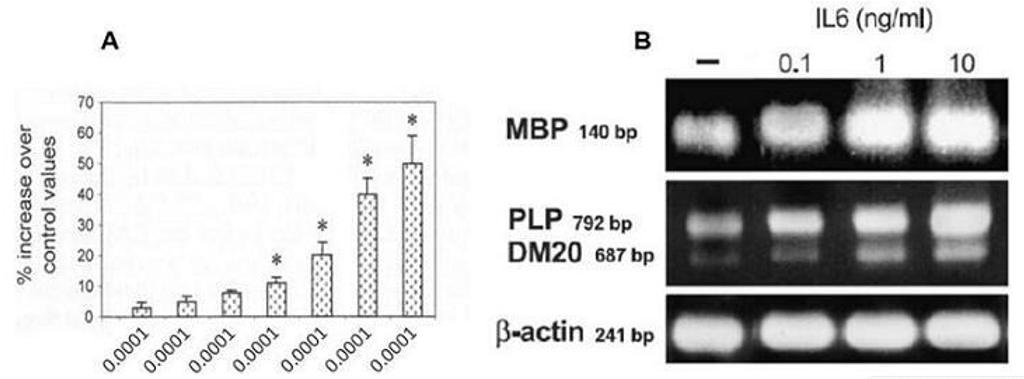
Figure 9: Illustration of survival (A) and differentiation of oligodendrocytes as assessed by myelin basic protein (MBP), proteolipid protein (PLP) and its spliced variant expression (B).
Valerio et al, Mol Cell Neurosci 21 (2002) 602-615.
Pizzi et al, Mol Cell Neurosci 25 (2004) 301-311.
| 123 |
The neuroprotective activity of IL-6 has been evaluated in various paradigms, including excitotoxicity. As well as protecting neurons, IL-6 potentially promotes axonal regeneration and restoration of functional synapses (Figure 10).
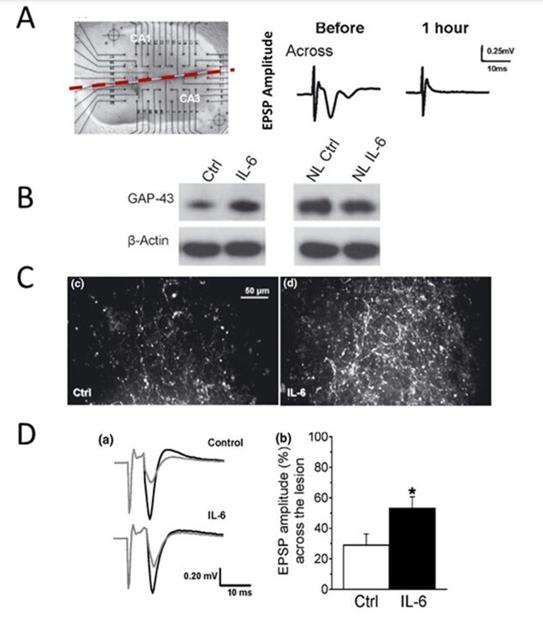
Figure 10: Axonal regeneration activity in hemi-sectioned slices of the hippocampus (A), with increased expression of growth-associated protein 43 (GAP43) in injured slices but not in normal slices (NL) (B). Axonal regeneration activity across the lesion (C) and functional recovery (D) of suppressed (A) excitatory postsynaptic potential (EPSP).Hakkoum et al, J Neurochem 100 (2007) 747-757.
The activity of IL-6 in preclinical models of DPN has been evaluated by three independent laboratories. This work has shown that IL-6 exhibits positive activity in neuropathy in a dose-dependent manner and may also help restore normal physiological parameters after neuropathy is well established (i.e. four weeks after the induction of diabetes and consequential neuropathy). The beneficial activity is observed on motor (Figure 11A) and sensory (Figure 11B) nerve function (conduction velocity), and behaviorally by measuring thermal (Figure 11C) and tactile (Figure 11D) perceptions. In addition to the direct effects on myelin and axons previously observed in vitro, IL-6 has also been observed to have activity in restoring microvascular blood flow in the nerve in vivo (Figure 11E), which is a major driver of diabetic neuropathies. Histological analyses of nerves in animals receiving preventive treatment with IL-6 during the development of neuropathy suggest that IL-6 exhibits protective activity on myelin and may play a role in preserving nerve fiber integrity, as well as nerve conduction velocity and the perception of sensations.
| 124 |
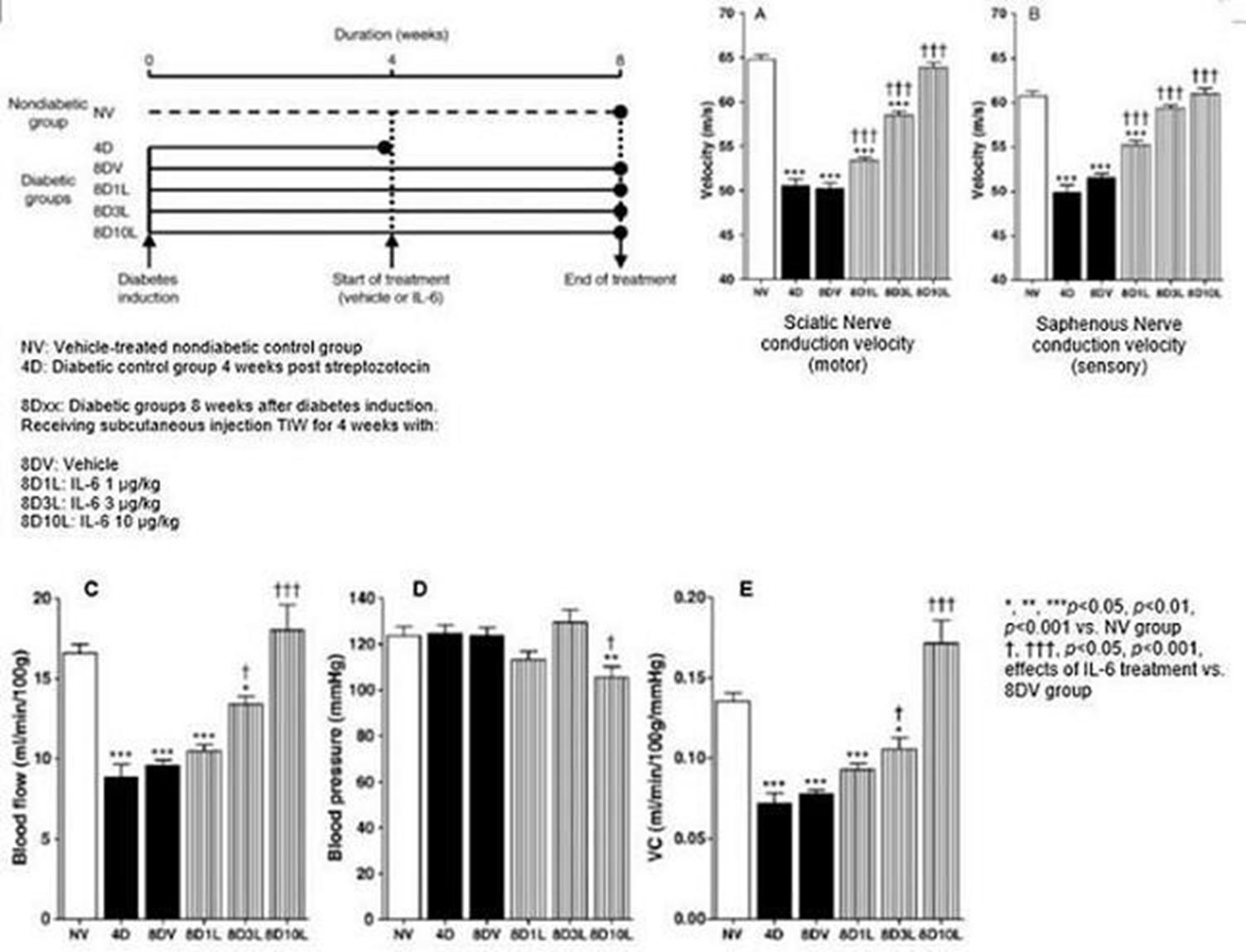
Figure 11: Curative treatment with IL-6 in rats with established diabetic neuropathy induced by streptozotocin. Cameron et al, Exp Neurol 207 (2007) 23-29.
Beyond the oncology indication, 15 pilot studies totaling 167 subjects, including 27 patients with type 2 diabetes, were conducted by independent academic groups not affiliated with us to evaluate the role of IL-6 in exercise and metabolism. The peer-reviewed results suggest that low dose IL-6 mimics several beneficial aspects of exercise, including expression of anti-inflammatory molecules, increased lipid metabolism, decreased insulin secretion, and activation of the STAT3 signaling pathway in muscle.
We believe these data provide strong support for the clinical development of IL-6 in DPN. Through its mechanism of action and potential disease modifying activity, low dose IL-6 may offer a therapeutic solution for neuropathic symptoms, as well as for cardiac autonomic neuropathies (CAN), in diabetic patients. We intend to use data collected from our CIPN studies with SON-080 to inform our decision about potential next development steps for SON-080 in DPN.
| 125 |
SON-080: Alkem Agreement
In October 2024, we announced the execution of the Alkem Agreement for the treatment of DPN in India as well as the manufacturing, marketing and commercialization of SON-080 for the treatment of CIPN and autonomic neuropathy in India. Pursuant to the terms of the Alkem Agreement, Alkem will bear the cost of certain expenses, including conducting clinical studies, preparing and filing regulatory applications and undertaking other developmental and regulatory activities for commercializing SON-080 for DPN in India. Alkem has agreed to pay us, within 12 weeks of the Effective Date of the Alkem Agreement, a $1.0 million upfront non-refundable cash payment, of which $0.5 million was paid in October 2024 and another $0.5 million was paid in May, 2025, which after tax withholdings resulted in a net payment of $0.8 million, as well as potential additional milestone payments totaling up to $1.0 million subject to the achievement of certain development and regulatory milestones. In addition, Alkem is obligated to pay us a royalty equal to a percentage in the low double digits of net sales less Alkem’s actual cost of goods sold and Alkem’s sales and marketing and related expenses of SON-080 in India until the first commercial sale of a competitive Intermittent Low Dose IL-6 compound as set forth in the Alkem Agreement.
SON-080: New Life Therapeutics Agreement
In May 2021, we announced the execution of the New Life Agreement, described in detail below which resulted in the out-license of our IL-6 (SON-080) asset for DPN to New Life. The licensed territory includes the 10 ASEAN countries of Singapore, Malaysia, Indonesia, Thailand, The Philippines, Cambodia, Brunei, Vietnam, Myanmar, and Lao PDR. In June and July of 2021, we amended the New Life Agreement to make Sonnet BioTherapeutics, CH, SA (rather than Sonnet BioTherapeutics, Inc.) the party to the New Life Agreement (First Amendment) and we also made Sonnet BioTherapeutics, Inc. the Guarantor of performance under the New Life Agreement (Second Amendment), respectively. In addition to the initial $0.5 million received by us upon signing of the LOI in August 2020, an additional $0.5 million non-refundable upfront payment was received by us upon execution of the New Life Agreement. According to the terms of the New Life Agreement, we could receive a $1.0 million deferred license fee within 30 days of the achievement of an early commercial sales milestone, a total of up to $19.0 million in milestone payments and a tiered royalty ranging from 12% to 30% on commercial sales. On December 2, 2024, New Life provided us with written notice of its intention to exercise its Give Back Option pursuant to the New Life Agreement. We were informed by New Life that it has elected to move its business in a different direction. We are negotiating the terms of the Give Back Option with New Life. If we and New Life are unable to reach a mutual agreement on such terms, the Give Back Option will expire unexercised, New Life will retain the rights granted subject to the terms and conditions of the New Life Agreement and the New Life Agreement will remain in effect unless otherwise terminated by either us or New Life pursuant to the terms and conditions of the New Life Agreement.
SON-1210
SON-1210, our lead bifunctional construct, combines IL-12 and IL-15 conjugated to FHAB. These cytokines were selected based on synergistic biologic activity. IL-12 is known to increase IL-15Rα receptor and IFN-ɣ, activate NK and TH1 (tumor killing) cells, and decreases Tregs. IL-15 acts through its specific receptor, IL15Rα, which is expressed on antigen-presenting dendritic cells (APC), monocytes, and macrophages. In addition to the potential antitumor properties of IL-12 described above, we believe IL-15 can potentially add the following complementary activity:
| ● | Induce differentiation and proliferation of T, natural killer (NK), and B cells | |
| ● | Enhance cytolytic activity of CD8+ T cells | |
| ● | Induce long-lasting CD8+ memory T cells enhancing immune surveillance against cancer for month/years | |
| ● | Stimulate differentiation and immunoglobulin synthesis by B cells | |
| ● | Induce maturation of dendritic cells | |
| ● | Upregulate IL-12β1 receptor expression |
| 126 |
We have conducted a number of preclinical studies with SON-1210 and the murine version (mIL12-FHAB-hIL15), and this work was published in December 2023. Mice injected once or three times with the doses indicated had suppressed tumor growth in the B16F10 melanoma model compared to controls (Figure 12). Compared to placebo-treated mice, mIL12-FHAB-hIL15 mice showed slower tumor growth in a dose-dependent manner. A single dose of 5 μg was fully effective, whereas a single dose of 10 μg did not further slow the tumor volume increase. The 3x group showed an even more effective response, with tumor growth delayed until day 14. All groups treated with mono- or bifunctional cytokine(s) linked to FHAB showed significant growth inhibition, starting on day 4. A time-to-event efficacy approach in the mice revealed an increase in survival following mIL12-FHAB-hIL15 treatment, with 1 μg inducing 12-day median survival, whereas 10 μg induced 19-day survival, compared to 10 days in the tumor-bearing placebo mice. The median survival with a single mIL12-FHAB-hIL15 dose of 5 μg was 18.5 days, which was prolonged to 21 days after 3 doses. Thus, there was a clear dose-dependent effect of mIL12-FHAB-hIL15 treatment on survival (p < 0.01).
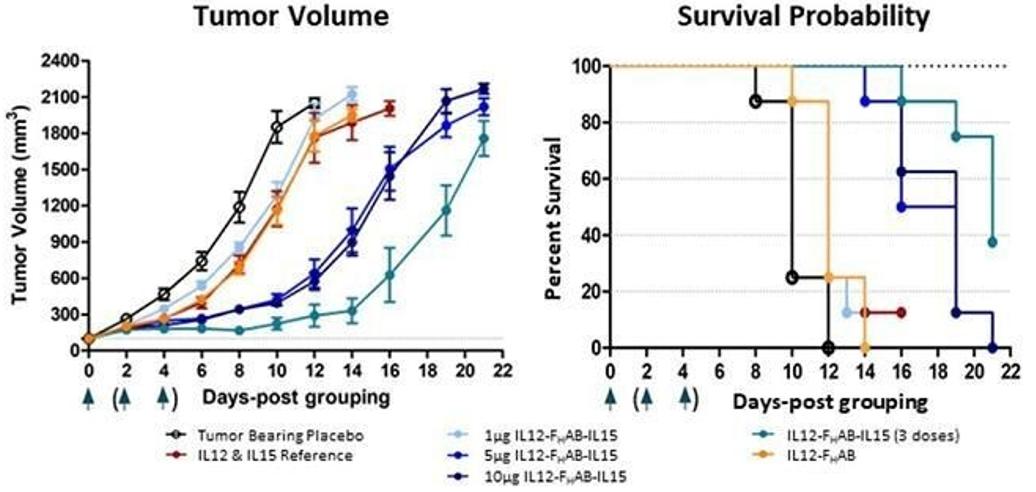
Figure 12: These data show an enhanced reduction in tumor growth with mIL12-FHAB-hIL15 compared to concomitantly administered, naked mIL-12 and hIL-15 in a mouse model of melanoma.
| 127 |
Analysis of PD cytokine response 3 days after dosing (Figure 13) showed that mIL12-FHAB-hIL15 increased IFN-ɣ, IL-10, IL-12, IL-6, and TNFα levels in a dose-dependent manner compared to the tumor-bearing placebo group, with no evidence of cytokine release syndrome. There was a substantial increase in IFN-ɣ levels with a single dose of mIL12-FHAB-hIL15 to over 2000 pg/mL at 3 days, whereas mild increases were observed in other cytokines. Two doses of 5 μg increased the peak response to almost 9000 pg/mL. By day 8, the cytokine response pattern was sustained but generally dampened, with maximal IFN-ɣ levels returning to 500 pg/mL after a single dose or 2100 pg/mL after three doses of mIL12-FHAB-hIL15 at 5 μg. However, TNFα levels remained elevated.
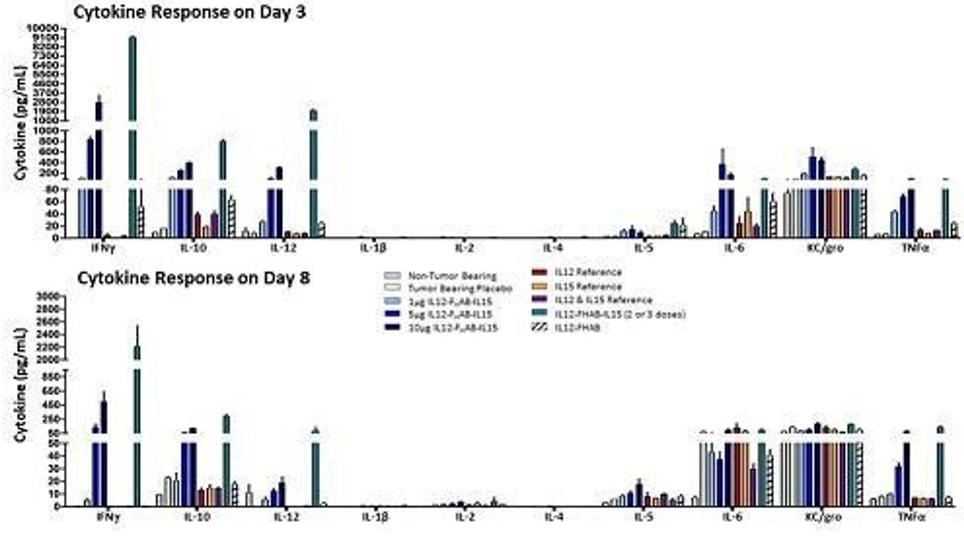
Figure 13: The combination of IL-12 and IL-15 in cis linked to the FHAB displayed synergistic activity, leading to enhanced IFN-ɣ activity versus the combined cytokines or IL12-FHAB alone in a mouse model of melanoma.
In February 2023, we announced the successful completion of two IND-enabling toxicology studies with SON-1210 in NHPs. A NHP non-GLP dose escalation study of SON-1210 was completed in September 2022, and a GLP repeat dose NHP study was completed in the fourth calendar quarter of 2022. The cGMP manufacturing for bulk drug is complete, and a lyophilized formulation of drug product was manufactured in early 2023 to support the FIH clinical study. The initial tox material supported the non-GLP study, while the GLP study was being performed on the same lot of GMP drug as intended for the Phase 1 clinical study. The regulatory authorization process for SON-1210 is scheduled to commence with the Sarcoma Oncology Center as they plan to conduct an investigator-initiated Phase 1/2a clinical study to evaluate SON-1210 in combination with NALIRIFOX® (the combination of liposomal irinotecan, 5-fluorouracil/leucovorin, and oxaliplatin), which is licensed for the treatment of front line metastatic PDAC.
SON-1210: Sarcoma Oncology Center Agreement
On August 19, 2024, we announced that we had entered into a Master Clinical Collaboration Agreement (the “Sarcoma Agreement”) with the Sarcoma Oncology Center, to advance the development of SON-1210, our bifunctional IL12-FHAB-IL15 asset. Preclinical data published on December 20, 2023 demonstrated the potential of SON-1210 for solid tumor immunotherapy. An Innovative Immuno-Oncology Consortium (“IIOC”) led by oncology experts funded by the Sarcoma Oncology Center will conduct an investigator-initiated Phase 1b/2a study of SON-1210. Under the terms of the Sarcoma Agreement, the IIOC, in collaboration with us, will prepare a protocol and conduct clinical study to evaluate SON-1210 in combination with several chemotherapeutic agents for the specific treatment of metastatic pancreatic cancer. We will provide the study drug, SON-1210, and support operational services for the planned Phase 1b/2a study.
Discovery Assets: SON-1410 (IL18-FHAB-IL12) and SON-3015 (Anti-IL6-FHAB-Anti-TGFβ)
In August 2021, we announced the selection of a novel development candidate after completing comparative studies in a mouse melanoma model. The candidate represents our second bifunctional compound integrating IL-12 and IL18 with our FHAB platform. IL-18 can regulate both innate and adaptive immune responses through its effects on natural killer (NK) cells, monocytes, dendritic cells, T cells, and B cells. IL-18 acts synergistically with other pro-inflammatory cytokines to promote interferon-γ (IFN-γ) production by NK cells and T cells. Systemic administration of IL-18 has been shown to have anti-tumor activity in several animal models. Moreover, tumor-infiltrating lymphocytes (TILs) express more IL-18 receptors than other T cells.
| 128 |
IL18-FHAB-IL12 (SON-1410) showed statistically significant tumor size reduction in a mouse melanoma study compared with the placebo, as well as a dose response. The data demonstrated:
| Compound | Day 0, Single Dose Tumor @ 100 mm3 | Day 8 Tumor Volume (mm3 +/- SEM), N=8 | Day 8 Percentage Tumor Shrinkage | |||||
| Placebo | NA | 1747 +/- 301 | - | |||||
| IL18-FHAB-IL12 | 1 µg | 918 +/- 130 | 47 | % | ||||
| IL18-FHAB-IL12 | 5 µg | 619 +/- 141 | 65 | % | ||||
A separate mouse study was also performed comparing the selected version of IL18-FHAB-IL12 with two other candidates, GMCSF-FHAB-IL18 and GMCSF-FHAB-IL12. The comparison data indicated significantly greater reduction in tumor volume, along with higher IFN-γ levels and immune cell responses (NK, NKT, Th1, and cytotoxic CD8 T cells) using IL18-FHAB-IL12, compared with GMCSF-FHAB-IL12 or GMCSF-FHAB-IL18. However, published IL-18 clinical trials have shown that while it is well tolerated, IL-18 has poor efficacy in the treatment of cancers, most likely due in large part to the high co-expression of IL-18 binding protein (IL-18BP) in the TME. In particular, IL-18BP serves as a “decoy receptor” that binds to IL-18 with much higher affinity, compared with the IL-18Rc complex, thereby causing a negative feedback loop with IL-18 and inhibiting IL-18-mediated TIL activation. Thus, there exists a potential for the discovery of IL-18 variant compositions that could harness the therapeutic potential of IL-18 for the treatment of cancers. Our strategy for amino acid modifications to rIL-18 was based on a compilation of literature review, 3D X-ray crystallography structures, and computer modeling analysis. Subsequently, certain IL-18 variant sequences were synthesized, engineered into expression constructs and manufactured at small scale in either CHO cell culture or E. coli. Highly purified milligram quantities of SON-1411 or SON-1400 were analyzed in vitro for IL-18Rc or IL-18BP binding activities, respectively, using the HEK-Blue™ and Bright-Glo Luciferase™ IL-18Rc reporter assays. In vitro results for at least one variant of IL-18 showed equivalent binding to the IL-18 Rc, compared to the wild-type IL-18 reference molecule, concomitant with no or reduced binding to IL-18BP.
TGF-β/IL-6 biology is a strong predictor of overall survival in cancer, and combined targeting to suppress IL-6 and TGFβ signaling using SON-3015 may represent a promising strategy for treating tumor and bone metastases. TGFβ is released from degraded bone, and enhances IL-6 production, contributing to the vicious circle of bone metastasis. High FcRn expression in the bone environment would result in accumulation in the bone of the dual construct anti-IL6-FHAB-anti-TGFβ, thereby potentially inhibiting or blocking bone metastases. We have elected to place the SON-3015 development program on hold for expense reduction purposes.
We face numerous challenges and uncertainties with respect to the development and commercialization of our therapeutic compounds, including our FHAB technology. Please see “Risk Factors” contained elsewhere in this prospectus for more information.
Competition
The pharmaceutical and biotechnology industries are characterized by rapidly advancing technologies, intense competition and a strong emphasis on proprietary products. While we believe that our technology, development experience and scientific knowledge provide us with competitive advantages, we face potential competition from many different sources, including large pharmaceutical and biotechnology companies, academic institutions, government agencies and other public and private research organizations that conduct research, seek patent protection and establish collaborative arrangements for the research, development, manufacturing and commercialization of cancer immunotherapies. Any product candidates that we successfully develop and commercialize will compete with new immunotherapies that may become available in the future.
We compete in the segments of the pharmaceutical, biotechnology and other related markets that develop immuno-oncology treatments. There are many other companies that have commercialized and/or are developing immuno-oncology treatments for cancer including large pharmaceutical and biotechnology companies, such as Amgen, AstraZeneca/MedImmune, Bristol-Myers Squibb, Merck, Novartis, Pfizer and Roche/Genentech.
| 129 |
We face significant competition from pharmaceutical and biotechnology companies that target the use of specific cytokines or other large molecules as immunomodulating therapies in the cancer setting. These generally include, single- or bi-specific antibodies, fusion proteins, antibody drug conjugates and targeted vaccines.
With respect to SON-080, we are aware of other companies developing products to treat CIPN, including but not limited to Kyorin Pharmaceuticals and Trevana; however, we believe we are the only company studying the use of a disease-modifying cytokine for the indication. Regarding DPN, there are several companies selling commercially approved drugs, including but not limited to Eli Lilly, Ono Pharmaceuticals, Pfizer, Collegium Pharmaceuticals and Daiichi Sankyo, as well as a number of companies with compounds in clinical development, including but not limited to Avanir Pharmaceuticals, Pfizer, Vertex Pharmaceuticals, Applied Therapeutics, and Helixsmith.
With respect to our first FHAB-derived candidate, SON-1010, we are aware of other competing IL-12 programs, which include, but are not limited to those being developed by Xilio Therapeutics, Werewolf Therapeutics, Dragonfly Therapeutics, Krystal Biotech and Precigen. We believe that our FHAB integrated IL-12 is tumor-targeted with an enhanced PK profile that differentiates it from the competition.
With respect to our earlier stage pipeline FHAB product candidates SON-1210, SON-1411 and SON-3105, we are not aware of any other competing companies working on these specific bifunctional programs.
Many of the companies against which we are competing or against which we may compete in the future have significantly greater financial resources and expertise in research and development, manufacturing, preclinical testing, conducting clinical trials, obtaining regulatory approvals and marketing approved drugs than we do. Mergers and acquisitions in the pharmaceutical, biotechnology and diagnostic industries may result in even more resources being concentrated among a smaller number of our competitors. Smaller or early-stage companies may also prove to be significant competitors, particularly through collaborative arrangements with large and established companies. These competitors also compete with us in recruiting and retaining qualified scientific and management personnel and establishing clinical trial sites and enrolling subjects for our clinical trials, as well as in acquiring technologies complementary to, or necessary for, our programs.
We could see a reduction or elimination of our commercial opportunity if our competitors develop and commercialize products that are safer, more effective, have fewer or less severe side effects, are more convenient or are less expensive than any products that we or our collaborators may develop. Our competitors also may obtain FDA or foreign regulatory approval for their products more rapidly than we may obtain approval for ours, which could result in our competitors establishing a strong market position before we or our collaborators are able to enter the market. The key competitive factors affecting the success of all our product candidates, if approved, are likely to be their efficacy, safety, convenience, price, the effectiveness of companion diagnostics, if required, the level of biosimilar or generic competition and the availability of reimbursement from government and other third-party payors.
Manufacturing
We rely on contract development and manufacturing organizations, or CDMOs, to produce our drug candidates in accordance with the FDA’s current Good Manufacturing Practices, or cGMP, regulations for use in our clinical trials. The manufacture of biopharmaceuticals is subject to extensive cGMP regulations, which impose various procedural and documentation requirements and govern all areas of record keeping, production processes and controls, personnel and quality control. Our pipeline molecules are manufactured using the standard industrial Chinese Hamster Ovary (CHO) platform with common bio-chemical engineering from readily available raw materials.
To meet our projected needs for clinical supplies to support our activities through regulatory approval and commercial manufacturing, the one of the CDMOs with whom we currently work has increased their scale of production, and is building a cGMP manufacturing site in the United States, available by Q3 calendar year 2024. The landscape for CDMOs is strong and there are multiple potential sources for contract manufacturing. We have not yet engaged alternate suppliers since our current CDMO is able to scale production and continues to successfully manufacture our pipeline. Our relationships with CDMOs are managed by internal personnel with extensive experience in pharmaceutical development and manufacturing.
| 130 |
License and Other Commercial Arrangements
Janssen Pharmaceuticals (Johnson & Johnson)
In October 2022, we announced a collaboration agreement with Janssen Biotech, Inc. (Janssen), one of the Janssen Pharmaceutical Companies of Johnson & Johnson, where in vitro and in vivo efficacy of SON-1010 (IL12-FHAB), SON-1210 (IL12-FHAB-IL15) and SON-1410 (IL18-FHAB-IL12) will be evaluated in combination with certain Janssen proprietary cell therapy assets. The agreement was facilitated by Johnson & Johnson Innovation. Under the terms of the agreement, we will supply the three referenced compounds for use in head-to-head in vitro and in vivo efficacy studies. If successful and subject to provisions of the agreement, Janssen could exercise its option and we could then seek a license and/or an expanded collaboration.
Alkem Laboratories Limited
On October 8, 2024, we entered into the Alkem Agreement with Alkem. Pursuant to the Alkem Agreement, we granted Alkem an exclusive license (with the right to sublicense) to research, develop, manufacture, import, export, market, use and commercialize pharmaceutical products containing our IL-6 (SON-080) asset (or any derivatives, fragments or conjugates thereof) (the “Compounds”) (such products, the “Products”) for the treatment of diabetic peripheral neuropathy (DPN) (the “DPN Field”) and to manufacture, import, export, market, use and commercialize Products for the treatment of chemotherapy-induced peripheral neuropathy (CIPN) and autonomic neuropathy (together with the DPN Field, collectively, the “Fields”) in India (the “Exclusive Territory”). Except as provided for in the Alkem Agreement, we agreed not to develop, use, sell, offer or otherwise commercialize any Compounds or Products for use in the DPN Field in the Exclusive Territory during the term of the Alkem Agreement. We retain all rights to manufacture Compounds and Products anywhere in the world. We will enter into a follow-on supply agreement with Alkem pursuant to which we will manufacture for Alkem Compounds and Products for development and commercialization thereof in accordance with the Alkem Agreement on terms to be negotiated by the parties. Pursuant to the terms of the Alkem Agreement, Alkem will bear the cost of, and be responsible for, among other things, conducting clinical studies and additional non-clinical studies (if any, subject to both parties’ approval), preparing and filing applications for regulatory approval and undertaking other developmental and regulatory activities for commercializing Products in the DPN Field in the Exclusive Territory. Alkem will own and maintain all regulatory filings and approvals for Products in the Exclusive Territory. Upon payment of a Clinical Data Access Fee (as defined in the Alkem Agreement), we will have rights to access and use the data generated by the clinical trials conducted in connection with the Alkem Agreement.
In consideration of the license and other rights granted by us, Alkem agreed to pay us, within 12 weeks of the effective date of the License Agreement, a $1.0 million upfront non-refundable cash payment, of which $0.5 million was paid in October 2024, which after tax withholdings resulted in a net payment of $0.4 million, as well as potential additional milestone payments totaling up to $1.0 million subject to the achievement of certain development and regulatory milestones. In addition, during the Royalty Term (as defined below), Alkem is obligated to pay us a royalty equal to a percentage in the low double digits of net sales less Alkem’s actual cost of goods sold and Alkem’s sales and marketing and related expenses of Products in the Exclusive Territory. The “Royalty Term” means, on a Product-by-Product basis in the Exclusive Territory, the period commencing on the date of the First Commercial Sale (as defined in the License Agreement) of such Product in the Exclusive Territory and continuing until Alkem ceases Commercialization (as defined in the Alkem Agreement) of such Product in the DPN Field. The Royalty Term will expire upon the first commercial sale of a competitive Intermittent Low-Dose IL6 compound as set forth in the Alkem Agreement.
We retain the sole responsibility to pay our third party licensors to the extent such obligations are applicable to the rights granted to Alkem with respect to the Products and will remain liable for all obligations under the license related to the Compounds and Products between us and ARES Trading SA. The Alkem Agreement will remain in effect in perpetuity until terminated as a result of breach, bankruptcy or upon 90 days prior written notice, in each case as set forth in the Alkem Agreement. Pursuant to the Alkem Agreement, the parties agreed to form a joint development committee to provide strategic oversight of the parties’ collaboration activities under the Alkem Agreement, including to coordinate the development of Products in the Exclusive Territory. The Alkem Agreement also contains customary representations, warranties and covenants by both parties, as well as customary provisions relating to indemnification, confidentiality and other matters.
| 131 |
Sarcoma Oncology Center
On August 19, 2024, we announced that we had entered into a Master Clinical Collaboration Agreement (the “Sarcoma Agreement”) with the Sarcoma Oncology Center, to advance the development of SON-1210, our bifunctional IL12-FHAB-IL15 asset. Preclinical data published on December 20, 2023 has demonstrated the potential of SON-1210 for solid tumor immunotherapy. An Innovative Immuno-Oncology Consortium (“IIOC”) led by oncology experts funded by the Sarcoma Oncology Center will conduct an investigator-initiated Phase 1b/2a study of SON-1210 in pancreatic cancer, an indication with significant unmet medical need. Under the terms of the Sarcoma Agreement, the IIOC, led by Dr. Sant Chawla, Director of the Sarcoma Oncology Center, in collaboration with us, will prepare a protocol and conduct an investigator-initiated Phase 1b/2a clinical study to evaluate SON-1210 in combination with several chemotherapeutic agents including but not limited to the combination of liposomal irinotecan, 5-fluorouracil/leucovorin, and oxaliplatin (“NALIRIFOX”) for the specific treatment of metastatic pancreatic cancer. NALIRIFOX is the U.S. FDA regimen approved for the treatment of metastatic pancreatic cancer in the front-line setting. We will provide the study drug, SON-1210, and support operational services for the planned Phase 1b/2a study.
Roche
In January 2023, we announced a collaboration agreement with Roche for the clinical evaluation of SON-1010 with atezolizumab (Tecentriq®). Wes have entered into a Master Clinical Trial and Supply Agreement (“MCSA”) with Roche, along with ancillary Quality and Safety Agreements, to study the safety and efficacy of the combination of SON-1010 and atezolizumab in a platinum-resistant ovarian cancer (“PROC”) patient setting. Further, we and Roche will provide SON-1010 and atezolizumab, respectively, for use in the Phase 1b/Phase 2a combination safety, dose-escalation, and efficacy study (SB221).
New Life
In May 2021, we entered into the New Life Agreement with New Life. Under the New Life Agreement, we granted New Life an exclusive license (with the right to sublicense) to develop and commercialize pharmaceutical preparations containing a specific recombinant human IL-6, SON-080 (the “Compound”) (such preparations, the “Products”) for the prevention, treatment or palliation of diabetic peripheral neuropathy in humans (the “DPN Field”) in Malaysia, Singapore, Indonesia, Thailand, Philippines, Vietnam, Brunei, Myanmar, Lao PDR and Cambodia (the “Exclusive Territory”). New Life had the ability to exercise an option to expand (1) the field of the exclusive license to include the prevention, treatment or palliation of chemotherapy-induced peripheral neuropathy in humans (the “CIPN Field”), which option is non-exclusive and also expired on December 31, 2021; and/or (2) the territorial scope of the license to include the People’s Republic of China, Hong Kong and/or India, which option is exclusive and expired on December 31, 2021. In June and July of 2021, we amended the New Life Agreement to make Sonnet BioTherapeutics CH SA (rather than Sonnet BioTherapeutics, Inc.) the party to the New Life Agreement (First Amendment) and we also made Sonnet BioTherapeutics, Inc. the Guarantor of performance under the New Life Agreement (Second Amendment), respectively.
We will retain all rights to manufacture Compounds and Products anywhere in the world. New Life and us will enter into a follow-on supply agreement pursuant to which we will supply to New Life Products for development and commercialization thereof in the DPN Field (if applicable) (and the CIPN Field, if applicable) in the Exclusive Territory on terms to be negotiated by the parties. We will also assist in transferring certain preclinical and clinical development know-how that is instrumental in New Life’s ability to benefit from the license.
New Life will bear the cost of, and be responsible for, among other things, conducting clinical studies and additional non-clinical studies and other developmental and regulatory activities for commercializing Products in the DPN Field (if applicable) (and the CIPN Field, if applicable) in the Exclusive Territory.
| 132 |
New Life paid us a $0.5 million non-refundable upfront cash payment in August 2020 upon executing a letter of intent to negotiate a license agreement and a $0.5 million non-refundable upfront cash payment in June 2021 in connection with the execution of the New Life Agreement. New Life is also obligated to pay a non-refundable deferred license fee of an additional $1.0 million at the time of the satisfaction of certain milestones, as well as potential additional milestone payments to us of up to $19.0 million subject to the achievement of certain development and commercialization milestones. In addition, during the Royalty Term (as defined below), New Life is obligated to pay us tiered double digit royalties ranging from 12% to 30% based on annual net sales of Products in the Exclusive Territory. The “Royalty Term” means, on a Product-by-Product and a country-by-country basis in the Exclusive Territory, the period commencing on the date of the first commercial sale (subject to certain conditions) of such Product in such country in the Exclusive Territory and continuing until New Life ceases commercialization of such Product in the DPN Field (or CIPN Field, if applicable).
The New Life Agreement will remain in effect on a Product-by-Product, country-by-country basis and will expire upon the expiration of the Royalty Term for the last-to-expire Product in the last-to-expire country, subject to (i) each party’s early termination rights including for material breach or insolvency or bankruptcy of the other party and (ii) our Buy Back Option and New Life’s Give Back Option (as defined below).
In addition, New Life granted to us an exclusive option to buy back the rights granted by us to New Life (the “Buy Back Option”) and we granted New Life the right to give back the rights with respect to Products in the DPN Field and/or the CIPN Field (if applicable) in one or more countries in the Exclusive Territory on terms to be agreed upon (the “Give Back Option”), which options will expire upon the initiation of a Phase III Trial for the applicable Product. On December 2, 2024, New Life provided us with written notice of its intention to exercise its Give Back Option pursuant to the New Life Agreement. We were informed by New Life that is has elected to move its business in a different direction. We are negotiating the terms of the Give Back Option with New Life. If we and New Life are unable to reach a mutual agreement on such terms, the Give Back Option will expire unexercised, New Life will retain the rights granted subject to the terms and conditions of the New Life Agreement and the New Life Agreement will remain in effect unless otherwise terminated by either us or New Life pursuant to the terms and conditions of the New Life Agreement.
XOMA
We (as successor-in-interest to Oncobiologics, Inc. (“Oncobiologics”), after Oncobiologics spun-off certain assets into us and concurrently distributed all of its shares in us on a pro rata basis to Oncobiologics’s stockholders on April 6, 2015) and XOMA (US) LLC (“XOMA”) are party to a Discovery Collaboration Agreement, dated July 23, 2012 and an Amendment of Discovery Collaboration Agreement, dated May 7, 2019 (together, the “Collaboration Agreement”) pursuant to which XOMA granted us a non-exclusive, non-transferrable license and/or right to use certain materials, technologies and related information related to discovery, optimization and development of antibodies and related proteins and to develop and commercialize products thereunder (each, a “Product”). We are obligated to make contingent milestone payments to XOMA totaling $3.75 million on a Product-by-Product basis upon the achievement of certain development and approval milestones related to a Product. To that point, we have paid $500,000 for initiation of enrollment of a Product (i.e., SON-1010) in a Phase 1 Trial. We have also agreed to pay XOMA low single-digit royalties on net sales of Products sold by us. Royalties on each Product are payable on a country-by-country basis until the later of (i) a specified period of time after the First Commercial Sale (as defined in the Collaboration Agreement), and (ii) the date of expiration of the last valid claim in the last-to-expire of the issued patents covered by the Collaboration Agreement. In addition, we have the right to reduce the rate of the royalty on a Product-by-Product basis by paying XOMA a specified amount. The Collaboration Agreement may be terminated by either party for cause and contains customary indemnification provisions.
ARES
On August 28, 2015, Relief, now one of our wholly owned subsidiaries, signed a License Agreement (the “ARES License Agreement”) with Ares Trading, a wholly owned subsidiary of Merck KGaA (“ARES”). Under the terms of the ARES License Agreement, ARES has granted us a sublicensable, exclusive, worldwide, royalty-bearing license on proprietary patents to research, develop, use and commercialize products (each, a “Product”) using atexakin alfa (“Atexakin”), a low dose formulation of human IL-6 in peripheral neuropathies and vascular complications. Three patents are included in the ARES License Agreement that protect the use of Atexakin to treat i) diabetic neuropathy, ii) chemotherapy-induced peripheral neuropathy and iii) vascular complications.
| 133 |
Pursuant to the ARES License Agreement, we will pay ARES high single-digit royalties on net sales of Products sold by us. Royalties are payable on a Product-by-Product and country-by-country basis until the later of (i) a specified period of time after the First Commercial Sale (as defined in the ARES License Agreement) in such country, and (ii) the last date on which such product is covered by a valid claim in such country. If a Product is not covered by a valid claim in a country or such valid claim has expired or been invalidated before the twelfth (12th) anniversary of the date of the First Commercial Sale of such Product in such country, then the royalty rate will be reduced by fifty percent (50%). We will also pay ARES a sublicensing fee that is a percentage of the proceeds received from a sublicensing event (“Sublicensing Receipts”) using a sliding scale (which percentage decreases at later stages of clinical development at which the sublicensing event occurs) that starts in the low double digits and decreases to the high single digits. The ARES License Agreement may be terminated by us for convenience at any time or by either party upon a breach by the other party. The Ares License agreement contains customary indemnification provisions.
The Ares License Agreement was amended effective November 1, 2021, in order to clarify the application of some of the terms and conditions contained therein related to sublicensing. In particular:
| ● | We are now authorized to grant sublicenses to third parties without the prior written consent of ARES, providing that the financial condition of any such sublicenses reflects fair market value as determined by us in good faith. |
| ● | Because the initial conditions by which we would remunerate ARES out of Sublicensing Receipts were unclear, the ARES License Agreement was clarified such that we will now have to pay ARES a percentage of all Sublicensing Receipts in case the relevant sublicense agreement is signed before or after completion of the first Phase 1 clinical trial (as opposed to payment only in case the relevant sublicense agreement is signed after completion of the first Phase 1 clinical trial, as was set in the original ARES License Agreement). |
| ● | It was agreed that the foregoing clarification would only apply to future sublicensing agreements, and with respect to the royalties (but not the milestone payments) that may be generated from the New Life Agreement. |
Intellectual Property
With respect to our patent portfolio, we have five issued patents (U.S., Japan, China, New Zealand and Russia), and we have filed patent applications in nine (9) other major markets which are directed to numerous fusion proteins that include the Fully Human Albumin Binding (FHAB) domain. If granted, these resulting patents would expire on dates ranging from 2038 to 2041, subject to patent term extensions under certain circumstances. The patent application filings include:
| ● | National filings corresponding to WO/2018/151868 (PCT/US2018/00085) - This application is directed to fully human “Albumin Binding Domain (FHAB) Fusion Proteins,” including fusion proteins with scFv’s (e.g., anti-TGFβ, PD-L1, TNF, IL-1, IL-6, IL-7, IL-8, etc.), fusion proteins with cytokines (e.g., IL-2-FHAB, IL-12-FHAB, IL-15-FHAB, IL-7-FHAB, etc.) and combinations of two cytokines, such as IL-12-FHAB-IL-15, GM-CSF-FHAB-IL-18, and IL-18-FHAB-IL-12; and methods of treatments using such FHAB fusion proteins. A patent was issued in the United States on June 8, 2021, as U.S. Patent No. 11,028,166. A patent was issued in Japan on December 23, 2022, as Japanese Patent No. 7200138. A patent was issued in Russia on December 21, 2022, as Russian Patent No. 2786444. A patent was issued in New Zealand on October 3, 2023, as New Zealand Patent No. 756674. A patent was issued in China on April 26, 2024, as Chinese Patent No. ZL201880016019.1. U.S. Patent No. 11,028,166 is currently estimated to expire on March 26, 2039, while Japanese Patent No. 7200138, Russian Patent No. 2786444, Chinese Patent No. ZL201880016019.1 and New Zealand Patent No. 756674 are estimated to expire on February 20, 2038. As of October 22, 2024, the European Patent Office sent a Communication under Rule 71(3) EPC indicating that their office intends to grant this major territory patent in those European countries selected by us. Thus, we have opted to pursue EP patent validation using the classic national EP validation procedure whereby countries that we wish to have validated (i.e., patent filings and requisite foreign patent translations) are selected and the necessary documentation submitted to the EU patent office. Applications are also pending in Australia, Brazil, Canada, Europe, Hong Kong, and India. Continuation and divisional applications are pending in the United States and Japan, respectively. |
| 134 |
| ● | U.S. Patent No. 11,028,166 and the PCT patent application (PCT/US2018/00085), titled “Albumin Binding Domain Fusion Proteins” originally received an application filing date of February 20, 2018, which is four days after the one-year anniversary of the filing date of U.S. provisional patent applications U.S. 62/459,975 and U.S. 62/459,981 to which both the U.S. patent and the PCT patent application claim a priority benefit. A request to restore the priority benefit to the filing date of U.S. provisional patent applications U.S. 62/459,975 and U.S. 62/459,981 was granted for the U.S. patent and PCT patent application. Subsequently, national phase patent applications were filed from the PCT patent application in Australia, Brazil, Canada, Europe, India, Japan, New Zealand and Russia. However, due to differences in the patent laws in these jurisdictions, the priority claims to U.S. 62/459,975 and U.S. 62/459,981 have thus far only been accepted in Australia, Europe, India, Japan, New Zealand, and Russia. |
| ● | On June 11, 2024, the U.S. Patent and Trademark Office granted our patent No. 12,006,361, titled, “Albumin Binding Domain Fusion Proteins,” covering composition of matter for our product candidate SON-1210, our proprietary, bifunctional version of IL-12 and IL-15, configured using our FHAB platform. The granted patent is a Continuation of Patent No. 11,028,166 issued in June 2021. |
| ● | US provisional application directed to anti-IL6-FHAB fusion proteins, including anti-IL6-FHAB, anti-IL6-FHAB-anti-TGFβ, and anti-IL6-FHAB-anti-IL8 fusion proteins; and methods of treatments using such fusion proteins was re-filed as US 63/245,702 on September 22, 2021. However, due in large part to scientific challenges, the supportive data was not obtained within the one-year period after filing the provisional patent, and therefore, the patent was abandoned. |
| ● | US provisional application directed to Antigen/Albumin Binding Domain Conjugates, and methods of treatments using such conjugates was re-filed as US 63/187,278 on May 11, 2021. Data in support of the provisional patent claims was not generated, and therefore, this patent was abandoned. |
| ● | US provisional application directed to Method of Treating Age-Related Frailty with Interleukin-6 was filed June 4, 2021, as Application no. 63/197,097 and converted to a PCT application (PCT/US22/32215; Publication No. WO2022/25688) on June 3, 2022, then to a US National Stage application (U.S. Pat. Appl. No. 18/566,029) on November 30, 2023. |
| ● | US provisional application directed to Antibody-Based Drug Conjugates was filed December 7, 2021, as Application no. 63/286,996. This provisional patent was abandoned due to insufficient supportive data within the one-year timeframe. |
| ● | US provisional patent application directed to IL-12-Albumin-Binding Domain Fusion Protein Formulations and Methods of Use Thereof filed on May 27, 2022, as Application no. 63/346,368. This provisional patent was converted to a PCT application (PCT/US2023/067566) on May 26, 2023. |
| ● | US provisional patent application directed to Low Dose IL-6 Formulations and Methods of Use Thereof was filed on September 30, 2022, as Application no. 63/377,971. This provisional patent was converted to a PCT application (PCT/US2023/075593; Publication No. WO02024/073718) on September 29, 2023. |
| ● | US provisional patent application directed to Methods for the Treatment of Cancer with Recombinant IL-12 Albumin Binding Domain Fusion Proteins filed on November 2, 2022, as Application no. 63/421,846. This provisional patent was converted to a PCT application (PCT/US2023/078366; Publication No. WO2024/097767) on November 1, 2023. |
| ● | US provisional patent application directed to Methods of Making Recombinant IL-12/IL-15 Albumin Binding Domain Fusion Proteins was filed on April 12, 2024 as Application no. 63/633,641. |
| ● | US provisional patent application directed to Methods of Making Recombinant IL-12 Albumin Binding Domain Fusion Proteins was filed on March 14, 2023, as Application no. 63/490,202, and converted to a PCT application (PCT/US2024/19798; Publication No. WO2024-192171) on March 13, 2024. |
| ● | US provisional patent application directed to Antibody-Based Drug Conjugates was filed October 21, 2024, as Application no. 63/709,765. |
| 135 |
| ● | US provisional patent applications directed to Interleukin 18 (IL-18) Variants and Fusion Proteins Comprising Same were filed December 29, 2023, as Application no. 63/616,148, and June 10, 2024, as Application no. 63/658,322. A patent titled “Interleukin 18 (IL-18) Variants and Fusion Proteins Comprising Same” was issued in the United States on November 5, 2024, as U.S. Patent No. 12134635. |
| ● | US provisional patent application directed to Methods For The Treatment Of Diabetes-Associated Autonomic Neuropathy was filed March 6, 2024, as Application no. 63/561,924. |
With respect to our trademark portfolio, we received international registrational approval with the World Intellectual Property Office (WIPO) for the Sonnet BioTherapeutics and FHAB marks, each having an Effective Date of September 17, 2020. Further, both marks were published by the European Union Intellectual Property Office (EUIPO), having Effective Dates of Nov. 30, 2020 and December 6, 2020, respectively. In 2021, the USPTO issued Notices of Allowance for both marks, indicating that both applications have successfully completed the opposition period and have matured to registration with the submission acceptable Statements of Use. To that end, the USPTO issued a Notice of Allowance of the Statement of Use for each of the Sonnet BioTherapeutics and FHAB applications and the Sonnet BioTherapeutics mark already received a Certificate of Registration under Registration no. 6,790,475.
| ● | The Switzerland Trademark Office granted protection to the Sonnet BioTherapeutics and FHAB marks on September 14, 2021, and Oct. 26, 2021, respectively, and are protected under International Trademark Registration nos. 1558330 and 1558471. |
| ● | The Canadian Intellectual Property Office granted protection to the Sonnet BioTherapeutics mark on June 8, 2022 and is protected under International Trademark Registration no. 1558330 while the FHAB mark is protected under International Trademark Registration no. 15584471, for which the 18-month opposition period began on November 16, 2022. |
| ● | In addition to Switzerland and Canada, the Sonnet BioTherapeutics mark was also granted protection in Australia, European Union, Japan, Mexico, South Korea and the United Kingdom, in each case having a Registration no. of 1558330, an Effective Registration date of Sept. 17, 2020 and a renewal date of September 17, 2030. Likewise, the FHAB mark was granted protection in Australia, China, European Union, Japan, Mexico, South Korea and the United Kingdom, in each case having a Registration no. of 1558471, a Granted Protection Date of September 17, 2020 and renewal date of Sept. 17, 2030. |
| ● | Although the Sonnet BioTherapeutics mark was initially rejected in China due to potential non-use claims directed to certain competing companies, our intellectual property law firm is quite confident that since the initial Class 42 rejection was successfully cancelled, two new trademark applications for this same mark were also registered and/or published in 2021 could also be overcome; however, we won’t be able to initiate non-use cancellation filings against these marks until 2025, which is the anticipated timeframe by which these pending class 42 applications are likely to become registered in China. |
Employees
As of September 30, 2024, we had 13 full-time employees. None of our employees are represented by a labor union or covered by a collective bargaining agreement, and we believe our relationship with our employees is good. Additionally, we utilize independent contractors and other third parties to assist with various aspects of its business.
Government Regulation
The research, development, testing, manufacture, quality control, approval, packaging, storage, recordkeeping, labeling, advertising, promotion, distribution, marketing, post-approval monitoring and reporting, and import and export of pharmaceutical products, including biological products, are extensively regulated by government authorities in the United States, at the federal, state and local level, and other countries and jurisdictions. Some jurisdictions also regulate the pricing of pharmaceutical products. The processes for obtaining marketing approvals in the United States and in foreign countries and jurisdictions, along with subsequent compliance with applicable statutes and regulations and other regulatory authorities, require the expenditure of substantial time and financial resources.
| 136 |
Licensure and Regulation of Biologics in the United States
In the United States, biological products, or biologics, are regulated under the Public Health Service Act, or PHSA, and the Federal Food, Drug, and Cosmetic Act, or FDCA, and their implementing regulations. The failure to comply with the applicable requirements at any time during the product development process may subject an applicant to delays in the conduct of a study, regulatory review and approval, and/or administrative or judicial sanctions. These sanctions may include, without limitation, the FDA’s refusal to allow an applicant to proceed with clinical testing, refusal to approve pending applications, license suspension or revocation, withdrawal of an approval, product recalls, product seizures, suspension of production or distribution, injunctions, fines, investigations and civil and criminal penalties. Biological product candidates must be granted a biological license by the FDA before they may be legally marketed in the United States.
The process required by the FDA to obtain a biological license in the United States generally involves the following:
| ● | Completion of extensive nonclinical, or preclinical, laboratory tests and preclinical animal trials and applicable requirements for the humane use of laboratory animals and formulation studies in accordance with applicable regulations, including good laboratory practices, or GLPs; |
| ● | Submission to the FDA of an investigational new drug, or IND, application prior to initiation of any human clinical trials. Permission to proceed must be received before the beginning of such trials; |
| ● | Performance of adequate and well-controlled human clinical trials to establish the safety, potency and purity of the product candidate for each proposed indication, in accordance with the FDA’s regulation generally referred to as the good clinical practices, or GCP and any additional requirements for the protection of human research subjects and their health information, to establish the safety and efficacy of the proposed biological product for its intended use. The FDA may also impose clinical holds on biological product candidate at any time before or during our clinical trials due to safety concerns or non-compliance. If the FDA imposes a clinical hold, trials may not recommence without FDA authorization and then only under terms authorized by the FDA; |
| ● | Preparation and submission to the FDA of a Biologic License Application, or BLA, for a biologic product requesting marketing for one or more proposed indications, including submission of detailed information on the manufacture and composition of the product in clinical development and proposed labeling; |
| ● | Review of the product by an FDA advisory committee, as determined by the FDA review division; |
| ● | Satisfactory completion of one or more FDA inspections of the manufacturing facility or facilities, including those of third parties, at which the product, or components thereof, are produced to assess compliance with current Good Manufacturing Practices, or cGMP, requirements and to assure that the facilities, methods and controls are adequate to preserve the product’s identity, strength, quality and purity; |
| ● | Satisfactory completion of one or more FDA audits of the clinical study sites to assure compliance with GCPs, and the integrity of clinical data in support of the BLA; |
| ● | Payment of user fees and securing FDA approval of the BLA and licensure of the new biologic product; |
| ● | Compliance with any post-approval requirements, including the potential requirement to implement a Risk Evaluation and Mitigation Strategy, or REMS, and any post-approval studies required by the FDA. |
| 137 |
Nonclinical Studies and Investigational New Drug Application
Each product candidate must undergo nonclinical testing before testing in humans. These tests include laboratory evaluations of product chemistry, formulation and stability, as well as animal studies to evaluate the potential for activity and toxicity and must be conducted in compliance with applicable regulations. The results of the nonclinical tests, together with manufacturing information and analytical data, are submitted to the FDA as part of an IND application. The IND automatically becomes effective 30 days after receipt by the FDA, unless before that time the FDA raises concerns or questions about the product or conduct of the proposed clinical trial, including concerns that human research subjects will be exposed to unreasonable health risks. In that case, the IND sponsor and the FDA must resolve any outstanding FDA concerns before the clinical trial can begin.
Submission of the IND may result in the FDA not allowing the trial to commence or on the terms originally specified by the sponsor in the IND. If the FDA raises concerns or questions, it may choose to impose clinical holds on biological product candidates at any time before or during clinical trials due to safety concerns or non-compliance. If the FDA imposes a clinical hold, trials may not recommence without FDA authorization and only under terms authorized by the FDA.
Human Clinical Trials in Support of a BLA
Clinical trials involve the administration of the investigational product candidate to healthy volunteers or patients with the disease to be treated under the supervision of a qualified principal investigator in accordance with GCP requirements. A protocol for each clinical trial and any subsequent protocol amendments must be submitted to the FDA as part of the IND. A sponsor who wishes to conduct a clinical trial outside the United States may, but need not, obtain FDA authorization to conduct the clinical trial under an IND. If a foreign clinical trial is not conducted under an IND, the sponsor may submit data from the clinical trial to the FDA in support of the BLA so long as the clinical trial is well-designed and well-conducted in accordance with GCP, including review and approval by an independent ethics committee, and the FDA is able to validate the study data through an onsite inspection, if necessary.
Further, each clinical trial must be reviewed and approved by an institutional review board, or IRB, either centrally or individually at each institution at which the clinical trial will be conducted or, for trials conducted outside of the United States, by an independent ethics committee referred to above. The IRB will consider, among other things, clinical trial design, patient informed consent, ethical factors and the safety of human subjects. An IRB must operate in compliance with FDA regulations. The FDA, IRB, or the clinical trial sponsor may suspend or discontinue a clinical trial at any time for various reasons, including a finding that the clinical trial is not being conducted in accordance with FDA requirements or the subjects or patients are being exposed to an unacceptable health risk. Clinical testing also must satisfy extensive GCP rules and the requirements for informed consent. Additionally, some clinical trials are overseen by an independent group of qualified experts organized by the clinical trial sponsor, known as a data safety monitoring board or committee. This group may recommend continuation of the study as planned, changes in study conduct, or cessation of the study at designated check points based on access to certain data from the study.
Clinical trials typically are conducted in three sequential phases that may overlap or be combined. Additional studies may be required after approval.
| ● | Phase 1: the biological product candidate is initially introduced into healthy human volunteers and tested for safety. In the case of some products for severe or life-threatening diseases, especially when the product may be too inherently toxic to ethically administer to healthy volunteers, the initial human testing is often conducted in patients, such as cancer patients. |
| ● | Phase 2: the biological product candidate is evaluated in a limited patient population to identify possible adverse effects and safety risks, preliminary evaluate the efficacy of the product for specific targeted diseases and determine dosage tolerance, optimal dosage and dosing schedule. |
| ● | Phase 3: Clinical trials are undertaken to further evaluate dosage, clinical efficacy, potency and safety in an expanded patient population and geographically dispersed clinical study sites. These trials are intended to establish the overall risk/benefit ratio of the product and provide adequate basis for product labelling. |
| ● | Phase 4: post-approval clinical trials, or Phase 4 clinical trials, may be conducted after initial marketing approval. They provide additional experience for the treatment of patients in the intended therapeutic indication, particularly for long-term safety follow-up. If the FDA approves a product while a company has ongoing clinical trials that were not necessary for approval, a company may be able to use the data from these clinical trials to meet all or part of any Phase 4 clinical trial requirement or to request a change in the product labeling. Failure to exhibit due diligence with regard to conducting required Phase 4 clinical trials could result in withdrawal of approval for products. |
| 138 |
Compliance with cGMP Requirements
Before approving a BLA, the FDA will typically inspect the facility(ies) where the product is manufactured to ensure full compliance of the manufacturing processes and facilities with cGMP requirements and consistent production with required specifications. Manufacturers and others involved in the manufacture and distribution of products must also register their establishments with the FDA and certain state agencies. Both domestic and foreign manufacturing establishments must register and provide additional information to the FDA upon their initial participation in the manufacturing process. Any product manufactured by or imported from a facility that has not registered is deemed misbranded under the FDCA. Establishments may be subject to periodic unannounced inspections by government authorities. Manufacturers may have to provide records regarding their establishments.
Review and Approval of a BLA
Results of product candidate development, nonclinical testing and clinical trials are submitted to the FDA as part of a BLA requesting a license to market the product. The BLA must contain extensive and detailed information on the manufacturing and composition of the product and proposed labeling as well as payment of a user fee. The FDA has 60 days after submission of the application to conduct an initial review to determine whether the BLA is sufficient to accept for filing. Once the submission has been accepted for filing, the FDA begins its in-depth review. The FDA has twelve months in which to complete its initial review of a standard application (or six months for a priority review) and respond to the applicant. The FDA does not always meet its goal dates and the review process may be significantly extended by FDA requests for additional information or clarification. The review process and the goal date may be extended by three months if the FDA requests or if the applicant otherwise provides additional information or clarification regarding information already provided in the submission within the last three months before the goal date.
On the basis of the FDA’s evaluation of the application and accompanying information, the FDA may issue an approval letter, denial letter, or a complete response letter. An approval letter authorizes commercial marketing of the product with specific prescribing information for specific indications. Under the PHSA, the FDA may approve a BLA if it determines that the product is safe, pure and potent and the facility where the product will be manufactured meets standards designed to ensure that it continues to be safe, pure and potent. If the application is not approved, the FDA may issue a complete response letter, which will contain the conditions that must be met in order to secure final approval of the application, and when possible, will outline recommended actions the sponsor might take to obtain approval of the application. Sponsors that receive a complete response letter may submit to the FDA information that represents a complete response to the issues identified by the FDA. Such resubmissions are classified under the Prescription Drug User Fee Act, or PDUFA, as either Class 1 or Class 2, based on the information submitted by an applicant in response to an action letter. Under the goals and policies agreed to by the FDA under PDUFA, the FDA has two months to review a Class 1 resubmission and six months to review a Class 2 resubmission. The FDA will not approve an application until issues identified in the complete response letter have been addressed. The FDA issues a denial letter if it determines that the establishment or product does not meet the agency’s requirements.
The FDA may also refer the application to an advisory committee for review, evaluation and non-binding recommendation as to whether the application should be approved. In particular, the FDA may refer applications for novel biologic products or biologic products that present difficult questions of safety or efficacy to an advisory committee.
If the FDA approves a new product, the FDA may limit its approved indications for use as well as require that contraindications, warnings or precautions be included in the product labeling. In addition, the FDA may call for post-approval studies, including Phase 4 clinical trials, to further assess the product’s safety after approval. The FDA may also require testing and surveillance programs to monitor the product after commercialization, or impose other conditions, including distribution restrictions or other risk management mechanisms, including REMS, to help ensure that the benefits of the product outweigh the potential risks. The FDA may prevent or limit further marketing of a product based on the results of post-market studies or surveillance programs. After approval, many types of changes to the approved product, such as adding new indications, manufacturing changes and additional labeling claims, are subject to further testing requirements and FDA review and approval.
| 139 |
Fast Track, Breakthrough Therapy and Priority Review Designations
The FDA is authorized to designate certain products for expedited review if they are intended to address an unmet medical need in the treatment of a serious or life-threatening disease or condition. These programs are referred to as (i) fast track designation, (ii) breakthrough therapy designation and (iii) priority review designation.
| ● | Fast Track Review: The FDA may designate a product for fast track review if it is intended (alone or in combination with one or more other products) for the treatment of a serious or life-threatening disease or condition, and it demonstrates the potential to address unmet medical needs for such a disease or condition. Sponsors may have greater interactions with the FDA and the FDA may initiate review of sections of a fast track product’s application before the application is complete. The sponsor must also provide, and the FDA must approve, a schedule for the submission of the remaining information and the sponsor must pay applicable user fees. However, the FDA’s time period goal for reviewing a fast track application does not begin until the last section of the application is submitted. Fast track designation may be withdrawn by the FDA. |
| ● | Breakthrough Therapy: A product may be designated as a breakthrough therapy and be eligible for expedited review if it is intended, alone or in combination with one or more other products, to treat a serious or life-threatening disease or condition and preliminary clinical evidence indicates that the product may demonstrate substantial improvement over existing therapies on one or more clinically significant endpoints, such as substantial treatment effects observed early in clinical development. The FDA may take certain actions with respect to breakthrough therapies. |
| ● | Priority Review: The FDA may designate a product for priority review if such product treats a serious condition and, if approved, would provide a significant improvement in safety or effectiveness when compared with other available therapies. This assessment is made by the FDA on a case-by-case basis. A priority designation is intended to direct overall attention and resources to the evaluation of such applications, and to shorten the FDA’s goal for taking action on a marketing application from 10 to six months. |
Accelerated Approval Pathway
The FDA may grant accelerated approval to a product for a serious or life-threatening condition that provides meaningful therapeutic advantage to patients over existing treatments based upon a determination that the product has an effect on a surrogate endpoint that is reasonably likely to predict clinical benefit. The FDA may also grant accelerated approval for such a condition when the product has an effect on an intermediate clinical endpoint that can be measured earlier than an effect on irreversible morbidity or mortality, or IMM, and that is reasonably likely to predict an effect on IMM or other clinical benefit, taking into account the severity, rarity, or prevalence of the condition and the availability or lack of alternative treatments. Products granted accelerated approval must meet the same statutory standards for safety and effectiveness as those granted traditional approval.
For the purposes of accelerated approval, a surrogate endpoint is a marker, such as a laboratory measurement, radiographic image, physical sign, or other measure that is thought to predict clinical benefit but is not itself a measure of clinical benefit. Surrogate endpoints can often be measured more easily or more rapidly than clinical endpoints. An intermediate clinical endpoint is a measurement of a therapeutic effect that is considered reasonably likely to predict the clinical benefit of a product, such as an effect on IMM. The accelerated approval pathway is most often used in settings in which the course of a disease is long, and an extended period of time is required to measure the intended clinical benefit of a product, even if the effect on the surrogate or intermediate clinical endpoint occurs rapidly. Thus, accelerated approval has been used extensively in the development and approval of products for treatment of a variety of cancers in which the goal of therapy is generally to improve survival or decrease morbidity and the duration of the typical disease course requires lengthy and sometimes large trials to demonstrate a clinical or survival benefit.
The accelerated approval pathway is usually contingent on a sponsor’s agreement to conduct, in a diligent manner, additional post-approval confirmatory studies to verify and describe the product’s clinical benefit. As a result, a product candidate approved on this basis is subject to rigorous post-marketing compliance requirements, including the completion of Phase 4 or post-approval clinical trials to confirm the effect on the clinical endpoint. Failure to conduct required post-approval studies, or confirm a clinical benefit during post-marketing studies, would allow the FDA to withdraw the product from the market on an expedited basis. All promotional materials for product candidates approved under accelerated regulations are subject to prior review by the FDA.
| 140 |
Post-Approval Regulation
Even if regulatory approval is granted, a marketed product is subject to continuing comprehensive requirements under federal, state and foreign laws and regulations, including requirements and restrictions regarding adverse event reporting, recordkeeping, marketing, and compliance with cGMP. Adverse events reported after approval of a drug can result in additional restrictions on the use of a marketed product or requirements for additional post-marketing studies or clinical trials.
Maintaining substantial compliance with applicable federal, state and local statutes and regulations requires the expenditure of substantial time and financial resources. Rigorous and extensive FDA regulation of biological products continues after approval, particularly with respect to cGMP requirements. Biological product manufacturers and other entities involved in the manufacture and distribution of approved biological products are required to register their establishments with the FDA and certain state agencies and are subject to periodic unannounced inspections by the FDA and certain state agencies for compliance with cGMP requirements and other laws. We will rely, and expect to continue to rely, on third parties for the production of clinical and commercial quantities of any products that we may commercialize. Manufacturers of our products are required to comply with applicable requirements in the cGMP regulations, including quality control and quality assurance and maintenance of records and documentation. Other post-approval requirements applicable to biological products include record-keeping requirements, reporting of adverse effects and reporting updated safety and efficacy information.
Discovery of previously unknown problems or the failure to comply with the applicable regulatory requirements relating to the manufacturer or promotion of an approved product may result in restrictions on the marketing of a product or withdrawal of the product from the market as well as significant administrative, civil or criminal sanctions.
Orphan Drug Designation
Orphan drug designation in the United States is designed to encourage sponsors to develop products intended for rare diseases or conditions. In the United States, a rare disease or condition is statutorily defined as a condition that affects fewer than 200,000 individuals in the United States or that affects more than 200,000 individuals in the United States and for which there is no reasonable expectation that the cost of developing and making available the product for the disease or condition will be recovered from sales of the product in the United States.
Orphan drug designation qualifies a company for tax credits and market exclusivity for seven years following the date of the product’s marketing approval if granted by the FDA. An application for designation as an orphan product can be made any time prior to the filing of an application for approval to market the product. A product may be designated as an orphan drug by the FDA Office of Orphan Products Development, or OOPD, based on an acceptable application. The product must then go through the review and approval process like any other product. Orphan drug designations may be revoked based on a change in the incidence of the disease.
A sponsor may request orphan drug designation of a previously unapproved product or a new orphan indication for an already marketed product. In addition, a sponsor of a product that is otherwise the same product as an already approved orphan drug may seek and obtain orphan drug designation for the subsequent product for the same rare disease or condition if it can present a plausible hypothesis that its product may be clinically superior to the first drug. More than one sponsor may receive orphan drug designation for the same product for the same rare disease or condition, but each sponsor seeking orphan drug designation must file a complete request for designation.
The period of exclusivity begins on the date that the marketing application is approved by the FDA and applies only to the indication for which the product has been designated. The FDA may approve a second application for the same product for a different use or a second application for a clinically superior version of the product for the same use. The FDA cannot, however, approve the same product made by another manufacturer for the same indication during the market exclusivity period unless it has the consent of the sponsor or the sponsor is unable to provide sufficient quantities.
| 141 |
Pediatric Research
Under the Pediatric Research Equity Act, certain applications for approval must include an assessment, generally based on clinical study data, of the safety and effectiveness of the subject drug in relevant pediatric populations. The FDA may waive or defer the requirement for a pediatric assessment, either at the company’s request or by the FDA’s initiative. The FDA may determine that a Risk Evaluation and Mitigation Strategy are necessary to ensure that the benefits of a new product outweigh its risks. REMS may include various elements, ranging from a medication guide or patient package insert to limitations on who may prescribe or dispense the drug, depending on what the FDA considers necessary for the safe use of the drug. Sponsors are required to submit an initial pediatric study plan to their IND after their end-of-phase 2 meeting with the FDA.
Regulation and Procedures Governing Approval of Medicinal Products in the European Union
In order to market any product outside of the United States, a company also must comply with numerous regulatory requirements of other countries and jurisdictions. Whether or not it obtains FDA approval for a product, an applicant will need to obtain the necessary approvals by the comparable foreign regulatory authorities before it can initiate clinical trials or marketing of the product in those countries or jurisdictions.
Clinical Trial Approval
Pursuant to the currently applicable Clinical Trials Directive 2001/20/EC and the Directive 2005/28/EC on GCP, a system for the approval of clinical trials in the European Union has been implemented through national legislation of the Member States. Under this system, an applicant must obtain approval from the competent national authority of a European Union Member State in which the clinical trial is to be conducted or in multiple Member States if the clinical trial is to be conducted in a number of Member States. Furthermore, the applicant may only start a clinical trial at a specific study site after the independent ethics committee has issued a favorable opinion. The clinical trial application, or CTA, must be accompanied by an investigational medicinal product dossier with supporting information prescribed by Directive 2001/20/EC and Directive 2005/28/EC and corresponding national laws of the Member States and further detailed in applicable guidance documents.
In April 2014, the European Union adopted a new Clinical Trials Regulation (EU) No 536/2014, which is set to replace the current Clinical Trials Directive 2001/20/EC. It is expected that the new Clinical Trials Regulation will apply in 2019 or 2020. It will overhaul the current system of approvals for clinical trials in the European Union. Specifically, the new regulation, which will be directly applicable in all Member States, aims at simplifying and streamlining the approval of clinical trials in the European Union. For instance, the new Clinical Trials Regulation provides for a streamlined application procedure using a single entry point and strictly defined deadlines for the assessment of clinical trial applications.
Marketing Authorization
To obtain a marketing authorization for a product under the European Union regulatory system, an applicant must submit an MAA, either under a centralized procedure administered by the EMA or one of the procedures administered by competent authorities in European Union Member States (decentralized procedure, national procedure, or mutual recognition procedure). A marketing authorization may be granted only to an applicant established in the European Union. An applicant must demonstrate compliance with all measures included in an EMA-approved Pediatric Investigation Plan, or PIP, covering all subsets of the pediatric population, unless the EMA has granted a product-specific waiver, class waiver, or a deferral for one or more of the measures included in the PIP.
The centralized procedure provides for the grant of a single marketing authorization by the European Commission that is valid for all European Union Member States. It is compulsory for specific products, including for medicines produced by certain biotechnological processes, products designated as orphan medicinal products, advanced therapy products and products with a new active substance indicated for the treatment of certain diseases, including products for the treatment of cancer. For products with a new active substance indicated for the treatment of other diseases and products that are highly innovative or for which a centralized process is in the interest of patients, the centralized procedure may be optional.
| 142 |
Under the centralized procedure, the Committee for Medicinal Products for Human Use, or the CHMP, established at the EMA is responsible for conducting the assessment of a product to define its risk/benefit profile. Under the centralized procedure, the maximum timeframe for the evaluation of an MAA is 210 days, excluding clock stops when additional information or written or oral explanation is to be provided by the applicant in response to questions of the CHMP. Accelerated evaluation may be granted by the CHMP in exceptional cases, when a medicinal product is of major interest from the point of view of public health and, in particular, from the viewpoint of therapeutic innovation.
Periods of Authorization and Renewals
A marketing authorization is valid for five years, in principle, and it may be renewed after five years on the basis of a reevaluation of the risk benefit balance by the EMA or by the competent authority of the authorizing Member State. Once renewed, the marketing authorization is valid for an unlimited period, unless the European Commission or the competent authority decides, on justified grounds relating to pharmacovigilance, to proceed with one additional five-year renewal period. Any authorization that is not followed by the placement of the drug on the European Union market (in the case of the centralized procedure) or on the market of the authorizing Member State within three years after authorization ceases to be valid.
Regulatory Requirements after Marketing Authorization
Following approval, the holder of the marketing authorization is required to comply with a range of requirements applicable to the manufacturing, marketing, promotion and sale of the medicinal product. These include compliance with the European Union’s stringent pharmacovigilance or safety reporting rules, pursuant to which post-authorization studies and additional monitoring obligations can be imposed. In addition, the manufacturing of authorized products, for which a separate manufacturer’s license is mandatory, must also be conducted in strict compliance with the EMA’s GMP requirements and comparable requirements of other regulatory bodies in the European Union, which mandate the methods, facilities and controls used in manufacturing, processing and packing of drugs to assure their safety and identity. Finally, the marketing and promotion of authorized products, including industry-sponsored continuing medical education and advertising directed toward the prescribers of drugs and/or the general public, are strictly regulated in the European Union under Directive 2001/83EC, as amended.
Orphan Drug Designation and Exclusivity
Regulation (EC) No. 141/2000 and Regulation (EC) No. 847/2000 provide that a product can be designated as an orphan drug by the European Commission if its sponsor can establish: that the product is intended for the diagnosis, prevention or treatment of (1) a life-threatening or chronically debilitating condition affecting not more than five in ten thousand persons in the European Union when the application is made, or (2) a life-threatening, seriously debilitating or serious and chronic condition in the European Union and that without incentives it is unlikely that the marketing of the drug in the European Union would generate sufficient return to justify the necessary investment. For either of these conditions, the applicant must demonstrate that there exists no satisfactory method of diagnosis, prevention, or treatment of the condition in question that has been authorized in the European Union or, if such method exists, the drug has to be of significant benefit compared to products available for the condition. An orphan drug designation provides benefits such as fee reductions, regulatory assistance and the possibility to apply for a centralized European Union marketing authorization. Marketing authorization for an orphan drug leads to a ten-year period of market exclusivity. The market exclusivity period may however be reduced to six years if, at the end of the fifth year, it is established that the product no longer meets the criteria for orphan drug designation.
| 143 |
Combination Products in the United States
Certain products, the combination products, may be comprised of components that would normally be regulated under different types of regulatory authorities and frequently by different centers at the FDA. A combination product may be (i) a product comprised of two or more regulated components that are physically, chemically, or otherwise combined or mixed and produced as a single entity; (ii) two or more separate products packaged together in a single package or as a unit and comprised of drug and device products, device and biological products, or biological and drug products; (iii) drug, or device, or biological product packaged separately that according to its investigational plan or proposed labeling is intended for use only with an approved individually specified drug, or device, or biological product where both are required to achieve the intended use, indication, or effect and where upon approval of the proposed product the labeling of the approved product would need to be changed, e.g., to reflect a change in intended use, dosage form, strength, route of administration, or significant change in dose; or (iv) any investigational drug, device, or biological product packaged separately that according to its proposed labeling is for use only with another individually specified investigational drug, device, or biological product where both are required to achieve the intended use, indication, or effect. The FDA is charged with assigning a center with primary jurisdiction, or a lead center, for review of a combination product, this determination being based on the “primary mode of action” of the combination product. Sponsors may request a jurisdiction determination by submitting a Request for Designation to the office of Combination Drug Products.
Merger with Chanticleer and Acquisition of Relief
Until March 31, 2020, the Company was in the business of owning, operating and franchising fast casual dining concepts domestically and internationally. As previously disclosed, on April 1, 2020, the Company completed its merger transaction with Sonnet, pursuant to which Sonnet became a wholly-owned subsidiary of the Company (the “Merger”). On April 1, 2020, in connection with the Merger, the Company changed its name to “Sonnet BioTherapeutics Holdings, Inc.” Sonnet was incorporated as a New Jersey corporation on April 6, 2015.
The Merger was treated by the Company as a reverse merger and accounted for as a reverse recapitalization in accordance with U.S. generally accepted accounting principles (“U.S. GAAP”). For accounting purposes, Sonnet is considered to have acquired the Company.
In connection with and prior to the Merger, the Company contributed and transferred to Amergent Hospitality Group, Inc. (“Amergent”), a newly formed, wholly owned subsidiary of the Company, all of the assets and liabilities relating to the Company’s restaurant business. The dividend, which together with the contribution and transfer of the Company’s restaurant business described above, is referred to as the “Spin-Off.” Prior to the Spin-Off, Amergent engaged in no business or operations.
As a result of the Spin-Off and the Merger, since April 1, 2020, the Company has operated through Sonnet and its direct and indirect subsidiaries and the ongoing business of the Company is the Sonnet business.
In addition, in connection with and prior to the Merger, on April 1, 2020, Sonnet completed its acquisition of the global development rights for Atexakin Alfa (low dose formulation of Interleukin-6, IL-6, now “SON-080”) from Relief Therapeutics Holding SA (“Relief Holding”) through its acquisition of Relief Holding’s wholly-owned subsidiary, Relief Therapeutics SA (“Relief”), in exchange for the issuance to Relief Holding of shares of Sonnet common stock that converted into an aggregate of 2,460 shares of Company common stock in the Merger.
Recent Offerings
December 2024 Registered Direct and PIPE Offering
On December 9, 2024, we entered into a securities purchase agreement for a registered direct offering, pursuant to which we sold an aggregate of (i) 768,000 shares of common stock, and (ii) pre-funded warrants to purchase up to an aggregate of 317,325 shares of common stock. Pursuant to the registered direct purchase agreement, in a concurrent private placement, we also sold warrants to purchase up to 1,085,325 shares of common stock. Each registered direct share (or registered direct pre-funded warrant in lieu thereof) was sold in the registered direct offering together with one registered direct common warrant at a combined offering price of $2.23, priced at-the-market under the rules of the Nasdaq Stock Market. The registered direct pre-funded warrants had an excise price of $0.0001 per share, were immediately exercisable and were exercised in full on December 10, 2024. The registered direct common warrants have an exercise price of $2.10 per share, are immediately exercisable and will expire five years from the date of issuance.
| 144 |
In addition, on December 9, 2024, we also entered into a securities purchase agreement for a concurrent private placement with an existing securityholder, pursuant to which we sold an aggregate of (i) 127,500 shares of common stock, (ii) pre-funded warrants to purchase up to an aggregate of 545,500 shares of common stock, and (iii) common warrants to purchase up to an aggregate of 673,000 shares of common stock. Each private placement share (or private placement pre-funded warrant in lieu thereof) was sold in the private placement together with one private placement common warrant at a combined offering price of $2.23, priced at-the-market under the rules of the Nasdaq Stock Market. The private placement pre-funded warrants have an excise price of $0.0001 per share, are immediately exercisable and may be exercised at any time from the closing date of the private placement until all of the private placement pre-funded warrants are exercised in full. The private placement common warrants have an exercise price of $2.10 per share, are immediately exercisable and will expire five years from the date of issuance.
The registered direct offering and the concurrent private placement closed on December 10, 2024 for aggregate gross proceeds to us of approximately $3.9 million, before deducting the placement agent fees and estimated offering expenses paid by us.
November 2024 Underwritten Public Offering
On November 6, 2024, we entered into an underwriting agreement with Chardan, as the underwriter, pursuant to which we agreed to sell to Chardan, in a firm commitment underwritten public offering, an aggregate of (i) 155,000 shares of common stock, (ii) pre-funded warrants to purchase up to 956,111 shares of common stock, and (iii) accompanying warrants to purchase up to 2,222,222 shares of common stock at the combined public offering price of $4.50 per share and accompanying common warrant and $4.4999 per pre-funded warrant and accompanying common warrant, in each case less underwriting discounts and commissions. The offering closed on November 7, 2024. Pursuant to the underwriting agreement, we agreed to pay Chardan (i) a commission of 7.0% of the gross proceeds of the offering, (ii) all reasonable out-of-pocket expenses of Chardan relating to the offering, including a maximum of $125,000 for the fees and disbursements of counsel to Chardan, and (iii) a non-accountable expense allowance equal to 1% of the gross proceeds of the offering. The net proceeds to us from the offering were approximately $4.2 million, after deducting underwriting discounts and commissions and estimated offering expenses. We expect to use the proceeds from the offering for research and development, including clinical trials, working capital, the repayment of all or a portion of our liabilities, and general corporate purposes.
Warrant Inducement Offering
On June 19, 2024, we entered into inducement offer letter agreements with holders of certain existing warrants issued in October 2023 having an original exercise price of $12.80 per share to purchase up to an aggregate of 353,562 shares of our common stock at a reduced exercise price of $9.60 per share (the “Warrant Inducement Offering”). The Warrant Inducement Offering closed on June 21, 2024, resulting in gross proceeds to us of $3.4 million and net proceeds of $2.9 million. Also, in connection with the Warrant Inducement Offering, we (i) issued to holders who participated in the transaction new common stock warrants to purchase an aggregate of 703,125 shares of common stock, (ii) reduced the exercise price of existing warrants to purchase 354,994 shares of common stock for those holders who did not exercise warrants in the transaction from $12.80 per share to $9.60 per share for the remaining term of the warrants, and (iii) reduced the exercise price of certain existing warrants issued in June 2023 to purchase 28,409 shares of common stock from $118.7824 per share to $12.40 per share and extended the expiration date of these warrants from December 30, 2026 to June 21, 2029. The new common stock warrants are immediately exercisable at a price of $12.40 per share and expire five years from the date of issuance. Warrants to purchase 14,142 shares of common stock were issued to the placement agent as compensation for its services related to the Warrant Inducement Offering. These common stock warrants are immediately exercisable at a price of $14.88 per share and expire five years from the date of issuance.
Nasdaq Letters and Reverse Stock Split
On August 5, 2024, we received a letter from the Listing Qualifications Staff (the “Staff”) of The Nasdaq Stock Market LLC (“The Nasdaq Stock Market”) indicating that, based upon our non-compliance with the $1.00 minimum bid price requirement set forth in Nasdaq Listing Rule 5550(a)(2) for continued listing on The Nasdaq Capital Market (the “Bid Price Requirement”), the Staff had determined to delist our securities from The Nasdaq Capital Market unless we timely request a hearing before the Nasdaq Hearing Panel (the “Panel”). The Nasdaq Listing Rules require listed securities to maintain a minimum bid price of $1.00 per share and, based upon the closing bid price of our common stock for the last 30 consecutive business days, we no longer meet this requirement. Because we effected one or more reverse stock splits over the prior two-year period with a cumulative ratio of 250 shares or more to one, the Staff did not grant additional time for us to regain compliance with the Bid Price Requirement.
| 145 |
On August 28, 2024, we received notice from The Nasdaq Stock Market that the Panel had granted us an exception until October 15, 2024 (the “Exception”) to effect a reverse stock split of our common stock once approved by our stockholders, and regain compliance with the $1.00 minimum bid price requirement for continued listing on The Nasdaq Capital Market under the Bid Price Requirement. In the event we failed to regain compliance with the Bid Price Requirement by October 15, 2024, our securities would have been delisted from The Nasdaq Capital Market. The Exception was granted following the Panel’s review of an expired review questionnaire submitted by us to Nasdaq on August 19, 2024.
At our annual meeting of stockholders held on September 12, 2024, our stockholders voted to approve an amendment to our Certificate of Incorporation, as amended (the “Certificate of Incorporation”), to effect a reverse stock split of our issued and outstanding shares of common stock, at a specific ratio, ranging from one-for-two (1:2) to one-for-twelve (1:12), at any time prior to the one-year anniversary date of the Annual Meeting, with the exact ratio to be determined by our Board. On September 25, 2024, we filed a Certificate of Amendment to our Certificate of Incorporation, as amended, with the Secretary of State of the State of Delaware, effected at 12:01 a.m. Eastern Time on September 30, 2024, a one-for-eight (1:8) reverse stock split of our issued and outstanding shares of common stock. On October 16, 2024, we received a letter from The Nasdaq Stock Market stating that because our shares had a closing bid price above $1.00 per share for 11 consecutive trading days, our common stock had regained compliance with the Bid Price Requirement of $1.00 per share for continued listing on The Nasdaq Capital Market, as set forth in Nasdaq Listing Rule 5550(a)(2). We will be subject to a mandatory panel monitor for a period of one year from October 16, 2024. If, within that one-year monitoring period, the Staff finds us again out of compliance with the Minimum Bid Price Requirement, notwithstanding Nasdaq Listing Rule 5810(c)(2), then the Staff will issue a delist determination letter and we will have an opportunity to request a new hearing with the initial Panel or a newly convened Panel if the initial Panel is unavailable.
Corporate and Available Information
We were organized on October 21, 1999, under its original name, Tulvine Systems, Inc., under the laws of the State of Delaware. On April 25, 2005, Tulvine Systems, Inc. formed a wholly owned subsidiary, Chanticleer Holdings, Inc., and on May 2, 2005, Tulvine Systems, Inc. merged with, and changed its name to, Chanticleer Holdings, Inc. On April 1, 2020, we completed our business combination with Sonnet, in accordance with the terms of the Agreement and Plan of Merger, dated as of October 10, 2019, as amended, by and among us, Sonnet and Biosub Inc., a wholly-owned subsidiary of the Company (“Merger Sub”) (the “Merger Agreement”), pursuant to which Merger Sub merged with and into Sonnet, with Sonnet surviving as a wholly owned subsidiary of us (the “Merger”). Under the terms of the Merger Agreement, we issued shares of common stock to Sonnet’s stockholders at an exchange rate of 0.106572 shares for each share of Sonnet common stock outstanding immediately prior to the Merger. In connection with the Merger, we changed our name from “Chanticleer Holdings, Inc.” to “Sonnet BioTherapeutics Holdings, Inc.,” and the business conducted by us became the business conducted by Sonnet.
Our principal executive offices are located at 100 Overlook Center, Suite 102, Princeton, New Jersey 08540. Our telephone number is (609) 375-2227 and the corporate website address is https://www.sonnetbio.com/. We included the website address in this prospectus only as an inactive textual reference and do not intend it to be an active link to our website. The information on the website is not incorporated by reference in this prospectus.
Our Annual Report on Form 10-K, Quarterly Reports on Form 10-Q, Current Reports on Form 8-K and all amendments to those reports, as well as other documents we file with the SEC, are available free of charge through the Investors section of our website as soon as reasonably practicable after such material is electronically filed with or furnished to the SEC. The public can obtain documents that we file with the SEC at www.sec.gov.
| 146 |
MANAGEMENT’S DISCUSSION AND ANALYSIS OF FINANCIAL CONDITION AND RESULTS OF
OPERATIONS OF SONNET
Unless the context otherwise requires, all references in this section to the “we,” “us,” “our,” “Sonnet” or “the Company” refer to Sonnet prior to the consummation of the Transactions.
The following Management’s Discussion and Analysis of Financial Condition and Results of Operations (“MD&A”) is intended to help facilitate an understanding of our financial condition and our historical results of operations for the periods presented. This MD&A should be read in conjunction with the financial statements and notes thereto included in this prospectus. This MD&A may contain forward-looking statements that involve risks and uncertainties. For a discussion on forward-looking statements, see the information set forth above under the caption “Cautionary Note Regarding Forward-Looking Statements,” which information is incorporated herein by reference.
The foregoing does not represent an exhaustive list of matters that may be covered by the forward-looking statements contained herein or risk factors that we are faced with that may cause our actual results to differ from those anticipated in our forward-looking statements. Please see “Risk Factors” for additional risks which could adversely impact our business and financial performance.
All forward-looking statements are expressly qualified in their entirety by this cautionary notice. You are cautioned not to place undue reliance on any forward-looking statements, which speak only as of the date of this report or the date of the document incorporated by reference into this report. We have no obligation, and expressly disclaim any obligation, to update, revise or correct any of the forward-looking statements, whether as a result of new information, future events or otherwise. We have expressed our expectations, beliefs and projections in good faith and we believe they have a reasonable basis. However, we cannot assure you that our expectations, beliefs or projections will result or be achieved or accomplished.
Overview
Sonnet is a clinical stage, oncology-focused biotechnology company with a proprietary platform for innovating biologic medicines of single or bifunctional action. Known as FHAB®™ (Fully Human Albumin Binding), the technology utilizes a fully human single-chain variable fragment (scFv) that binds to and “hitchhikes” on human serum albumin for transport to target tissues. We designed the construct to extend the half-life in serum and to improve drug delivery to and accumulation in solid tumors, which extends the duration of cytokine activity. FHAB development candidates can be produced in mammalian cell culture, which enables glycosylation of the interleukins, thereby reducing the risk of immunogenicity. Production can also be performed in E. coli. We believe our FHAB technology, for which we received an initial U.S. patent in June 2021 and a continuation of such patent in June 2024, is a distinguishing feature of our biopharmaceutical platform. The approach is well suited for future drug development across a range of human disease areas, including in oncology, autoimmune, pathogenic, inflammatory, and hematological conditions.
Our current internal pipeline development activities are focused on cytokines, which are a class of cell signaling molecules that serve as potent immunomodulatory agents, linked to the FHAB domain. Working both independently and synergistically, specific cytokines have shown the ability to modulate the activation and maturation of immune cells to help fight cancer and pathogens. However, because they do not preferentially accumulate in specific tissues and are quickly eliminated from the body, the conventional approach to achieving a treatment effect with cytokine therapy typically requires the administration of high and frequent doses. This can result in the potential for systemic toxicity, which poses challenges to the therapeutic application of this class of drugs.
Our lead proprietary asset, SON-1010, is a single-chain version of human Interleukin 12 (“IL-12”), covalently linked to the FHAB construct, for which we are pursuing clinical development in solid tumor indications, including ovarian cancer, soft tissue sarcoma, colorectal cancer, and breast cancer. In March 2022, the FDA cleared our Investigational New Drug (“IND”) application for SON-1010. This allowed us to initiate a U.S. clinical trial (SB101) in oncology patients with solid tumors during the second calendar quarter of 2022. In September 2021, we created a wholly-owned Australian subsidiary, SonnetBio Pty Ltd (“Subsidiary”), for the purpose of conducting certain clinical trials. We received approval and initiated an Australian clinical study (SB102) of SON-1010 in healthy volunteers during the third calendar quarter of 2022 and published the final results of that study in February 2024. Interim safety, tolerability, and efficacy data from the SB101 study was most recently reported in March 2025, following successful completion of dose escalation in December 2024.
| 147 |
In January 2023, we announced a collaboration agreement with Roche for the clinical evaluation of SON-1010 with atezolizumab (Tecentriq®). The companies have entered into a Master Clinical Supply Agreement (“MCSA”), along with ancillary Quality and Safety Agreements, to study the safety and efficacy of the combination of SON-1010 and atezolizumab in a platinum-resistant ovarian cancer (“PROC”) patient setting. Further, the companies will provide SON-1010 and atezolizumab, respectively, for use in the Phase 1b/Phase 2a combination safety, dose-escalation, and proof-of-concept (“POC”) study (SB221). Part 1 of this 2-part study was approved in June 2023 by the local Human Research Ethics Committee in Australia under CT-2023-CTN-01399-1 and the Therapeutic Goods Administration has been notified. In August 2023, the FDA accepted the IND for SB221. The trial consists of a modified 3+3 dose-escalation design in Part 1 to establish the maximum tolerated dose (“MTD”) of SON-1010 with a fixed dose of atezolizumab. Clinical benefit in PROC will be confirmed in an expansion group. Since the highest dose has been well tolerated, the Safety Review Committee (“SRC”) recommended adding a seventh cohort using a maintenance dose that was 25% higher to study its safety and effect before proceeding to the randomized Phase 2a portion in patients with PROC at one of the two highest doses. Part 2 of the study will then investigate SON-1010 in combination with atezolizumab, or the standard of care (“SOC”) for PROC in a randomized comparison to show POC. Interim safety, tolerability, and efficacy data from the SB221 study was most recently reported in April 2025 following completion of enrollment of the initial dose escalation series.
In January 2025, we announced an expansion of our Phase 1 SB101 clinical study of SON-1010 to add a new cohort to evaluate its effect in combination with trabectedin (Yondelis®), following the successful completion of monotherapy dose escalation. Trabectedin is an alkylating DNA-binding agent that was approved as a second-line treatment in early 2024 for patients with undetectable, metastatic liposarcoma or leiomyosarcoma who have received a prior anthracycline-containing regimen. It is also known to transition tumor macrophages into a pro-inflammatory phenotype. We believe that SON-1010 has the potential to complement that activity by activating the NK and T cells in the TME to secrete more interferon-gamma (IFNγ), which is considered to be important for anti-tumor control. The initial safety and tolerability of this approach was reported in March 2025 and top line data is expected by the end of calendar 2025. This cohort is also fully enrolled, bringing the total number of people exposed to SON-1010 to 99 to date, including 45 with soft tissue sarcoma and 30 with PROC. Partial responses have been seen in both indications at the highest dose.
We acquired the global development rights to our most advanced compound, SON-080, a fully human version of Interleukin 6 (“IL-6”), in April 2020 through our acquisition of the outstanding shares of Relief Therapeutics SA. We are advancing SON-080 in target indications of Chemotherapy-Induced Peripheral Neuropathy (“CIPN”) and Diabetic Peripheral Neuropathy (“DPN”). We received approval to initiate an ex-U.S. Phase 1b/2a study with SON-080 in CIPN (SB211) during the third quarter of 2022. The Data Safety Monitoring Board (“DSMB”) completed its review of the preliminary safety data during the first calendar quarter of 2024 and cleared the trial to proceed to Part 2. Following the completion of the DSMB review, we announced initial safety data from the CIPN study. On the basis of the DSMB review of both initial safety and a preliminary trend of efficacy data, an outreach program was initiated to identify a potential partner to develop SON-080 in the DPN indication. Until new clinical data are generated in the DPN indication, we have decided to delay further direct development of this program.
On October 8, 2024, we entered into a license agreement (the “Alkem Agreement”) with Alkem Laboratories Limited (“Alkem”) for the development and commercialization of SON-080 in DPN and/or CIPN and/or autonomic neuropathy in India. Pursuant to the terms of the Alkem Agreement, Alkem will bear the cost of, and be responsible for, among other things, conducting clinical studies, preparing and filing applications for regulatory approval aiming at commercializing SON-080 in the DPN indication in India.
Pursuant to a license agreement (the “New Life Agreement”) we entered into with New Life Therapeutics Pte, Ltd. (“New Life”) of Singapore in May 2021, we agreed to be jointly responsible for developing SON-080 in DPN with New Life, with the objective to analyze the data and to consider initiating a Phase 2 study, pending the outcome of any partnering activity. We were informed by New Life that it has elected to move its business in a different direction. Consequently, on December 2, 2024, New Life provided written notice to us of its intention to exercise its right to give back the rights with respect to the Products under the New Life Agreement (the “Give Back Option”) under the New Life Agreement, subject to the negotiation and mutual agreement of the terms of such Give Back Option by us and New Life. We are negotiating the terms of the Give Back Option with New Life. If we and New Life are unable to reach a mutual agreement on such terms, the Give Back Option will expire unexercised, New Life will retain the rights granted subject to the terms and conditions of the New Life Agreement and the New Life Agreement will remain in effect unless otherwise terminated by either us or New Life pursuant to the terms and conditions of the New Life Agreement.
| 148 |
SON-1210 (IL12-FHAB-IL15), our lead bifunctional construct, combines FHAB with single-chain human IL-12 and human Interleukin 15 (“IL-15”). This drug candidate is being developed for solid tumor indications, including colorectal and pancreatic cancer. In February 2023, we announced the successful completion of two IND-enabling toxicology studies with SON-1210 in non-human primates. In August 2024, we entered into a Master Clinical Collaboration Agreement (the “SOC Agreement”) with the Sarcoma Oncology Center (“SOC”) to advance the development of SON-1210. An Innovative Immuno Oncology Consortium (“IIOC”) that is funded by the SOC will conduct an investigator-initiated Phase 1b/2a study of SON-1210 in pancreatic cancer. In November 2024, the IIOC submitted a pre-IND package to the FDA. Based on the FDA feedback of approving the basic study design, preparations for the full IND submission package are underway.
SON-1411 (IL18-FHAB-IL12) is a bifunctional combination of human Interleukin 18 (“IL-18”), which was modified to resist inhibitory interaction with the IL-18 binding protein while maintaining biological activity, along with single-chain human IL-12 for solid tumor cancers. Cell line development and titer/bioactivity assessments are underway. The SON-1411 development program has been re-engaged with a focus on cell line development and in vivo evaluation in an appropriate humanized mouse model.
We have completed sequence confirmation for SON-3015 (anti-IL6-FHAB-anti-TGFβ). Early-stage bifunctional drug has been generated and is being stored for future use in in vivo mice studies. We have elected to place the SON-3015 development program on hold for expense reduction purposes.
On July 11, 2025, we entered into a definitive Business Combination Agreement (the “BCA”) with Rorschach I LLC (“Rorschach”), Hyperliquid Strategies Inc. (“HSI”), TBS Merger Sub Inc., and Rorschach Merger Sub, LLC, pursuant to which, subject to the terms and conditions contained in the BCA, Rorschach Merger Sub, LLC, will merge with and into Rorschach with Rorschach surviving as a direct wholly owned subsidiary of HSI and TBS Merger Sub Inc. will merge with and into Sonnet, with Sonnet surviving as a direct wholly owned subsidiary of HSI. Following the closing, Sonnet will operate as a wholly owned subsidiary of HSI and will continue to focus on the development of our existing biotech assets, including SON-1010, while disposing of other assets, including SON-1210 (IL12-FHAB-IL15), SON-1411 (IL18BPR-FHAB-IL12), ADC complex: SON-5010 HER2-FHAB-toxin (POC) and SON-080 (Low-dose IL-6). The transaction is subject to customary closing conditions, including approval by our stockholders, and is expected to close in the second half of calendar 2025. In connection with the transaction, legacy Sonnet stockholders and certain other equity holders of record will receive contingent value rights (CVRs) tied to the potential future value of our biotech assets.
We have incurred recurring operating losses and negative cash flows since inception. Our ability to generate product or licensing revenue sufficient to achieve profitability will depend heavily on the successful development and eventual commercialization of one or more of our current or future product candidates. Our net losses were $10.4 million and $4.3 million for the nine months ended June 30, 2025 and 2024, respectively. As of June 30, 2025, we had cash of 0.3 million. In July 2025, we raised $18.0 million through the sale of convertible notes, preferred stock and warrants and the exercise of certain outstanding warrants. In accordance with the BCA, we may not spend cash proceeds of $7.5 million received from the exercise of outstanding warrants without the prior written consent of Rorschach.
We expect to continue to incur significant expenses and increasing operating losses for at least the next several years. We expect that our expenses and capital requirements will increase in connection with our ongoing activities, particularly if and as we:
| ● | conduct additional clinical trials for product candidates; |
| ● | continue to discover and develop additional product candidates; |
| 149 |
| ● | acquire or in-license other product candidates and technologies; |
| ● | maintain, expand and protect our intellectual property portfolio; |
| ● | hire additional clinical, scientific and commercial personnel; |
| ● | establish a commercial manufacturing source and secure supply chain capacity sufficient to provide commercial quantities of any product candidates for which we may obtain regulatory approval; |
| ● | seek regulatory approval for product candidates that successfully complete clinical trials; |
| ● | establish a sales, marketing and distribution infrastructure to commercialize any products for which we may obtain regulatory approval; and |
| ● | add operational, financial and management information systems and personnel, including personnel to support our product development and planned future commercialization efforts, as well as to support our operation as a public reporting company. |
We will not generate revenue from product sales, if any, unless and until we receive licensing revenue and/or successfully complete clinical development and obtain regulatory approval for our product candidates. If we obtain regulatory approval for any of our product candidates and do not enter into a commercialization partnership, we expect to incur significant expenses related to developing our internal commercialization capability to support product sales, marketing and distribution. We will continue to incur significant costs associated with operating as a public company.
As a result, we will need substantial additional funding to support our continuing operations and pursue our growth strategy. Until such time as we can generate significant revenue from product sales, if ever, we expect to finance our operations through the sale of equity, including sales pursuant to our ChEF Purchase Agreement (the “Purchase Agreement”) with Chardan related to a “ChEF,” Chardan’s committed equity facility (the “Facility”), debt financings or other capital sources, which may include collaborations with other companies or other strategic transactions. We may not be able to raise additional funds or enter into such other agreements or arrangements when needed on favorable terms, or at all. If we fail to raise capital or enter into such agreements as and when needed, we may have to significantly delay, reduce or eliminate the development and commercialization of one or more of our product candidates or delay our pursuit of potential in-licenses or acquisitions.
Because of the numerous risks and uncertainties associated with product development, we are unable to predict the timing or amount of increased expenses or when or if we will be able to achieve or maintain profitability. Even if we are able to generate product sales, we may not become profitable. If we fail to become profitable or are unable to sustain profitability on a continuing basis or raise additional capital or enter into collaboration or license agreements, then we may be unable to continue our operations at planned levels and be forced to reduce or terminate operations.
Since our inception in 2015, we have devoted substantially all of our efforts and financial resources to organizing and staffing the Company, business planning, raising capital, acquiring or discovering product candidates and securing related intellectual property rights and conducting discovery, research and development activities for product candidates. We do not have any products approved for sale and have not generated any revenue from product sales. We have funded our operations to date primarily with proceeds from sales of common stock, warrants and proceeds from the issuance of convertible debt.
| 150 |
Lead Clinical Programs Update
SON-1010
Phase 1 Trial (SB101 Trial): in Solid Tumors (SON-1010 Monotherapy) and in Sarcoma (with Trabectedin)
This first-in-human study is primarily designed to evaluate the safety of multiple ascending doses of SON-1010 in cancer patients and is being conducted at several sites across the United States. The highest dose group studied to date was enrolled at 1200 ng/kg in December 2024 and one patient has had a partial response (PR) at that dose. We recently announced an expansion of this trial to study the combination of SON-1010 with trabectedin (Yondelis®) in certain advanced soft-tissue sarcomas (STS), following the successful completion of monotherapy dose escalation. Enrollment in this cohort is underway and is expected to be completed in 3Q calendar year 2025. Topline safety data of the combination with trabectedin is expected in H2 calendar year 2025. No new safety concerns have been reported to date.
Phase 1b/2a Trial (SB221 Trial): PROC (Combo with Atezolizumab)
The second trial is a global Phase 1b/2a multicenter, dose-escalation and randomized proof-of-concept study to assess the safety, tolerability, PK, PD, and preliminary efficacy of SON-1010 administered subcutaneously (SC) in combination with atezolizumab given intravenously (IV). Enrollment remains ongoing and an update on safety in that trial after the MTD was established at 1200 ng/kg was released on April 4, 2025. Two of the three patients with PROC who were enrolled at the MTD have had a PR, one by tumor volume reduction criteria and one by Gynecological Cancer Intergroup (GCIG) criteria.
Program Highlights:
| ● | PK data reveals about 10-fold extended half-life for SON-1010 compared with rhIL-12 and suggests tumor targeting by FHAB binding to albumin. | |
| ● | Dose-related, controlled, and prolonged IFNγ response. | |
| ● | The SB101, SB102, and SB221 trials have collectively enrolled 99 subjects, with 13 of 24 evaluable monotherapy patients (54%) with cancer suggesting clinical benefit of SON-1010 monotherapy (stable disease [SD] at four months). At the highest dose, 5 of 6 patients (83%) had clinical benefit and one patient had a PR by RECIST criteria (45% decrease from baseline) to SON-1010. | |
| ● | Patients have received up to 24 cycles of SON-1010 as monotherapy and up to 19 cycles of SON-1010 with atezolizumab without dose-limiting toxicity at any dose level. | |
| ● | Toxicity is minimized in both trials with the use of a lower ‘desensitizing’ first dose that takes advantage of the known tachyphylaxis with rhIL-12, which allows higher maintenance doses and potential improvements in efficacy. | |
| ● | Favorable safety profile. | |
| ● | Dose escalation has been completed and the SON-1010 MTD was established at 1200 ng/kg in both trials. | |
| ● | The final 1200 ng/kg dose-escalation cohort in SB101 was increased in size to six patients to enhance the assessment of PK and PD at the MTD. An expansion cohort was also added to study the dosing of SON-1010 alternating with trabectedin in certain types of soft tissue sarcoma. | |
| ● | The safety and toxicity profile that has developed is typical for a Phase 1 oncology trial, with the majority of adverse events (AEs) being reported as mild. All AEs seen to date have been transient, with no evidence of cytokine release syndrome. |
Upcoming Milestones:
| ● | Phase 1: Solid Tumors (SON-1010 Monotherapy) |
| ○ | H1 calendar year 2025: Topline Efficacy Data |
| ● | Phase 1b/2a: PROC (SON-1010 in Combination with Atezolizumab) |
| ○ | H2 calendar year 2025: RP2D Safety & Topline Efficacy |
| ● | Phase 1: Soft-tissue Sarcoma (SON-1010 with Trabectedin) |
| ○ | H2 calendar year 2025: Topline Efficacy Data |
| 151 |
SON-080
Phase 1b/2a Trial (SB211 Trial): Chemotherapy Induced Peripheral Neuropathy (CIPN)
The SB211 study was a double-blind, randomized, controlled trial of SON-080 conducted at two sites in Australia in patients with persistent CIPN using a new proprietary version of recombinant human Interleukin-6 (rhIL-6) that builds upon previous work with atexakin alfa. The goal of the first portion of the SB211 study was to confirm safety and tolerability before continued development in Phase 2. As previously announced in March 2024, a data and safety monitoring board reviewed the unblinded safety and tolerability of SON-080 in the first nine patients and concluded that the symptoms were tolerable in the initial patients and the study could proceed to Phase 2. Given the business priorities at the time, the SB211 study was put on hold.
In October 2024, we entered into the Alkem Agreement with Alkem for the research, development, manufacturing, marketing, and commercialization of our SON-080 molecule for the treatment of DPN in India and the manufacturing, marketing, and commercialization of SON-080 for CIPN and autonomic neuropathy in India. Alkem will conduct all clinical trials it believes appropriate to obtain regulatory/commercial approval in India of SON-080 for the treatment of DPN. Subsequent to the partnership established with Alkem, preparations are being made to support initiation of a Phase 2 clinical trial in DPN, a mechanistically synergistic and larger, high-value indication with unmet medical need.
Phase 1b Data Highlights:
| ● | SON-080 demonstrated to be well-tolerated at both 20 µg and 60 µg/dose, which was about 10-fold lower than the MTD for IL-6 that was established in previous clinical evaluations. | |
| ● | Pain and quality of life survey results suggest the potential for rapid improvement of peripheral neuropathy symptoms and post-dosing durability with both doses, compared to placebo controls. |
Upcoming Milestones:
| ● | H2 calendar year 2025: Alkem’s Initiation of Phase 2 trial |
SON-1210: Proprietary, Bifunctional Version of Human Interleukins 12 (IL-12) and 15 (IL-15), Configured Using Our FHAB Platform, in Combination with Chemotherapy for the Treatment of Advanced Solid Tumors and Metastatic Pancreatic Cancer
In August 2024, we entered into the SOC Agreement with the SOC to conduct an investigator-initiated Phase 1/2a clinical study to evaluate SON-1210 in combination with several chemotherapeutic agents including but not limited to NALIRIFOX (the combination of liposomal irinotecan, 5-fluorouracil/leucovorin, and oxaliplatin) for the specific treatment of metastatic pancreatic cancer. The NALIRIFOX regimen is U.S. FDA-approved for the treatment of metastatic pancreatic cancer in the front-line and refractory settings. We expect the SOC to initiate SON-1210 dosing in study SOC-241 in H2 calendar year 2025.
Upcoming Milestones:
| ● | H2 calendar year 2025: 1st Patient Dosed in Investigator-Initiated Phase 1b/2a Study |
Components of Results of Operations
Collaboration Revenue
Collaboration revenue was earned from the license arrangement entered into with New Life in May 2021, which granted New Life rights to an exclusive license (with the right to sublicense) to develop and commercialize pharmaceutical preparations containing a specific recombinant human IL-6, SON-080 (the “Compound”) (such preparations, the “Products”) for the prevention, treatment or palliation of diabetic peripheral neuropathy in humans (the “DPN Field”) in the Exclusive Territory. We identified the following obligations under the arrangement: (i) License to develop, market, import, use and commercialize the Product in the Field in the Exclusive Territory (the “New Life License”); and (ii) transfer of know-how and clinical development and regulatory activities (“R&D Activities”). We determined that the New Life License and the R&D Activities are not distinct from each other and, therefore, combined these material promises into a single performance obligation. Under this agreement, we received upfront cash payments totaling $1.0 million, which were fully allocated to the single performance obligation and were recognized over the estimated performance period of R&D services, which ended in the first fiscal quarter of 2024.
| 152 |
Collaboration revenue was also earned from the Alkem Agreement entered into in October 2024, which granted Alkem rights to an exclusive license (with the right to sublicense) to research, develop, manufacture, import, export, market, use and commercialize pharmaceutical products containing our IL-6 (SON-080) asset (or any derivatives, fragments or conjugates thereof) (the “Compounds”) (such products, the “Products”) for the treatment of DPN (the “DPN Field”) and to manufacture, import, export, market, use and commercialize Products for the treatment of CIPN and autonomic neuropathy (together with the DPN Field, the “Fields”) in India. We identified the following obligations under the Alkem Agreement: (i) License to research, develop, market, import, use and commercialize the Product in the DPN Field in India (the “Alkem License”) and (ii) supply of Compound for a Phase 2 clinical trial (“Supply”). We determined that the Alkem License and Supply are not distinct from each other and, therefore, combined these material promises into a single performance obligation. Under the Alkem Agreement, we are entitled to upfront cash payments totaling $1.0 million, which have been fully allocated to the single performance obligation and were recognized at the point-in-time at which the Company transferred the Alkem License and Supply to Alkem.
Operating Expenses
Research and Development Expenses
Research and development expenses consist primarily of costs incurred in connection with the discovery and development of our product candidates. We expense research and development costs as incurred and such costs include:
| ● | employee-related expenses, including salaries, share-based compensation and related benefits, for employees engaged in research and development functions; |
| ● | expenses incurred in connection with the preclinical and clinical development of our product candidates, including under agreements with third parties, such as consultants and clinical research organizations; |
| ● | the cost of manufacturing drug products for use in our preclinical studies and clinical trials, including under agreements with third parties, such as consultants and contract manufacturing organizations; |
| ● | facilities, depreciation and other expenses, which include direct or allocated expenses for rent and maintenance of facilities and insurance; |
| ● | costs related to compliance with regulatory requirements; and |
| ● | payments made under third-party licensing agreements. |
We recognize external development costs based on an evaluation of the progress to completion of specific tasks using information provided by our service providers. This process involves reviewing open contracts and purchase orders, communicating with their personnel to identify services that have been performed on our behalf, and estimating the level of service performed and the associated cost incurred for the service when we have not yet been invoiced or otherwise notified of actual costs. Nonrefundable advance payments for goods or services to be received in the future for use in research and development activities are recorded as prepaid expenses. Such amounts are recognized as an expense when the goods have been delivered or the services have been performed.
Our direct research and development expenses consist primarily of external costs, such as fees paid to outside consultants, contract research organizations, contract manufacturing organizations and research laboratories in connection with preclinical development, process development, manufacturing and clinical development activities. Our direct research and development expenses also include fees incurred under third-party license agreements. We do not allocate employee costs and costs associated with discovery efforts, laboratory supplies and facilities, including depreciation or other indirect costs, to specific product candidates because these costs are deployed across multiple programs and as such, are not separately classified. We use internal resources primarily to conduct our research and discovery as well as for managing preclinical development, process development, manufacturing and clinical development activities. These employees work across multiple programs and therefore, we do not track costs by product candidate.
| 153 |
We will continue to incur research and development expenses for the foreseeable future as we attempt to advance development of our product candidates. The successful development of our product candidates is highly uncertain. At this time, we cannot reasonably estimate or know the nature, timing and costs of the efforts that will be necessary to complete the remainder of the development of our current pipeline or any future product candidates we may develop due to the numerous risks and uncertainties associated with clinical development, including risks and uncertainties related to:
| ● | the timing and progress of preclinical and clinical development activities; |
| ● | the number and scope of preclinical and clinical programs that we decide to pursue; |
| ● | our ability to maintain our current research and development programs and to establish new ones; |
| ● | establishing an appropriate safety profile with investigational new drug-enabling studies; |
| ● | successful patient enrollment in, and the initiation and completion of, clinical trials; |
| ● | the successful completion of clinical trials with safety, tolerability and efficacy profiles that are satisfactory to the FDA or any comparable foreign regulatory authority; |
| ● | the receipt of regulatory approvals from applicable regulatory authorities; |
| ● | our ability to establish new licensing or collaboration arrangements; |
| ● | establishing agreements with third-party manufacturers for clinical supply for our clinical trials and commercial manufacturing, if any of our product candidates is approved; |
| ● | development and timely delivery of clinical-grade and commercial-grade drug formulations that can be used in our clinical trials and for commercial launch; |
| ● | obtaining, maintaining, defending and enforcing patent claims and other intellectual property rights; |
| ● | launching commercial sales of product candidates, if approved, whether alone or in collaboration with others; |
| ● | maintaining a continued acceptable safety profile of the product candidates following approval; and |
| ● | the potential impact of health epidemics or outbreaks of communicable diseases on operations which may affect among other things, the timing of clinical trials, availability of raw materials, and the ability to access and secure testing facilities. |
A change in the outcome of any of these variables with respect to the development of our product candidates could significantly change the costs and timing associated with the development of that product candidate. We may never succeed in obtaining regulatory approval for any of our product candidates.
General and Administrative Expenses
General and administrative expenses consist primarily of salaries and related costs for personnel, including share-based compensation, in executive, finance and administrative functions. General and administrative expenses also include direct and allocated facility-related costs as well as professional fees for legal, patent, consulting, accounting, and audit services.
| 154 |
Our general and administrative expenses will increase in the future as we increase our headcount to support continued research activities and development of product candidates. We will continue to incur increased accounting, audit, legal, regulatory, compliance and director and officer insurance costs as well as investor and public relations expenses associated with being a public company.
Other Income (Expenses)
Other Income
We have participated in the Program sponsored by the New Jersey Economic Development Authority. The Program enables approved biotechnology companies with unused NOLs and unused research and development credits to sell these tax benefits for at least 80% of the value of the tax benefits to unaffiliated, profitable corporate taxpayers in the state of New Jersey. Other income consists of net proceeds from the sale of New Jersey state NOLs through the Program. We plan to sell additional NOLs under the Program in the future, subject to program availability and state approval.
Foreign Exchange Gain (Loss)
Foreign exchange gain (loss) consists of exchange rate changes on transactions denominated in currencies other than the U.S. dollar.
Provision for Income Taxes
Provision for income taxes consists of foreign withholding taxes incurred on collaboration revenue.
Results of Operations
Comparison of the Years Ended September 30, 2024 and 2023
The following table summarizes our results of operations for the years ended September 30, 2024 and 2023:
| Years ended September 30, | ||||||||||||
| 2024 | 2023 | Change | ||||||||||
| Collaboration revenue | $ | 18,626 | $ | 147,805 | $ | (129,179 | ) | |||||
| Operating expenses: | ||||||||||||
| Research and development | 5,737,252 | 11,814,690 | $ | (6,077,438 | ) | |||||||
| General and administrative | 6,130,845 | 7,125,732 | (994,887 | ) | ||||||||
| Total operating expense | 11,868,097 | 18,940,422 | (7,072,325 | ) | ||||||||
| Loss from operations | (11,849,471 | ) | (18,792,617 | ) | 6,943,146 | |||||||
| Foreign exchange gain (loss) | 84,293 | (40,077 | ) | 124,370 | ||||||||
| Other income | 4,327,946 | - | 4,327,946 | |||||||||
| Net loss | $ | (7,437,232 | ) | $ | (18,832,694 | ) | $ | 11,395,462 | ||||
Collaboration Revenue
We recognized $18,626 of revenue related to the New Life Agreement during the year ended September 30, 2024 compared to $0.1 million during the year ended September 30, 2023. The decrease of $0.1 million was due to a delay in timing in the performance of R&D services.
Research and Development Expenses
Research and development expenses were $5.7 million for the year ended September 30, 2024, compared to $11.8 million for the year ended September 30, 2023. The decrease of $6.1 million was primarily due to the cancellation of accrued but unpaid bonuses that had been awarded for fiscal years 2022 and 2023 in the amount of $1.0 million, as well as due to cost saving initiatives, as we are managing expenses for liquidity purposes and are tightening our focus on the research and development projects we have assessed to have the greatest near-term potential. In addition to transitioning product development activities to cost advantaged locations such as India and Australia, we have suspended antiviral development related to SON-1010 and reduced expenditures on tertiary programs and those related to SON-080 and SON-1210 while we seek partnering opportunities.
| 155 |
General and Administrative Expenses
General and administrative expenses were $6.1 million for the year ended September 30, 2024, compared to $7.1 million for the year ended September 30, 2023. The decrease of $1.0 million relates primarily to the cancellation of accrued but unpaid bonuses that had been awarded for fiscal years 2022 and 2023 in the amount of $0.9 million, and cost saving initiatives, as we are managing expenses for liquidity purposes, and a decrease in consulting expenses related to licensing, partially offset by costs incurred in connection with the Purchase Agreement.
Other Income
Other income for the year ended September 30, 2024 of $4.3 million was due to net proceeds received from the sale of New Jersey state net operating losses.
Comparison of the Three Months Ended June 30, 2025 and 2024
The following table summarizes our results of operations for the three months ended June 30, 2025 and 2024:
| Three Months Ended June 30, | ||||||||||||
| 2025 | 2024 | Change | ||||||||||
| Collaboration revenue | $ | — | $ | — | $ | — | ||||||
| Operating expenses: | ||||||||||||
| Research and development | 2,425,551 | 1,727,033 | 698,518 | |||||||||
| General and administrative | 1,380,905 | 1,801,632 | (420,727 | ) | ||||||||
| Total operating expenses | 3,806,456 | 3,528,665 | 277,791 | |||||||||
| Loss from operations | (3,806,456 | ) | (3,528,665 | ) | (277,791 | ) | ||||||
| Foreign exchange gain | 30,652 | 23,110 | 7,542 | |||||||||
| Loss before provision for income taxes | (3,775,804 | ) | (3,505,555 | ) | (270,249 | ) | ||||||
| Provision for income taxes | — | — | — | |||||||||
| Net loss | $ | (3,775,804 | ) | $ | (3,505,555 | ) | $ | (270,249 | ) | |||
Research and Development Expenses
Research and development expenses were $2.4 million for the three months ended June 30, 2025, compared to $1.7 million for the three months ended June 30, 2024. The increase of $0.7 million was primarily due to increases in costs for our SB101 and SB221 clinical trials and fees incurred in connection with the extension of a license agreement.
General and Administrative Expenses
General and administrative expenses were $1.4 million for the three months ended June 30, 2025, compared to $1.8 million for the three months ended June 30, 2024. The decrease of $0.4 million primarily relates to lower costs incurred in connection with the Facility and a decrease in consulting expenses, partially offset by an increase in legal and professional expenses.
| 156 |
Comparison of the Nine Months Ended June 30, 2025 and 2024
The following table summarizes our results of operations for the Nine months ended June 30, 2025 and 2024:
| Nine Months Ended June 30, | ||||||||||||
| 2025 | 2024 | Change | ||||||||||
| Collaboration revenue | $ | 1,000,000 | $ | 18,626 | $ | 981,374 | ||||||
| Operating expenses: | ||||||||||||
| Research and development | 6,196,534 | 4,538,363 | 1,658,171 | |||||||||
| General and administrative | 5,688,764 | 4,156,360 | 1,532,404 | |||||||||
| Total operating expenses | 11,885,298 | 8,694,723 | 3,190,575 | |||||||||
| Loss from operations | (10,885,298 | ) | (8,676,097 | ) | (2,209,201 | ) | ||||||
| Other income | 720,102 | 4,327,946 | (3,607,844 | ) | ||||||||
| Foreign exchange (loss) gain | (104,036 | ) | 39,512 | (143,548 | ) | |||||||
| Loss before provision for income taxes | (10,269,232 | ) | (4,308,639 | ) | (5,960,593 | ) | ||||||
| Provision for income taxes | (158,400 | ) | — | (158,400 | ) | |||||||
| Net loss | $ | (10,427,632 | ) | $ | (4,308,639 | ) | $ | (6,118,993 | ) | |||
Collaboration Revenue
We recognized $1.0 million of revenue related to the Alkem Agreement during the nine months ended June 30, 2025, compared to $18,626 of revenue related to the New Life Agreement during the nine months ended June 30, 2024. Revenue of $1.0 million for the nine months ended June 30, 2025 was due to our transfer of the Alkem License and Supply to Alkem during the first quarter of fiscal 2025. Revenue of $18,626 for the nine months ended June 30, 2024 was due to our completion of R&D Activities related to New Life during the first quarter of fiscal 2024.
Research and Development Expenses
Research and development expenses were $6.2 million for the nine months ended June 30, 2025, compared to $4.5 million for the nine months ended June 30, 2024. The increase of $1.7 million was primarily due to the cancellation of accrued but unpaid bonuses that had been awarded for fiscal years 2022 and 2023 in the amount of $1.0 million during the nine months ended June 30, 2024, and a $0.7 million increase in costs for our SB101 and SB221 clinical trials and fees incurred in connection with the extension of a license agreement.
General and Administrative Expenses
General and administrative expenses were $5.7 million for the nine months ended June 30, 2025, compared to $4.2 million for the nine months ended June 30, 2024. The increase of $1.5 million was related primarily to the cancellation of accrued but unpaid bonuses that had been awarded for fiscal years 2022 and 2023 in the amount of $0.9 million during the nine months ended June 30, 2024 and a $0.6 million increase in professional fees, including those related to the Alkem Agreement executed during the nine months ended June 30, 2025.
Other Income
Other income was $0.7 million for the nine months ended June 30, 2025, compared to $4.3 million for the nine months ended June 30, 2024. The decrease of $3.6 million was due to a reduction in unused New Jersey state NOLs available for sale under the Program.
Provision for Income Taxes
Provision for income taxes was $0.2 million for the nine months ended June 30, 2025 as a result of collaboration revenue earned under the Alkem Agreement.
Liquidity and Capital Resources
We have funded operations to date primarily with proceeds from sales of common stock, warrants and proceeds from the issuance of convertible debt. We will likely offer additional securities for sale in response to market conditions or other circumstances, including sales to Chardan pursuant to the Facility, if we believe such a plan of financing is required to advance our business plans and is in the best interests of our stockholders. There is no certainty that equity or debt financing will be available in the future or that it will be at acceptable terms and at this time, it is not possible to predict the outcome of these matters.
| 157 |
We have incurred net losses of $10.4 million and $4.3 million for the nine months ended June 30, 2025 and 2024, respectively, and net losses of $7.4 million and $18.8 million for the years ended September 30, 2024 and 2023, respectively. We expect to continue to incur significant operational expenses and net losses in the upcoming 12 months and beyond. Our net losses may fluctuate significantly from quarter to quarter and year to year, depending on the stage and complexity of our R&D studies and related expenditures, the receipt of additional payments on the licensing of our technology, if any, and the receipt of payments under any current or future collaborations into which we may enter.
We have evaluated whether there are conditions or events, considered in the aggregate, that raise substantial doubt about our ability to continue as a going concern. We believe our cash of $0.3 million at June 30, 2025, in addition to $10.5 million raised in July 2025 through the sale of convertible notes, preferred stock and warrants and the exercise of certain outstanding warrants, will fund our projected operations into February 2026. Substantial additional financing will be needed by us to fund our operations. These factors raise substantial doubt about our ability to continue as a going concern.
The following tables summarize our sources and uses of cash for each of the periods presented:
| Nine Months Ended June 30, | ||||||||
| 2025 | 2024 | |||||||
| Net cash used in operating activities | $ | (7,140,544 | ) | $ | (5,437,553 | ) | ||
| Net cash used in investing activities | (12,000 | ) | (12,000 | ) | ||||
| Net cash provided by financing activities | 7,324,385 | 6,729,625 | ||||||
| Net increase in cash | $ | 171,841 | $ | 1,280,072 | ||||
| Year Ended September 30, | ||||||||
| 2024 | 2023 | |||||||
| Net cash used in operating activities | $ | (8,607,723 | ) | $ | (21,341,842 | ) | ||
| Net cash used in investing activities | (12,000 | ) | (443,250 | ) | ||||
| Net cash provided by financing activities | 6,494,920 | 21,006,472 | ||||||
| Net increase in cash | $ | (2,124,803 | ) | $ | (778,620 | ) | ||
Operating Activities
During the nine months ended June 30, 2025, we used $7.1 million of cash in operating activities, which was primarily attributable to our net loss of $10.4 million, partially offset by a $1.6 million increase in accounts payable due to delays in payments made for cash management purposes, a $0.8 million decrease in prepaid expenses and other current assets primarily related to research and development expenses, $0.5 million of financing costs related to the Facility and a $0.2 million decrease in incentive tax receivable due to the collection of the incentive tax receivable for fiscal year 2024.
During the nine months ended June 30, 2024, we used $5.4 million of cash in operating activities, which was primarily attributable to our net loss of $4.3 million and a $2.5 million net decrease in accounts payable and accrued expenses and other current liabilities primarily due to the cancellation of accrued but unpaid bonuses that had been awarded for fiscal years 2022 and 2023 and the decrease in research and development expenses; offset by a $0.9 million net decrease in prepaid expenses and other current assets and incentive tax receivable, primarily related to the collection of the incentive tax receivable for fiscal year 2023, and $0.4 million in financing costs related to the Facility that were required to be charged to general and administrative expenses.
During the year ended September 30, 2024, we used $8.6 million of cash in operating activities which was primarily attributable to our net loss of $7.4 million and a $2.2 million net decrease in accounts payable and accrued expenses primarily due to the decrease in research and development expenses, offset by an increase of $0.5 million from a decrease in prepaid expenses and other assets, $0.4 million in financing costs associated with the Purchase Agreement that are classified as financing activities and $0.2 million in share-based compensation expense.
| 158 |
During the year ended September 30, 2023, we used $21.3 million of cash in operating activities which was primarily attributable to our net loss of $18.8 million, a $0.5 million net increase in prepaid expenses and other assets primarily due to cash outflows for research and development activities and a $2.4 million net decrease in accounts payable and accrued expenses primarily due to the decrease in research and development expenses, offset by $0.3 million in acquired in-process research and development and $0.2 million in share-based compensation expense.
Investing Activities
During each of the nine months ended June 30, 2025 and 2024, we used $12,000 of cash to purchase in-process research and development.
During the year ended September 30, 2024, we used $12,000 of cash in investing activities for the purchase of acquired in-process research and development.
During the year ended September 30, 2023, we used $0.4 million of cash in investing activities for the purchase of acquired in-process research and development.
Financing Activities
During the nine months ended June 30, 2025, net cash provided by financing activities was $7.3 million, consisting of $7.8 million of net proceeds from the sale of common stock and pre-funded warrants through a combination of public, registered direct and PIPE offerings, partially offset by the payment of $0.5 million of financing costs related to the Facility.
During the nine months ended June 30, 2024, net cash provided by financing activities was $6.7 million, consisting primarily of net proceeds from the sale of common stock and pre-funded warrants in a public offering in the amount of $3.9 million and proceeds from the exercise of warrants in the amount of $3.0 million, offset by $0.2 million of financing costs paid in connection with the Facility.
During the year ended September 30, 2024, net cash provided by financing activities was $6.5 million, consisting of $3.5 million in net proceeds from the sale of common stock through the Purchase Agreement and in an underwritten public offering. In addition, we received proceeds of $3.0 million from the exercise of warrants.
During the year ended September 30, 2023, net cash provided by financing activities was $21.0 million, consisting primarily of net proceeds from the sale of common stock under an at-the-market facility and through and underwritten public offering and a registered direct offering.
Funding Requirements
We expect to continue to incur significant expenses in connection with our ongoing activities, particularly as we advance preclinical activities and clinical trials of product candidates in development. In addition, we expect to continue to incur costs associated with operating as a public company. The timing and amount of our operating expenditures will depend largely on:
| ● | the scope, number, initiation, progress, timing, costs, design, duration, any potential delays, and results of clinical trials and nonclinical studies for our current or future product candidates; |
| ● | the clinical development plans we establish for these product candidates; |
| ● | the number and characteristics of product candidates and programs that we develop or may in-license; |
| ● | the outcome, timing and cost of regulatory reviews, approvals or other actions to meet regulatory requirements established by the FDA and comparable foreign regulatory authorities, including the potential for the FDA or comparable foreign regulatory authorities to require that we perform more studies for our product candidates than those that we currently expect; |
| 159 |
| ● | our ability to obtain marketing approval for product candidates; |
| ● | the cost of filing, prosecuting, defending and enforcing patent claims and other intellectual property rights covering our product candidates; |
| ● | our ability to maintain, expand and defend the scope of our intellectual property portfolio, including the cost of defending intellectual property disputes, including patent infringement actions brought by third parties against us or our product candidates; |
| ● | the cost and timing of completion of commercial-scale outsourced manufacturing activities with respect to product candidates; |
| ● | our ability to establish and maintain licensing, collaboration or similar arrangements on favorable terms and whether and to what extent we retain development or commercialization responsibilities under any new licensing, collaboration or similar arrangement; |
| ● | the cost of establishing sales, marketing and distribution capabilities for any product candidates for which we may receive regulatory approval in regions where we choose to commercialize our products on our own; |
| ● | the success of any other business, product or technology that we acquire or in which we invest; |
| ● | the costs of acquiring, licensing or investing in businesses, product candidates and technologies; |
| ● | our need and ability to hire additional management and scientific and medical personnel; |
| ● | the costs to operate as a public company in the United States, including the need to implement additional financial and reporting systems and other internal systems and infrastructure for our business; |
| ● | market acceptance of our product candidates, to the extent any are approved for commercial sale; |
| ● | the effect of competing technological and market developments; and |
| ● | the potential impact of a widespread outbreak of any communicable disease on our clinical trials and operations. |
Until such time, if ever, as we can generate substantial product revenue, we expect to finance our cash needs through a combination of equity offerings, debt financings, collaborations, strategic alliances, and marketing, distribution or licensing arrangements with third parties. To the extent that we raise additional capital through the sale of equity or convertible debt securities, the ownership interest of ours may be materially diluted, and the terms of such securities could include liquidation or other preferences that adversely affect the rights of our stockholders. Debt financing and preferred equity financing, if available, may involve agreements that include restrictive covenants that limit our ability to take specified actions, such as incurring additional debt, making capital expenditures or declaring dividends. If we raise funds through collaborations, strategic alliances or marketing, distribution or licensing arrangements with third parties, we may have to relinquish valuable rights to technologies, future revenue streams, research programs or product candidates or grant licenses on terms that may not be favorable to us. If we are unable to raise additional funds through equity or debt financings or other arrangements when needed, we may be required to delay, reduce or eliminate product development or future commercialization efforts, sell off assets, or grant rights to develop and market product candidates that we would otherwise prefer to develop and market.
| 160 |
Committed Equity Facility
On May 2, 2024, we entered into a Purchase Agreement (the “May 2024 Purchase Agreement”) and a Registration Rights Agreement (the “May 2024 Registration Rights Agreement”), each with Chardan, related to a separate facility. Pursuant to the May 2024 Purchase Agreement, we have the right from time to time at our option to sell to Chardan up to $25.0 million in aggregate gross purchase price of newly issued shares of our common stock, of which $24.7 million is available to be sold as of June 30, 2025. The Facility will allow us to raise primary equity on a periodic basis at our sole discretion depending on a variety of factors including, among other things, market conditions, the trading price of the common stock, and determinations by us regarding the use of proceeds of such common stock. The purchase price of the shares of common stock will be determined by reference to the Volume Weighted Average Price (“VWAP”) of the common stock during the applicable purchase period, less a fixed 4% discount to such VWAP, and the total shares to be purchased on any day may not exceed 20% of the trading volume of our common stock during the applicable purchase period. The May 2024 Purchase Agreement will be effective for a 36-month period ending May 16, 2027, unless earlier terminated upon the terms and conditions therein. We sold 153,020 shares of common stock pursuant to the May 2024 Purchase Agreement for net proceeds of approximately $0.2 million during the nine months ended June 30, 2025.
Alkem Licensing Agreement
In October 2024, we executed the Alkem Agreement for the treatment of DPN in India as well as the manufacturing, marketing and commercialization of SON-080 for the treatment of CIPN and autonomic neuropathy in India. Pursuant to the terms of the Alkem Agreement, Alkem will bear the cost of certain expenses, including conducting clinical studies, preparing and filing regulatory applications and undertaking other developmental and regulatory activities for commercializing SON-080 for DPN in India. Alkem paid us $1.0 million in upfront non-refundable cash payments, which after tax withholdings resulted in net payments of $0.8 million, and will pay us potential additional milestone payments totaling up to $1.0 million subject to the achievement of certain development and regulatory milestones. In addition, Alkem is obligated to pay us a royalty equal to a percentage in the low double digits of net sales less Alkem’s actual cost of goods sold and Alkem’s sales and marketing and related expenses of SON-080 in India until the first commercial sale of a competitive intermittent low dose IL-6 compound as set forth in the Alkem Agreement.
November 2024 Underwritten Public Offering
On November 7, 2024, we closed a public offering of common stock and certain warrants through Chardan, as underwriter, for net proceeds of $4.2 million through the issuance and sale of 155,000 shares of our common stock, pre-funded warrants to purchase up to 956,111 shares of common stock, and accompanying common warrants to purchase up to an aggregate of 2,222,222 shares of our common stock. Each share of common stock and pre-funded warrant to purchase one share of common stock was sold together with a common warrant to purchase two shares of common stock. The public offering price of each share of common stock and accompanying common warrant was $4.50 and the public offering price of each pre-funded warrant and accompanying common warrant was $4.4999. The common warrants were immediately exercisable at a price of $4.50 per share of common stock, expire five years from the date of issuance and contain an alternative cashless exercise provision. The pre-funded warrants were immediately exercisable at any time, until exercised in full, at a price of $0.0001 per share of common stock.
December 2024 Registered Direct and PIPE Offering
On December 10, 2024, we closed a registered direct offering with institutional investors for the issuance and sale of 768,000 shares of our common stock, pre-funded warrants to purchase up to 317,325 shares of common stock, and accompanying warrants to purchase up to an aggregate of 1,085,325 shares of our common stock. Each share of common stock and pre-funded warrant to purchase one share of common stock was sold together with a common warrant to purchase one share of common stock. The offering price of each share of common stock and accompanying common warrant was $2.23 and the offering price of each pre-funded warrant and accompanying common warrant was $2.2299, priced at-the-market under the rules of the Nasdaq Stock Market. The registered direct warrants were immediately exercisable at a price of $2.10 per share, expire five years from the date of issuance and contain an alternative cashless exercise provision. The pre-funded warrants were immediately exercisable at any time, until exercised in full, at a price of $0.0001 per share of common stock.
| 161 |
We closed a concurrent private placement with an existing investor for the issuance and sale of 127,500 shares of our common stock, pre-funded warrants to purchase up to 545,500 shares of common stock, and accompanying warrants to purchase up to an aggregate 673,000 shares of our common stock. Each share of common stock and pre-funded warrant to purchase one share of common stock was sold in the private placement (“PIPE”) together with a common warrant to purchase one share of common stock. The PIPE offering price of each share of common stock and accompanying common warrant was $2.23 and the PIPE offering price of each pre-funded warrant and accompanying common warrant was $2.2299, priced at-the-market under the rules of the Nasdaq Stock Market. The PIPE warrants were immediately exercisable at a price of $2.10 per share, expire five years from the date of issuance and contain an alternative cashless exercise provision. The pre-funded warrants are immediately exercisable at any time, until exercised in full, at a price of $0.0001 per share of common stock.
We raised net proceeds of approximately $3.4 million from the registered direct and PIPE offering.
July 2025 Convertible Notes
In July 2025, we completed a private placement of zero-interest convertible notes, raising $2.0 million in gross proceeds. The notes mature on June 30, 2026, and are convertible at any time into up to 1,730,104 shares of common stock at a fixed price of $1.156 per share. In connection with the notes, investors also received five-year warrants to purchase 865,052 shares of common stock at the same $1.156 exercise price, providing approximately $50,000 in additional cash proceeds. The terms of the notes include an automatic conversion feature if we complete a subsequent equity financing of at least $5.0 million within 90 days; otherwise, investors may purchase an additional 3,460,208 warrants at $0.25 per share, and Sonnet is required to file a registration statement covering all underlying securities.
July 2025 PIPE Offering
In July 2025, we closed a $5.5 million PIPE to accredited investors, issuing shares of non-voting convertible preferred stock and warrants to purchase shares of common stock. The PIPE was conducted in connection with the signing of the BCA. At the closing of the PIPE, the $2.0 million outstanding principal amount of the convertible notes described above automatically converted into shares of convertible preferred stock and warrants on the same terms as the PIPE investors. The net proceeds from the PIPE are being used for general corporate purposes, working capital, continued development of Sonnet’s biotech assets, and transaction expenses related to the business combination. Following the close of the business combination, Sonnet will operate as a wholly owned subsidiary of HSI, with legacy Sonnet shareholders receiving contingent value rights (CVRs) tied to the potential future value of the company’s biotech assets.
Exercise of warrants
In July 2025, holders exercised outstanding warrants to purchase 3,421,624 shares of our common stock, from which we received gross proceeds of $10.5 million. In accordance with the BCA, we may not spend any cash proceeds in excess of $3.0 million received from the exercise of warrants without the prior written consent of Rorschach.
Contractual Obligations and Commitments
Our contractual obligations as of June 30, 2025 that will affect our future liquidity consist of an operating lease. As of June 30, 2025, we had a current operating lease liability of $0.1 million.
In addition to the operating lease, we have entered into other contracts in the normal course of business with certain CROs, CMOs and other third-parties for preclinical research studies and testing, clinical trials and manufacturing services. These contracts do not contain any minimum purchase commitments and are cancellable upon prior notice. Payments due upon cancellation consist only of payments for services provided and expenses incurred, including non-cancellable obligations to our service providers, up to the date of cancellation.
| 162 |
Critical Accounting Policies and Estimates
Our management’s discussion and analysis of financial condition and results of operations are based on our consolidated financial statements, which have been prepared in accordance with U.S. GAAP. The preparation of these consolidated financial statements requires us to make estimates and judgments that affect the reported amounts of assets, liabilities, and expenses and the disclosure of contingent assets and liabilities in our financial statements. On an ongoing basis, we evaluate our estimates and judgments, including those related to the accrual for research and development expenses. We base our estimates on historical experience, known trends and events, and various other factors that are believed to be reasonable under the circumstances, the results of which form the basis for making judgments about the carrying values of assets and liabilities that are not readily apparent from other sources. Actual results may differ from these estimates under different assumptions or conditions.
While our significant accounting policies are described in more detail in the notes to the unaudited interim consolidated financial statements included elsewhere in this Form 10-Q, we believe that the following accounting policies are those most critical to the judgments and estimates used in the preparation of the consolidated financial statements.
Research and Development Expenses
Research and development expenses include all direct and indirect costs associated with the development of our biopharmaceutical products. These expenses include personnel costs, consulting fees, and payments to third parties for research, development and manufacturing services. These costs are charged to expense as incurred.
At the end of each reporting period, we compare payments made to third-party service providers to the estimated progress toward completion of the related project, based on the measure of progress as defined in the contract. Factors we consider in preparing the estimates include costs incurred by the service provider, milestones achieved, and other criteria related to the efforts of our service providers. Such estimates are subject to change as additional information becomes available. Depending on the timing of payment to the third-party service providers and the progress we estimate has been made as a result of the service provided, we will record a prepaid expense or accrued liability related to these costs. Contingent development or regulatory milestone payments are recognized upon the related resolution of such contingencies. As of June 30, 2025, we did not make any material adjustments to our prior estimates of accrued research and development expenses.
Recently Issued Accounting Pronouncements
A description of recently issued accounting pronouncements that may potentially impact our financial position and results of operations is disclosed in Note 2 to the unaudited interim consolidated financial statements included elsewhere in this Form 10-Q.
| 163 |
INFORMATION ABOUT RORSCHACH AND PUBCO
Unless the context otherwise requires, references in this prospectus to “Pubco,” “we,” “us” and “our” and any related terms refer to Hyperliquid Strategies Inc and its consolidated subsidiaries.
Overview
Rorschach is a Delaware limited liability company formed on June 13, 2025. Rorschach was formed for the purpose of completing the Transactions pursuant to the Transaction Agreement, and had no business operations prior to the Closing Date.
Pubco is a new holding and operating company that was formed to pursue a business strategy of acquiring HYPE, the native token of Hyperliquid, following the Closing of the Business Combination with Sonnet. Pubco intends to implement a leading HYPE treasury strategy using the net cash proceeds of the Closing PIPE and approximately 12.6 million HYPE tokens contributed in connection with the Transactions. Pubco’s primary focus is accumulating its long-term HYPE position and staking HYPE tokens. We currently expect that our cash reserves (as explained in more detail below) combined with staking-related income will be sufficient to cover the holding company’s current and future operating expenses.
Pubco is led by Bob Diamond, co-founder and Chief Executive Officer of Atlas Merchant Capital, as Chairman, with other reputable independent board members such as Eric Rosengren (former President of the Federal Reserve Bank of Boston), Larry Leibowitz (former member of the NYSE Euronext management committee) and Tom King (former member of the Barclays Group Executive Committee). Pubco’s management team consists of David Schamis, co-founder and Chief Investment Officer of Atlas Merchant Capital, as Chief Executive Officer, and a newly hired Chief Financial Officer. Additionally, we expect Pubco to have other key functions built out at or around the time of the closing of the Transactions.
At the closing of the Transactions, Pubco entered into a Strategic Advisor Agreement with Rorschach Advisors LLC (“Sponsor”), whereby the Sponsor was engaged to provide technical advisory services related to the digital asset ecosystem, including Hyperliquid and related digital assets, developments in digital asset industries, the selection of third-party vendors with respect to asset management and related digital asset services and other strategic advice regarding Pubco’s digital assets treasury operations. Although the Sponsor is a newly formed entity with no operating history, it is backed by experienced professionals with extensive track records in finance, investment management and the blockchain and digital asset space. The Sponsor’s leadership includes Bob Diamond, Co-founder and CEO of Atlas Merchant Capital LLC, who previously served as CEO of Barclays PLC and brings decades of experience in global banking and strategic investments, and David Schamis, Co-founder and CIO of Atlas, who has significant experience in private equity and alternative investments across various asset classes, including emerging technologies. Through Atlas Merchant Capital, both professionals were deeply involved with and invested into Circle Internet Financial, the issuer of the USDC stablecoin, which helped position Circle as a key player in stablecoin infrastructure and digital payments. Furthermore, the Sponsor may benefit from the experience of and input from established and reputable players in the cryptocurrency and blockchain space, such as Paradigm Operations LP.
Information in this section regarding Hyperliquid and its operations is based on information that has been publicly disseminated by Hyperliquid, and has not been independently verified by us.
Strategy
Pubco’s primary strategic objective is to benefit from and support the long-term growth and adoption of the Hyperliquid ecosystem. Pubco intends to implement this objective by using cash proceeds of the Closing PIPE and any potential future capital raising transactions to accumulate the native token of the Hyperliquid ecosystem, HYPE. In addition to its HYPE token accumulation strategy, to further enhance Pubco’s ability to generate income and seek to create value for Pubco’s shareholders, it aims to deploy its HYPE token holdings selectively, primarily through staking substantially all of its HYPE holdings, which Pubco expects will generate ongoing staking rewards. To a lesser degree such secondary income generating and value creating activities may also include appropriate DeFi related activities within the Hyperliquid ecosystem. Any non-staking DeFi related activities will only be undertaken after thorough internal reviews and assessments (including legal, operational, risk and compliance reviews), which will need to confirm that Pubco’s principal HYPE holdings will be unaffected by such activities.
| 164 |
On an opportunistic basis, Pubco may selectively deploy a portion of its HYPE holdings or future capital raising proceeds into M&A transactions involving HYPE-aligned businesses. Pubco may consider acquiring other digital asset treasury companies (holding HYPE positions) or entities that directly contribute to or operate within the Hyperliquid blockchain and its DeFi infrastructure.
Pubco believes that this strategy positions it as a differentiated public market vehicle for investors seeking exposure to the Hyperliquid ecosystem, through its direct HYPE token ownership, its active deployment of HYPE tokens to generate additional income and through its alignment with and support of the Hyperliquid ecosystem.
Pubco believes the HYPE token is an attractive asset because of (i) the impressive growth and development of the Hyperliquid protocol since its inception in 2023, (ii) the future growth opportunities Pubco sees in the near- and mid-term for the Hyperliquid ecosystem and (iii) the anticipated future prospects for the HYPE token.
To implement our strategy, we have adopted a Treasury Reserve Policy (the “Treasury Reserve Policy”) that sets forth our treasury management and capital allocation strategies. Under the Treasury Reserve Policy, our treasury reserve assets will consist of:
| ● | HYPE tokens held by Pubco, with HYPE tokens serving as the primary treasury reserve asset on an ongoing basis, with the level of Pubco’s HYPE token holdings subject to factors including general market conditions and anticipated working capital requirements of the business; and |
| ● | Cash equivalents and short-term investments (“Cash Assets”) to be held by Pubco to address ongoing working capital requirements. |
Capital Allocation Framework
Pubco’s HYPE token accumulation strategy will generally involve, from time to time and subject to market conditions, (i) issuing debt or equity securities or engaging in other capital raising transactions with the objective of using the proceeds to purchase HYPE tokens and (ii) acquiring HYPE tokens with our liquid assets that exceed anticipated working capital requirements. Pubco intends to fund further HYPE token acquisitions primarily through issuances of common stock and a variety of fixed-income instruments, which may include debt, convertible notes and preferred stock.
Pubco views its HYPE token holdings as long-term holdings and expects to continue to accumulate HYPE in the future. It has not set any specific target for the amount of HYPE it seeks to hold, and Pubco will continue to monitor market conditions in determining whether to engage in additional financings to purchase additional HYPE. This overall strategy also contemplates that Pubco may (i) enter into additional capital raising transactions that are collateralized by its HYPE holdings, and (ii) consider pursuing strategies to create income streams or otherwise generate funds using its HYPE holdings.
To guide our HYPE token accumulation strategy in a disciplined manner, we intend to establish procedural guidelines for exchanging cash for HYPE tokens and converting HYPE tokens to cash, centered primarily on the market-to-NAV (“mNAV”) ratio, which compares Pubco’s market capitalization to its net asset value (which will primarily be driven by the value of our HYPE token holdings). Our guidelines will be designed to capitalize on mNAV premiums and mitigate mNAV discounts, while preserving long-term value. Evaluation criteria to be included in our guidelines on raising equity capital to acquire additional HYPE tokens or disposing of a portion of HYPE token holdings for share repurchases or other accretive uses will include our mNAV ratio, prevailing market conditions (e.g., HYPE token price volatility, liquidity depth, or broader crypto market trends), regulatory developments, macroeconomic indicators, operational constraints (e.g., transaction costs or counterparty availability) and alignment with our overall risk management framework.
All decisions will remain subject to the discretion of senior management and the board of directors. Our guidelines will be reviewed periodically, with any actions documented and disclosed as required. We may deviate from or suspend our guidelines in exceptional circumstances, such as during periods of extreme market stress, legal restrictions, or if alternative opportunities (e.g., staking yield optimization) better serve our strategic objectives.
| 165 |
In relation to Pubco’s Cash Asset requirements, Pubco’s working capital requirements are expected to be limited in scope, reflecting its streamlined operations focused on raising capital and deploying it into HYPE token holdings. Primary working capital requirements are expected to include:
| ● | Third-party vendor fees for custodial services (e.g., secure storage of digital assets through providers like qualified custodians) and trading execution (Pubco is not likely to engage in frequent transactions but may incur brokerage or exchange fees during initial deployments); |
| ● | Insurance premiums for directors and officers liability, cyber risk coverage, and asset protection; |
| ● | Employee-related expenses for a small team of professionals handling treasury management, compliance, and administration; and |
| ● | Other advisory fees including fees related to accounting, tax, regulatory and legal compliance. |
Pubco will project estimated working capital needs for the next 12-24 months and hold appropriate Cash Asset reserves, subject to adjustments based on asset growth, regulatory changes or operational efficiencies. Pubco currently expects that out of the gross cash proceeds of approximately $299.9 million from the Closing PIPE, it will allocate no less than $265 million toward acquiring HYPE tokens, leaving up to approximately $35 million, less expenses incurred in connection with the Transaction, available for Cash Asset reserves for the next 12-24 months. Any unbudgeted additional working capital requirements in the near future are expected to be funded from either ongoing capital raises or reserves without drawing on HYPE token holdings. As discussed above, Pubco plans to stake substantially all of its HYPE holdings. If, due to unforeseen circumstances, Pubco’s Cash Assets fall below a certain threshold, currently anticipated to be 12 months of estimated working capital requirements, Pubco will unstake a portion of its HYPE token holdings to ensure that the combination of its Cash Assets and liquid unstaked HYPE are sufficient to meet that threshold.
Pubco does not expect any continuation of research and development for Sonnet’s product candidates to affect working capital requirements, as the legacy Sonnet operations will be conducted through a wholly owned subsidiary post-closing. Relevant expenses associated with legacy operations will be confined to an agreed-upon, fully funded budget, which is expected to cover ongoing activities, including R&D for select product candidates such as SON-1010, general and administrative costs, and any potential partnering or disposition efforts. The legacy budget is intended to be fully funded through dedicated proceeds from pre-transaction financings and any existing Sonnet cash reserves. In particular, pursuant to the terms of the CVR Agreement, if the $7.5 million in gross aggregate proceeds from the Bridge Financing and the Initial PIPE, together with $3 million of proceeds Sonnet has received since the signing of the Transaction Agreement pursuant to the exercise of warrants, are expended by Sonnet before the expiration of the CVR Term, then Sonnet will, until the earlier to occur of (i) one year thereafter and (ii) the expiration of the CVR Term, be entitled to raise additional capital at the Sonnet level or enter into a third-party licensing agreement or other strategic agreement, on terms reasonably acceptable to us, in an effort to pursue a Company Legacy Transaction during the CVR Term. We will not have any obligation to use Pubco cash or assets to fund the continuation of research and development for Sonnet’s product candidates.
Plan of Operation for the Next Twelve Months
Our plan of operation for the next twelve months is centered around the accumulation of HYPE tokens. It is expected we will deploy cash proceeds from the Closing PIPE to accumulate HYPE tokens shortly after closing and continue to monitor the markets for opportunities to raise additional capital to facilitate the acquisition of additional HYPE tokens.
| 166 |
Over the next 12 months, Pubco intends to execute its strategic initiatives in the following sequence:
Initial Stage (Up to 6 Months). Following the closing of the Transactions, Pubco currently intends to allocate substantially all of the cash proceeds raised in the Closing PIPE, excluding a cash reserve of approximately $15 to 30 million, to pay ongoing operational expenses and operate its business plan for the next 12 to 24 months, to acquire HYPE tokens. Acquisitions of HYPE tokens during this period will add to the approximately 12.6 million HYPE tokens contributed by Rorschach at Closing. This established a foundational HYPE token treasury position. Market volatility, the timing of capital deployment, and the execution across exchanges or OTC desks are all challenges we will face during the deployment of the proceeds from the Closing PIPE and any other capital raised during this period. Subject to market conditions, the share price of Pubco and the availability of capital, we may seek to raise additional capital through private placements of shares of Pubco or other capital market instruments (such as equity lines) with the objective of deploying such capital to accumulate additional HYPE tokens. Concurrently, we aim to launch our staking program by selecting and onboarding third-party providers (subject to due diligence and integration), with an objective to stake substantially all of our initial HYPE token holdings to generate further income. Challenges at this stage may include market volatility potentially leading to unfavorable HYPE entry prices, regulatory delays in connection with potential future capital raises, and the commencement of the vesting schedule in November 2025 for HYPE allocated to core contributors, which could pressure HYPE token prices in the near term. See “Risk Factors” for additional risks related to implementing a HYPE treasury strategy.
Follow-On Stage (6-12 Months): During this stage, activities will be aimed at scaling our treasury operations by conducting further capital raises that may include non-equity instruments (e.g. convertible debt). We expect that any net proceeds from our capital raising activities will continue to be applied towards additional HYPE token accumulation. We will focus on further optimizing staking rewards by diversifying across 3-5 validators. Proceeds from staking rewards are expected to be reinvested into additional HYPE token accumulation to compound treasury growth. We will monitor the digital asset treasury company landscape and Hyperliquid ecosystem for any opportunistic acquisition opportunities that will generate additional income and create value for our shareholders. Challenges at this stage may include market volatility, regulatory delays in SEC approvals for potential future capital raises, the emergence of competing digital asset treasury companies and cyber attacks due to the increasing public profile of Pubco.
Ongoing (12+ Months): As Pubco aims to be the leading digital asset treasury company within the Hyperliquid ecosystem, it intends to continue raising capital to deploy towards accumulating HYPE tokens. Potential future benefits associated with increased size and reputation may include a higher mNAV premium afforded to Pubco by its investors, increased ability to optimize cash flow through lower trading or preferential custodial and trading rates, as well as access to value-accretive acquisition opportunities. Pubco will continue to scan the landscape for opportunistic acquisition opportunities that are expected to either increase the scale of its treasury operations or help in the generation of income within the Hyperliquid ecosystem. Challenges at this stage continue to primarily include market volatility, regulatory delays in SEC approvals for potential future capital raises, the emergence of competing digital asset treasury companies and cyber attacks due to the increasing public profile of Pubco.
We expect that the primary costs for the various stages of our development are associated with implementing our treasury strategy will include:
| ● | Trading fees: the cost of the acquisition will be a function of the bid/ask spread for the HYPE tokens, and should be a small percentage of the acquisition price, as well as any additional trading fees charged by our trading partners. |
| ● | Custody fees: Pubco will pay a custody agent for safekeeping of the tokens. Custody agents charge a fee based on the fair value of the custodied assets, which we would estimate based on today’s fair value would range from $200,000 to $400,000 per quarter. |
| ● | Staking costs: Pubco does not expect significant fees to receive staking rewards. Pubco will engage a counterparty to stake its HYPE holdings. The counterparty will keep a percentage of any staking yield earned as a fee and pass on the remainder to Pubco. Pubco would not expect that percentage to exceed 15%. |
| ● | Advisory fees: Pubco contemplates raising additional capital in the future, either in the form or equity or debt related instruments. Pubco anticipates working with financial, legal and other advisors to place the relevant securities. The financial advisor will generally charge a fee that is a percentage of the size of the offering that will depend on various factors, including the size, type and complexity of the offering. Similarly, aggregate additional advisor fees will also depend on the type and complexity of the underlying instrument. |
| 167 |
| ● | Other fees: additional opportunities that may arise to either enhance yield or generate income will be evaluated subsequently and no cost estimate is readily available for these alternatives until they are known and evaluated further. |
Pubco will monitor market, regulatory, and counterparty risks on a continuous basis to optimize execution across all phases of its plan of operations.
Sources and Uses of Capital for HYPE Accumulation
Pubco intends to fund its HYPE accumulation using the capital raised in connection with the Transactions, including gross cash proceeds of approximately $299.9 million from the Closing PIPE, net of estimated working capital requirements for the next 12-24 months. In addition to the gross cash proceeds, investors have contributed approximately 12.5 million HYPE tokens to Rorschach. Of the gross cash proceeds, we intend to invest no less than $265 million of the proceeds (which represents the remaining proceeds following payment of estimated transaction expenses and setting aside estimated working capital for the next 12-24 months) to acquire HYPE tokens immediately following the closing. We expect to use the remainder for general corporate purposes and transaction-related expenses.
Proceeds from the Transactions will be held in U.S. dollars until deployed and converted to HYPE tokens in one or more transactions executed following the closing of the Transactions.
Current and Projected HYPE Token Holdings
Following the closing of the Transactions and deployment of funds from the PIPE, Pubco expects to acquire no less than $265 million worth of HYPE tokens, in addition to the approximately 12.5 million HYPE tokens contributed to Pubco at Closing. The final amount of HYPE tokens acquired will depend on prevailing market prices at the time of such purchases. The HYPE token contributions in the Transactions combined with further accumulation of HYPE tokens using cash proceeds from the Transactions (net of anticipated working capital requirements) will result in initial HYPE token holdings by Pubco that we expect will reflect the largest HYPE token holdings by a U.S. public company.
HYPE Staking Strategy
To benefit from our substantial HYPE token holdings and contribute to the Hyperliquid network’s security and development, we anticipate staking substantially all of our total HYPE token holdings, subject to ongoing risk assessments and market conditions. Over time, the percentage staked HYPE token holdings may be adjusted upward or downward subject to factors including reward rates and the availability of other HYPE token deployment opportunities.
Pubco intends to implement a conservative staking strategy aimed at generating additional benefits from its treasury holdings, while prioritizing security, liquidity and compliance. Under Pubco’s staking program, it plans to engage reputable third-party staking providers to facilitate staking operations, leveraging their specialized infrastructure and expertise in validator management. Criteria for selecting such providers will include factors such as regulatory compliance (e.g., registration with relevant authorities), proven track record in secure staking services (e.g., no history of hacks or operational failures), insurance coverage for staked assets, transparent fee structures, integration with qualified custodians, and demonstrated uptime and performance in the Hyperliquid ecosystem. Any potential third-party staking providers will be evaluated through a formal due diligence process involving legal reviews, security audits, and reference checks from other institutional clients.
| 168 |
Pubco may engage multiple third-party staking providers to further diversify risk and seek to enhance overall staking efficiency. In such cases, we expect that the allocation of HYPE tokens among providers will be determined based on a combination of quantitative and qualitative factors, including each staking provider’s historical performance metrics (such as yield rates, uptime, and slashing incidents), security and insurance coverage levels, fee competitiveness, integration compatibility with Pubco’s custodians and alignment with Pubco’s risk management framework (e.g., limiting exposure to any single provider to no more than a specified percentage of total staked assets to mitigate concentration risks). Allocations will be periodically reviewed and adjusted by Pubco so as to seek to optimize returns while maintaining the staking program’s conservative focus on security and liquidity.
Over time, Pubco will explore opportunities to become a “validator” on the Hyperliquid network.
The Protocol operates as a decentralized exchange providing functionality for trading types including spot and perpetual futures built on its Layer-1 blockchain, utilizing the HYPE token as its native token. Staking HYPE refers to the process by which holders of HYPE tokens lock or delegate their tokens to support the security, consensus and operations of the Hyperliquid network, in exchange for potential rewards and other benefits. This mechanism is integral to the Protocol’s delegated proof-of-stake (DPoS) consensus model, known as HyperBFT, which supports distributed validation of transactions and block production. By staking HYPE, stakers contribute to maintaining the integrity of the Hyperliquid Layer-1 blockchain, including its HyperCore (asset management layer) and HyperEVM (EVM-compatible execution environment) components, thereby aligning incentives for network stability and long-term participation.
Staking rewards for HYPE tokens are calculated on-chain, where the annual reward rate is inversely proportional to the square root of the total HYPE tokens staked across the network. Staking rewards accrue every minute and will be distributed daily to us. Staking rewards will be automatically redelegated (compounded) to the chosen validators unless otherwise directed by us.
Our policies with respect to the use of proceeds from staking rewards will focus on value preservation and enhancement, with rewards expected to be primarily reinvested into additional HYPE token accumulation to compound treasury growth. Any re-allocation of proceeds from staking rewards towards other purposes, such as DeFi activities within the Hyperliquid ecosystem, may be reviewed from time to time. Any re-allocation proposal will outline relevant risk/return trade-offs, operational as well as legal and compliance considerations and will be subject to board approval.
To manage liquidity risks associated with staking, we intend to implement risk management practices including:
| ● | Diversifying delegations across multiple high-performing validators; |
| ● | Monitoring validator metrics such as uptime, commission rates, and response times via blockchain analytics tools; |
| ● | Maintaining sufficient unstaked reserves taking into account the protocol’s 7-day unstaking queue in our liquidity forecasting models; and |
| ● | Conducting regular stress tests for scenarios like network congestion or reward rate declines. |
Additionally, we will establish thresholds for automatic undelegation if validator performance falls below predefined benchmarks or if market volatility warrants increased liquidity.
Custody arrangements for staked HYPE tokens will involve qualified institutional custodians compliant with relevant standards that support delegated staking, helping to ensure that private keys remain under secure, multi-signature control with no direct exposure to Pubco. Staked assets will be held in segregated, non-commingled accounts, with real-time auditing and insurance against theft or loss, while unstaked HYPE will remain in cold storage to further reduce counterparty risks.
| 169 |
Pubco’s planned staking program is intended to be flexible and may evolve based on regulatory developments, network upgrades, or changes in staking mechanics within the Protocol, with all decisions properly reviewed, approved and documented.
Overview of the Hyperliquid Ecosystem
The Hyperliquid protocol is a decentralized exchange built on the proprietary Hyperliquid Layer 1 blockchain, designed to facilitate high-speed, transparent, and secure trading of spot pairs and perpetual contracts (“Perps”). Launched in 2023, Hyperliquid has developed into a comprehensive decentralized finance ecosystem, emphasizing on-chain transparency, gas-free transactions, and high-leverage trading (up to 40x).
The Hyperliquid ecosystem is comprised of two primary components. HyperCore is the custom-built core asset management and consensus layer, handling staking, delegations, and bridge operations for asset transfers (e.g., from Arbitrum). It supports the delegated proof-of-stake (DPoS) model, where validators secure the network and process transactions without gas fees for users. HyperCore was custom-built and designed to handle large amounts of transactions at high throughput rates. The second component, HyperEVM, uses an Ethereum Virtual Machine (EVM)-compatible execution environment launched in early 2025, allowing developers to deploy smart contracts and build DeFi applications on the Hyperliquid blockchain. This layer has fostered an expanding ecosystem, including protocols and dApps for lending and borrowing, yield farming, liquidity provision, and tokenized assets.
The Protocol has rapidly gained recognition as a high performance, customer-centric, low-cost decentralized exchange and has become one of the leaders in crypto derivatives trading. During August 2025, the Protocol’s average daily market share of Perps trading volume on all decentralized exchanges was 61% (according to DeFiLlama). Since its launch in 2023, cumulative Perps trading volume on the Protocol has exceeded $3.1 trillion (according to DeFiLlama), with the Protocol reporting its highest ever Perps trading volume in August 2025, exceeding $405 million (according to DeFiLlama).
The Protocol has attracted more than 864,000 cumulative new users since its launch in 2023, (according to the Hyper Foundation) driven by its innovative product features and the rapidly expanding suite of protocols on its HyperEVM layer, such as Unit.
Building on the successful adoption of the Protocol in Perps trading, future developments may include increased adoption of the Protocol in crypto spot markets, continued Protocol decentralization, including increased validator diversity (currently the network has 24 active validators) and the expansion of the Hyperliquid ecosystem through the adoption of various consensus driven Hyperliquid Improvement Proposals (“HIPs”).
Overview of the HYPE Token
The native token of the Hyperliquid ecosystem is the HYPE token, which serves as the foundational asset for governance, staking, fee reductions, and ecosystem incentives.
The HYPE token was launched in November 2024 via an airdrop to approximately 100,000 eligible users based on Protocol activity. The HYPE token functions as the backbone of the ecosystem, facilitating network security, governance decisions, and value accrual through various mechanisms. The HYPE token is part of volatile digital asset markets, where its value may be influenced by trading volumes, staking participation, broader market sentiment and other factors.
The HYPE token is currently among the top 12 cryptocurrencies by market capitalization (as reported by CoinMarketCap.com).
The lifecycle of a HYPE token transaction typically begins with user initiation. A user will connect a wallet and deposit tokens into the Hyperliquid ecosystem through a relevant interface, specifying details like recipient address, amount, and transaction type, signed with a private key. Using the Hyperliquid exchange interface, a user may then choose to engage in a transaction involving Hyperliquid’s spot or perps exchange protocol. Any proposed and signed transaction is broadcast to the Hyperliquid network, where it enters the mempool and awaits validation by network nodes. Validators using the HyperBFT consensus mechanism then process validate the transaction (verifying sufficient balance, correct signatures, etc.) in near-real-time with sub-second finality. Upon validation, the transaction is added to a block. Upon validation and inclusion in the blockchain distributed ledger, the transaction record is immutable and is then reflected in the user’s wallet balance, with any associated fees deducted in HYPE tokens. The user’s adjusted balances are shown accordingly in the Hyperliquid exchange interface, as well as in the user’s connected wallet. Any related actions (such as staking or voting) may be executed thereafter.
| 170 |
Use cases for HYPE tokens include paying fees for transactions on the Hyperliquid network, staking to secure the protocol and earn staking rewards (with tiered discounts on trading fees based on staked amounts), participating in governance proposals through voting, accessing premium features like auction participation for liquidity provision, or utilizing it as collateral in DeFi applications.
Supply: As of October 4, 2025, HYPE tokens had a circulating supply of approximately 336.68 million tokens out of a total supply of 1 billion HYPE tokens, as reported by CoinMarketCap.com, with the maximum supply capped at 1 billion tokens.
The maximum supply of 1 billion HYPE tokens has been allocated as follows:
| ● | 23.8% (or 238 million HYPE tokens) are allocated to the core contributors (subject to a lock-up, with a monthly vesting schedule commencing November 2025); |
| ● | 31% (or 310 million HYPE tokens) were distributed unlocked through the Genesis airdrop event on November 29, 2024; |
| ● | 38.9% (or 388 million HYPE tokens) are reserved for future emissions and community rewards (with cliff vesting); |
| ● | 6% (or 60 million HYPE tokens) are reserved for the Hyper Foundation budget (not subject to a public lock-up schedule); and |
| ● | Smaller portions are allocated for community grants (0.3%; no public information on potential lock-up schedule) and specific initiatives like HIP-2 (0.012%; unlocked). |
The above allocations represent the maximum number of HYPE tokens issuable with no further HYPE tokens currently expected.
Core contributors received approximately 23.8% (or 238 million HYPE Tokens) of the total supply of 1 billion HYPE tokens. HYPE tokens allocated to core contributors are locked until November 2025, at which time a gradual monthly vesting period will commence that will continue until 2027 to 2028, according to a July 2, 2025 report by Artemis Analytics.
The HYPE token is the native gas token for HyperEVM, and both base fees and priority fees are burned for every transaction. To date, transaction fees have burned 0.006% of HYPE’s total supply, according to a July 1, 2025 report by Galaxy Research.
Currently, 99% of fees generated by the Protocol are allocated to the Assistance Fund, which automatically purchases HYPE tokens from the open market. A portion of the HYPE tokens acquired by the Assistance Fund may be sent to a burn wallet to be permanently removed from circulation. The Assistant Fund’s fee share was increased from 97% to 99% following an August 26, 2025 announcement by Hyperliquid.
The combination of a maximum total supply of 1 billion HYPE tokens and the protocol’s burning mechanisms are generally expected to result in a decline in the supply of HYPE over time, contributing to a deflationary trend, though the precise timing and further details of such trend cannot be predicted at this time.
| 171 |
The Hyper Foundation
Pubco does not have any direct relationship with the Hyper Foundation. Based on publicly available information, we understand that the Hyper Foundation supports the Hyperliquid network’s growth through its 6% HYPE token allocation, which it uses for community grants and ecosystem development. Additionally, its significant staking activities contribute to the network’s overall security. The Hyper Foundation’s governance role primarily involves is participation in the network’s decentralized decision-making through on-chain Hyperliquid Improvement Proposals (“HIPs”), which are voted on by all HYPE holders and require community consensus for approval.
Emissions and Inflation
Rewards are sourced from a sustainable emissions reserve, with staking rewards modeled after Ethereum (inversely proportional to the square root of total staked HYPE tokens). As of July 2025, with around 400 million HYPE tokens staked, the approximate yearly reward rate on staked/delegated HYPE was 2.37%, distributed daily and automatically restaked / redelegated to compound rewards, according to Hyperliquid Docs.
Utility
HYPE token holders benefit from: staking and security capabilities. Holders can stake HYPE tokens to validators to earn rewards and contribute to network consensus via the DPoS model. Staking also unlocks governance voting rights and tiered trading fee discounts.
HYPE tokens also enable on-chain proposals and voting for protocol upgrades, validator jailing, and parameter adjustments.
Hype tokens can also be used for liquidity provision on HyperEVM protocols, bridging assets, and accessing premium features like liquid staking derivatives (e.g., kHYPE).
Mechanics of Staking HYPE Tokens
At present, staking HYPE tokens occurs exclusively within the HyperCore infrastructure of the Protocol. To initiate staking, a Staker must first transfer HYPE tokens from their spot account (used for trading and general holdings) to a dedicated staking account. This transfer is instantaneous and incurs no fees. Once in the staking account, the Staker delegates (stakes) its HYPE tokens to one or more validators—entities responsible for producing blocks and participating in consensus. Delegation is flexible, allowing Stakers to allocate tokens across multiple validators without restriction. Each delegation is subject to an initial one-day lock-up period, during which the tokens cannot be undelegated. After this period, Stakers may partially or fully undelegate at any time, with the undelegated balance immediately returning to the staking account for potential redelegation or withdrawal.
Validators must self-delegate a minimum of 10,000 HYPE tokens to become active and eligible for delegations. The network’s consensus requires more than two-thirds of the total staked HYPE to be controlled by honest validators to prevent disruptions, such as failed block production or attacks. Validators may impose a commission on rewards earned by their delegators, but any increase in this commission is capped at 1% or less per staking epoch to safeguard Stakers from exploitative changes. The validator set and associated stakes remain static during each staking epoch, which lasts approximately 90 minutes (100,000 rounds) on the mainnet.
As of July 21, 2025, an additional utility for staked HYPE tokens includes access to staking tiers, which provide tiered discounts on trading fees based on the amount of HYPE tokens staked. These tiers, implemented effective May 5, 2025, are as follows:
| ● | Wood Tier: Greater than 10 HYPE staked, offering a 5% discount on trading fees. | |
| ● | Bronze Tier: Greater than 100 HYPE staked, offering a 10% discount on trading fees. | |
| ● | Silver Tier: Greater than 1,000 HYPE staked, offering a 15% discount on trading fees. | |
| ● | Gold Tier: Greater than 10,000 HYPE staked, offering a 20% discount on trading fees. | |
| ● | Platinum Tier: Greater than 100,000 HYPE staked, offering a 30% discount on trading fees. | |
| ● | Diamond Tier: Greater than 500,000 HYPE staked, offering a 40% discount on trading fees. |
| 172 |
Stakers may link their staking account to a separate trading account to apply these discounts, with the linkage being permanent and initiated by the trading account for finalization by the staking account. No action is required if staking and trading occur from the same address.
Rewards and Benefits
Stakers earn rewards proportional to their delegated stake relative to the validator’s total stake. The annual reward rate is dynamic, calculated inversely proportional to the square root of the total network-staked HYPE, and is modeled after Ethereum’s staking economics. For example, at a total staked amount of 400 million HYPE, the approximate yearly reward rate was 2.37% as of July 2025. Rewards are accrued every minute, distributed daily, and automatically compounded by redelegating to the chosen validator. These rewards are funded from the Protocol’s future emissions reserve, promoting sustainable token economics without uncontrolled inflation.
Beyond financial rewards, staking confers governance rights, enabling Stakers to participate in on-chain decisions, such as voting to jail underperforming validators. Staking also enhances network security by ensuring robust consensus, supports features like gas-free transactions and high-leverage trading (up to 40x), and, through the aforementioned tiers, reduces operational costs for active traders. Third-party protocols, such as liquid staking derivatives (e.g., kHYPE via Kinetiq), may offer additional liquidity options, allowing Stakers to receive tradable tokens while their HYPE remains staked.
Mechanics of Serving as a Validator
Validators operate within the HyperCore infrastructure, leveraging the HyperBFT consensus algorithm, which processes transactions in rounds—discrete bundles requiring signatures from a quorum (more than two-thirds of total staked HYPE tokens) for commitment. Each round may result in a new execution state block if it contains at least one transaction. The consensus ensures all honest nodes agree on the ordered list of committed rounds, supporting features like gas-free transactions and high-leverage trading (up to 40x). Validators must self-delegate HYPE tokens to become eligible and may receive delegations from other HYPE token holders, increasing their total stake and influence in consensus.
The Protocol’s bridge for asset transfers (e.g., from Arbitrum) is secured by a separate set of validators (initially four), distinct from the mainnet consensus validators, to facilitate interoperability while mitigating risks.
Requirements to Become a Validator
To become an active validator, an entity must:
| ● | Self-delegate a minimum of 10,000 HYPE tokens, representing a significant financial commitment (approximately $250,000 at recent historical prices, subject to market fluctuations). |
| ● | Operate a validator node using the Protocol’s open source software, available via the official GitHub repository (hyperliquid-dex/node). |
| ● | Meet technical hardware specifications: at least 4 CPU cores, 32 GB RAM, 200 GB disk space, running Ubuntu 24.04, with ports 4001 and 4002 open for peer-to-peer gossip (ideally hosted in Tokyo, Japan, for optimal latency). |
| ● | Maintain two wallets: a validator wallet (cold, for holding funds and rewards) and a signer wallet (hot, for signing consensus messages), both requiring a non-zero USDC balance for signed actions. |
| ● | Achieve a position in the top 21 by total stake (self-delegated plus delegated) to participate actively in consensus. |
Validators must also configure alerting systems (e.g., via Slack) for uptime monitoring and may connect up to two non-validator sentry nodes for enhanced functionality, such as public API serving.
| 173 |
Validator Responsibilities
Validators bear significant operational duties, including:
| ● | Producing blocks and participating in consensus by responding promptly to messages, ensuring network agreement on transaction orders. |
| ● | Verifying transactions, maintaining quorum integrity (requiring more than two-thirds honest stake), and voting to jail underperforming peers. |
| ● | Managing node operations: streaming data (e.g., trades, fills, order statuses), handling state snapshots every 10,000 blocks, and optionally serving EVM JSON-RPC or info endpoints. |
| ● | Engaging in governance, such as proposing or voting on changes (e.g., via HIP proposals for staking referrals or delegation programs). |
| ● | Upholding network security by operating honestly, as malicious actions undermine the DPoS model and could lead to broader ecosystem risks. |
Validators are encouraged to dedicate machine resources primarily to consensus, avoiding excessive non-validator peering or expensive local servers to maintain performance.
Validator Rewards and Benefits
Validators earn rewards proportional to their total stake (self-delegated plus delegated), sourced from the Protocol’s future emissions reserve. The annual reward rate is dynamic, modeled after Ethereum, and inversely proportional to the square root of total staked HYPE (e.g., currently approximately 2.37% at 400 million HYPE staked). Rewards accrue every minute, are distributed daily, and are automatically restaked/redelegated to compound rewards.
Validators may impose commissions on delegator rewards (typically 1-5%, with increases capped at 1% per staking epoch to prevent exploitation). Bottom-tier validators may earn $3,000 to $5,000 annually, potentially insufficient to cover costs without significant delegations. Additional benefits include participation in delegation programs, referral proposals (e.g., staking referral programs), and earning points for historical data contributions or bug bounties.
Any future staking activities by Pubco will be subject to comprehensive internal risk assessments and oversight by Pubco’s finance and compliance teams. At this time, Pubco has not implemented any HYPE staking strategy.
Custody of Pubco’s HYPE Tokens
Pubco intends to hold substantially all of its HYPE tokens in a custody account at one or more well regarded crypto custodians. As a result, the primary counterparty risk it is exposed to with respect to its HYPE tokens is performance obligations under the custody arrangement or arrangements into which Pubco has entered or enters into.
In light of the significant amount of HYPE tokens Pubco intends to hold, it expects to continually evaluate digital asset custodians to diversify the custody of its HYPE tokens.
| 174 |
Pubco will carefully select the custodians that custody its HYPE tokens after undertaking a due diligence process. As part of its custodian selection process, Pubco will evaluate and select custodians that can demonstrate that they operate with strict security protocols, including multifactor authentication procedures designed to safekeep its HYPE tokens. In evaluating and selecting qualified custodians for its digital asset holdings, including HYPE tokens, Pubco will prioritize those offering robust insurance coverage against risks such as cyber attacks, theft, loss, or operational failures, considering both the availability of such policies and the adequacy of coverage amounts relative to the value of assets under custody. This assessment will be integrated into Pubco’s overall due diligence process to ensure alignment with its risk management framework and regulatory compliance obligations. In addition, Pubco’s custodial services agreements will generally specify that the private keys that control the HYPE tokens will be held in offline or “cold” storage, which is designed to mitigate risks that a system may be susceptible to when connected to the internet, including the risks associated with unauthorized network access and cyberattacks. However, private keys may be temporarily held outside of cold storage in limited circumstances, such as (1) during the execution of necessary transactions (e.g., HYPE token purchases, transfers to staking providers, or participation in governance voting), where keys are briefly accessed in a secure, controlled environment using multi-signature protocols or hardware security modules (HSMs) before being returned to cold storage, (2) during the onboarding or integration process with qualified custodians, where keys may be handled in a secure hot wallet for initial setup or validation, and (3) in response to specific operational requirements, such as audits or compliance-driven asset verifications, provided such actions are conducted under strict security measures and documented protocols to help mitigate risks.
Initially, our HYPE tokens will be held by Anchorage, a qualified custodian. Rorschach has entered into a master custody service agreement (the “Custody Agreement”) with Anchorage. Under the Custody Agreement, in consideration for Anchorage providing custody services, Rorschach will pay to Anchorage fees depending on the Assets Under Custody (“AUC”) tier, ranging from 13 annual basis points (“Annual Basis Points”) for AUC under $250 million to 11 Annual Basis Points for AUC greater than $250 million. The Custody Agreement also provides that Anchorage will offer an optional service, to act as a validator for HYPE staking, in exchange for a fee equal to 10% of the rewards that Rorschach earns from an Anchorage validator. The Custody Agreement has an initial term of three years and automatically renews for additional one-year terms unless either party terminates the Custody Agreement at least 30 days before the end of the then-current term, subject to earlier termination for cause. Under the Custody Agreement, private keys for HYPE tokens are maintained in offline “cold” storage using air-gapped hardware security modules (“HSMs”) distributed across secure locations, isolating them from cyber threats and ensuring robust protection. Anchorage’s multi-layered custody approach includes segregated, bankruptcy-remote accounts that keep client assets fully separated from others and verifiable on-chain; quorum-based controls requiring at least two endorsements from three client users for sensitive operations like transactions or policy changes; and passwordless user authentication with biometric verification (e.g., facial recognition, fingerprint) integrated with behavioral analytics and multi-factor challenges on pre-onboarded devices. Physical security involves audited facilities with restricted access and disaster recovery protocols, while regulatory compliance is upheld through Anchorage’s status as a federally chartered digital asset bank, regular audits, and SOC 1 Type 2 certification.
Our initial HYPE token accumulation transactions will be executed in coordination with to-be-identified reputable digital asset trading service providers. Such service providers may be affiliated with Pubco’s HYPE custodians. As noted, the primary counterparty risk Pubco is exposed to with respect to its HYPE token holdings is performance obligations under custody and asset trading arrangements. Prior to engaging any such service provider, we will conduct extensive due diligence on relevant components of their compliance and risk infrastructure to help minimize potential counter-party risks that could lead to asset loss, delayed execution, or financial exposure if counterparties fail to deliver services securely or efficiently. Selection criteria for relevant service providers will include regulatory compliance, robust security, liquidity, insurance coverage and operational reliability. Material agreement terms may include best execution, capped fees, multi-signature custody with audit rights, indemnification for counterparty negligence and termination rights.
Pubco also intends to negotiate liability provisions in its custodial contracts, pursuant to which its custodians will be held liable for their failure to safekeep the HYPE tokens. In addition to custodial arrangements, Pubco also intends to utilize affiliates of its HYPE token custodians to execute HYPE acquisition and disposition transactions on its behalf. There could be potential conflicts of interest associated with Pubco utilizing affiliates of its HYPE token custodians to execute acquisition and disposition transactions. Potential conflicts may arise from affiliated entities prioritizing their own commercial interests over those of clients like Pubco. The custodian’s affiliate’s knowledge about Pubco’s holdings or transaction intentions may be used towards front-running or unfair pricing, potentially resulting in suboptimal execution prices, higher fees, or manipulative practices like wash trading that distort market integrity and harm Pubco’s interests. If Pubco decides to use affiliates of its HYPE token custodians for transaction execution, it intends to require full transparency of the actions of its counter-parties, ethical walls and independent oversight to help ensure best execution and fair treatment. Pubco will leverage the due diligence conducted in connection with its custodial arrangements when conducting due diligence of these trade execution service providers.
| 175 |
Pubco also intends to conduct due diligence reviews during the custodial relationship to monitor the safekeeping of its HYPE tokens. As part of its process, Pubco intends to obtain and review its custodians’ Services Organization Controls reports. Pubco also intends to be contractually entitled to review its custodians’ relevant internal controls through a variety of methods. Pubco expects to conduct supplemental due diligence in the future, when it believes it is warranted by market circumstances or otherwise.
Pubco intends to negotiate specific contractual terms and conditions with its custodians that it believes will help establish, under existing law, that Pubco’s property interest in the HYPE tokens held by its custodians is not subject to the claims of the custodian’s creditors in the event the custodian enters bankruptcy, receivership or similar insolvency proceedings. All of its custodians are expected to be subject to regulatory regimes intended to protect customers in the event that a custodian enters bankruptcy, receivership or similar insolvency proceedings. Based on existing law and the terms and conditions of its contractual arrangements with its custodians, we believe that the HYPE tokens held on Pubco’s behalf by its custodians would not be considered part of a custodian’s bankruptcy estate were one or more of our custodians were to enter bankruptcy, receivership or similar insolvency proceedings.
Incidental Rights
We may have incidental rights to passively receive additional benefits or digital assets arising from our HYPE token holdings during events such as airdrops, hard forks or similar events. While these events have the potential to create value for Pubco, such events may also introduce risks, which could include security vulnerabilities, regulatory compliance issues, tax liabilities and operational complexities. As part of our governance framework, we intend to implement policies aimed at prioritizing security, compliance and alignment with our overall treasury strategy. We expect that key elements of these policies will include:
General Principles: Our highest priority will be to ensure the safety and security of Pubco’s existing digital assets. Accordingly, no action related to an incidental right should compromise the primary assets. We do not intend to automatically support any fork, airdrop or similar event, and we expect that claiming or supporting any new digital assets will be subject to a careful evaluation process.
Monitoring and Identification: We will actively track the Hyperliquid ecosystem for upcoming forks, airdrops or similar events. This includes subscribing to relevant official announcements, developer forums and crypto news sources that we deem reliable. We will maintain an internal database or dashboard to log potential events, including details such as event type, affected assets, timelines and eligibility criteria.
Evaluation and Approval: We plan to adopt clear and objective criteria to decide whether to claim or support any incidental rights. We will assess the impact of any event on technical stability and security and will not support any event we deem unsafe, with the security of our existing holdings taking precedence. We will evaluate any new digital asset or associated activities for regulatory and legal compliance risks across relevant jurisdictions. We will assess potential costs and resources associated with the implementation of the event and where possible avoid participation in complex events that require substantial changes in our existing infrastructure, and any decision to support or claim an incidental asset will go through a formal internal approval process involving relevant operational teams and senior management.
Claiming Process: We plan to work closely with our custodians to design and implement secure procedures for claiming. We expect that such procedures will be specifically directed at avoiding exposing our primary holdings to risks such as phishing or chain-specific vulnerabilities.
Compliance: We will seek to ensure continued compliance with regulatory requirements, including legal, tax and accounting, and we will develop relevant accounting guidelines for events that create potential valuation challenges due to the lack of exchange listings or due to high levels of volatility. We will integrate, classify and track any new digital assets as they are released to us.
Risk Management: As part of our general risk management framework, we will conduct periodic risk assessments for potential events, covering items such as cyberattacks, market volatility and counterparty risks from new protocols. We will seek to ensure that any new digital assets received will be in line with Pubco’s acceptable risk profile and investment objectives.
| 176 |
Documentation: We intend to document our decisions, including rationales for supporting or declining events, to support audits and regulatory inquiries.
Government Regulation
The laws and regulations applicable to HYPE tokens and other digital assets are evolving and subject to interpretation and change.
Governments around the world have reacted differently to digital assets; certain governments have deemed them illegal, and others have allowed their use and trade without restriction, while in some jurisdictions, such as the U.S., transactions involving digital assets are subject to overlapping, uncertain and evolving regulatory requirements. Furthermore, the application of state and federal securities laws and other laws and regulations to transactions involving digital assets is evolving and unclear in certain respects, and it is possible that regulators in the United States or foreign countries may interpret or apply existing laws and regulations in a manner that adversely affects the operations or functionality of Hyperliquid, the price of HYPE tokens or the ability of individuals or institutions such as us to own or transfer HYPE tokens.
The U.S. federal government, states, regulatory agencies, and foreign countries may also enact new laws and regulations, or pursue regulatory, legislative, enforcement or judicial actions, that could materially impact the price of HYPE tokens or the ability of individuals or institutions such as us to own or transfer HYPE tokens. For example, within the past several years:
| ● | President Trump signed an Executive Order instructing a working group comprised of representatives from key federal agencies to evaluate measures that can be taken to provide regulatory clarity and certainty built on technology-neutral regulations for individuals and firms involved in digital assets, including through well-defined jurisdictional regulatory boundaries, and this working group submitted a report with regulatory and legislative proposals on July 30, 2025; |
| ● | in January 2025, the SEC announced the formation of a “Crypto Task Force,” which was created to provide clarity on the application of the federal securities laws to the crypto asset market and to recommend policy measures with respect to digital asset security status, registration and listing of digital asset-based investment vehicles, and digital asset custody, lending and staking; |
| ● | in May 2025, the SEC issued a statement providing its view that certain staking activities on blockchain networks that use protocol staking activities do not involve the offer or sale of securities under the Securities Act or the Exchange Act; |
| ● | in April and August 2024, Uniswap Labs and OpenSea, respectively, publicized that they had each received a Wells Notice from the SEC, notifying them that the SEC was planning to recommend legal action against them based on allegations that they operate as unregistered securities exchanges; however, in February 2025 each of Uniswap Labs and OpenSea announced that the SEC had closed their investigations without taking any enforcement action; |
| ● | in November 2023, Binance Holdings Ltd. and its then chief executive officer reached a settlement with the U.S. Department of Justice, the Commodity Futures Trading Commission, the U.S. Department of Treasury’s Office of Foreign Asset Control, and the Financial Crimes Enforcement Network to resolve a multi-year investigation by the agencies and a civil suit brought by the Commodity Futures Trading Commission, pursuant to which Binance agreed to, among other things, pay $4.3 billion in penalties across the four agencies and to discontinue its operations in the United States; |
| ● | in November 2023, the SEC filed a complaint against Payward Inc. and Payward Ventures Inc., together known as Kraken, alleging, among other claims, that Kraken’s crypto trading platform was operating as an unregistered securities exchange, broker, dealer and clearing agency; |
| 177 |
| ● | in June 2023, the SEC filed complaints against Binance and Coinbase, Inc. (“Coinbase”), and their respective affiliated entities, relating to, among other claims, assertions that each party was operating as an unregistered securities exchange, broker, dealer and clearing agency; |
| ● | the European Union adopted Markets in Crypto Assets Regulation, a comprehensive digital asset regulatory framework for the issuance and use of digital assets, like bitcoin; |
| ● | in June 2023, the United Kingdom adopted and implemented the Financial Services and Markets Act 2023, which regulates market activities in “cryptoassets;” and |
| ● | in China, the People’s Bank of China and the National Development and Reform Commission have outlawed cryptocurrency mining and declared all cryptocurrency transactions illegal within the country. |
While the complaint against Coinbase was dismissed in February 2025, the complaint against Payward Inc. and Payward Ventures Inc. was dismissed with prejudice in March 2025, and the complaint against Binance was dismissed on May 29, 2025, the SEC or other state, federal or foreign regulatory agencies may initiate similar actions in the future, which could materially impact the operations or functionality of Hyperliquid, the price of HYPE and our ability to own or transfer HYPE. For example, in April 2025, the State of Oregon brought a civil enforcement action against Coinbase for allegedly selling unregistered securities.
As digital assets have grown in both popularity and market size, there has been increasing focus on the operations of digital asset networks, digital asset users and digital asset exchanges, with particular focus on the extent to which digital assets can be used to launder the proceeds of illegal activities, fund criminal or terrorist activities, or circumvent sanctions regimes, including those sanctions imposed in response to the ongoing conflict between Russia and Ukraine. Many state and federal agencies have issued consumer advisories regarding the risks posed by digital assets to investors. In addition, federal and state agencies, and other countries have issued rules or guidance regarding the treatment of digital asset transactions and requirements for businesses engaged in activities related to digital assets. If we are found to have purchased any of our HYPE from bad actors that have used HYPE to launder money or persons subject to sanctions, we may be subject to regulatory proceedings and any further transactions or dealings in HYPE by us may be restricted or prohibited.
In addition, decentralized protocols may provide a degree of anonymity or pseudonymity and can be misused for criminal activities. This misuse, or the perception of such misuse, could lead to greater regulatory oversight of the Protocol, and there is the possibility that law enforcement agencies could close or blacklist the Protocol or other HYPE-related infrastructure with little or no notice and prevent users from accessing or retrieving HYPE held via such platforms or infrastructure. For example, the U.S. Treasury Department’s Office of Foreign Assets Control has issued updated advisories regarding the use of virtual currencies, added a number of digital asset exchanges and service providers to the Specially Designated Nationals and Blocked Persons list and engaged in several enforcement actions, including a series of enforcement actions that have either shut down or significantly curtailed the operations of several smaller digital asset exchanges associated with Russian and/or North Korean nationals.
A portion of our HYPE token holdings may serve as collateral securing our outstanding indebtedness, and we may incur additional indebtedness or enter into other financial instruments in the future that may be collateralized by our HYPE token holdings. We may also consider pursuing strategies to create income streams or otherwise generate funds using our HYPE token holdings. These types of HYPE token-related transactions are the subject of enhanced regulatory oversight. These and any other HYPE token-related transactions we may enter into, beyond simply acquiring and holding HYPE tokens, may subject us to additional regulatory compliance requirements and scrutiny, including under federal and state money services regulations, money transmitter licensing requirements and various commodity and securities laws and regulations.
Commodity Futures Trading Commission (“CFTC”). The CFTC takes the position that some digital assets, including HYPE tokens, fall within the definition of a “commodity” under the Commodities Exchange Act of 1936, as amended (the “CEA”). Under the CEA, the CFTC has broad enforcement authority to police market manipulation and fraud in spot digital assets markets in which we may transact. Beyond instances of fraud or manipulation, the CFTC generally does not oversee cash or spot market exchanges or transactions involving digital asset commodities that do not utilize margin, leverage, or financings – however, potential future legislation may expand the CFTC’s authority over spot digital asset transactions. In addition, CFTC regulations and CFTC oversight and enforcement authority apply with respect to futures, swaps, other derivative products and certain retail leveraged commodity transactions involving digital asset commodities, including the markets on which these products trade.
| 178 |
Potential Regulation of HYPE Tokens Under Securities Laws. Neither the SEC nor any other U.S. federal or state regulator has publicly stated whether they believe that the HYPE token is a “security,” nor has any court addressed the status of the HYPE token under the U.S. federal securities laws or similar laws. Therefore, while (for the reasons discussed below) we believe that the HYPE token is not a “security” within the meaning of the U.S. federal securities laws, and registration of Pubco under the Investment Company Act of 1940, as amended (the “Investment Company Act”) is therefore not required under the applicable securities laws, a regulator or federal court may determine otherwise. Our belief, even if reasonable under the circumstances, would not preclude legal or regulatory action based on such a finding that the HYPE token is a “security” or that transactions in HYPE tokens constitute “securities transactions,” which could require us to register as an investment company under the Investment Company Act.
We have implemented a process for analyzing the U.S. federal securities law status of the HYPE token and other digital assets as guidance and case law evolve. As part of our U.S. federal securities law analytical process, we take into account a number of factors, including the various definitions of “security” under U.S. federal securities laws and federal court decisions interpreting the elements of these definitions, such as the U.S. Supreme Court’s decisions in the Howey and Reves cases, as well as court rulings, reports, orders, press releases, public statements, and speeches by the SEC Commissioners and SEC Staff providing guidance on when a digital asset or a transaction to which a digital asset may relate may be a security for purposes of U.S. federal securities laws. Our position that the HYPE token is not a “security” under U.S. federal securities laws is premised, among other reasons, on our conclusion that HYPE does not meet the elements of the Howey test and thus is not a security nor bought and sold in securities transactions. Rather, we believe that the HYPE token is a commodity not subject to the U.S. securities laws.
We acknowledge, however, that the SEC, a court or another relevant entity could take a different view. Application of securities laws to the specific facts and circumstances of digital assets is complex, evolving and subject to change. Our conclusion, even if reasonable under the circumstances, would not preclude legal or regulatory action based on a finding that the HYPE token, or any other digital asset we might hold is a “security.” As such, we are at risk of enforcement proceedings and lawsuits against us or others, which could result in potential injunctions, cease-and-desist orders, fines and penalties if the HYPE token is determined by a regulatory body or a court to be a security or to be bought and sold in securities transactions.
Investment Company Act. The Investment Company Act is intended to protect investors (for example, by preventing insiders from managing investment companies to their benefit and to the detriment of public investors), and it requires an issuer primarily engaged in the business of investing, reinvesting or trading in securities to register as an investment company, unless a valid exemption applies. Under Sections 3(a)(1)(A) and (C) of the Investment Company Act, a company generally will be deemed to be an “investment company” if (i) it is or holds itself out as being engaged primarily, or proposes to engage primarily, in the business of investing, reinvesting, or trading in securities or (ii) it engages or proposes to engage in the business of investing, reinvesting, owning, holding, or trading in securities, and it owns or proposes to acquire investment securities having a value exceeding 40% of the value of its total assets (exclusive of U.S. government securities and cash items) on an unconsolidated basis.
We do not believe that we are an “investment company” as such term is defined in either Section 3(a)(1)(A) or Section 3(a)(1)(C) of the Investment Company Act since we believe the HYPE token is not an investment security. With respect to Section 3(a)(1)(A), we do not hold ourselves out as being engaged primarily or propose to engage primarily in the business of investing, reinvesting, or trading in securities within the meaning of such section. With respect to Section 3(a)(1)(C), we do not own or propose to acquire investment securities having a value exceeding 40% of the value of our total assets (exclusive of U.S. government securities and cash items) on an unconsolidated basis. Our stockholders will not have the regulatory protections provided to investors in investment companies.
| 179 |
The HYPE token and other digital assets, as well as new business models and transactions enabled by blockchain technologies, present novel interpretive questions under the Investment Company Act. There is a risk that assets or arrangements that we have concluded are not securities could be deemed to be securities by the SEC or another authority for purposes of the Investment Company Act, which would increase the percentage of securities held by us for Investment Company Act purposes. The SEC has requested information from a number of participants in the digital assets’ ecosystem, regarding the potential application of the Investment Company Act to their businesses. For example, in an action unrelated to Pubco, in February 2022, the SEC issued a cease-and-desist order under the Investment Company Act to BlockFi Lending LLC (“BlockFi”), in which the SEC alleged that BlockFi was operating as an unregistered investment company because it issued securities and also held more than 40% of its total assets, excluding cash, in investment securities, including the loans of digital assets made by BlockFi to institutional borrowers.
If we were deemed to be an investment company, Rule 3a-2 under the Investment Company Act is a safe harbor that provides a one-year grace period for transient investment companies that have a bona fide intent to be engaged primarily, as soon as is reasonably possible (in any event by the termination of such one-year period), in a business other than that of investing, reinvesting, owning, holding or trading in securities, with such intent evidenced by the company’s business activities and an appropriate resolution of its board of directors. The grace period is available not more than once every three years and runs from the earlier of (i) the date on which the issuer owns securities and/or cash having a value exceeding 50% of the issuer’s total assets on either a consolidated or unconsolidated basis or (ii) the date on which the issuer owns or proposes to acquire investment securities having a value exceeding 40% of the value of such issuer’s total assets (exclusive of U.S. government securities and cash items) on an unconsolidated basis. Accordingly, the grace period may not be available at the time that we seek to rely on Rule 3a-2; however, Rule 3a-2 is a safe harbor and we may rely on any exemption or exclusion from investment company status available to us under the Investment Company Act at any given time. Furthermore, maintaining our status as a non-investment company or reliance on Rule 3a-2 could require us to take actions to dispose of securities and/or acquire other assets, which dispositions or acquisitions could be required to take place under unfavorable market conditions and could result in the incurrence of losses, and could limit our ability to make certain investments or enter into joint ventures, or otherwise limit or change our service offerings and operations.
If we were to be required to register as an investment company in the future, restrictions imposed by the Investment Company Act - including limitations on our ability to issue different classes of stock and equity compensation to directors, officers, and employees and restrictions on management, operations, and transactions with affiliated persons - likely would make it impractical for us to continue our business as contemplated, and could have a material adverse effect on our business, results of operations, financial condition, and prospects. In such event, there would be no guarantee that we would be able to take actions to modify our operations to bring our operations into compliance with the Investment Company Act. Furthermore, any steps we are able to take to ensure future compliance with the Investment Company Act would not insulate us from liability for past violations. In addition, if we were to be required to register as an investment company in the future, any violation of the Investment Company Act could subject us to material adverse consequences, including potentially significant regulatory penalties and the possibility that certain of our contracts would be deemed unenforceable. Any of these events could adversely affect our business, results of operations, financial condition, and prospects.
Employees
As of September 30, 2025, Pubco had no employees.
| 180 |
MANAGEMENT’S DISCUSSION AND ANALYSIS OF FINANCIAL CONDITION AND RESULTS OF OPERATIONS OF RORSCHACH AND PUBCO
The following discussion and analysis should be read in conjunction with the financial statements and the notes to those statements that are included elsewhere in this prospectus. In addition to historical financial information, this discussion and analysis contains forward-looking statements based upon current expectations that involve risks, uncertainties and assumptions. See the section titled “Cautionary Note Regarding Forward-Looking Statements.” Actual results and timing of selected events may differ materially from those anticipated in these forward-looking statements as a result of various factors, including those set forth under “Risk Factors” or elsewhere in this prospectus. Such forward-looking statements may be identified by words such as “anticipate,” “estimate,” “plan,” “project,” “continuing,” “ongoing,” “expect,” “believe,” “intend,” “may,” “will,” “should,” “could,” and similar expressions. Throughout this section, unless otherwise noted, references to “Rorschach” and “Pubco” refer to those entities prior to the Closing, and references to “we” or “our” refer to Pubco and Rorschach together.
Each of Rorschach and Pubco is a newly formed company that was formed for the purpose of completing the Transactions pursuant to the Transaction Agreement.
Recent Developments
On July 11, 2025, Rorschach and Pubco entered into the Transaction Agreement with Sonnet and the other parties thereto. Subject to the terms and conditions of the Transaction Agreement, at the Rorschach Merger Effective Time, Rorschach Merger Sub will merge with and into Rorschach, with Rorschach surviving the Rorschach Merger as a direct wholly owned subsidiary of Pubco. As a result of the Rorschach Merger, each limited liability company interest of Rorschach issued and outstanding immediately prior to the Rorschach Merger Effective Time will be canceled and the holder thereof will have the right to receive shares of Pubco Common Stock.
Concurrently with the execution of the Transaction Agreement, Rorschach entered into Contribution Agreements pursuant to which certain investors agreed to contribute to Rorschach, prior to the Closing, an aggregate of approximately $583 million in HYPE tokens (based on an agreed spot price of HYPE of $46.372, as used in the Transaction Agreement) and $305 million in cash.
On December 2, 2025, the Transactions were consummated, and as a result, Pubco holds approximately $580 million in HYPE tokens (based on an agreed spot price of HYPE of $46.372, as used in the Transaction Agreement) and has cash of at least $300 million on its balance sheet (prior to payment of expenses related to the Transactions).
Key Factors Affecting Our Performance
Limited Operating History
Each of Rorschach and Pubco has a limited operating history and there is limited historical financial information upon which to base an evaluation of their performance. Rorschach’s and Pubco’s financial statements must be considered in light of the uncertainties, risks, expenses, and difficulties frequently encountered by companies in their early stages of operations. As each entity was recently incorporated, the audited financial statements of Rorschach for the period from June 13, 2025 (inception) to June 30, 2025 presented in this prospectus does not present results for the full twelve-month period or for any prior periods, and only an audited balance sheet of Pubco as of July 2, 2025 is included in this prospectus.
Public Company Expenses
Pubco’s business strategy for the next twelve months is centered around the accumulation of HYPE as a primary treasury reserve asset. It is expected that Pubco will deploy its excess cash into HYPE shortly after Closing and continue to monitor the markets for opportunities to raise additional capital to facilitate the acquisition of additional HYPE tokens. Following the Closing, Pubco and Rorschach expect to incur increased expenses as a result of being a public company (for legal, insurance, financial reporting, accounting and auditing compliance), as well as for operating expenses and those related to Pubco’s HYPE treasury strategy. Pubco and Rorschach expect their expenses to increase substantially after the Closing.
Results of Operations and Known Trends or Future Events
Rorschach and Pubco have not generated any revenues to date. Their only activities since inception have been organizational activities, and those related to the Transaction. We currently do not know when Pubco or Rorschach will generate revenues, if ever. Our future operational results and expenses may be subject to fluctuations from period to period.
Liquidity and Capital Resources
We have not generated any revenues to date. Our only activities since inception have been organizational activities, and those related to the Transaction. As indicated in the accompanying financial statements, at June 30, 2025, Rorschach had no cash and a member’s deficit of ($596,667), and at July 2, 2025, Pubco had no cash and a stockholder’s deficit of ($2,425).
| 181 |
We intend to fund our HYPE acquisitions using the capital raised in connection with the Transaction, including gross cash proceeds of approximately $299.9 million from the PIPE. In addition to the gross cash proceeds, investors have contributed approximately 12.5 million HYPE tokens to Rorschach. Of the gross cash proceeds, we intend to invest no less than $265 million of the proceeds (which represents the remaining proceeds following payment of estimated transaction expenses and setting aside estimated working capital for the next 12 months) to acquire HYPE immediately following the closing. We expect to use the remainder for general corporate purposes and transaction-related expenses, and we expect that such amounts will be sufficient to fund our operations for at least 12 months following the Closing. However, if our estimates are incorrect, we may have insufficient funds available. In order to fund working capital deficiencies or finance transactions we may need to raise additional equity or debt.
The majority of the initial PIPE financing is earmarked specifically for HYPE acquisition. These proceeds will be held in U.S. dollars until deployed and converted to HYPE in one or more transactions executed following the Closing.
Controls and Procedures
We will be required to comply with the SEC’s rules implementing Section 302 of the Sarbanes-Oxley Act of 2002, which will require our management to certify financial and other information in our quarterly and annual reports and provide an annual management report on the effectiveness of our internal control over financial reporting. We will not be required to make our first assessment of our internal control over financial reporting under Section 404 until our second annual report after becoming a public company.
Further, our independent registered public accounting firm is not yet required to formally attest to the effectiveness of our internal controls over financial reporting, and will not be required to do so for as long as we are an “emerging growth company” pursuant to the provisions of the JOBS Act.
Off-Balance Sheet Arrangements; Commitments and Contractual Obligations
As of June 30, 2025, Rorschach did not, and as of July 2, 2025, Pubco did not, have any off-balance sheet arrangements as defined in Item 303(a)(4)(ii) of Regulation S-K and did not have any commitments or contractual obligations, other than pursuant to the Transaction Agreement and related agreements.
JOBS Act
The JOBS Act contains provisions that, among other things, relax certain reporting requirements for qualifying public companies. We qualify as an “emerging growth company” and under the JOBS Act will be allowed to comply with new or revised accounting pronouncements based on the effective date for private (not publicly traded) companies. We are electing to delay the adoption of new or revised accounting standards, and as a result, we may not comply with new or revised accounting standards on the relevant dates on which adoption of such standards is required for non-emerging growth companies. As a result, our financial statements may not be comparable to companies that comply with new or revised accounting pronouncements as of public company effective dates.
Additionally, we are in the process of evaluating the benefits of relying on the other reduced reporting requirements provided by the JOBS Act. Subject to certain conditions set forth in the JOBS Act, if, as an “emerging growth company,” we choose to rely on such exemptions we may not be required to, among other things, (i) provide an independent registered public accounting firm’s attestation report on our system of internal controls over financial reporting pursuant to Section 404, (ii) provide all of the compensation disclosure that may be required of non-emerging growth public companies under the Dodd-Frank Wall Street Reform and Consumer Protection Act, (iii) comply with any requirement that may be adopted by the PCAOB regarding mandatory audit firm rotation or a supplement to the report of the independent registered public accounting firm providing additional information about the audit and the financial statements (auditor discussion and analysis), and (iv) disclose certain executive compensation related items such as the correlation between executive compensation and performance and comparisons of the CEO’s compensation to median employee compensation. These exemptions will apply for a period of five years following the completion of this offering or until we are no longer an “emerging growth company,” whichever is earlier.
Emerging Growth Company and Smaller Reporting Company Status
We are an emerging growth company, as defined in the Jumpstart Our Business Startups Act of 2012. Under the JOBS Act, emerging growth companies can delay adopting new or revised accounting standards issued subsequent to the enactment of the JOBS Act until such time as those standards apply to private companies. We have elected to use this extended transition period for complying with new or revised accounting standards that have different effective dates for public and private companies until the earlier of the date we (i) are no longer an emerging growth company or (ii) affirmatively and irrevocably opt out of the extended transition period provided in the JOBS Act. As a result, our financial statements may not be comparable to companies that comply with new or revised accounting pronouncements as of public company effective dates.
Quantitative and Qualitative Disclosures About Market Risk
Market risk represents the risk of loss that may impact our financial position because of adverse changes in financial market prices and rates. We currently do not hold any financial instruments.
We are exposed to the impact of market price changes in HYPE.
| 182 |
MANAGEMENT OF PUBCO FOLLOWING THE TRANSACTIONS
Executive Officers and Directors After the Transactions
Upon the Closing, the business and affairs of Pubco are managed by or under the direction of Pubco Board. Upon the Closing, the board of directors of Pubco was initially comprised of seven members, which include Bob Diamond as Chairman, Jeff Tuder, Eric S. Rosengreen, Thomas C. King, Larry Leibowitz, and Nailesh Bhatt and Albert Dyrness, two of the current board members of Sonnet. Following the Closing, on the Closing Date, the newly-appointed Pubco Board increased the size of the Pubco Board to eight members and re-appointed David Schamis to fill the newly-created vacancy. Additionally, the officers of Pubco are David Schamis as Chief Executive Officer, Brett Beldner as Chief Financial Officer, Jeroen Nieuwkoop as Chief Operating Officer, and such other individuals as Rorschach may select. Following Closing and during the CVR Term, Raghu Rao will remain the Chief Executive Officer of the Company, which will operate as a wholly owned subsidiary of Pubco. The following table lists the names, ages as of September 30, 2025, and positions of the individuals who serve as directors and executive officers of Pubco upon the Closing:
| Name | Age | Position | Nominated By | |||
| Executive Officers | ||||||
| David Schamis | 51 | Chief Executive Officer and Director | - | |||
| Brett Beldner | 54 | Chief Financial Officer | - | |||
| Jeroen Nieuwkoop | 54 | Chief Operating Officer | - | |||
| Directors | ||||||
| Bob Diamond | 74 | Chairman of the Board | Rorschach | |||
| Jeff Tuder | 52 | Director | Rorschach | |||
| Eric S. Rosengren | 68 | Director | Rorschach | |||
| Thomas C. King | 64 | Director | Rorschach | |||
| Larry Leibowitz | 65 | Director | Rorschach | |||
| Nailesh Bhatt | 53 | Director | Sonnet | |||
| Albert Dyrness | 62 | Director | Sonnet |
David Schamis serves as the Chief Executive Officer of Pubco and a member of the Pubco Board following the Closing. Mr. Schamis is Founding Partner and Chief Investment Officer of Atlas Merchant Capital LLC. Previously, Mr. Schamis worked at J.C. Flowers from 2000 to 2014, most recently as a Managing Director and member of the management committee. Mr. Schamis joined J.C. Flowers at its inception and has significant experience investing in financial services and related businesses globally. Prior to J.C. Flowers, Mr. Schamis worked in the financial institutions investment banking group at Salomon Brothers from 1995 to 2000. Mr. Schamis is currently a member of the Board of Directors of South Street Securities Holdings, Inc., Panmure Liberum Limited, Kepler Cheuvreux SA, Marsh, Berry & Company, LLC, Cascadia Capital and Proformex. Mr. Schamis received a B.A. in Economics from Yale University. Mr. Schamis also is a member of the Board of Trustees of the village of Sands Point, NY.
Brett Beldner serves as the Chief Financial Officer of Pubco following the Closing. Mr. Beldner is a seasoned finance professional with a track record of both decentralized and traditional finance experience. Over the past five years, he has worked in the decentralized finance industry as both a Partner / Head of Finance for a private investment fund, Hard Yaka Ventures LP, from July 2022 to January 2025, focusing on payment technology and cryptocurrency as well as the Controller of Digital Currency Group, Inc., a global venture capital firm that builds and supports blockchain and digital companies, from February 2021 to February 2022. Mr. Beldner brings 13 years of traditional finance experience as well, from his time working as a finance / accounting professional at Macquarie Group, Barclays PLC and Lehman Brothers. Prior to working in industry, he spent seven years working at PwC advising clients on complicated financial structures and transactions. Mr. Beldner received a B.A. from Duke University in economics and an MBA from the University of Maryland in Finance. He also is a New York State licensed CPA.
| 183 |
Jeroen Nieuwkoop serves as the Chief Operating Officer of Pubco following the Closing. Since November 2020, Mr. Nieuwkoop has served as the Group Chief Strategy Officer of NASDAQ-listed Triller Group Inc. (previously AGBA Group Holding Limited) (“AGBA”); since August 2025 Mr. Nieuwkoop has served on a part-time basis, and his service will end in November 2025. Mr. Nieuwkoop brings extensive experience in operational management, private equity, mergers and acquisitions, and general corporate finance across the financial services industry. As part of the AGBA team, he spearheaded strategic corporate development initiatives, managed FinTech investments, and headed up several corporate departments. At AGBA, he was a board member or observer at Nutmeg, a British digital wealth platform; Tandem Money, a British challenger bank and Zai, a global payments company based in Ireland and Australia. Prior to AGBA, from 2005 to July 2020, Mr. Nieuwkoop was a Managing Director at Primus Pacific Partners, a private equity firm focused on financial services. From 2000 to 2005, Mr. Nieuwkoop held corporate development positions at Fubon Financial Holding Co., Ltd. Mr. Nieuwkoop started his career in the financial institutions investment banking group at Salomon Brothers from 1995 to 2000. Mr. Nieuwkoop received a Master of Science (MSc) in Business Administration and Management from the Erasmus University Rotterdam.
Bob Diamond serves as the Chairman of Pubco Board following the Closing. Mr. Diamond is Founding Partner and Chief Executive Officer of Atlas Merchant Capital LLC. Until 2012, Mr. Diamond was Chief Executive of Barclays, having previously held the position of President of Barclays, responsible for Barclays Capital and Barclays Global Investors (“BGI”). He became an executive director of Barclays in 2005 and had been a member of the Barclays Executive Committee since 1997. Prior to Barclays, Mr. Diamond held senior executive positions at Credit Suisse First Boston and Morgan Stanley in the United States, Europe and Asia. Mr. Diamond worked at Credit Suisse First Boston from 1992 to 1996, where his roles included Vice Chairman and Head of Global Fixed Income and Foreign Exchange in New York, as well as Chairman, President and CEO of Credit Suisse First Boston Pacific. Mr. Diamond worked at Morgan Stanley from 1979 to 1992, including as the Head of European and Asian Fixed Income Trading. Mr. Diamond is currently Chairman of the Board of Concord Acquisition Corp II (“Concord II”), a publicly-traded special purpose acquisition company, and a member of the Board of Directors of South Street Securities Holdings, Inc. and Crux Informatics. He is also a Trustee of The American Foundation of the Imperial War Museum Inc., a Life Member of The Council on Foreign Relations and is involved in several non-profit initiatives, including being a Director of the Diamond Foundation. He is also Life Trustee and former Chair of the Colby College Board of Trustees.
Jeff Tuder serves as a member of Pubco Board following the Closing. Mr. Tuder is currently an Operating Partner of Atlas Merchant Capital LLC, having joined in September 2020. He also founded Tremson Capital Management, LLC to invest in undervalued public equities and to make private equity and credit investments in partnership with a number of family offices. He also serves as Chief Executive Officer of Concord II and Chief Financial Officer of two other special purpose acquisition companies, Digital Asset Acquisition Corp and Real Asset Acquisition Corp. Prior to founding Tremson, Mr. Tuder held various investment positions at a number of investment firms including Fortress Investment Group and JHL Capital Group, among others. Mr. Tuder is currently Chairman of the Board of Directors of Inseego Corporation (NASDAQ: INSG) and a director of GCT Semiconductor Holding, Inc. (NYSE: GCTS), Digital Asset Acquisition Corp (NASDAQ: DAAQ) and Real Asset Acquisition Corp (NASDAQ: RAAQ). Mr. Tuder received a B.A. in English Literature from Yale College.
Eric S. Rosengren serves as a member of Pubco Board following the Closing. Mr. Rosengren is CEO of Rosengren Consulting and Visiting Scholar at the MIT Golub Center for Finance and Policy. He previously served as President and CEO of the Federal Reserve Bank of Boston from 2007 to his retirement in 2021. As a Federal Reserve Bank president, he was a participant and voting member of the Federal Open Market Committee. Mr. Rosengren joined the Boston Fed in 1985 and held various roles in the Bank’s Research and Supervision, Regulation, and Credit Departments. He has published numerous papers and articles, and is often cited in leading academic journals and is featured in major media on topics including macroeconomics, monetary policy, international banking, bank supervision, and risk management. Mr. Rosengren serves on the board of directors of Beacon Financial Corporation, Inc. (NYSE: BBT), f/k/a Berkshire Hills Bancorp, Inc., a bank holding company, is a member of the Investment Advisory Group for the Harold Alfond Foundation, and is a member of the Board of Trustees of Colby College. He graduated Summa Cum Laude from Colby College and received a PH.D. in economics from University of Wisconsin-Madison.
| 184 |
Thomas C. King serves as a member of Pubco Board following the Closing. Mr. King has served as an Operating Partner at Atlas Merchant Capital since November 2018. From December 2009 through March 2016, Mr. King held several senior roles at Barclays PLC (NYSE: BCS), an international investment banking firm, including serving as Chief Executive Officer of Investment Banking and Chairman of the Investment Banking Executive Committee. Mr. King was also a member of the Barclays Group Executive Committee, which oversees all of the Barclays PLC businesses. Mr. King currently serves as a director, and as Chair of the compensation committee, of Clear Channel Outdoor Holdings, Inc. (NYSE: CCO), an out-of-home advertising company. Mr. King served as a director of Leerink Partners LLC, a leading investment bank focused on the healthcare and life science industries, until its sale in January 2019. Mr. King also served on the board of directors of Panmure Gordon, a British corporate and institutional investment bank, from December 2018 until it completed its merger with Liberum Investment in May 2024. Additionally, Mr. King served as a director of Concord Acquisition Corp from December 2020 until its delisting in December 2022, as a director of Concord Acquisition Corp II from September 2021 to January 2023, as a director of Concord Acquisition Corp III (NYSE: CNDB), a blank check company, from November 2021 until its merger with GCT Semiconductor, Inc in March 2024, as a director of Silicon Valley Bank from September 2022 until March 2023, as a director of SVB Financial Group from September 2022 until its reorganization in November 2024 and as a director of Radius Global Infrastructure, Inc. (NASDAQ: RADI), an international aggregator of rental streams underlying wireless and other digital infrastructure sites, from November 2020 until its sale in September 2023. Mr. King received his MBA with distinction from the Wharton School, University of Pennsylvania and his Bachelor of Arts degree from Bowdoin College.
Larry Leibowitz serves as a member of Pubco Board following the Closing. Mr. Leibowitz is a finance and technology entrepreneur who specializes in business transformation and capital markets. Mr. Leibowitz is an Operating Partner of Atlas Merchant Capital, and serves as a member of the boards of Concord Acquisition Corp II and Forge Global Holdings, Inc. (NYSE: FRGE), as well as Vice Chairman of XCHG Xpansiv, an intelligent commodities exchange focusing on renewable energy products. He is also on the board of various other private companies in the data management, fintech, digital law, and site logistics businesses. Mr. Leibowitz also served on the boards of directors of Enfusion Inc. (NYSE: ENFN), a software provider in the investment management industry, until its merger with Clearwater Analytics Holdings, Inc., in April 2025, and Concord Acquisition Corp III (NYSE: CNDB), a blank check company, from November 2021 until its merger with GCT Semiconductor, Inc. in March 2024, Most recently, Mr. Leibowitz served as Chief Operating Officer, Head of Global Equities Markets and as a Member of the board of directors of NYSE Euronext, from 2007 to 2013. Prior to that, Mr. Leibowitz served as Chief Operating Officer of Americas Equities at UBS, Co-head of Schwab Soundview Capital Markets, and CEO of Redibook. Mr. Leibowitz was formerly a founding partner at Bunker Capital, and Managing Director and Head of Quantitative Trading and Equities technology at CS First Boston. Mr. Leibowitz graduated from Princeton University with an A.B. in Economics.
Nailesh Bhatt serves as a member of Pubco Board following the Closing. Mr. Bhatt has been the Chief Executive Officer of VGYAAN Pharmaceuticals LLC (“VGYAAN”), a company focused on developing and commercializing clinically critical drugs. Mr. Bhatt was also a Board Member of VGYAAN until June 2023. Prior to that, in November 2001, Mr. Bhatt founded Proximare and is its Managing Director. Proximare is a strategic advisory firm focused exclusively on the pharmaceutical industry. Mr. Bhatt also serves as a Board Member of Azurity Pharmaceuticals, Inc., CoreRx Pharma and Spectra Medical Devices. In June 2015, Mr. Bhatt founded Proximare Lifesciences Fund. Mr. Bhatt pursued a Bachelor of Arts at Boston University with a major in Biology. The Company believes Mr. Bhatt can make valuable contributions to the Board due to his years of experience in the pharmaceutical industry working with start-ups to Fortune 500 companies.
Albert Dyrness serves as a member of Pubco Board following the Closing. Mr. Dyrness is a recognized biopharmaceutical industry expert in bio-process engineering with expertise in upstream, downstream, and fill/finish processes. Since July 2019, Mr. Dyrness has been the Managing Director of ADVENT Engineering Services, Inc., a Trinity Consultants Company, which serves as its life-sciences division. In 1988, Mr. Dyrness Co-Founded ADVENT Engineering Services, Inc., an engineering consulting firm serving the energy and life sciences industries. Starting with only 4 employees in the San Francisco Bay Area, ADVENT has grown to a staff of over 130 engineers with offices in Toronto, Canada, Singapore, Raleigh, North Carolina, Portland Oregon, Boston, Massachusetts, Irvine and San Ramon, California. In 2016, Mr. Dyrness became President and Chief Technical Officer of ADVENT and, in 2017, guided the company to a merger with Trinity Consultants, a 700-person engineering consulting firm. He also served as a member of the board of directors of Oncobiologics, Inc. (now Outlook Therapeutics, Inc.; Nasdaq: OTLK) from December 2015 to September 2017. In 1986, Mr. Dyrness graduated from the Massachusetts Institute of Technology where he studied mechanical engineering and entrepreneurism. The Company believes Mr. Dyrness is capable of making valuable contributions to the Board due to his years of experience in a Nasdaq-listed public company, along with years of entrepreneurial experience, including in the biopharmaceutical industry.
| 185 |
Family Relationships
There are no family relationships among any of Pubco’s directors or executive officers.
Involvement in Certain Legal Proceedings
None of Pubco’s directors, director nominees, and executive officers has been involved in any legal or regulatory proceedings, as set forth in Item 401 of Regulation S-K, during the past ten years.
Director Independence
Pubco Board has determined that each of the directors except for Mr. Diamond and Mr. Tuder on Pubco Board qualify as independent directors under the Nasdaq Listing Rules and the SEC with respect to each director and director nominee and that all members of Pubco audit and risk committee, compensation committee and nominating and corporate governance committee qualify as independent and satisfy the relevant SEC and Nasdaq independence requirements for such committees.
The Nasdaq Listing Rules generally require that a majority of the members of a listed company’s board of directors be independent. In addition, the listing rules generally require that, subject to specified exceptions, each member of our audit, compensation and nominating and corporate governance committees be independent.
In addition, audit and risk committee members must also satisfy the independence criteria set forth in Rule 10A-3 under the Exchange Act. In order to be considered independent for purposes of Rule 10A-3, a member of an audit committee of a listed company may not, other than in their capacity as a member of the audit committee, the board of directors, or any other board committee accept, directly or indirectly, any consulting, advisory, or other compensatory fee from the listed company or any of its subsidiaries; or be an affiliated person of the listed company or any of its subsidiaries.
Pubco Board will perform an annual review of the independence of our directors based, in part, on the review of information by our management and outside legal counsel.
Board Meetings and Committees
Pursuant to Pubco Bylaws, every act of a majority of the directors present at a meeting at which a quorum is present will be the act of Pubco Board, unless a greater number is required by law or by Pubco Charter.
Audit and Risk Committee
Pubco audit and risk committee will assist Pubco Board in fulfilling its responsibility to oversee (i) the integrity of Pubco’s financial statements, Pubco’s accounting and financial reporting processes and financial statement audits, (ii) Pubco’s compliance with legal and regulatory requirements, (iii) Pubco’s systems of internal control over financial reporting and disclosure controls and procedures, (iv) the independent auditor’s engagement, qualifications, performance, compensation, and independence, (v) review and approval of related party transactions, and (vi) the communication among Pubco’s independent auditors, Pubco’s financial and senior management and Pubco Board.
Pubco audit and risk committee consists of three members, each of whom will qualify as independent directors according to the rules and regulations of the SEC and Nasdaq with respect to audit committee membership: Eric Rosengren, Larry Leibowitz and Thomas King. In addition, all of the audit committee members meet the requirements for financial literacy under applicable SEC and Nasdaq rules and Eric Rosengren qualifies as an “audit committee financial expert,” as such term is defined in Item 407(d) of Regulation S-K. Pubco Board has adopted a written charter for the audit committee, which is available on Pubco’s website at [hypestrat.xyz]. The reference to Pubco’s website address in this prospectus does not include or incorporate by reference the information on Pubco’s website into this prospectus.
The composition and function of the audit committee will comply with all applicable requirements of the Sarbanes-Oxley Act and all applicable SEC rules and regulations. Pubco will comply with future requirements to the extent they become applicable to Pubco. Pubco will comply with future requirements to the extent they become applicable to Pubco.
| 186 |
Compensation Committee
The purpose of Pubco compensation committee is to evaluate, recommend, approve, and review Pubco’s executive officer and director compensation arrangements, plans and programs and to administer its cash-based and equity-based plans for employees and consultants. Pubco compensation committee’s principal functions are to: (i) review and recommend to Pubco Board for approval all forms of Pubco’s non-equity and equity-based compensation of executive officers and directors; and (ii) administer Pubco’s equity-based compensation plans, pursuant to which various types of incentive awards, including, without limitation, stock options, restricted stock awards, stock appreciation rights, and stock units may be granted to Pubco’s directors, executive officers, and key employees. Pubco compensation committee is responsible for evaluating executive compensation, including equity awards for all of Pubco’s executive officers, setting base salary amounts, fixing incentive opportunity levels, and other supplemental benefits. This includes reviewing and making recommendations to Pubco Board regarding corporate goals and objectives relevant to the compensation of the Chief Executive Officer and all other executive officers that report to him, evaluating, at least annually, the performance of these officers in light of these goals and objectives, and reviewing and making recommendations to Pubco Board regarding the compensation level of these officers based on such evaluation.
The Compensation Committee also annually reviews director compensation to ensure non-employee directors are adequately compensated for the time expended in fulfilling their duties to Pubco, as well as the skill-level required by Pubco of members of Pubco Board. From time to time as Pubco compensation committee deems appropriate or as requested by Pubco Board, Pubco compensation committee will evaluate director compensation arrangements and make recommendations to Pubco Board accordingly.
Pubco compensation committee is authorized to engage compensation consultants, if they deem necessary, to assist with its responsibilities related to Pubco’s executive compensation program and the director compensation program.
Pubco compensation committee consists of three members: Eric Rosengren, Larry Leibowitz and Thomas King. Pubco Board has adopted a written charter for the compensation committee, which is available on Pubco’s website at [hypestrat.xyz]. The reference to Pubco’s website address in this prospectus does not include or incorporate by reference the information on Pubco’s website into this prospectus. The composition and function of the compensation committee will comply with all applicable requirements of the Sarbanes-Oxley Act and all applicable SEC rules and regulations. Pubco will comply with future requirements to the extent they become applicable to Pubco.
Nominating and Corporate Governance Committee
The purpose of Pubco nominating and corporate governance committee is to exercise general oversight with respect to the governance of Pubco Board by (i) identifying, reviewing the qualifications of, and recommending to Pubco Board proposed nominees for election to Pubco Board, consistent with criteria approved by Pubco Board, and (ii) selecting, or recommending that Pubco Board select, the director nominees for the next annual meeting of stockholders. Pubco nominating and corporate governance committee provides advice, counsel, and direction to management on the basis of the information it receives, discussions with management, and the experience of Pubco nominating and corporate governance committee members.
Pubco nominating and corporate governance committee members consists of three members: Eric Rosengren, Larry Leibowitz and Thomas King. Pubco Board has adopted a written charter for the nominating and corporate governance committee, which is available on Pubco’s website at [hypestrat.xyz]. The reference to Pubco’s website address in this prospectus does not include or incorporate by reference the information on Pubco’s website into this prospectus.
The composition and function of the nominating and corporate governance committee will comply with all applicable requirements of the Sarbanes-Oxley Act and all applicable SEC rules and regulations. Pubco will comply with future requirements to the extent they become applicable to Pubco.
| 187 |
Compensation Committee Interlocks and Insider Participation
During the last completed fiscal year of Sonnet, Albert Dyrness and Raghu Rao served as members of the Sonnet compensation committee, none of whom was formerly an officer of Sonnet or has served as an employee of Sonnet during the last completed fiscal year.
Pubco Director Compensation
Compensation for directors of Pubco will be determined by Pubco Board. We anticipate that compensation for service on Pubco Board will generally be consistent with the compensation provided to the current non-employee directors of Sonnet. Pubco Board will periodically assess the amount and terms of any compensation paid to directors of Pubco.
Indemnification of Officers and Directors
Pubco Charter provides that Pubco will indemnify to the fullest extent permitted by the DGCL its directors and officers and any person who is or was serving at the request of Pubco as a director or officer of another corporation, partnership, joint venture, trust or other enterprise. Pubco Charter also provides that Pubco may indemnify its employees and agents as determined by Pubco Board in accordance with applicable law.
In addition, Pubco Charter states that it will have the power to purchase and maintain insurance on behalf of any person who is or was a director, officer, employee or agent of Pubco, or is or was serving at the request of Pubco as a director, officer, employee or agent of another corporation, partnership, joint venture, trust or other enterprise, against any expense, liability or loss incurred by that person in any such capacity, or arising out of that person’s status as such, whether or not the corporation would have the power to indemnify that person against such liability under the DGCL. We also have and intend to maintain director and officer liability insurance, if available on reasonable terms.
Insofar as indemnification for liabilities arising under the Securities Act may be permitted to directors, officers or persons controlling as under the foregoing provisions, we have been informed that in the opinion of the SEC, such indemnification is against public policy as expressed in the Securities Act and is therefore unenforceable.
Non-Employee Director Compensation Prior to the Transaction
The following table provides information for the year ended September 30, 2024 regarding all compensation awarded to, earned by, or paid to each person who served as a director of Sonnet for some portion or all of fiscal 2024 and who will be a director of Pubco following the Closing.
| Name | Fees Earned or Paid in Cash | Stock Awards ($)(1) | Option Awards ($)(1) | All Other Compensation ($) | Total ($) | |||||||||||||||
| Nailesh Bhatt (2) | 54,000 | 4,328 | - | - | 58,328 | |||||||||||||||
| Albert Dyrness(3) | 55,500 | 4,328 | - | - | 59,828 | |||||||||||||||
(1) Represents the aggregate grant date fair value for grants made in 2024 computed in accordance with FASB ASC Topic 178. This calculation does not give effect to any estimate of forfeitures related to service-based vesting, but assumes that the executive will perform the requisite service for the award to vest in full.
(2) Mr. Bhatt holds an aggregate of 373 restricted stock units, as of September 30, 2024.
(3) Mr. Dyrness holds an aggregate of 373 restricted stock units, as of September 30, 2024.
| 188 |
Executive Compensation Prior to the Transactions
The following table shows the compensation awarded to or earned by each person serving as our principal executive officer during fiscal year 2024, our two most highly compensated executive officers who were serving as executive officers as of September 20, 2024, and up to two additional individuals for whom disclosure would have been provided but for the fact that such individuals were not serving as an executive officer as of September 30, 2024. The persons listed in the following table are referred to herein as the “Named Executive Officers.”
| Name and Principal Position | Year | Salary ($) | Bonus ($) | Stock Awards ($)(1) | Option Awards ($)(1) | All Other Compensation ($) | Total ($) | |||||||||||||||||||||
| Pankaj Mohan, Ph.D. | 2024 | 538,998 | - | 87,628 | - | - | 626,626 | |||||||||||||||||||||
| President and Chief Executive Officer (2) | 2023 | 538,998 | - | 95,724 | - | - | 634,722 | |||||||||||||||||||||
| John Cini, Ph.D. | 2024 | 397,750 | - | 21,907 | - | - | 419,657 | |||||||||||||||||||||
| Chief Scientific Officer | 2023 | 397,750 | - | 23,931 | - | 20,000 | 441,681 | |||||||||||||||||||||
| Jay Cross | 2024 | 388,725 | - | 16,852 | - | 1,228 | 406,805 | |||||||||||||||||||||
| Chief Financial Officer(3) | 2023 | 388,725 | - | 15,829 | - | - | 404,554 | |||||||||||||||||||||
(1) Represents the aggregate grant date fair value for grants made in fiscal year 2024 and 2023 computed in accordance with Financial Accounting Standards Board (“FASB”) Accounting Standards Codification (“ASC”) Topic 718. This calculation does not give effect to any estimate of forfeitures related to service-based vesting, but assumes that the executive will perform the requisite service for the award to vest in full.
(2) Raghu Rao, Sonnet’s current Interim Chief Executive Officer, replaced Dr. Mohan effective on April 1, 2025.
(3) Donald Griffith, Sonnet’s current Chief Financial Officer, replaced Mr. Cross effective on February 12, 2025.
Employment Agreements
The material terms of each Named Executive Officer’s employment agreement or arrangement are described below.
We entered into an employment agreement with Dr. Mohan on December 31, 2018, as amended (the “Mohan Agreement”), setting forth the terms of his employment as Chief Executive Officer. Pursuant to the employment agreement, Dr. Mohan was entitled to, among other things, (i) an annual gross base salary of $490,000, (ii) eligibility for a bonus equal to 5.4% of gross revenue received by the Company from a strategic transaction and (iii) for any year in which the bonus in the previous clause amounts to less than 50% of the base salary, an additional performance-based cash bonus to bring the aggregate cash bonus for such year to up to 50% of the base salary, as determined by the Board. Pursuant to Dr. Mohan’s employment agreement, if he was terminated without “Cause” or for “Good Reason” within 2 months prior to or within 12 months following a “Change in Control”, he was entitled to (i) his base salary for 18 months, (ii) a bonus equal to his performance bonus for the year in which the termination occurs, divided by 12, and then multiplied by 18, and (iii) if he timely continued coverage under COBRA, payment for COBRA premiums necessary to continue coverage until the earliest of (a) 18 months following the termination date, (b) the date he becomes eligible for substantially equivalent health insurance coverage in connection with new employment or self-employment, or (c) the date he becomes ineligible for COBRA continuation coverage. If Dr. Mohan was terminated without “Cause” or for “Good Reason” not coincident with a “Change in Control”, he was entitled to (i) his base salary for 18 months, (ii) any performance bonus for the performance year in which his termination occurs, and (iii) if he timely continued coverage under COBRA, payment for COBRA premiums necessary to continue coverage until the earliest of (a) 18 months following the termination date, (b) the date he becomes eligible for substantially equivalent health insurance coverage in connection with new employment or self-employment, or (c) the date he becomes ineligible for COBRA continuation coverage.
| 189 |
We entered into an employment agreement with Dr. Cini on January 10, 2020, as amended (the “Cini Agreement”), setting forth the terms of his employment as Chief Scientific Officer. Pursuant to the Cini Agreement, Dr. Cini is entitled to, among other things, (i) an annual gross base salary of $370,000, (ii) eligibility for a bonus equal to 1.1% of gross revenue received by the Company from a strategic transaction and (iii) for any year in which the bonus in the previous clause amounts to less than 35% of the base salary, an additional performance-based cash bonus to bring the aggregate cash bonus for such year to up to 35% of the base salary, as determined by the Board. The Cini Agreement shall terminate in accordance with its terms. Pursuant to the Cini Agreement, if he is terminated without “Cause” or for “Good Reason” within 2 months prior to or within 12 months following a “Change in Control”, he is entitled to (i) his base salary for 12 months and (ii) if he timely continued coverage under COBRA, payment for COBRA premiums necessary to continue coverage until the earliest of (a) 18 months following the termination date, (b) the date he becomes eligible for substantially equivalent health insurance coverage in connection with new employment or self-employment, or (c) the date he becomes ineligible for COBRA continuation coverage. If Dr. Cini is terminated without “Cause” or for “Good Reason” not coincident with a “Change in Control”, he is entitled to (i) his base salary for 9 months and (ii) if he timely continued coverage under COBRA, payment for COBRA premiums necessary to continue coverage until the earliest of (a) 12 months following the termination date, (b) the date he becomes eligible for substantially equivalent health insurance coverage in connection with new employment or self-employment, or (c) the date he becomes ineligible for COBRA continuation coverage.
We entered into an employment agreement with Mr. Cross on January 10, 2020 (the “Cross Agreement”), setting forth the terms of his employment as Chief Financial Officer. Pursuant to the Cross Agreement, Mr. Cross was entitled to, among other things, (i) an annual gross base salary of $365,000 and (ii) eligibility for a performance-based cash bonus of up to 40% of the base salary, as determined by the Board. Pursuant to the Cross Agreement, if he was terminated without “Cause” or for “Good Reason” within 2 months prior to or within 12 months following a “Change in Control”, he was entitled to (i) his base salary for 12 months, (ii) any performance bonus for the performance year in which his termination occurs, and (iii) if he timely continued coverage under COBRA, payment for COBRA premiums necessary to continue coverage until the earliest of (a) 18 months following the termination date, (b) the date he becomes eligible for substantially equivalent health insurance coverage in connection with new employment or self-employment, or (c) the date he becomes ineligible for COBRA continuation coverage. If Mr. Cross was terminated without “Cause” or for “Good Reason” not coincident with a “Change in Control”, he was entitled to (i) his base salary for 9 months, (ii) any performance bonus for the performance year in which his termination occurs, and (iii) if he timely continued coverage under COBRA, payment for COBRA premiums necessary to continue coverage until the earliest of (a) 12 months following the termination date, (b) the date he becomes eligible for substantially equivalent health insurance coverage in connection with new employment or self-employment, or (c) the date he becomes ineligible for COBRA continuation coverage.
Other Agreements
On April 1, 2020, we entered into an employment agreement with Ms. Dexter (the “Dexter Agreement”), setting forth the terms of her employment as Chief Technical Officer. Pursuant to the employment agreement, Ms. Dexter is entitled to, among other things, (i) an annual gross base salary of $310,000 and (ii) eligibility for a performance-based cash bonus of up to 35% of the base salary, as determined by the Board. The employment agreement shall terminate in accordance with its terms. Pursuant to Ms. Dexter’s employment agreement, if she is terminated without “Cause” or for “Good Reason” within 2 months prior to or within 12 months following a “Change in Control”, she is entitled to (i) her base salary for 12 months, (ii) any performance bonus for the performance year in which her termination occurs, and (iii) if she timely continued coverage under COBRA, payment for COBRA premiums necessary to continue coverage until the earliest of (a) 18 months following the termination date, (b) the date she becomes eligible for substantially equivalent health insurance coverage in connection with new employment or self-employment, or (c) the date she becomes ineligible for COBRA continuation coverage. If Ms. Dexter is terminated without “Cause” or for “Good Reason” not coincident with a “Change in Control”, she is entitled to (i) his base salary for 9 months, (ii) any performance bonus for the performance year in which her termination occurs, and (iii) if she timely continued coverage under COBRA, payment for COBRA premiums necessary to continue coverage until the earliest of (a) 12 months following the termination date, (b) the date she becomes eligible for substantially equivalent health insurance coverage in connection with new employment or self-employment, or (c) the date she becomes ineligible for COBRA continuation coverage.
On January 1, 2019, we extended an Offer Letter to Donald Griffith setting forth the terms of his employment as Financial Controller (the “Griffith Offer Letter”). Pursuant to the Griffith Offer Letter, Mr. Griffith is entitled to, among other things, (i) an annual prorated gross base salary of $150,000 and (ii) eligibility for a target bonus equal to 25% of gross salary earned. The Griffith Offer Letter has no specific term and constitutes an at-will employment. The terms of the Griffith Offer Letter continue to govern Mr. Griffith’s employment with us as Chief Financial Officer.
| 190 |
On February 12, 2025, we entered into an employment agreement with Dr. McAndrew (the “McAndrew Agreement”), setting forth the terms of his employment as Chief Business Officer. Pursuant to the McAndrew Agreement, Dr. McAndrew is entitled to, among other things, (i) an annual gross base salary of $330,000 and (ii) eligibility for a performance-based cash bonus of up to 35% of the Base Salary, as determined by the Board. The McAndrew Agreement shall terminate in accordance with the terms set forth therein. Pursuant to the McAndrew Agreement, if Dr. McAndrew is terminated without “Cause” or for “Good Reason” within 2 months prior to or within 12 months following a “Change in Control”, he is entitled to (i) his base salary for 12 months, (ii) any performance bonus for the performance year in which his termination occurs, and (iii) if he timely continued coverage under COBRA, payment for COBRA premiums necessary to continue coverage until the earliest of (a) 18 months following the termination date, (b) the date he becomes eligible for substantially equivalent health insurance coverage in connection with new employment or self-employment, or (c) the date he becomes ineligible for COBRA continuation coverage. If Dr. McAndrew is terminated without “Cause” or for “Good Reason” not coincident with a “Change in Control”, he is entitled to (i) his base salary for 9 months, (ii) any performance bonus for the performance year in which his termination occurs, and (iii) if he timely continued coverage under COBRA, payment for COBRA premiums necessary to continue coverage until the earliest of (a) 12 months following the termination date, (b) the date he becomes eligible for substantially equivalent health insurance coverage in connection with new employment or self-employment, or (c) the date he becomes ineligible for COBRA continuation coverage.
We entered into an employment agreement with Mr. Rao as of July 31, 2025 (the “Rao Agreement”), setting forth the terms of his employment as Interim Chief Executive Officer. Pursuant to the Rao Agreement, Mr. Rao is entitled to, among other things, (i) an annual gross base salary of $400,000, (ii) eligibility for a bonus equal to 5.0% of gross revenue received by the Company from a strategic transaction (provided that no bonus will be payable with respect to the Transactions) and (iii) at the sole discretion of the Board, a cash or equity/options/restricted stock units for achieving or progressing company stated goals. The Rao Agreement shall terminate in accordance with its terms. Pursuant to the Rao Agreement, if he is terminated without “Cause”, he is entitled to his base salary for 6 months, payable in accordance with the Company’s then-current payroll practices and subject to all required withholdings. In the event Mr. Rao resigns for any reason, Mr. Rao will not receive any severance benefits, provided that, pursuant to the Company’s standard payroll policies, the Company shall pay Mr. Rao any accrued obligations.
Potential Payments Upon Termination or Change of Control
The material terms of certain of Sonnet’s executive officer’s employment agreements contain provisions providing for potential payments upon termination or change of control, described below.
Pursuant to the Rao Agreement, Mr. Rao is entitled to, among other things, a bonus equal to 5.0% of gross revenue received by the Company from a strategic transaction (provided that no bonus will be payable with respect to the Transactions) and at the sole discretion of the Board, a cash or equity/options/restricted stock units for achieving or progressing company stated goals. The Rao Agreement shall terminate in accordance with its terms. Pursuant to the Rao Agreement, if he is terminated without “Cause”, he is entitled to his base salary for 6 months, payable in accordance with the Company’s then-current payroll practices and subject to all required withholdings. In the event Mr. Rao resigns for any reason, Mr. Rao will not receive any severance benefits, provided that, pursuant to the Company’s standard payroll policies, the Company shall pay Mr. Rao any accrued and unpaid obligations.
Pursuant to the Cini Agreement, if Mr. Cini is terminated without “Cause” or for “Good Reason” within 2 months prior to or within 12 months following a “Change in Control”, he is entitled to (i) his base salary for 12 months and (ii) if he timely continued coverage under COBRA, payment for COBRA premiums necessary to continue coverage until the earliest of (a) 18 months following the termination date, (b) the date he becomes eligible for substantially equivalent health insurance coverage in connection with new employment or self-employment, or (c) the date he becomes ineligible for COBRA continuation coverage. If Dr. Cini is terminated without “Cause” or for “Good Reason” not coincident with a “Change in Control”, he is entitled to (i) his base salary for 9 months and (ii) if he timely continued coverage under COBRA, payment for COBRA premiums necessary to continue coverage until the earliest of (a) 12 months following the termination date, (b) the date he becomes eligible for substantially equivalent health insurance coverage in connection with new employment or self-employment, or (c) the date he becomes ineligible for COBRA continuation coverage.
Pursuant to the McAndrew Agreement, if Dr. McAndrew is terminated without “Cause” or for “Good Reason” within 2 months prior to or within 12 months following a “Change in Control”, he is entitled to (i) his base salary for 12 months, (ii) any performance bonus for the performance year in which his termination occurs, and (iii) if he timely continued coverage under COBRA, payment for COBRA premiums necessary to continue coverage until the earliest of (a) 18 months following the termination date, (b) the date he becomes eligible for substantially equivalent health insurance coverage in connection with new employment or self-employment, or (c) the date he becomes ineligible for COBRA continuation coverage. If Dr. McAndrew is terminated without “Cause” or for “Good Reason” not coincident with a “Change in Control”, he is entitled to (i) his base salary for 9 months, (ii) any performance bonus for the performance year in which his termination occurs, and (iii) if he timely continued coverage under COBRA, payment for COBRA premiums necessary to continue coverage until the earliest of (a) 12 months following the termination date, (b) the date he becomes eligible for substantially equivalent health insurance coverage in connection with new employment or self-employment, or (c) the date he becomes ineligible for COBRA continuation coverage.
| 191 |
BENEFICIAL OWNERSHIP OF SECURITIES
Security Ownership of Certain Beneficial Owners and Management of Sonnet
The following table sets forth certain information as of July 30, 2025 with respect to the beneficial ownership of Company Common Stock by the following: (i) each of our current directors; (ii) each of our Named Executive Officers; (iii) all of the current executive officers and directors as a group; and (iv) each person known by us to own beneficially more than five percent (5%) of the outstanding shares of the Company Common Stock.
For purposes of the following table, beneficial ownership is determined in accordance with the applicable SEC rules and the information is not necessarily indicative of beneficial ownership for any other purpose. Except as otherwise noted in the footnotes to the table, we believe that each person or entity named in the table has sole voting and investment power with respect to all shares of Company Common Stock shown as beneficially owned by that person or entity (or shares such power with his or her spouse). Under the SEC’s rules, shares of the Company Common Stock issuable under convertible securities that are convertible, vesting or exercisable on or within 60 days after July 30, 2025 are deemed outstanding and therefore included in the number of shares reported as beneficially owned by a person or entity named in the table and are used to compute the percentage of the Company Common Stock beneficially owned by that person or entity. These shares are not, however, deemed outstanding for computing the percentage of the Company Common Stock beneficially owned by any other person or entity.
The percentage of the Company Common Stock beneficially owned by each person or entity named in the following table is based on 6,599,165 shares of Company Common Stock issued and outstanding as of July 30, 2025 plus any shares issuable upon exercise of convertible securities held by such person or entity.
| Name And Address of Beneficial Owner* | Amount And Nature of Beneficial Ownership | Percent Of Class | ||||||
| Named Executive Officers and Directors: | ||||||||
| Nailesh Bhatt | 547 | ** | ||||||
| Albert Dyrness | 537 | ** | ||||||
| Donald Griffith | 375 | ** | ||||||
| Raghu Rao | 6,262 | (1) | ** | |||||
| Lori McNeill | 394 | ** | ||||||
| John. K. Cini, Ph.D. | 2,116 | ** | ||||||
| Susan Dexter | 1643 | ** | ||||||
| Richard Kenney | 567,879 | (2) | ** | |||||
| All current executive officers and directors as a group (8 persons) | 579,753 | ** | ||||||
| * | Unless otherwise indicated, the address is c/o Sonnet BioTherapeutics, Inc., 100 Overlook Center, Suite 102, Princeton, New Jersey, 08540. |
| ** | Less than 1%. |
| (1) | Includes 3,906 shares of Company Common Stock issuable upon exercise of warrants which are exercisable within 60 days of July 30, 2025. |
| (2) | Includes (i) 406,505 shares of Company Common Stock issuable upon exercise of warrants which are exercisable within 60 days of July 30, 2025 and (ii) 160,000 shares of Company Common stock issuable upon conversion of Series 5 Preferred Stock which are convertible within 60 days of July 30,2025. |
| 192 |
Security Ownership of Certain Beneficial Owners and Management of Pubco
The following table sets forth information regarding the beneficial ownership of shares of Pubco Common Stock immediately following consummation of the Transactions by:
| ● | each person who became the beneficial owner of more than 5% of shares of Pubco Common Stock post-Transactions; | |
| ● | each person who became an executive officer or director of Pubco post-Transactions; and | |
| ● | all executive officers and directors of Pubco post-Transactions. |
Beneficial ownership is determined according to the rules of the SEC, which generally provide that a person has beneficial ownership of a security if he, she or it possesses sole or shared voting or investment power over that security, including options and warrants that are currently exercisable or exercisable within 60 days.
On the Closing, Pubco issued 127,025,563 shares of Pubco Common Stock. If the actual facts are different from the foregoing assumptions, ownership figures in Pubco and the columns under “After the Transactions” in the table that follows will be different.
Unless otherwise indicated, we believe that all persons named in the table below have sole voting and investment power with respect to the voting securities beneficially owned by them.
| After the Transactions | ||||||||
| Number of Shares Beneficially Owned | Percent of Class(2) | |||||||
| Name and Address of Beneficial Owner(1) | ||||||||
| Five Percent Stockholders: | ||||||||
| Rorschach Advisors LLC(3) | 7,761,860 | 6.1 | % | |||||
| New Atlas LLC(4) | 8,161,472 | 6.4 | % | |||||
| D1 Capital Partners Master LP(5) | 8,000,000 | 6.3 | % | |||||
| HYPE Investments LLC(6) | 6,720,000 | 5.3 | % | |||||
| Rorschach Capital LLC(7) | 6,580,800 | 5.2 | % | |||||
| Directors and Executive Officers: | ||||||||
| Bob Diamond | - | - | ||||||
| Jeff Tuder | - | - | ||||||
| Eric S. Rosengren | - | - | ||||||
| Thomas C. King | - | - | ||||||
| Larry Liebowitz | - | - | ||||||
| Nailesh Bhatt | 110 | * | ||||||
| Albert Dyrness | 110 | * | ||||||
| David Schamis | - | - | ||||||
| Brett Beldner | - | - | ||||||
| Jeroen Nieuwkoop | - | - | ||||||
| Total Directors and Executive Officers as a Group (nine persons) | 220 | * | ||||||
| * | Less than 1%. |
| (1) | Unless otherwise noted, the business address of each of those listed in the table is 477 Madison Avenue, 22nd Floor, New York, New York, 10022. |
| (2) | Percentage calculated in accordance with Rule 13(d)-3(d)(1)(i) promulgated under the Exchange Act. |
| (3) | Rorschach Advisors LLC the record holder of the shares of common stock reported herein. Our sponsor is governed by a board of managers consisting of three managers. Each manager has one vote, and the approval of a majority of the managers is required to approve an action of our sponsor. Under the so-called “rule of three,” if voting and dispositive decisions regarding an entity’s securities are made by three or more individuals, and a voting or dispositive decision requires the approval of a majority of those individuals, then none of the individuals is deemed a beneficial owner of the entity’s securities. Based upon the foregoing analysis, no manager of Rorschach Advisors exercises voting or dispositive control over any of the securities held by it, even those in which he or she directly holds a pecuniary interest. Accordingly, none of them will be deemed to have or share beneficial ownership of such shares. Number of shares beneficially owned excludes shares issuable upon exercise of the Advisor Warrants, which are not currently exercisable. |
| (4) | The business address for New Atlas LLC is 127 Dingletown Road, Greenwich, CT 06830. |
| (5) | The business address for D1 Capital Partners Master LP is 9 West 57th Street, 36th Floor, NY, NY 10019. |
| (6) | The business address for HYPE Investments LLC is 33 Union Square West, Floor 11, NY, NY 10003. |
| (7) | Rorschach Capital LLC have two managers, Timothy Kacani and Michele Cito, who may be deemed to share beneficial ownership of the securities reported. |
| 193 |
CERTAIN RELATIONSHIPS AND RELATED PARTY TRANSACTIONS
Rorschach and Pubco Related Party Transactions
Except as disclosed below, there has been no transaction since June 13, 2025, the date of our incorporation, and there is no current transaction, in which (i) the amounts involved exceeded the lesser of $120,000 or 1% of Rorschach’s total assets for the period ended June 30, 2025 and (ii) any person who will serve as an executive officer or director of Pubco or beneficially own more than 5% of the outstanding shares of Pubco Common Stock following the Transactions, or any immediate family member of, or any person sharing the household with, any of these individuals or entities, had or will have a direct or indirect material interest.
Pursuant to the terms of the Transaction Agreement, at the Closing, Pubco issued to the Advisor (i) the Advisor Shares, in an amount equal to 5% of the shares of Pubco Common Stock issued and outstanding, on a fully-diluted, as converted basis, immediately following the Company Merger Effective Time and (ii) the Advisor Warrants to purchase a number of shares of Pubco Common Stock equal to, in the aggregate, 15% of the fully diluted number of outstanding shares of Pubco Common Stock immediately after Closing. The Advisor Warrants will be exercisable for five years following the Closing, at an exercise price equal to (i) for one-third of the Advisor Warrants, $9.375, (ii) for one-third of the Advisor Warrants, $12.50 and (iii) for one-third of the Advisor Warrants, $18.75. David Schamis, Pubco’s Chief Executive Officer and a director upon the Closing, is a manager of Advisor.
Pursuant to the Transaction Agreement, in connection with the Closing, Pubco and the Advisor entered into the Advisor Rights Agreement and the Advisory Agreement. The Advisor Rights Agreement provides the Advisor certain rights with respect to Pubco, including, subject to the conditions set forth in the Advisor Rights Agreement, director nomination rights and information rights. Pursuant to the Advisory Agreement, the Advisor will provide technical advisory services to Pubco related to the digital asset ecosystem, including Hyperliquid and related digital assets, developments in digital asset industries, the selection of third-party vendors with respect to asset management and related digital asset services and other strategic advice regarding digital assets treasury operations for a term of five years. The Advisory Agreement provides that, unless otherwise agreed by Advisor and subject in all respects to applicable law, in the event that Pubco raises equity or equity-linked financing during the term, Advisor shall be entitled to receive grants of equity in the form of (a) shares of Pubco Common Stock equal to 5% of the number of shares of Pubco Common Stock issued or issuable pursuant to such financing and (b) warrants to purchase an aggregate number of shares of Pubco Common Stock equal to 15% of the number of shares of Pubco Common Stock issued or issuable pursuant to such financing, in substantially the same form as the Advisor Warrants, or as otherwise may be agreed by Pubco and Advisor. The Advisor shall also be entitled to receive such additional compensation, if any, as may be approved by the Pubco Board.
Certain Relationships and Related Transactions, and Director Independence of Sonnet
Other than compensation arrangements for the Named Executive Officers and the Company’s directors, we describe below each transaction and series of similar transactions, since the beginning of fiscal year 2023, to which the Company was a party or will be a party, in which:
| ● | the amounts involved exceeded or will exceed the lesser of $120,000 or one percent of the average of the Company’s total assets at year-end for the last two completed fiscal years; and | |
| ● | any of the Company’s directors, nominees for director, executive officers or holders of more than 5% of Company Common Stock, or any member of the immediate family of the foregoing persons, had or will have a direct or indirect material interest. |
Public Offering
Pankaj Mohan, the Company’s former Chairman and Chief Executive Officer, purchased 4,296 shares of Company Common Stock and warrants to purchase 8,593 shares of Company Common Stock pursuant to an underwritten public offering by the Company at $12.80 per share and accompanying two warrants. The offering closed on October 27, 2023.
Raghu Rao, a director of the Company and the Company’s current Chief Executive Officer, purchased 1,953 shares of Company Common Stock and warrants to purchase 3,906 shares of Company Common Stock pursuant to an underwritten public offering by the Company at $12.80 per share and accompanying two warrants. The offering closed on October 27, 2023.
Indemnification Agreements
The Company has entered into indemnification agreements with each of its current directors and executive officers. These agreements will require the Company to indemnify these individuals to the fullest extent permitted under Delaware law against liabilities that may arise by reason of their service to the Company, and to advance expenses incurred as a result of any proceeding against them as to which they could be indemnified. Pubco also intends to enter into indemnification agreements with our future directors and executive officers.
Director Independence
Our Board currently consists of six directors. Our Board has determined that Messrs. Bhatt, Dyrness and Rao and Ms. McNeill are “independent” as that term is defined under the rules of The Nasdaq Stock Market.
| 194 |
SELLING SECURITYHOLDER
This prospectus relates to the possible offer and resale from time to time by Chardan of up to 160,000,000 shares of our Common Stock that have been or may be issued by us to Chardan pursuant to the Purchase Agreement upon the terms and subject to the conditions and limitations of the Purchase Agreement. For additional information regarding the issuance of the shares of Common Stock to be offered by Chardan included in this prospectus, see the section titled “Committed Equity Financing.” We are registering the shares of Common Stock included in this prospectus pursuant to the provisions of the Chardan Registration Rights Agreement in order to permit Chardan to offer the shares of Common Stock for resale from time to time. Except for the transactions described in this section below under the heading “Material Relationships” and elsewhere in this prospectus, contemplated by the Purchase Agreement and as set forth in the section titled “Plan of Distribution (Conflicts of Interest)” in this prospectus, Chardan has not had any material relationship with us or any of our affiliates within the past three years.
The following table is prepared based on information provided to us by Chardan. It sets forth the name and address of Chardan, the aggregate number of shares of our Common Stock that Chardan may offer pursuant to this prospectus, and the beneficial ownership of Chardan both before and after the offering. We have based percentage ownership after this offering on approximately 127,025,563 shares of Common Stock outstanding immediately following the closing of the Business Combination.
We cannot advise you as to whether Chardan will in fact sell any or all of such shares of our Common Stock or how long Chardan will hold any shares of our Common Stock before selling them. In addition, Chardan may sell, transfer or otherwise dispose of, at any time and from time to time, the shares of our Common Stock in transactions exempt from the registration requirements of the Securities Act after the date of this prospectus. Because the purchase price of the shares of our Common Stock that may be issued under the Purchase Agreement is determined on each purchase date with respect to each purchase, the number of shares of our Common Stock that we may actually sell to Chardan under the Purchase Agreement may be fewer than or more than the number of shares of our Common Stock being offered by this prospectus. For purposes of this table, we have assumed that Chardan will have sold all of the securities covered by this prospectus upon the completion of the offering. Any changed or new information given to us by Chardan, including regarding the identity of, and the securities held by, Chardan will be set forth in a prospectus supplement or amendments to the registration statement of which this prospectus is a part, if and when necessary.
Please see the section entitled “Plan of Distribution (Conflicts of Interest)” for further information regarding Chardan’s method of distributing these securities.
| Common Stock Beneficially Owned Prior to this Offering | Maximum Number of Common Stock to be Offered Pursuant | Common Stock Owned After this Offering(2) | ||||||||||||||||||
| Name of Selling Securityholder | Number of Shares | Percent | to this Prospectus | Number of Shares | Percent | |||||||||||||||
| Chardan Capital Markets LLC(1) | — | — | 160,000,000 | — | — | |||||||||||||||
| (1) | In accordance with Rule 13d-3(d) under the Exchange Act, we have excluded from the number of shares beneficially owned prior to the offering all of the shares that Chardan may be required to purchase upon the terms and subject to the conditions and limitations of the Purchase Agreement, because the issuance of such shares of Common Stock is solely at our discretion and is subject to conditions and limitations contained in the Purchase Agreement, the satisfaction of which are entirely outside of Chardan’s control, including the registration statement that includes this prospectus becoming and remaining effective. Furthermore, the Purchase Agreement prohibits us from issuing and selling any shares of Common Stock to Chardan to the extent such shares of Common Stock, when aggregated with all other shares of our Common Stock then beneficially owned by Chardan, would cause Chardan’s beneficial ownership of our Common Stock to exceed 4.99%. The business address of Chardan is 1 Pennsylvania Plaza, Suite 4800, New York, New York 10119. Each of Steven Urbach, Jonas Grossman and Scott Blakeman has voting and dispositive power over the shares held by Chardan. |
| (2) | Assumes the sale of all shares being offered pursuant to this prospectus. |
| 195 |
Material Relationships
Relationships with Pubco and Rorschach
Chardan has acted as Rorschach’s exclusive merger and acquisition advisor with respect to the Business Combination and is entitled to receive a fee, payable in cash or equity, at Chardan’s option, equal to $4.0 million (“Rorschach Fee”).
Relationships with Sonnet
Chardan has acted as Sonnet’s and Rorschach’s exclusive advisor with respect to the Closing PIPE and is entitled to receive a fee (“Sonnet Fee”), payable in cash or equity at Chardan’s option, equal to up to 7.0% of the aggregate gross proceeds raised in connection with the Closing PIPE. Sonnet also agreed to reimburse Chardan for certain of its expenses in an amount up to $50,000, or, in the event the Closing occurs, up to $100,000.
Chardan also served as underwriter and placement agent to Sonnet in connection with a series of offerings as follows:
| ● | In Sonnet’s public underwritten offerings in November 2024 (the “November 2024 Offering”), in October 2023 (the “October 2023 Offering”), and in February 2023 (the “February 2023 Offering”), Chardan served as an underwriter, and was compensated as such in that capacity. | |
| ● | In Sonnet’s registered direct and concurrent private placement offerings in December 2024 (the “December 2024 Offering”) and in June 2023 (the “June 2023 Offering”), Chardan served as a placement agent, and was compensated as such in that capacity. |
In addition, May 2024, Sonnet entered into a committed equity facility with Chardan to sell to Chardan up to $25.0 million of shares of Sonnet’s common stock at a discount, and Chardan was also paid commitment fees for such services.
Chardan is also expected to own approximately 2,182,240 shares of Common Stock as payment of the Rorschach Fee and Sonnet Fee described above, immediately following the closing of the Business Combination separate and apart from any shares of Common Stock it may purchase under the Purchase Agreement. Such shares are not reflected in the table above as they are not deemed to be beneficially owned as of the date hereof.
| 196 |
PLAN OF DISTRIBUTION
(CONFLICTS OF INTEREST)
We are registering the resale by Chardan of up to 160,000,000 shares of our Common Stock. Although the Purchase Agreement provides that we may sell up to an aggregate of $1.0 billion of shares of our Common Stock to the Selling Securityholder, only 160,000,000 shares of our Common Stock issuable under the Facility are being registered for resale under the registration statement that includes this prospectus. The actual number of shares of our Common Stock issuable will vary depending on the then current market price of shares of our Common Stock sold to Chardan in this offering.
We will not receive any of the proceeds from the sale of the securities by Chardan. However, we may receive up to $1.0 billion in aggregate gross proceeds from Chardan under the Purchase Agreement in connection with sales of shares of our Common Stock to Chardan pursuant to the Purchase Agreement after the date of this prospectus. The aggregate proceeds to Chardan will be the purchase price of the securities less any discounts and commissions borne by Chardan.
Once issued and upon effectiveness of the registration statement of which this prospectus forms a part, the securities beneficially owned by Chardan covered by this prospectus may be offered and sold from time to time by Chardan, including any donees, pledgees, transferees or other successors in interest selling securities received after the date of this prospectus from Chardan as a gift, pledge, partnership distribution or other transfer. Chardan will act independently of us in making decisions with respect to the timing, manner and size of each sale. Such sales may be made on one or more exchanges or in the over-the-counter market or otherwise, at prices and under terms then prevailing or at prices related to the then current market price or in negotiated transactions. Chardan reserves the right to accept and, together with its respective agents, to reject, any proposed purchase of securities to be made directly or through agents. Chardan and any of its permitted transferees may sell their securities offered by this prospectus on any stock exchange, market or trading facility on which the securities are traded or in private transactions.
Subject to any limitations set forth in any applicable agreement that provides for registration rights, Chardan may use any one or more of the following methods when selling the securities offered by this prospectus:
| ● | purchases by a broker-dealer as principal and resale by such broker-dealer for its own account pursuant to this prospectus; | |
| ● | ordinary brokerage transactions and transactions in which the broker solicits purchasers; | |
| ● | one or more underwritten offerings; | |
| ● | block trades in which the broker-dealer so engaged will attempt to sell the securities as agent, but may position and resell a portion of the block as principal to facilitate the transaction; | |
| ● | an exchange distribution in accordance with the rules of the applicable exchange; | |
| ● | in market transactions, including transactions on a national securities exchange or quotations service or over-the-counter market; | |
| ● | distributions to their members, partners or stockholders; | |
| ● | agreements with broker-dealers to sell a specified number of the securities at a stipulated price per share; | |
| ● | in “at the market” offerings, as defined in Rule 415 under the Securities Act, at negotiated prices, at prices prevailing at the time of sale or at prices related to such prevailing market prices, including sales made directly on a national securities exchange or sales made through a market maker other than on an exchange or other similar offerings through sales agents; |
| 197 |
| ● | directly to purchasers, including through a specific bidding, auction or other process or in privately negotiated transactions; | |
| ● | through the writing or settlement of options or other hedging transactions, whether through an options exchange or otherwise; | |
| ● | through a combination of any of the above methods of sale; or | |
| ● | any other method permitted pursuant to applicable law. |
We are required to pay all fees and expenses incident to the registration of shares of our Common Stock to be offered and sold pursuant to this prospectus.
Chardan is a selling securityholder and is an “underwriter” within the meaning of Section 2(a)(11) of the Securities Act. Chardan is a registered broker-dealer and FINRA member and has informed us that it presently anticipates effectuating resales, if any, of our Common Stock that it may acquire from us pursuant to the Purchase Agreement, and that it may also engage one or more other registered broker-dealers to effectuate resales, if any, of such shares that it may acquire from us. Such sales will be made at prices and at terms then prevailing or at prices related to the then current market price. Each such registered broker-dealer will be an underwriter within the meaning of Section 2(a)(11) of the Securities Act. Chardan has informed us that each such broker-dealer (excluding Chardan), may receive commissions from Chardan for executing such sales for Chardan and, if so, such commissions will not exceed customary brokerage commissions.
The purchase price of the shares of our Common Stock that we elect to sell to Chardan pursuant to the Purchase Agreement will be determined by reference to the VWAP of the Common Stock during the applicable purchase date on which we have timely delivered written notice to Chardan directing it to purchase shares of our Common Stock under the Purchase Agreement, less a fixed 2.5% discount for a VWAP Purchase or Intraday VWAP Purchase, or 5.0% discount for a Off-Hour VWAP Purchase over the Off-Hour VWAP Purchase Period. Such discount will be deemed to be underwriting compensation in connection with sales of the shares of our Common Stock by Chardan to the public.
As consideration for its irrevocable commitment to, at our request, purchase our shares of Common Stock under the Purchase Agreement, upon the mutual agreement of the parties, we have agreed to pay Chardan the Commitment Fee consisting of (i) $125,000 payable on the Commencement Date, (ii) $250,000 payable once we have received an aggregate of $25.0 million in proceeds from sales of our Common Stock under the Facility and (iii) $625,000 payable once we have received an aggregate of $50.0 million in proceeds from sales of our Common Stock under the Facility. In accordance with FINRA Rule 5110, the Commitment Fee will be deemed underwriting compensation in connection with sales of the shares of Common Stock by Chardan to the public. We also paid Chardan the Documentation Fee, consisting of $25,000 in connection with the preparation of the Purchase Agreement. In accordance with FINRA Rule 5110, the Documentation Fee is deemed underwriting compensation in connection with sales of shares of Common Stock by Chardan to the public. Further, we agreed to reimburse Chardan for its fees and expenses (including fees and disbursements of its counsel) (i) for initial diligence and documentation related to the Facility in an amount up to $125,000 (against which the Documentation Fee shall be credited), and (ii) up to $25,000 per fiscal quarter during which the Facility is active and not suspended for its reasonable and documented fees and expenses related to ongoing diligence of Pubco except for any quarter in which additional diligence is reasonably required because of a material amendment or restatement to the registration statement. Any amounts described in this paragraph that remain due to Chardan within 30 days of the original due date for such expense shall be subject to an increase equal to 2.5% on a monthly basis from the original due date for such expense. In accordance with FINRA Rule 5110, these reimbursed fees and expenses are deemed underwriting compensation in connection with sales of shares of Common Stock by Chardan to the public.
The total underwriting compensation to be received in connection with sales of shares of our Common Stock by Chardan to the public, as determined under FINRA Rule 5110, will not exceed eight percent (8%) of the maximum dollar amount of shares of Common Stock to be sold to the public that have been or will be acquired by Chardan under the Facility.
| 198 |
We also have agreed to indemnify Chardan and certain other persons against certain liabilities in connection with the offering of shares of our Common Stock offered hereby, including liabilities arising under the Securities Act or, if such indemnity is unavailable, to contribute amounts required to be paid in respect of such liabilities. Chardan has agreed to indemnify us against liabilities under the Securities Act that may arise from certain written information furnished to us by Chardan specifically for use in this prospectus or, if such indemnity is unavailable, to contribute amounts required to be paid in respect of such liabilities. Insofar as indemnification for liabilities arising under the Securities Act may be permitted to our directors, officers, and controlling persons, we have been advised that in the opinion of the SEC this indemnification is against public policy as expressed in the Securities Act and is therefore, unenforceable.
Chardan has agreed that neither it nor any entity managed or controlled by it, will engage in, directly or indirectly, any (i) “short sale” (as such term is defined in Rule 200 of Regulation SHO of the Exchange Act) of the Common Stock or (ii) hedging transaction, which, with respect to items (i) and (ii), establishes a net short position with respect to the Common Stock, during the term of the Purchase Agreement.
To the extent required, this prospectus may be amended or supplemented from time to time to describe a specific plan of distribution. In connection with distributions of the shares or otherwise, Chardan may enter into hedging transactions with broker-dealers or other financial institutions, subject to the limitations in the Purchase Agreement. In connection with such transactions, broker-dealers or other financial institutions may engage in short sales of shares of Common Stock in the course of hedging transactions, and broker-dealers or other financial institutions may engage in short sales of shares of Common Stock in the course of hedging the positions they assume with Chardan. Chardan may also sell shares of Common Stock short and redeliver the shares to close out such short positions. Chardan may also enter into option or other transactions with broker-dealers or other financial institutions which require the delivery to such broker- dealer or other financial institution of shares offered by this prospectus, which shares such broker-dealer or other financial institution may resell pursuant to this prospectus (as supplemented or amended to reflect such transaction). Chardan may also pledge shares to a broker-dealer or other financial institution, and, upon a default, such broker-dealer or other financial institution may effect sales of the pledged shares pursuant to this prospectus (as supplemented or amended to reflect such transaction).
Chardan may enter into derivative transactions with third parties, or sell securities not covered by this prospectus to third parties in privately negotiated transactions. If the applicable prospectus supplement indicates, in connection with those derivatives, the third parties may sell securities covered by this prospectus and the applicable prospectus supplement, including in short sale transactions. If so, the third party may use securities pledged by any stockholder or borrowed from any stockholder or others to settle those sales or to close out any related open borrowings of stock, and may use securities received from any stockholder in settlement of those derivatives to close out any related open borrowings of stock. The third party in such sale transactions will be an underwriter and will be identified in the applicable prospectus supplement (or a post-effective amendment). In addition, any stockholder may otherwise loan or pledge securities to a financial institution or other third party that in turn may sell the securities short using this prospectus. Such financial institution or other third party may transfer its economic short position to investors in our securities or in connection with a concurrent offering of other securities.
In effecting sales, broker-dealers or agents engaged by Chardan may arrange for other broker-dealers to participate. Broker-dealers or agents may receive commissions, discounts or concessions from Chardan in amounts to be negotiated immediately prior to the sale.
In order to comply with the securities laws of certain states, if applicable, the shares must be sold in such jurisdictions only through registered or licensed brokers or dealers. In addition, in certain states the shares may not be sold unless they have been registered or qualified for sale in the applicable state or an exemption from the registration or qualification requirement is available and is complied with.
We have advised Chardan that the anti-manipulation rules of Regulation M under the Exchange Act may apply to sales of shares in the market and to the activities of Chardan and its affiliates. In addition, we will make copies of this prospectus available to Chardan for the purpose of satisfying the prospectus delivery requirements of the Securities Act. Chardan may indemnify any broker-dealer that participates in transactions involving the sale of the shares against certain liabilities, including liabilities arising under the Securities Act.
At the time a particular offer of shares is made, if required, a prospectus supplement will be distributed that will set forth the number of shares being offered and the terms of the offering, including the name of any underwriter, dealer or agent, the purchase price paid by any underwriter, any discount, commission and other item constituting compensation, any discount, commission or concession allowed or reallowed or paid to any dealer, and the proposed selling price to the public.
We know of no existing arrangements between Chardan or any other stockholder, broker, dealer, underwriter or agent relating to the sale or distribution of the shares of Common Stock offered by this prospectus.
Our Common Stock is listed on the Nasdaq Capital Market under the symbol “PURR”.
Conflicts of Interest
Chardan is a member of FINRA and is expected to act as an executing broker for the resale of the shares of Common Stock in this offering. The receipt by Chardan of all the proceeds from resales of shares of Common Stock results in a “conflict of interest” under FINRA Rule 5121. Accordingly, such resales will be conducted in compliance with FINRA Rule 5121. To the extent that the shares of Common Stock do not have a “bona fide public market”, as defined in FINRA Rule 5121, a qualified independent underwriter will participate in the preparation of, and exercise the usual standards of “due diligence” with respect to, the registration statement. LifeSci Capital, LLC has agreed to act as qualified independent underwriter for this offering and will receive a quarterly fee of $50,000 to be paid on the first business day of each quarter for so long as the Purchase Agreement remains in effect, up to an aggregate amount of $400,000 for doing so. Pursuant to FINRA Rule 5121, Chardan will not confirm resales of shares of Common Stock to any account over which it exercises discretionary authority without the prior written approval of the customer.
| 199 |
WHERE YOU CAN FIND MORE INFORMATION
This prospectus is part of a registration statement we filed with the SEC. This prospectus does not contain all of the information set forth in the registration statement and the exhibits to the registration statement. For further information with respect to us and the securities being offering under this prospectus, we refer you to the registration statement and the exhibits and schedules filed as a part of the registration statement. You should rely only on the information contained in this prospectus. We have not authorized anyone else to provide you with different information. No offer of these securities is being made in any jurisdiction where the offer is not permitted. You should assume that the information contained in this prospectus is accurate only as of the date of those respective documents, regardless of the time of delivery of this prospectus or any sale of our securities.
We will file annual, quarterly and current reports, proxy statements and other information with the SEC. Our SEC filings will be available to the public from commercial document retrieval services and over the Internet at the SEC’s website at http://www.sec.gov.
LEGAL MATTERS
The validity of the Common Stock and certain other legal matters will be passed upon for us by Greenberg Traurig, LLP.
EXPERTS
The consolidated financial statements of Sonnet BioTherapeutics Holdings, Inc. as of September 30, 2024 and 2023 and for the years then ended have been included herein in reliance upon the report of KPMG LLP, independent registered public accounting firm, appearing elsewhere herein, and upon the authority of said firm as experts in accounting and auditing. The audit report covering the September 30, 2024 consolidated financial statements contains an explanatory paragraph that states that Sonnet BioTherapeutics Holdings, Inc. has incurred recurring losses and negative cash flows from operations since inception and will require substantial additional financing to continue to fund its research and development activities that raise substantial doubt about its ability to continue as a going concern. The consolidated financial statements do not include any adjustments that might result from the outcome of this uncertainty.
The financial statements of Rorschach I LLC as of June 30, 2025, and for the period from June 13, 2025 (inception) through June 30, 2025, which contains an explanatory paragraph relating to substantial doubt about the ability of Rorschach I LLC to continue as going concern, as described in Note 1 to the financial statements, have been included herein in reliance upon the report of CBIZ CPAs P.C., independent accountants, appearing elsewhere herein, and upon the authority of said firm as experts in accounting and auditing.
The balance sheet of Hyperliquid Strategies Inc as of July 2, 2025, which contains an explanatory paragraph relating to substantial doubt about the ability of Pubco to continue as going concern, as described in Note 1 to the financial statements, has been included herein in reliance upon the report of CBIZ CPAs P.C., independent accountants, appearing elsewhere herein, and upon the authority of said firm as experts in accounting and auditing.
| 200 |
INDEX TO FINANCIAL STATEMENTS
Sonnet BioTherapeutics Holdings, Inc.
| PAGE | |
| Sonnet BioTherapeutics Holdings, Inc. Audited Financial Statements, Years Ended September 30, 2024 and 2023 | |
| Report of Independent Registered Public Accounting Firm (KPMG, LLP, Philadelphia, PA, Auditor Firm ID: 185) | F-2 |
| Consolidated Balance Sheets | F-3 |
| Consolidated Statements of Operations | F-4 |
| Consolidated Statements of Changes in Stockholders’ Equity (Deficit) | F-5 |
| Consolidated Statements of Cash Flows | F-6 |
| Notes to Consolidated Financial Statements | F-7 |
| Sonnet BioTherapeutics Holdings, Inc. and Subsidiaries Unaudited Financial Statements, Nine Months Ended June 30, 2025 and 2024 | |
| Consolidated Balance Sheets | F-25 |
| Consolidated Statements of Operations | F-26 |
| Consolidated Statements of Changes in Stockholders’ Equity (Deficit) | F-27 |
| Notes to Interim Consolidated Financial Statements | F-29 |
Rorschach I LLC
| PAGE | |
| Rorschach I LLC, Audited Financial Statements for the Period from June 13, 2025 (Inception) through June 30, 2025 | |
| Report of Independent Registered Public Accounting Firm (PCAOB ID: 199) | F-44 |
| Financial Statements | |
| Balance Sheet | F-45 |
| Statement of Operations | F-46 |
| Statements of Changes in Members’ Deficit | F-47 |
| Statement of Cash Flows | F-48 |
| Notes to Financial Statements | F-49 |
Hyperliquid Strategies Inc
| PAGE | |
| Hyperliquid Strategies Inc Audited Balance Sheet as of July 2, 2025 | |
| Report of Independent Registered Public Accounting Firm (PCAOB ID: 199) | F-53 |
| Consolidated Balance Sheet | F-54 |
| Notes to Consolidated Balance Sheet | F-55 |
| F-1 |
Sonnet BioTherapeutics Holdings, Inc. Audited Financial Statements, Years Ended September 30, 2024 and 2023
Report of Independent Registered Public Accounting Firm
To the Stockholders and Board of Directors
Sonnet BioTherapeutics Holdings, Inc.:
Opinion on the Consolidated Financial Statements
We have audited the accompanying consolidated balance sheets of Sonnet BioTherapeutics Holdings, Inc. and subsidiaries (the Company) as of September 30, 2024 and 2023, the related consolidated statements of operations, changes in stockholders’ deficit, and cash flows for the years then ended, and the related notes (collectively, the consolidated financial statements). In our opinion, the consolidated financial statements present fairly, in all material respects, the financial position of the Company as of September 30, 2024 and 2023, and the results of its operations and its cash flows for the years then ended, in conformity with U.S. generally accepted accounting principles.
Going Concern
The accompanying consolidated financial statements have been prepared assuming that the Company will continue as a going concern. As discussed in Note 1 to the consolidated financial statements, the Company has incurred recurring losses and negative cash flows from operations since inception and will require substantial additional financing to continue to fund its research and development activities that raise substantial doubt about its ability to continue as a going concern. Management’s plans in regard to these matters are also described in Note 1. The consolidated financial statements do not include any adjustments that might result from the outcome of this uncertainty.
Basis for Opinion
These consolidated financial statements are the responsibility of the Company’s management. Our responsibility is to express an opinion on these consolidated financial statements based on our audits. We are a public accounting firm registered with the Public Company Accounting Oversight Board (United States) (PCAOB) and are required to be independent with respect to the Company in accordance with the U.S. federal securities laws and the applicable rules and regulations of the Securities and Exchange Commission and the PCAOB.
We conducted our audits in accordance with the standards of the PCAOB. Those standards require that we plan and perform the audit to obtain reasonable assurance about whether the consolidated financial statements are free of material misstatement, whether due to error or fraud. The Company is not required to have, nor were we engaged to perform, an audit of its internal control over financial reporting. As part of our audits, we are required to obtain an understanding of internal control over financial reporting but not for the purpose of expressing an opinion on the effectiveness of the Company’s internal control over financial reporting. Accordingly, we express no such opinion.
Our audits included performing procedures to assess the risks of material misstatement of the consolidated financial statements, whether due to error or fraud, and performing procedures that respond to those risks. Such procedures included examining, on a test basis, evidence regarding the amounts and disclosures in the consolidated financial statements. Our audits also included evaluating the accounting principles used and significant estimates made by management, as well as evaluating the overall presentation of the consolidated financial statements. We believe that our audits provide a reasonable basis for our opinion.
Critical Audit Matter
The critical audit matter communicated below is a matter arising from the current period audit of the consolidated financial statements that was communicated or required to be communicated to the audit committee and that: (1) relates to accounts or disclosures that are material to the consolidated financial statements and (2) involved our especially challenging, subjective, or complex judgments. The communication of a critical audit matter does not alter in any way our opinion on the consolidated financial statements, taken as a whole, and we are not, by communicating the critical audit matter below, providing a separate opinion on the critical audit matter or on the accounts or disclosures to which it relates.
Prepaid development expenses and accrued research and development expense
As discussed in Notes 2 and 3 to the consolidated financial statements, research and development costs are expensed as incurred, which include amounts due to third parties for research, development, and manufacturing services. At the end of each reporting period, the Company compares the payments made to third-party service providers to the estimated progress towards completion of the related project, based on the measure of progress as defined in the contract. Factors the Company considers in preparing the estimates include costs incurred by the service provider, milestones achieved, and other criteria related to the efforts of its service providers. Depending on the timing of payments to the third-party service providers and the progress the Company estimates has been made as a result of the services provided, the Company will record a prepaid expense or accrued liability related to these costs. As of September 30, 2024, the Company reported prepaid expenses and other current assets of $1.2 million, a portion of which related to these costs, and accrued research and development expenses of $0.6 million.
We identified the evaluation of certain prepaid and accrued research and development expenses for third-party service providers as a critical audit matter. Evaluating the estimated progress toward completion of research and development projects, including the factors described above, required especially subjective auditor judgment.
The following are the primary procedures we performed to address this critical audit matter. To evaluate the Company’s estimate of costs incurred as of September 30, 2024, for a selection of prepaid and accrued research and development expenses, we (1) examined the provisions in the contracts, invoices and communications received from third party service providers related to the project status; (2) sent confirmations to the third-party service providers; and (3) inquired of the individuals who are responsible for monitoring and tracking the status of research and development activities.
/s/ KPMG LLP
We have served as the Company’s auditor since 2015.
Philadelphia, Pennsylvania
December 17, 2024
| F-2 |
Sonnet BioTherapeutics Holdings, Inc.
Consolidated Balance Sheets
| September 30, | ||||||||
| 2024 | 2023 | |||||||
| Assets | ||||||||
| Current assets: | ||||||||
| Cash and cash equivalents | $ | 149,456 | $ | 2,274,259 | ||||
| Prepaid expenses and other current assets | 1,206,409 | 1,677,396 | ||||||
| Incentive tax receivable | 762,078 | 786,574 | ||||||
| Total current assets | 2,117,943 | 4,738,229 | ||||||
| Property and equipment, net | 20,523 | 33,366 | ||||||
| Operating lease right-of-use asset | 123,417 | 193,689 | ||||||
| Deferred offering costs | 15,000 | 49,988 | ||||||
| Other assets | 494,147 | 414,206 | ||||||
| Total assets | $ | 2,771,030 | $ | 5,429,478 | ||||
| Liabilities and stockholders’ deficit | ||||||||
| Current liabilities: | ||||||||
| Accounts payable | $ | 2,183,416 | $ | 2,201,999 | ||||
| Accrued expenses and other current liabilities | 942,489 | 3,230,922 | ||||||
| Current portion of operating lease liability | 84,291 | 73,048 | ||||||
| Deferred income | — | 18,626 | ||||||
| Total current liabilities | 3,210,196 | 5,524,595 | ||||||
| Operating lease liability, net of current portion | 46,573 | 130,863 | ||||||
| Total liabilities | 3,256,769 | 5,655,458 | ||||||
| Commitments and contingencies (Note 5) | - | - | ||||||
| Stockholders’ deficit: | ||||||||
| Preferred stock, $0.0001 par value: 5,000,000 shares authorized; no shares issued or outstanding | — | — | ||||||
| Common stock, $0.0001 par value: 125,000,000 shares authorized; 650,284 and 218,786 issued and outstanding at September 30, 2024 and 2023, respectively | 65 | 22 | ||||||
| Additional paid-in capital | 117,195,181 | 110,017,751 | ||||||
| Accumulated deficit | (117,680,985 | ) | (110,243,753 | ) | ||||
| Total stockholders’ deficit | (485,739 | ) | (225,980 | ) | ||||
| Total liabilities and stockholders’ deficit | $ | 2,771,030 | $ | 5,429,478 | ||||
See accompanying notes to consolidated financial statements
| F-3 |
Sonnet BioTherapeutics Holdings, Inc.
Consolidated Statements of Operations
| Years ended September 30, | ||||||||
| 2024 | 2023 | |||||||
| Collaboration revenue | $ | 18,626 | $ | 147,805 | ||||
| Operating expenses: | ||||||||
| Research and development | 5,737,252 | 11,814,690 | ||||||
| General and administrative | 6,130,845 | 7,125,732 | ||||||
| Total operating expense | 11,868,097 | 18,940,422 | ||||||
| Loss from operations | (11,849,471 | ) | (18,792,617 | ) | ||||
| Foreign exchange gain (loss) | 84,293 | (40,077 | ) | |||||
| Other income | 4,327,946 | — | ||||||
| Net loss | $ | (7,437,232 | ) | $ | (18,832,694 | ) | ||
| Per share information: | ||||||||
| Net loss per share, basic and diluted | $ | (11.35 | ) | $ | (145.13 | ) | ||
| Weighted average shares outstanding, basic and diluted | 655,240 | 129,760 | ||||||
See accompanying notes to consolidated financial statements
| F-4 |
Sonnet BioTherapeutics Holdings, Inc.
Consolidated Statements of Changes in Stockholders’ Deficit
| Common stock | Additional paid-in | Accumulated | ||||||||||||||||||
| Shares | Amount | capital | deficit | Total | ||||||||||||||||
| Balance at October 1, 2022 | 31,496 | $ | 4 | $ | 88,872,336 | $ | (91,411,059 | ) | $ | (2,538,719 | ) | |||||||||
| Sale of common stock, net of issuance costs | 104,159 | 10 | 20,895,948 | — | 20,895,958 | |||||||||||||||
| Net share settlement of warrants | 64,928 | 6 | (6 | ) | — | — | ||||||||||||||
| Issuance of common stock on vesting of restricted stock units and restricted stock awards | 954 | — | — | — | — | |||||||||||||||
| Exercise of warrants | 17,249 | 2 | 847 | — | 849 | |||||||||||||||
| Share-based compensation | — | — | 248,626 | — | 248,626 | |||||||||||||||
| Net loss | — | — | — | (18,832,694 | ) | (18,832,694 | ) | |||||||||||||
| Balance at September 30, 2023 | 218,786 | 22 | 110,017,751 | (110,243,753 | ) | (225,980 | ) | |||||||||||||
| Sale of common stock, net of issuance costs | 167,987 | 17 | 3,976,365 | — | 3,976,382 | |||||||||||||||
| Retirement of shares in connection with reverse stock split | (190 | ) | — | — | — | — | ||||||||||||||
| Issuance of common stock on vesting of restricted stock units and restricted stock awards | 976 | — | — | — | — | |||||||||||||||
| Net share settlement of warrants | 94,288 | 9 | (9 | ) | — | — | ||||||||||||||
| Exercise and modification of warrants, net of issuance costs | 168,437 | 17 | 2,969,884 | — | 2,969,901 | |||||||||||||||
| Share-based compensation | — | — | 231,190 | — | 231,190 | |||||||||||||||
| Net loss | — | — | — | (7,437,232 | ) | (7,437,232 | ) | |||||||||||||
| Balance at September 30, 2024 | 650,284 | $ | 65 | $ | 117,195,181 | $ | (117,680,985 | ) | $ | (485,739 | ) | |||||||||
See accompanying notes to consolidated financial statements
| F-5 |
Sonnet BioTherapeutics Holdings, Inc.
Consolidated Statements of Cash Flows
| Years ended September 30, | ||||||||
| 2024 | 2023 | |||||||
| Cash flows from operating activities: | ||||||||
| Net loss | $ | (7,437,232 | ) | $ | (18,832,694 | ) | ||
| Adjustments to reconcile net loss to net cash used in operating activities: | ||||||||
| Acquired in-process research and development | 12,000 | 282,000 | ||||||
| Depreciation | 12,843 | 12,845 | ||||||
| Amortization of operating lease right-of-use asset | 70,272 | 62,905 | ||||||
| Share-based compensation | 231,190 | 248,626 | ||||||
| Financing costs related to ChEF Purchase Agreement | 370,426 | — | ||||||
| Non-cash financing costs | 1,732 | — | ||||||
| Changes in operating assets and liabilities: | ||||||||
| Prepaid expenses and other current assets | 470,987 | (33,653 | ) | |||||
| Incentive tax receivable | 24,496 | (69,269 | ) | |||||
| Other assets | (79,941 | ) | (414,206 | ) | ||||
| Accounts payable | 48,423 | (2,631,215 | ) | |||||
| Accrued expenses and other current liabilities | (2,241,246 | ) | 231,953 | |||||
| Deferred income | (18,626 | ) | (147,805 | ) | ||||
| Operating lease liability | (73,047 | ) | (51,329 | ) | ||||
| Net cash used in operating activities | (8,607,723 | ) | (21,341,842 | ) | ||||
| Cash flows from investing activities: | ||||||||
| Purchases of in-process research and development | (12,000 | ) | (443,250 | ) | ||||
| Net cash used in investing activities | (12,000 | ) | (443,250 | ) | ||||
| Cash flows from financing activities: | ||||||||
| Proceeds from issuance of common stock, net of issuance costs | 3,896,577 | 21,006,371 | ||||||
| Payment of deferred offering costs | (15,000 | ) | — | |||||
| Payment of financing costs related to ChEF Purchase Agreement | (370,426 | ) | — | |||||
| Proceeds from exercise of warrants, net of issuance costs | 2,983,769 | 849 | ||||||
| Repayments of related party notes | — | (748 | ) | |||||
| Net cash provided by financing activities | 6,494,920 | 21,006,472 | ||||||
| Net decrease in cash | (2,124,803 | ) | (778,620 | ) | ||||
| Cash, beginning of year | 2,274,259 | 3,052,879 | ||||||
| Cash, end of year | $ | 149,456 | $ | 2,274,259 | ||||
| Supplemental disclosure of non-cash operating, investing and financing activities: | ||||||||
| Deferred offering costs charged against proceeds from sale of common stock | $ | — | $ | 32,340 | ||||
| Deferred offering costs in accounts payable and accrued expenses | $ | — | $ | 49,988 | ||||
| Net settlement of warrants | $ | 9 | $ | 52 | ||||
| Common stock and warrant issuance costs in accounts payable and accrued expenses | $ | 13,868 | $ | 78,073 | ||||
See accompanying notes to consolidated financial statements
| F-6 |
Sonnet BioTherapeutics Holdings, Inc.
Notes to Consolidated Financial Statements
1. Organization and Description of Business
Description of business
Sonnet BioTherapeutics, Inc. (“Prior Sonnet”) was incorporated as a New Jersey corporation on April 6, 2015. Prior Sonnet completed a merger with publicly-held Chanticleer Holdings, Inc. (“Chanticleer”) on April 1, 2020. After the merger, Chanticleer changed its name to Sonnet BioTherapeutics Holdings, Inc. (“Sonnet” or the “Company”). Sonnet is a clinical stage, oncology-focused biotechnology company with a proprietary platform for innovating biologic medicines of single or bifunctional action. Known as FHAB® (Fully Human Albumin Binding), the technology utilizes a fully human single chain antibody fragment (scFv) that binds to and “hitch-hikes” on human serum albumin (“HSA”) for transport to target tissues. Sonnet designed the construct to improve drug accumulation in solid tumors, as well as to extend the duration of activity in the body. FHAB development candidates can be produced in mammalian cell culture, which enables glycosylation of the interleukins, thereby reducing the risk of immunogenicity, as well as E. coli. Sonnet believes its FHAB technology, for which it received a U.S. patent in June 2021, is a distinguishing feature of its biopharmaceutical platform. The approach is well suited for future drug development across a range of human disease areas, including in oncology, autoimmune, pathogenic, inflammatory, and hematological conditions.
Sonnet’s lead proprietary asset, SON-1010, is a fully human version of Interleukin 12 (“IL-12”), covalently linked to the FHAB construct, for which Sonnet is pursuing clinical development in solid tumor indications, including ovarian cancer, non-small cell lung cancer and head and neck cancer. In March 2022, the FDA cleared Sonnet’s Investigational New Drug (“IND”) application for SON-1010. This allowed the Company to initiate a U.S. clinical trial (SB101) in oncology patients with solid tumors during the second calendar quarter of 2022. In September 2021, the Company created a wholly-owned Australian subsidiary, SonnetBio Pty Ltd (“Subsidiary”), for the purpose of conducting certain clinical trials. Sonnet received approval and initiated an Australian clinical study (SB102) of SON-1010 in healthy volunteers during the third calendar quarter of 2022. Interim safety and tolerability data from the SB101 and SB102 studies were reported in April 2023.
In January 2023, Sonnet announced a collaboration agreement with Roche for the clinical evaluation of SON-1010 with atezolizumab (Tecentriq®). The companies have entered into a Master Clinical Trial and Supply Agreement (“MCSA”), along with ancillary Quality and Safety Agreements, to study the safety and efficacy of the combination of SON-1010 and atezolizumab in a platinum-resistant ovarian cancer (“PROC”) patient setting. Further, the companies will provide SON-1010 and atezolizumab, respectively, for use in the Phase 1b/Phase 2a combination safety, dose-escalation, and proof-of-concept study (SB221). Part 1 of this 2-part study was approved in June 2023 by the local Human Research Ethics Committee in Australia under CT-2023-CTN-01399-1 and the Therapeutic Goods Administration has been notified. In August 2023, the FDA accepted the IND for SB221. The trial consists of a modified 3+3 dose-escalation design in Part 1 to establish the maximum tolerated dose (“MTD”) of SON-1010 with a fixed dose of atezolizumab. Clinical benefit in PROC will be confirmed in an expansion group to establish the recommended Phase 2 dose (“RP2D”). Part 2 of the study will then investigate SON-1010 in combination with atezolizumab, or the standard of care (“SOC”) for PROC in a randomized comparison to show proof-of-concept (“POC”).
As part of the ongoing cost-cutting efforts, all antiviral development with SON-1010 has been suspended.
The Company acquired the global development rights to its most advanced compound, SON-080, a fully human version of Interleukin 6 (“IL-6”), in April 2020 through its acquisition of the outstanding shares of Relief Therapeutics SA. Sonnet is advancing SON-080 in target indications of Chemotherapy-Induced Peripheral Neuropathy (“CIPN”) and Diabetic Peripheral Neuropathy (“DPN”). Sonnet received approval to initiate an ex-U.S. Phase 1b/2a study with SON-080 in CIPN during the third quarter of 2022. The Data Safety Monitoring Board (“DSMB”) overseeing the study met during the first calendar quarter of 2024 and cleared the trial to proceed to Part 2. Following the completion of the DSMB review, Sonnet announced initial safety data from the CIPN study. Pursuant to a license agreement the Company entered into with New Life Therapeutics Pte, Ltd. (“New Life”) of Singapore in May 2021, Sonnet and New Life would have been jointly responsible for developing SON-080 in DPN. The objective will be to analyze the data and to consider initiating a Phase 2 study, pending the outcome of any partnering activity.
SON-1210 (IL12-FHAB-IL15), Sonnet’s lead bifunctional construct, combines FHAB with single-chain human IL-12 and human Interleukin 15 (“IL-15”). This compound is being developed for solid tumor indications, including colorectal cancer. In February 2023, Sonnet announced the successful completion of two IND-enabling toxicology studies with SON-1210 in non-human primates. Sonnet is prepared to initiate the regulatory authorization process for SON-1210, pending the outcome of any partnering activity.
SON-1411 (IL18-FHAB-IL12) is a bifunctional combination of human Interleukin 18 (“IL-18”), which was modified to resist interaction with the IL-18 inhibitor binding protein, and single-chain human IL-12 for solid tumor cancers. Cell line development and process development are ongoing, with early experimental drug supply suitable for formulation and analytical method development activities. After some delays in 2023, activities will continue through 2024 with the potential to generate a drug suitable for preclinical studies and subsequent human studies.
Sonnet has completed sequence confirmation for SON-3015 (anti-IL6-FHAB-anti-TGFβ). Early-stage bifunctional drug has been generated and is being stored for future use in in vivo mice studies. The Company has elected to place the SON-3015 development program on hold for expense reduction purposes.
| F-7 |
Sonnet BioTherapeutics Holdings, Inc.
Notes to Consolidated Financial Statements
Liquidity
The Company has incurred recurring losses and negative cash flows from operations since inception and it expects to generate losses from operations for the foreseeable future primarily due to research and development costs for its potential product candidates. The Company’s cash and cash equivalents at September 30, 2024 were $0.1 million. This, combined with approximately $7.7 million raised through the sale of common stock and warrants in November and December 2024 (Note 10), $0.7 million received in November 2024 to satisfy the incentive tax receivable (Note 10) and $0.5 million received in October 2024 as an upfront payment related to the Alkem Agreement, which after tax withholdings resulted in a net payment of $0.4 million (Note 10), will fund the Company’s projected operations into July 2025. Substantial additional financing will be needed by the Company to fund its operations. These factors raise substantial doubt about the Company’s ability to continue as a going concern. The accompanying consolidated financial statements have been prepared on a going concern basis, which contemplates the realization of assets and satisfaction of liabilities in the normal course of business. However, substantial doubt about the Company’s ability to continue as a going concern exists. The consolidated financial statements do not include any adjustments that might result from the outcome of this uncertainty.
The Company plans to secure additional capital in the future through equity or debt financings, partnerships, collaborations, or other sources to carry out the Company’s planned development activities. If additional capital is not available when required, the Company may need to delay or curtail its operations until such funding is received. Various internal and external factors will affect whether and when the Company’s product candidates become approved for marketing and successful commercialization. The regulatory approval and market acceptance of the Company’s product candidates, length of time and cost of developing and commercializing these product candidates and/or failure of them at any stage of the approval process will materially affect the Company’s financial condition and future operations.
Operations since inception have consisted primarily of organizing the Company, securing financing, developing technologies through research and development and conducting preclinical studies. The Company faces risks associated with companies whose products are in development. These risks include the need for additional financing to complete its research and development, achieving its research and development objectives, defending its intellectual property rights, recruiting and retaining skilled personnel, and dependence on key members of management.
| F-8 |
Sonnet BioTherapeutics Holdings, Inc.
Notes to Consolidated Financial Statements
2. Summary of Significant Accounting Policies
a. Basis of presentation
The accompanying consolidated financial statements have been prepared in conformity with U.S. generally accepted accounting principles (“U.S. GAAP”). Any reference in these notes to applicable guidance is meant to refer to U.S. GAAP as found in the Accounting Standards Codification (“ASC”) and Accounting Standards Updates (“ASU”) promulgated by the Financial Accounting Standards Board (“FASB”).
b. Consolidation
The consolidated financial statements include the accounts of the Company and its wholly-owned subsidiaries. All intercompany accounts and transactions have been eliminated in consolidation.
c. Use of estimates
The preparation of the consolidated financial statements in conformity with U.S. GAAP requires management to make estimates and assumptions that affect the amounts reported in the consolidated financial statements and accompanying notes. Significant estimates and assumptions reflected in these consolidated financial statements include the accrual of research and development expenses. Estimates and assumptions are periodically reviewed in-light of changes in circumstances, facts and experience. Changes in estimates are recorded in the period in which they become known. Actual results could differ from management’s estimates.
d. Segment information
Operating segments are defined as components of an enterprise about which separate discrete information is available for evaluation by the chief operating decision maker, or decision-making group, in deciding how to allocate resources and assess performance. The Company views its operations and manages its business in one segment.
e. Fair value of financial instruments
Management believes that the carrying amounts of the Company’s financial instruments, including accounts payable, approximate fair value due to the short-term nature of those instruments.
f. Property and equipment
Property and equipment are recorded at cost and depreciated using the straight-line method over the estimated useful lives of the assets. Expenditures for repairs and maintenance that do not extend the estimated useful life or improve an asset are expensed as incurred. Upon retirement or sale, the cost and related accumulated depreciation and amortization of assets disposed of are removed from the accounts, and any resulting gain or loss is included in the consolidated statement of operations.
| F-9 |
Sonnet BioTherapeutics Holdings, Inc.
Notes to Consolidated Financial Statements
g. Impairment of long-lived assets
The Company reviews long-lived assets, such as property and equipment, for impairment whenever events or changes in circumstances indicate that the carrying amount of an asset may not be recoverable. Recoverability of assets to be held and used is measured by a comparison of the carrying amount of an asset to the undiscounted future cash flows expected to be generated by that asset. If the carrying amount of an asset exceeds its estimated undiscounted future cash flows, then an impairment charge is recognized for the amount by which the carrying value of the asset exceeds the estimated fair value of the asset. There were no impairment charges recorded during the fiscal years ended September 30, 2024 and 2023.
h. Deferred offering costs
Legal and other costs incurred in relation to equity offerings are capitalized as deferred offering costs and charged against the proceeds from equity offerings when received. If a financing is abandoned, deferred offering costs are expensed. As of September 30, 2024, the Company had $15,000 in deferred offering costs associated with a shelf registration statement. As of September 30, 2023, the Company had $49,988 in deferred offering costs.
i. Incentive tax receivable
Subsidiary is eligible to participate in an Australian research and development tax incentive program. As part of this program, Subsidiary is eligible to receive a cash refund from the Australian Taxation Office for a percentage of the research and development costs expended by Subsidiary in Australia. The cash refund is available to eligible companies with annual aggregate revenues of less than $20.0 million (Australian) during the reimbursable period. The Company estimates the amount of cash refund it expects to receive related to the Australian research and development tax incentive program and records the incentive when it is probable (i) the Company will comply with relevant conditions of the program and (ii) the incentive will be received. As of both September 30, 2024 and 2023, the Company’s estimate of the amount of cash refund it expects to receive for eligible spending related to the Australian research and development tax incentive program was $0.8 million. In November 2024, the Company received a cash refund of $0.7 million, with the $0.1 million difference attributable to a change in foreign exchange rates. In December 2023, the Company received a cash refund of $0.8 million. For each of the years ended September 30, 2024 and 2023, $0.8 million for the expected net cash refund related to the tax incentive program was included in research and development expenses.
j. Derivative liability
The Company evaluates all features contained in financing agreements to determine if there are any embedded derivatives that require separate accounting from the underlying agreement. An embedded derivative that requires separation is accounted for as a separate asset or liability from the host agreement. The derivative asset or liability is accounted for at fair value, with changes in fair value recognized in the consolidated statement of operations. The Company determined that certain features under the ChEF Purchase Agreement (see Note 7) qualified as an embedded derivative. The derivative liability is accounted for separately from the ChEF Purchase Agreement at fair value, which has been deemed de minimus.
k. Collaboration revenue
Collaboration arrangements may contain multiple components, which may include (i) licenses; (ii) research and development activities; and (iii) the manufacturing and supply of certain materials. Payments pursuant to these arrangements may include non-refundable payments, upfront payments, milestone payments upon the achievement of significant regulatory and development events, sales milestones and royalties on product sales. The amount of variable consideration is constrained until it is probable that the revenue is not at a significant risk of reversal in a future period.
In determining the appropriate amount of revenue to be recognized as the Company fulfills its obligations under a collaboration arrangement, the Company performs the following steps: (i) identification of the promised goods or services in the contract; (ii) determination of whether the promised goods or services are performance obligations, including whether they are capable of being distinct; (iii) measurement of the transaction price, including the constraint on variable consideration; (iv) allocation of the transaction price to the performance obligations; and (v) recognition of revenue as the Company satisfies each performance obligation.
| F-10 |
Sonnet BioTherapeutics Holdings, Inc.
Notes to Consolidated Financial Statements
The Company applies significant judgment when evaluating whether contractual obligations represent distinct performance obligations, allocating transaction price to performance obligations within a contract, determining when performance obligations have been met, and assessing the recognition of variable consideration. When consideration is received prior to the Company completing its performance obligation under the terms of a contract, a contract liability is recorded as deferred income. Deferred income expected to be recognized as revenue within the twelve months following the balance sheet date is classified as a current liability. In May 2021, the Company entered into a License Agreement (the “New Life Agreement”) with New Life. See Note 6 for further discussion of the New Life Agreement.
l. Research and development expense
Research and development expenses include all direct and indirect costs associated with the development of the Company’s biopharmaceutical products. These expenses include personnel costs, consulting fees, and payments to third parties for research, development, and manufacturing services. These costs are charged to expense as incurred.
At the end of the reporting period, the Company compares payments made to third-party service providers to the estimated progress toward completion of the related project, based on the measure of progress as defined in the contract. Factors the Company considers in preparing the estimates include costs incurred by the service provider, milestones achieved, and other criteria related to the efforts of its service providers. Such estimates are subject to change as additional information becomes available. Depending on the timing of payment to the service providers and the progress that the Company estimates has been made as a result of the service provided, the Company will record a prepaid expense or accrued liability relating to these costs. Upfront milestone payments made to third parties who perform research and development services on the Company’s behalf are expensed as services are rendered. Contingent development or regulatory milestone payments are recognized upon the related resolution of such contingencies.
m. Foreign currency
Transaction gains and losses resulting from exchange rate changes on transactions denominated in currencies other than the U.S. dollar are included in operations in the period in which the transaction occurs and reported within the foreign exchange loss line item in the consolidated statements of operations.
n. Share-based compensation
The Company measures equity classified share-based awards granted to employees and non-employees based on the estimated fair value on the date of grant and recognizes compensation expense of those awards over the requisite service period, which is the vesting period of the respective award. The Company accounts for forfeitures as they occur. For share-based awards with service-based vesting conditions, the Company recognizes compensation expense on a straight-line basis over the service period. The Company classifies share-based compensation expense in its consolidated statements of operations in the same manner in which the award recipient’s payroll costs are classified or in which the award recipient’s service payments are classified.
o. Other income
The Company has participated in the State of New Jersey’s Technology Business Tax Certificate Transfer Program (the “Program”) sponsored by the New Jersey Economic Development Authority. The Program enables approved biotechnology companies with unused net operating losses and unused research and development credits to sell these tax benefits for at least 80% of the value of the tax benefits to unaffiliated, profitable corporate taxpayers in the state of New Jersey. The Company received net proceeds of $4.3 million during the year ended September 30, 2024 from the sale of New Jersey state net operating losses through the Program, which is included in other income in the consolidated statements of operations. No such proceeds were received during the year ended September 30, 2023.
| F-11 |
Sonnet BioTherapeutics Holdings, Inc.
Notes to Consolidated Financial Statements
p. Income taxes
The Company uses the asset-and-liability method of accounting for income taxes. Deferred tax assets and liabilities are recognized for the estimated future tax consequences attributable to differences between the financial statement carrying amounts of existing assets and liabilities and their respective tax bases, and operating loss and credit carryforwards. Deferred tax assets and liabilities are measured using enacted tax rates expected to apply to taxable income in the years in which those temporary differences are expected to be recovered or settled. A valuation allowance is provided when it is more likely than not that some portion or all of a deferred tax asset will not be realized. The Company recognizes the benefit of an uncertain tax position that it has taken or expects to take on its income tax return if such a position is more likely than not to be sustained.
q. Reverse stock split
On September 30, 2024, the Company filed a Certificate of Amendment to its Certificate of Incorporation, as amended, with the Secretary of State of the State of Delaware, which effected a 1-for-8 reverse stock split of the Company’s issued and outstanding shares of common stock. As a result of the reverse stock split, every 8 shares of common stock issued and outstanding was converted into one share of common stock. The reverse stock split affected all stockholders uniformly and did not alter any stockholder’s percentage interest in the Company’s equity. No fractional shares were issued in connection with the reverse stock split. Stockholders who would otherwise be entitled to a fractional share of common stock were instead entitled to receive a proportional cash payment. The reverse stock split did not change the par value or authorized number of shares of common stock. All common share and per share amounts presented in the consolidated financial statements and accompanying notes have been retroactively adjusted to reflect the reverse stock split.
r. Net loss per share
Basic net loss per share of common stock is computed by dividing net loss by the weighted-average number of shares of common stock outstanding during each period (and potential shares of common stock that are exercisable for little or no consideration). Included in basic weighted-average number of shares of common stock outstanding during the year ended September 30, 2024 are the pre-funded October 2023 warrants to purchase 99,687 shares of common stock with an exercise price of $0.0008 per share and warrants exercised through the June 2024 inducement offer for 187,500 shares of common stock that are being held in abeyance as of September 30, 2024 (see Note 7). Included in basic weighted-average number of shares of common stock outstanding during the year ended September 30, 2023 are the Series B warrants to purchase 17 shares of common stock with an exercise price of $0.25 per share, which were net share settled in November 2022.
Diluted loss per share includes the effect, if any, from the potential exercise or conversion of securities such as common stock warrants and stock options which would result in the issuance of incremental shares of common stock. For diluted net loss per share, the weighted-average number of shares of common stock is the same for basic net loss per share due to the fact that when a net loss exists, dilutive securities are not included in the calculation as the impact is anti-dilutive.
| F-12 |
Sonnet BioTherapeutics Holdings, Inc.
Notes to Consolidated Financial Statements
The following potentially dilutive securities have been excluded from the computation of diluted shares of common stock outstanding as they would be anti-dilutive:
Schedule of Potentially Dilutive Securities Excluded from Computation of Diluted Shares
| September 30, | ||||||||
| 2024 | 2023 | |||||||
| Common stock warrants August 2021 | 14,031 | 16,039 | ||||||
| Underwriter warrants August 2021 | 284 | 284 | ||||||
| Chanticleer warrants | 6 | 6 | ||||||
| Series C warrants | 2,297 | 4,591 | ||||||
| Series 3 warrants | 1,566 | 1,566 | ||||||
| Unvested restricted stock units and awards | 17,152 | 288 | ||||||
| Common stock warrants February 2023 | 33,982 | 33,982 | ||||||
| Underwriter warrants February 2023 | 1,933 | 5,523 | ||||||
| Common stock private placement warrants June 2023 | 28,409 | 28,409 | ||||||
| Placement agent warrants June 2023 | 852 | 852 | ||||||
| Common stock warrants October 2023 | 354,994 | — | ||||||
| Underwriter warrants October 2023 | 10,664 | — | ||||||
| Placement agent warrants June 2024 | 14,142 | — | ||||||
| Common stock warrants June 2024 | 703,125 | — | ||||||
| Total anti-dilutive weighted average shares | 1,183,437 | 91,540 | ||||||
s. Recent accounting pronouncements
In November 2023, the FASB issued ASU 2023-07, Segment Reporting (Topic 280): Improvements to Reportable Segment Disclosures. ASU 2023-07, which is applicable to entities with a single reportable segment, will primarily require enhanced disclosures about significant segment expenses and enhanced disclosures in interim periods. The guidance in ASU 2023-07 will be applied retrospectively and is effective for annual reporting periods in fiscal years beginning after December 15, 2023 and interim reporting periods in fiscal years beginning after December 31, 2024, with early adoption permitted. The Company is currently evaluating the impact that the adoption of ASU 2023-07 will have on its consolidated financial statements and disclosures.
In December 2023, the FASB issued ASU 2023-09, Income Taxes (Topic 740): Improvements to Income Tax Disclosures. ASU 2023-09 is intended to improve income tax disclosure requirements by requiring (1) consistent categories and greater disaggregation of information in the rate reconciliation and (2) the disaggregation of income taxes paid by jurisdiction. The guidance makes several other changes to the income tax disclosure requirements. The guidance in ASU 2023-09 will be effective for annual reporting periods in fiscal years beginning after December 15, 2024. The Company is currently evaluating the impact that the adoption of ASU 2023-09 will have on its consolidated financial statements and disclosures.
In November 2024, the FASB issued ASU 2024-03, Income Statement—Reporting Comprehensive Income—Expense Disaggregation Disclosures (Subtopic 220-40): Disaggregation of Income Statement Expenses, which is intended to provide more detailed information about specified categories of expenses (purchases of inventory, employee compensation, depreciation and amortization) included in certain expense captions presented on the consolidated statement of operations. The guidance in this ASU is effective for fiscal years beginning after December 15, 2026, and interim periods within fiscal years beginning after December 15, 2027. Early adoption is permitted. The amendments may be applied either (1) prospectively to financial statements issued for periods after the effective date of this ASU or (2) retrospectively to all prior periods presented in the consolidated financial statements. The Company is currently evaluating the impact that the adoption of ASU 2024-03 will have on its consolidated financial statements and disclosures.
| F-13 |
Sonnet BioTherapeutics Holdings, Inc.
Notes to Consolidated Financial Statements
3. Accrued Expenses and Other Current Liabilities
Accrued expenses and other current liabilities consisted of the following:
Schedule of Accrued Expenses and Other Current Liabilities
| September 30, | ||||||||
| 2024 | 2023 | |||||||
| Compensation and benefits | $ | 149,802 | $ | 2,091,196 | ||||
| Research and development | 617,545 | 913,145 | ||||||
| Professional fees | 173,319 | 224,031 | ||||||
| Other | 1,823 | 2,550 | ||||||
| Accrued expenses and other current liabilities | $ | 942,489 | $ | 3,230,922 | ||||
During the first quarter of 2024, the Company cancelled accrued but unpaid bonuses that had been awarded for fiscal years 2022 and 2023, which has been accounted for as a change in estimate. The cancellation of bonuses reduced research and development expenses by $1.0 million and general and administrative expenses by $0.9 million for the year ended September 30, 2024.
4. Leases
In December 2019, the Company entered into a 36-month lease for office space in Princeton, New Jersey, which commenced February 1, 2020. In May 2022, the Company amended the existing lease agreement in order to increase the lease term by approximately three years, which has been accounted for as a lease modification. The operating lease right-of-use asset and liability were remeasured at the modification date, resulting in an increase to both balances of $0.2 million
The components of lease expense for the years ended September 30, 2024 and 2023 are as follows:
Schedule of Lease Expenses
| Lease expense | 2024 | 2023 | ||||||
| Operating lease expense | $ | 90,837 | $ | 90,837 | ||||
| Variable lease expense | 1,472 | 5,978 | ||||||
| Total lease cost | $ | 92,309 | $ | 96,815 | ||||
At September 30, 2024, the weighted average remaining lease term was 1.6 years and the weighted average discount rate was 12%.
Cash flow information related to operating leases for the years ended September 30, 2024 and 2023 is as follows:
Schedule of Operating Lease Liabilities
| Cash paid for amounts included in the measurement of lease liabilities: | 2024 | 2023 | ||||||
| Operating cash flows from operating leases | $ | 93,614 | $ | 79,259 | ||||
Future minimum lease payments under non-cancellable leases at September 30, 2024 are as follows:
Schedule of Future Minimum Lease Payments
| Fiscal year | ||||
| 2025 | $ | 95,487 | ||
| 2026 | 48,216 | |||
| Total undiscounted lease payments | 143,703 | |||
| Less: imputed interest | (12,839 | ) | ||
| Total lease liabilities | $ | 130,864 | ||
| F-14 |
Sonnet BioTherapeutics Holdings, Inc.
Notes to Consolidated Financial Statements
5. Commitments and Contingencies
Legal proceedings
From time to time, the Company is a party to various lawsuits, claims, and other legal proceedings that arise in the ordinary course of its business. While the outcomes of these matters are uncertain, management does not expect that the ultimate costs to resolve these matters will have a material adverse effect on the Company’s consolidated financial position, results of operations, or cash flows.
License agreements
In July 2012, the Company entered into a Discovery Collaboration Agreement (the “Collaboration Agreement”) with XOMA (US) LLC (“XOMA”), pursuant to which XOMA granted to the Company a non-exclusive, non-transferable license and/or right to use certain materials, technologies and related information related to discovery, optimization and development of antibodies and related proteins and to develop and commercialize products thereunder. The Company is obligated to make contingent milestone payments to XOMA totaling $3.8 million on a product-by-product basis upon the achievement of certain development and approval milestones related to a product. The Company has also agreed to pay XOMA low single-digit royalties on net sales of products sold by the Company. Royalties on each product are payable on a country-by-country basis until the later of (i) a specified period of time after the first commercial sale, and (ii) the date of expiration of the last valid claim in the last-to-expire of the issued patents covered by the Collaboration Agreement. The first milestone was achieved in April 2022, at which time the Company incurred a $0.5 million license fee which was recorded as acquired in-process research and development. No license fees were incurred during the years ended September 30, 2024 and 2023.
In August 2015, the Company entered into a License Agreement (the “ARES License Agreement”) with Ares Trading, a wholly-owned subsidiary of Merck KGaA (“ARES”). Under the terms of the ARES License Agreement, ARES has granted the Company a sublicensable, exclusive, worldwide, royalty-bearing license on proprietary patents to research, develop, use and commercialize products using atexakin alfa (“Atexakin”), a low dose formulation of human IL-6 in peripheral neuropathies and vascular complications. Pursuant to the ARES License Agreement, the Company will pay ARES high single-digit royalties on net sales of products sold by the Company. Royalties are payable on a product-by-product and country-by-country basis until the later of (i) a specified period of time after the first commercial sale in such country, and (ii) the last date on which such product is covered by a valid claim in such country.
In January 2019, the Company entered into a Frame Services and License Agreement (the “Cellca Agreement”) with Sartorius Stedim Cellca GMBH (“Cellca”), pursuant to which Cellca has granted the Company a worldwide, non-exclusive, perpetual, non-transferable license to develop, manufacture or have manufactured, use, sell, import, export and/or otherwise commercialize product based on Cellca’s work to generate a specified transfected cell line and develop an upstream production process for such cell line. The Cellca Agreement is effective unless terminated by either party by giving six months notice, or by giving 14 days notice if terminated for good cause. The Company is obligated to make milestone payments to Cellca totaling up to $0.7 million upon the achievement of certain development and approval milestones if the Buy-Out Option is not exercised. The Company has a Buy-Out Option that will be effective between the time of completion of a clinical trial and the receipt of regulatory approval for commercialization of product. The cost to exercise the Buy-Out Option increases on each anniversary of the commencement date of the Buy-Out Option Period, and ranges from $0.1 million to $0.6 million. The cost to exercise the Buy-Out Option will replace the $0.6 million contingent milestone payment due upon final regulatory approval. The first milestone was achieved in April 2022, at which time the Company incurred a $0.1 million license fees which was recorded as acquired in-process research and development. No license fees were incurred during the years ended September 30, 2024 and 2023.
| F-15 |
Sonnet BioTherapeutics Holdings, Inc.
Notes to Consolidated Financial Statements
In October 2021, the Company entered into a Non-Exclusive License Agreement (the “Brink Agreement”) with Brink Biologics Inc. (“Brink”), pursuant to which Brink has granted the Company a non-exclusive, non-transferable license and limited right to sublicense certain materials and related information to develop cell-based assays for batch, quality control, stability, efficacy, potency or any other type of assay required for production and commercialization of products. During the product development phase, the Company was obligated to make annual product development license fee payments of approximately $0.1 million. In April 2023, the Brink Agreement was amended, effective November 2022, to reduce the annual license fee payments to $12,000 for storage. If materials are removed from storage during the product development phase, the annual product development license fee of approximately $0.1 million will apply. If a product achieves commercial status, the Company is obligated to make a commercial product license fee payment of approximately $0.1 million per commercial product. The amended agreement has an initial term of one year and will automatically renew for one additional year unless terminated or converted to a product development license. After the second year, the license will automatically convert to a full license requiring a product development or a commercial product license fee unless the parties mutually agree to terminate the agreement. The Company incurred $12,000 in license fees during each of the years ended September 30, 2024 and 2023, which were recorded as acquired in-process research and development and included in research and development expenses in the consolidated statements of operations.
In February 2022, the Company entered into a Biological Materials License Agreement (the “InvivoGen Agreement”) with InvivoGen SAS (“InvivoGen”), pursuant to which InvivoGen has granted the Company a worldwide, non-exclusive license to use certain reporter cells for research, development and/or quality control purposes. The InvivoGen Agreement has an initial term of three years and may be extended for two additional three-year periods upon written notice by the Company and payment of an approximately €0.1 million fee per extension (approximately $0.1 million as of September 30, 2024). No license fees were incurred for the years ended September 30, 2024 and 2023.
In March 2022, the Company entered into a Material Transfer and License Agreement (the “ProteoNic Agreement”) with ProteoNic B.V. (“ProteoNic”), pursuant to which ProteoNic has granted to the Company a non-exclusive, non-transferable, non-sublicensable (except as provided for in the ProteoNic Agreement) license for certain materials, including plasmids and DNA sequences used to generate the vectors used in the Company’s cell lines, for the Company’s use in research, development and commercialization of product. The Company incurred a $24,600 license fee upon obtaining the license. No license fees were incurred during the years ended September 30, 2024 and 2023. In January 2024, the Company terminated the ProteoNic Agreement and has no further obligations under the arrangement.
| F-16 |
Sonnet BioTherapeutics Holdings, Inc.
Notes to Consolidated Financial Statements
Collaboration Agreement
In August 2024, the Company entered into a Master Clinical Collaboration Agreement (the “SOC Agreement”) with the Sarcoma Oncology Center (“SOC”) to advance the development of SON-1210. An Innovative Immuno Oncology Center funded by the SOC will conduct an investigator-initiated Phase 1/2a study of SON-1210 in pancreatic cancer. The Company will provide the study drug and provide support services for the study. If the Company establishes a partnership with a third party prior to the initiation of the initial efficacy combination trial under this collaboration, the Company will incur to the SOC a one-time fee equal to the greater of 5% or $1.5 million from the first upfront payment received from such third-party partnership.
Research and development agreement
In December 2021, the Company entered into a Research and Development Agreement (the “Navigo Agreement”) with Navigo Proteins GmbH (“Navigo”), pursuant to which Navigo will perform specified evaluation and development procedures to evaluate certain materials to determine their commercial potential. Under the terms of the Navigo Agreement, the Company has granted Navigo a royalty-free, non-exclusive, worldwide, non-sublicensable, non-transferable right and license to use certain technology to perform the evaluation and development activities, and Navigo has granted the Company (i) an exclusive, worldwide, perpetual, irrevocable, sublicensable, transferable, royalty-free right and license to research, develop, use, sell, have sold, distribute, import or otherwise commercially exploit certain materials, and (ii) a non-exclusive, worldwide, perpetual, sublicensable, non-transferable right and license to make or have made such materials. The Company incurred a $0.1 million technology access fee upon execution of the Navigo Agreement, at which time it was recorded as acquired in-process research. The Company is obligated to make contingent milestone payments to Navigo, as amended in March 2023, totaling up to $1.0 million upon the achievement of certain evaluation and development milestones as outlined in the Navigo Agreement. Certain evaluation milestones were achieved in 2023, totaling $0.3 million in license fees, which were recorded as acquired in-process research and development and included as research and development expenses in the consolidated statement of operations for the year ended September 30, 2023. No milestones were achieved and no license fees were incurred during the year ended September 30, 2024.
Employment agreements
The Company has entered into employment contracts with its officers and certain employees that provide for severance and continuation of benefits in the event of termination of employment either by the Company without cause or by the employee for good reason, both as defined in the contract. In addition, in the event of termination of employment following a change in control, as defined, either by the Company without cause or by the employee for good reason, any unvested portion of the employee’s initial stock option grant becomes immediately vested.
6. Collaboration Revenue
Under the New Life Agreement, the Company granted New Life an exclusive license (with the right to sublicense) to develop and commercialize pharmaceutical preparations containing a specific recombinant human IL-6, SON-080 (the “Compound”) (such preparations, the “Products”) for the prevention, treatment or palliation of diabetic peripheral neuropathy (“DPN”) in humans (the “DPN Field”) in Malaysia, Singapore, Indonesia, Thailand, Philippines, Vietnam, Brunei, Myanmar, Lao PDR and Cambodia (the “Exclusive Territory”). New Life had the option to expand (1) the field of the exclusive license to include the prevention, treatment or palliation of chemotherapy-induced peripheral neuropathy in humans (the “CIPN Field”), which option was non-exclusive and expired on December 31, 2021; and/or (2) the territorial scope of the license to include the People’s Republic of China, Hong Kong and/or India, which option was exclusive and expired on December 31, 2021.
The Company will retain all rights to manufacture Compounds and Products anywhere in the world. The Company and New Life shall enter into a follow-on supply agreement pursuant to which the Company shall supply to New Life Products for development and commercialization thereof in the DPN Field in the Exclusive Territory on terms to be negotiated by the parties. The Company will also assist in transferring certain preclinical and clinical development know-how that is instrumental in New Life’s ability to benefit from the license.
New Life will bear the cost of, and be responsible for, among other things, conducting clinical studies and additional non-clinical studies and other developmental and regulatory activities for and commercializing Products in the DPN Field in the Exclusive Territory.
| F-17 |
Sonnet BioTherapeutics Holdings, Inc.
Notes to Consolidated Financial Statements
New Life paid the Company a $0.5 million non-refundable upfront cash payment in August 2020 upon executing a letter of intent to negotiate a license agreement and a $0.5 million non-refundable upfront cash payment in June 2021 in connection with the execution of the New Life Agreement. New Life is also obligated to pay a non-refundable deferred license fee of an additional $1.0 million at the time of the satisfaction of certain milestones, as well as potential additional milestone payments to the Company of up to $19.0 million subject to the achievement of certain development and commercialization milestones. In addition, during the Royalty Term (as defined below), New Life is obligated to pay the Company tiered double-digit royalties ranging from 12% to 30% based on annual net sales of Products in the Exclusive Territory. The “Royalty Term” means, on a Product-by-Product and a country-by-country basis in the Exclusive Territory, the period commencing on the date of the first commercial sale (subject to certain conditions) of such Product in such country in the Exclusive Territory and continuing until New Life ceases commercialization of such Product in the DIPN Field.
The New Life Agreement will remain in effect on a Product-by-Product, country-by-country basis and will expire upon the expiration of the Royalty Term for the last-to-expire Product in the last-to-expire country, subject to (i) each party’s early termination rights including for material breach or insolvency or bankruptcy of the other party and (ii) the Company’s Buy Back Option and New Life’s Give Back Option (as defined below).
In addition, New Life granted to the Company an exclusive option to buy back the rights granted by the Company to New Life (the “Buy Back Option”) and the Company granted New Life the right to give back the rights with respect to Products in the DPN Field in one or more countries in the Exclusive Territory on terms to be agreed upon (the “Give Back Option”), which options will expire upon the initiation of a Phase III Trial for the applicable Product. On December 2, 2024, New Life provided the Company with written notice of its intention to exercise its Give Back Option pursuant to the New Life Agreement. The Company is negotiating the terms of the Give Back Option with New Life. If the Company and New Life are unable to reach a mutual agreement on such terms, the Give Back Option will expire unexercised, New Life will retain the rights granted subject to the terms and conditions of the New Life Agreement and the New Life Agreement will remain in effect unless otherwise terminated by either the Company or New Life pursuant to the terms and conditions of the New Life Agreement.
Revenue recognition
The Company first assessed the New Life Agreement under ASC 808, Collaborative Arrangements (“ASC 808”), to determine whether the New Life Agreement or units of accounts within the New Life Agreement represent a collaborative arrangement based on the risks and rewards and activities of the parties. The Company applied relevant guidance from ASC 606, Revenue from Contracts with Customers (“ASC 606”), to evaluate the appropriate accounting for the collaborative arrangement with New Life. In accordance with this guidance, the Company identified the following obligations under the arrangement: (i) License to develop, market, import, use and commercialize the Product in the Field in the Exclusive Territory (the “License”); and (ii) transfer of know-how and clinical development and regulatory activities (“R&D Activities”). The options to expand the CIPN Field and territory as well as the future supply agreement represent optional purchases, which are accounted for as separate contracts. The Company evaluated these separate contracts and did not identify any material right to be present. The Company determined that License and the R&D services are not distinct from each other and therefore combined these material promises into a single performance obligation.
The Company determined the initial transaction price of the single performance obligation to be $1.0 million, as the future development and commercialization milestones, which represent variable consideration, are subject to constraint at inception. At the end of each subsequent reporting period, the Company will reevaluate the probability of achievement of the future development and commercialization milestones subject to constraint and, if necessary, will adjust its estimate of the overall transaction price. Any such adjustments will be recorded on a cumulative catch-up basis. For the sales-based royalties, the Company will recognize revenue when the related sales occur.
| F-18 |
Sonnet BioTherapeutics Holdings, Inc.
Notes to Consolidated Financial Statements
Collaboration revenue from the single performance obligation is being recognized over the estimated performance of the R&D services. The Company recognized $18,626 and $0.1 million of collaboration revenue for the years ended September 30, 2024 and 2023, respectively.
Subsequent to September 30, 2024, New Life informed the Company that it will exercise its Give Back Option under the New Life Agreement. The Company and New Life are currently negotiating the terms under which New Life will give back its license rights.
7. Stockholders’ Deficit
2024 events
On May 2, 2024, the Company entered into a ChEF Purchase Agreement (the “Purchase Agreement”) and a Registration Rights Agreement (the “Registration Rights Agreement”), each with Chardan Capital Markets LLC (“Chardan”) related to a “ChEF,” Chardan’s committed equity facility (the “Facility”). Pursuant to the Purchase Agreement, the Company has the right from time to time at its option to sell to Chardan up to the lesser of (i) $25.0 million in aggregate gross purchase price of newly issued shares of the Company’s common stock and (ii) 77,771 shares of the Company’s common stock, which is equal to 19.99% of the shares of common stock outstanding immediately prior to the execution of the Purchase Agreement (the “Exchange Cap”), unless (i) the average price of such shares sold to Chardan under the Facility equals or exceeds the base price set forth in the Purchase Agreement, so that the Exchange Cap limitation would not apply to such issuances and sales pursuant to the Purchase Agreement under the rules of the Nasdaq Stock Market or (ii) the Company’s stockholders approve the issuance of common stock pursuant to the Purchase Agreement in excess of the Exchange Cap. As of September 30, 2024, the Company’s stockholders had voted to approve the issuance of common stock pursuant to the Purchase Agreement in excess of the Exchange Cap, and there is no limitation on the Company’s right to sell up to $25.0 million of shares of its common stock. The Facility will allow the Company to raise primary equity on a periodic basis at its sole discretion depending on a variety of factors including, among other things, market conditions, the trading price of the common stock, and determinations by the Company regarding the use of proceeds of such common stock. The purchase price of the shares of common stock will be determined by reference to the Volume Weighted Average Price (“VWAP”) of the common stock during the applicable purchase period, less a fixed 4% discount to such VWAP, and the total shares to be purchased on any day may not exceed 20% of the trading volume of the Company’s common stock during the applicable purchase period. The Purchase Agreement will be effective for a 36-month period ending May 16, 2027. Due to certain pricing and settlement provisions, the Purchase Agreement qualifies as a standby purchase equity agreement and includes an embedded put option and an embedded forward contract. The Company will account for the Purchase Agreement as a derivative measured at fair value, with changes in fair value recognized in the consolidated statement of operations. The derivative associated with the Purchase Agreement has been deemed de minimus. As a result, the Company will expense the difference between the discounted purchase price of the settled forward and the fair value of the shares on the date of settlement as a non-cash financing cost. During the year ended September 30, 2024, the Company sold 4,706 shares of common stock pursuant to the Purchase Agreement for net proceeds of $0.1 million. The Company incurred $0.4 million of costs in connection with the Purchase Agreement during the year ended September 30, 2024, which are included in general and administrative expenses in the consolidated statement of operations.
On October 26, 2023, the Company closed a public offering of common stock and certain warrants through Chardan Capital Markets LLC and Ladenburg Thalmann & Co. Inc. as underwriters, for net proceeds of $3.9 million through the issuance and sale of 163,281 shares of its common stock and, to certain investors, pre-funded warrants to purchase 192,187 shares of common stock, and accompanying common warrants to purchase up to an aggregate of 710,931 shares of its common stock (the “October Offering”). Each share of common stock and pre-funded warrant to purchase one share of common stock was sold together with a common warrant to purchase two shares of common stock. The public offering price of each share of common stock and accompanying common warrant was $12.80 and the public offering price of each pre-funded warrant and accompanying common warrant was $12.7992. The common warrants were immediately exercisable at a price of $12.80 per share of common stock, expire five years from the date of issuance and contain an alternative cashless exercise provision. In connection with the June 2024 inducement offer discussed further below, the exercise price was decreased to $9.60 per share of common stock for common warrants that remained unexercised at the time of the offer. The pre-funded warrants were immediately exercisable at any time, until exercised in full, at a price of $0.0001 per share of common stock. In addition, warrants to purchase 10,664 shares of common stock were issued to the underwriters as compensation for their services related to the offering. These common stock warrants have an exercise price of $16.00 per share and expire five years from the date of issuance.
| F-19 |
Sonnet BioTherapeutics Holdings, Inc.
Notes to Consolidated Financial Statements
2023 events
The Company entered into an At-the-Market Sales Agreement with BTIG, LLC (“BTIG”) on August 15, 2022 (the “2022 Sales Agreement”). Pursuant to the 2022 Sales Agreement, the Company could offer and sell, from time to time, through BTIG, as sales agent and/or principal, shares of its common stock having an aggregate offering price of up to $25.0 million, subject to certain limitations on the amount of common stock that may be offered and sold by the Company set forth in the 2022 Sales Agreement. Due to the offering limitations applicable to the Company, the Company filed prospectus supplements for the sale of shares of its common stock for an aggregate offering price of up to $7.8 million pursuant to the 2022 Sales Agreement. During the year ended September 30, 2023, the Company sold an aggregate of 17,087 shares of common stock pursuant to the 2022 Sales Agreement with BTIG for gross proceeds of $5.7 million and net proceeds of $5.5 million. There are no registered shares remaining to be sold under the 2022 Sales Agreement.
On February 10, 2023, the Company closed a public offering of common stock and certain warrants through Chardan Capital Markets LLC and EF Hutton, division of Benchmark Investments LLC as underwriters, for gross proceeds of $15.0 million and net proceeds of $13.6 million through the issuance and sale of 66,277 shares of its common stock and, to certain investors, pre-funded warrants to purchase 12,636 shares of common stock, and accompanying common warrants to purchase up to an aggregate of 157,818 shares of its common stock (the “February Offering”). Each share of common stock and pre-funded warrant to purchase one share of common stock was sold together with a common warrant to purchase two shares of common stock. The public offering price of each share of common stock and accompanying common warrant was $190.08 and the public offering price of each pre-funded warrant and accompanying common warrant was $190.0624.
The common stock warrants are immediately exercisable at a price of $190.08 per share of common stock, expire five years from the date of issuance and contain an alternative cashless exercise provision whereby, subject to certain conditions, a warrant may be exercised in a cashless transaction for shares of common stock at the rate of half a share of common stock per full share otherwise issuable upon a cash exercise. The pre-funded warrants were immediately exercisable at any time, until exercised in full, at a price of $0.02 per share of common stock. All of the pre-funded warrants have been exercised.
In addition, warrants to purchase 5,523 shares of common stock were issued to the underwriters as compensation for their services related to the offering. These common stock warrants have an exercise price of $237.60 per share and expire five years from the date of issuance.
On June 30, 2023, the Company closed a registered direct offering of common stock (and common stock equivalents in lieu thereof) and a concurrent private placement of certain common stock warrants through Chardan Capital Markets LLC as placement agent, for gross proceeds of $2.3 million and net proceeds of $1.9 million through the issuance and sale of 20,795 shares of its common stock and, to certain investors, pre-funded warrants to purchase 7,613 shares of common stock, and accompanying common warrants to purchase up to an aggregate of 28,409 shares of its common stock (the “June Offering”). Each share of common stock and pre-funded warrant to purchase one share of common stock was sold together with a common warrant to purchase one share of common stock. The public offering price of each share of common stock and accompanying common warrant was $79.20.
The common stock warrants were exercisable beginning December 30, 2023 at a price of $118.78 per share of common stock, had an original expiration of three and a half years from the date of issuance and contain an alternative cashless exercise provision. In connection with the June 2024 inducement offer discussed further below, the exercise price was decreased to $12.40 per share of common stock for common warrants and the expiration date was extended by approximately two and a half years. The pre-funded warrants were immediately exercisable at any time, until exercised in full, at a price of $0.02 per share of common stock. All of the pre-funded warrants have been exercised.
In addition, warrants to purchase 852 shares of common stock were issued to the placement agent as compensation for its services related to the offering. These common stock warrants have an exercise price of $118.78 per share and expire three and a half years from the date of issuance.
| F-20 |
Sonnet BioTherapeutics Holdings, Inc.
Notes to Consolidated Financial Statements
Common stock warrants
As of September 30, 2024, the following equity-classified warrants and related terms were outstanding:
Schedule of Warrants Outstanding
| Warrants Outstanding | Exercise Price | Expiration Date | ||||||||
| Common stock warrants August 2021 | 14,031 | $ | 2,094.40 | August 24, 2026 | ||||||
| Underwriter warrants August 2021 | 284 | $ | 2,618 | August 19, 2026 | ||||||
| Chanticleer warrants | 6 | $ | 144,144.00 - $224,224.00 | April 30, 2027 - December 17, 2028 | ||||||
| Series C warrants | 2,297 | $ | 7,860.16 | October 16, 2025 | ||||||
| Series 3 warrants | 1,566 | $ | 717.024 | August 15, 2027 | ||||||
| Common stock warrants February 2023 | 33,982 | $ | 190.08 | February 10, 2028 | ||||||
| Underwriter warrants February 2023 | 1,933 | $ | 237.60 | February 8, 2028 | ||||||
| Common stock private placement warrants June 2023 | 28,409 | $ | 12.4000 | June 21, 2029 | ||||||
| Placement agent warrants June 2023 | 852 | $ | 118.7824 | December 30, 2026 | ||||||
| Common stock warrants October 2023 | 354,994 | $ | 9.6000 | October 27, 2028 | ||||||
| Pre-funded warrants October 2023 | 99,687 | $ | 0.0008 | — | ||||||
| Underwriter warrants October 2023 | 10,664 | $ | 16.0000 | October 24, 2028 | ||||||
| Placement agent warrants June 2024 | 14,142 | $ | 14.8800 | June 19, 2029 | ||||||
| Common stock warrants June 2024 | 703,125 | $ | 12.4000 | June 21, 2029 | ||||||
| Total | 1,265,972 | |||||||||
On June 19, 2024, the Company entered into inducement offer letter agreements with holders of certain existing warrants issued in October 2023 having an original exercise price of $12.80 per share to purchase up to an aggregate of 353,562 shares of the Company’s common stock at a reduced exercise price of $9.60 per share. The transaction closed on June 21, 2024, resulting in net proceeds of the Company of $2.9 million. Due to beneficial ownership limitations, 187,500 shares of common stock related to the exercise of warrants in this transaction are being held in abeyance as of September 30, 2024. Also in connection with this inducement offer, the Company (i) issued to holders who participated in the transaction new common stock warrants to purchase an aggregate of 703,125 shares of common stock, (ii) reduced the exercise price of existing warrants to purchase 354.994 shares of common stock for those holders who did not exercise warrants in the transaction from $12.80 per share to $9.60 per share for the remaining term of the warrants, and (iii) reduced the exercise price of certain existing warrants issued in June 2023 to purchase 28,409 shares of common stock from $118.78 per share to $12.40 per share and extended the expiration date of these warrants from December 30, 2026 to June 21, 2029. The new common stock warrants are immediately exercisable at a price of $12.40 per share and expire five years from the date of issuance. Warrants to purchase 14,142 shares of common stock were issued to the placement agent as compensation for its services related to the offering. These common stock warrants are immediately exercisable at a price of $14.88 per share and expire five years from the date of issuance. The incremental fair value associated with the modification of certain existing June and October 2023 warrants to purchase common stock has been accounted for in additional paid-in capital as an equity cost because the modification was done in order to raise equity by inducing the exercise of warrants.
During the year ended September 30, 2024, an aggregate of 96,090 warrants were net share settled, resulting in the issuance of 94,288 shares of common stock, 355,937 warrants were exercised on a cash basis (including 187,500 warrants for which the related shares are being held in abeyance as of September 30, 2024 due to beneficial ownership limitations), resulting in proceeds of $3.0 million, and 4,302 warrants were abandoned by the warrant holder.
During the year ended September 30, 2023, 126,583 warrants were net share settled, resulting in the issuance of 64,928 shares of common stock.
During the year ended September 30, 2023, 17,249 warrants were exercised on a cash basis. The Company received de minimus proceeds in exchange for the issuance of common stock.
During the year ended September 30, 2023, 33 private warrants expired.
8. Share-Based Compensation
In April 2020, the Company adopted the 2020 Omnibus Equity Incentive Plan (the “Plan”). On January 1, 2024, the total number of shares authorized under the Plan increased to 17,157. There were 5 shares available for issuance under the Plan as of September 30, 2024. The Plan increases the amount of shares issuable under the Plan by four percent of the outstanding shares of common stock at each January 1, each year. The Plan permits the granting of share-based awards, including stock options, restricted stock units and awards, stock appreciation rights and other types of awards as deemed appropriate, in each case, in accordance with the terms of the Plan. The terms of the awards are determined by the Company’s Board of Directors.
| F-21 |
Sonnet BioTherapeutics Holdings, Inc.
Notes to Consolidated Financial Statements
Restricted stock units and awards
On January 1, 2024, 9,175 restricted stock units (“RSUs”) and 7,977 restricted stock awards (“RSAs”) were granted, 100% of which vest on January 1, 2025. Any unvested RSUs or RSAs will be forfeited upon termination of services. The fair value of an RSU or RSA is equal to the fair market value of the Company’s common stock on the date of grant. RSU and RSA expense is amortized straight-line over the vesting period.
In March of 2021, an additional 19 RSUs were granted, 50% of which vested on March 25, 2022 and the remaining 50% vested on March 25, 2023. In December of 2021, 259 RSUs were granted, 100% of which vested on January 1, 2023. In December of 2022, 976 RSUs were granted, 100% of which vested on January 1, 2024.
In January 2023, 688 of the RSUs granted in December 2022 were cancelled and subsequently reissued as restricted shares of the Company’s common stock (“Restricted Stock Awards” or “RSAs”). The RSAs have the same vesting conditions as the original RSUs issued in December 2022. The Company accounted for this as a stock compensation modification resulting in $38,837 of incremental expense which was recognized over the remaining vesting period.
Any unvested RSUs or RSAs will be forfeited upon termination of services. The fair value of an RSU or RSA is equal to the fair market value of the Company’s common stock on the date of grant. RSU and RSA expense is amortized straight-line over the vesting period.
The Company recorded share-based compensation expense associated with the RSUs and RSAs in its accompanying consolidated statements of operations as follows:
Schedule of Share-based Compensation Expense
| Years ended September 30, | ||||||||
| 2024 | 2023 | |||||||
| Research and development | $ | 109,356 | $ | 121,265 | ||||
| General and administrative | 121,834 | 127,361 | ||||||
| Share-based compensation | $ | 231,190 | $ | 248,626 | ||||
The following table summarizes RSU activity under the Plan:
Schedule of Restricted Stock Units Activity
| Weighted | ||||||||
| Average Grant | ||||||||
| RSU | Date Fair Value | |||||||
| Unvested balance at October 1, 2022 | 266 | $ | 1,507.76 | |||||
| Granted | 976 | $ | 171.77 | |||||
| Vested | (266 | ) | $ | 1,507.76 | ||||
| Forfeited | (688 | ) | $ | 170.72 | ||||
| Unvested balance at September 30, 2023 | 288 | $ | 174.26 | |||||
| Granted | 9,175 | $ | 14.08 | |||||
| Vested | (288 | ) | $ | 174.26 | ||||
| Forfeited | — | $ | — | |||||
| Unvested balance at September 30, 2024 | 9,175 | $ | 14.08 | |||||
As of September 30, 2024, total unrecognized compensation expense relating to unvested RSUs granted was $32,314, which is expected to be recognized over a weighted-average period of three months.
The following table summarizes RSA activity under the Plan:
Schedule of Restricted Stock Awards Activity
| Weighted | ||||||||
| Average Grant | ||||||||
| RSA | Date Fair Value | |||||||
| Unvested balance at October 1, 2022 | — | $ | — | |||||
| Granted | 688 | $ | 226.16 | |||||
| Unvested balance at September 30, 2023 | 688 | $ | 226.16 | |||||
| Granted | 7,977 | $ | 14.08 | |||||
| Vested | (688 | ) | $ | 226.16 | ||||
| Unvested balance at September 30, 2024 | 7,977 | $ | 14.08 | |||||
As of September 30, 2024, total unrecognized compensation expense relating to unvested RSAs granted was $28,080, which is expected to be recognized over a weighted-average period of three months.
| F-22 |
Sonnet BioTherapeutics Holdings, Inc.
Notes to Consolidated Financial Statements
9. Income Taxes
As of September 30, 2024, the Company had $107.5 million, $24.4 million and $16.0 million of federal, state and foreign net operating losses, respectively. The federal net operating losses will begin to expire in 2030, the state net operating losses will begin to expire in 2039 and the foreign net operating losses begin to expire in 2027. As of September 30, 2024, the Company has federal and state research and development tax credit carryforwards of $2.6 million and $0.5 million available to reduce future tax liabilities which will begin to expire in 2035 and 2032, respectively. Realization of the deferred tax asset is contingent on future taxable income and based upon the level of historical losses, management has concluded that the deferred tax asset does not meet the more-likely-than-not threshold for realizability. Accordingly, a full valuation allowance continues to be recorded against the Company’s deferred tax assets as of September 30, 2024 and 2023. The valuation allowance decreased $0.6 million during the year ended September 30, 2024 and increased $5.8 million during the year ended September 30, 2023.
Due to the change in ownership provisions of the Internal Revenue Code, the availability of the Company’s net operating loss carryforwards may be subject to annual limitations, against taxable income in future periods, which could substantially limit the eventual utilization of such carryforwards. The Company has not analyzed the historical or potential impact of its equity financings on beneficial ownership and therefore no determination has been made whether the net operating loss carryforwards are subject to any Internal Revenue Code Section 382 limitation. To the extent there is a limitation, there would be a reduction in the deferred tax assets with an offsetting reduction in the valuation allowance.
When uncertain tax positions exist, the Company recognizes the tax benefit of tax positions to the extent that the benefit will more likely-than-not be realized. The determination as to whether the tax benefit will more-likely-than-not be realized is based upon the technical merits of the tax position as well as consideration of the available facts and circumstances. The Company recognizes interest and penalties accrued on any unrecognized tax benefits within the provision for income taxes in its consolidated statements of operations. No unrecognized tax benefits have been recorded.
The tax effects of the temporary differences that gave rise to deferred taxes were as follows:
Schedule of Deferred Tax Assets and Liabilities
| September 30, | ||||||||
| 2024 | 2023 | |||||||
| Deferred tax assets: | ||||||||
| Net operating loss carryforwards | $ | 26,754,767 | $ | 27,996,751 | ||||
| Research and development credit carryforwards | 3,129,222 | 3,106,675 | ||||||
| Amortization | 5,791,883 | 4,692,227 | ||||||
| Share-based compensation | 19,357 | 226 | ||||||
| Operating lease liability | 36,786 | 57,319 | ||||||
| Accrued expenses and other | 26,977 | 546,612 | ||||||
| Section 163(j) disallowed interest expense | 761,450 | 763,172 | ||||||
| Gross deferred tax assets | 36,520,442 | 37,162,982 | ||||||
| Less: valuation allowance | (36,480,967 | ) | (37,100,582 | ) | ||||
| Deferred tax assets | 39,475 | 62,400 | ||||||
| Deferred tax liabilities: | ||||||||
| Property and equipment | (4,782 | ) | (7,954 | ) | ||||
| Operating lease right-of-use asset | (34,693 | ) | (54,446 | ) | ||||
| Net deferred tax assets | $ | — | $ | — | ||||
| F-23 |
Sonnet BioTherapeutics Holdings, Inc.
Notes to Consolidated Financial Statements
During the year ended September 30, 2024, the Company sold New Jersey state net operating losses in the amount of $49.4 million and unused New Jersey state research and development tax credits in the amount of $0.3 million, resulting in the recognition of other income of $4.4 million in the consolidated statement of operations. There were no such sales during the year ended September 30, 2023.
The Company recorded no income tax expense or benefit for the years ended September 30, 2024 and 2023. A reconciliation of income tax (expense) benefit at the statutory federal income tax rate and income taxes as reflected in the consolidated financial statements is as follows:
Schedule of Effective Income Tax Rate Reconciliation
| Years ended September 30, | ||||||||
| 2024 | 2023 | |||||||
| U.S. federal statutory rate | (21.0 | )% | (21.0 | )% | ||||
| State taxes, net of federal benefit | (5.8 | ) | (7.1 | ) | ||||
| Change in valuation allowance | (8.3 | ) | 30.8 | |||||
| Research and development credit | (4.6 | ) | (5.1 | ) | ||||
| Permanent differences | 2.7 | (1.6 | ) | |||||
| Foreign tax rate differential | 0.1 | 0.3 | ||||||
| State net operating losses | — | 3.7 | ||||||
| Sale of state net operating losses and research and development credits | 51.5 | — | ||||||
| Other | (14.6 | ) | — | |||||
| Effective income tax rate | — | % | — | % | ||||
In August 2022, the U.S. enacted the Inflation Reduction Act of 2022 (“IRA”). The IRA contains a number of tax-related provisions that will be effective for tax years beginning after December 31, 2022, including a corporate alternative minimum tax of 15% on certain large corporations and an excise tax of 1% on corporate stock repurchases. The Company is currently evaluating the various provisions of the IRA and does not anticipate a material impact on its consolidated financial statements.
10. Subsequent Events
The Company has evaluated subsequent events from the balance sheet date through December 17, 2024, the date at which the consolidated financial statements were available to be issued.
On October 8, 2024, the Company entered into a License Agreement (the “Alkem Agreement”) with Alkem Laboratories Limited (“Alkem”) to develop and commercialize SON-080 for DPN in India. Under the terms of the Alkem Agreement, Alkem will pay Sonnet $1.0 million in upfront payments and up to an additional $1.0 million in milestone payments. Additionally, the Company is entitled to receive a royalty equal to a percentage in the low double digits of the net sales of the product upon commercialization of SON-080 in India, less certain expenses as set forth in the Alkem Agreement. Alkem will conduct all clinical trials that it believes appropriate to obtain regulatory approval in India for SON-080 for the treatment of DPN. Upon payment of a clinical data access fee for Phase 2 and Phase 3 clinical trials, Sonnet will be able to use this data for partnering in any geography outside of India. In October 2024, the Company received $0.5 million as an upfront payment related to the Alkem Agreement, which after tax withholdings resulted in a net payment of $0.4 million.
On November 6, 2024, the Company entered into an underwriting agreement with Chardan Capital Markets LLC, pursuant to which the Company sold, in a firm commitment underwritten public offering, an aggregate of (i) 155,000 shares of its common stock, (ii) pre-funded warrants to purchase up to 956,111 shares of common stock, and (iii) accompanying warrants to purchase up to 2,222,222 shares of common stock, at the combined public offering price of $4.50 per share and accompanying warrant and $4.4999 per pre-funded warrant and accompanying common warrant, in each case less underwriting discounts and commissions. The Company raised net proceeds of approximately $4.2 million from the underwritten public offering.
On December 9, 2024, the Company entered into a definitive agreement with institutional investors for the sale of 1,085,325 shares of its common stock and warrants to purchase up to an aggregate 1,085,325 shares of common stock in a registered direct offering. Each share of common stock (or pre-funded warrant in lieu thereof) was sold in the registered direct offering together with one common warrant at a combined offering price of $2.23, priced at-the-market under the rules of the Nasdaq Stock Market. The registered direct warrants have an exercise price of $2.10 per share, are immediately exercisable and will expire five years from the date of issuance. The Company has also entered into a definitive agreement with an existing investor, in a concurrent private placement, for the sale of an aggregate of 673,000 shares of common stock and warrants to purchase up to an aggregate 673,000 shares of common stock. Each share of common stock (or pre-funded warrant in lieu thereof) was sold in the private placement (“PIPE”) offering together with one common warrant at a combined offering price of $2.23, priced at-the-market under the rules of the Nasdaq Stock Market. The PIPE warrants had an exercise price of $2.10 per share, were immediately exercisable and were exercised in full as of December 10, 2024. The Company raised net proceeds of approximately $3.5 million from the registered direct and PIPE offering.
| F-24 |
Sonnet BioTherapeutics Holdings, Inc. and Subsidiaries
Unaudited Financial Statements, Nine Months Ended June 30, 2025 and 2024
Sonnet BioTherapeutics Holdings, Inc.
Consolidated Balance Sheets
(unaudited)
| June 30, 2025 | September 30, 2024 | |||||||
| Assets | ||||||||
| Current assets: | ||||||||
| Cash | $ | 321,297 | $ | 149,456 | ||||
| Prepaid expenses and other current assets | 400,882 | 1,206,409 | ||||||
| Incentive tax receivable | 597,393 | 762,078 | ||||||
| Total current assets | 1,319,572 | 2,117,943 | ||||||
| Property and equipment, net | 12,854 | 20,523 | ||||||
| Operating lease right-of-use asset | 64,640 | 123,417 | ||||||
| Deferred offering costs | 171,900 | 15,000 | ||||||
| Other assets | 486,381 | 494,147 | ||||||
| Total assets | $ | 2,055,347 | $ | 2,771,030 | ||||
| Liabilities and stockholders’ deficit | ||||||||
| Current liabilities: | ||||||||
| Accounts payable | $ | 3,750,083 | $ | 2,183,416 | ||||
| Accrued expenses and other current liabilities | 1,282,906 | 942,489 | ||||||
| Current portion of operating lease liability | 68,837 | 84,291 | ||||||
| Total current liabilities | 5,101,826 | 3,210,196 | ||||||
| Operating lease liability, net of current portion | — | 46,573 | ||||||
| Total liabilities | 5,101,826 | 3,256,769 | ||||||
| Commitments and contingencies (Note 4) | - | - | ||||||
| Stockholders’ deficit: | ||||||||
| Preferred stock, $0.0001 par value: 5,000,000 shares authorized; no shares issued or outstanding | — | — | ||||||
| Common stock, $0.0001 par value: 125,000,000 shares authorized; 3,332,728 and 650,284 issued and outstanding at June 30, 2025 and September 30, 2024, respectively | 333 | 65 | ||||||
| Additional paid-in capital | 125,061,805 | 117,195,181 | ||||||
| Accumulated deficit | (128,108,617 | ) | (117,680,985 | ) | ||||
| Total stockholders’ deficit | (3,046,479 | ) | (485,739 | ) | ||||
| Total liabilities and stockholders’ deficit | $ | 2,055,347 | $ | 2,771,030 | ||||
See accompanying notes to unaudited interim consolidated financial statements
| F-25 |
Sonnet BioTherapeutics Holdings, Inc.
Consolidated Statements of Operations
(unaudited)
| Three Months Ended June 30, | Nine Months Ended June 30, | |||||||||||||||
| 2025 | 2024 | 2025 | 2024 | |||||||||||||
| Collaboration revenue | $ | — | $ | — | $ | 1,000,000 | $ | 18,626 | ||||||||
| Operating expenses: | ||||||||||||||||
| Research and development | 2,425,551 | 1,727,033 | 6,196,534 | 4,538,363 | ||||||||||||
| General and administrative | 1,380,905 | 1,801,632 | 5,688,764 | 4,156,360 | ||||||||||||
| Total operating expenses | 3,806,456 | 3,528,665 | 11,885,298 | 8,694,723 | ||||||||||||
| Loss from operations | (3,806,456 | ) | (3,528,665 | ) | (10,885,298 | ) | (8,676,097 | ) | ||||||||
| Other income | — | — | 720,102 | 4,327,946 | ||||||||||||
| Foreign exchange gain (loss) | 30,652 | 23,110 | (104,036 | ) | 39,512 | |||||||||||
| Loss before provision for income taxes | (3,775,804 | ) | (3,505,555 | ) | (10,269,232 | ) | (4,308,639 | ) | ||||||||
| Provision for income taxes | — | — | (158,400 | ) | — | |||||||||||
| Net loss | $ | (3,775,804 | ) | $ | (3,505,555 | ) | $ | (10,427,632 | ) | $ | (4,308,639 | ) | ||||
| Per share information: | ||||||||||||||||
| Net loss per share, basic and diluted | $ | (0.95 | ) | $ | (5.57 | ) | $ | (3.16 | ) | $ | (7.69 | ) | ||||
| Weighted average shares outstanding, basic and diluted | 3,965,220 | 629,660 | 3,296,271 | 560,264 | ||||||||||||
See accompanying notes to unaudited interim consolidated financial statements
| F-26 |
Sonnet BioTherapeutics Holdings, Inc.
Consolidated Statements of Changes in Stockholders’ Equity (Deficit)
(unaudited)
| Common stock | Additional paid-in | Accumulated | ||||||||||||||||||
| Shares | Amount | capital | deficit | Total | ||||||||||||||||
| Balance at October 1, 2024 | 650,284 | $ | 65 | $ | 117,195,181 | $ | (117,680,985 | ) | $ | (485,739 | ) | |||||||||
| Sale of common stock, net of issuance costs | 1,050,500 | 105 | 7,622,514 | — | 7,622,619 | |||||||||||||||
| Retirement of shares in connection with reverse stock split | (373 | ) | — | — | — | — | ||||||||||||||
| Shares released from abeyance | 32,375 | 3 | (3 | ) | — | — | ||||||||||||||
| Net share settlement of warrants | 1,209 | — | — | — | — | |||||||||||||||
| Exercise of warrants | 1,273,436 | 127 | (127 | ) | — | — | ||||||||||||||
| Share-based compensation | — | — | 60,395 | — | 60,395 | |||||||||||||||
| Net loss | — | — | — | (3,160,706 | ) | (3,160,706 | ) | |||||||||||||
| Balance at December 31, 2024 | 3,007,431 | 300 | 124,877,960 | (120,841,691 | ) | 4,036,569 | ||||||||||||||
| Sale of common stock, net of issuance costs | 98,846 | 10 | 116,805 | — | 116,815 | |||||||||||||||
| Issuance of common stock on vesting of restricted stock units and awards | 17,152 | 2 | (2 | ) | — | — | ||||||||||||||
| Net loss | — | — | — | (3,491,122 | ) | (3,491,122 | ) | |||||||||||||
| Balance at March 31, 2025 | 3,123,429 | 312 | 124,994,763 | (124,332,813 | ) | 662,262 | ||||||||||||||
| Sale of common stock | 54,174 | 5 | 67,058 | — | 67,063 | |||||||||||||||
| Shares released from abeyance | 155,125 | 16 | (16 | ) | — | — | ||||||||||||||
| Net loss | — | — | — | (3,775,804 | ) | (3,775,804 | ) | |||||||||||||
| Balance at June 30, 2025 | 3,332,728 | $ | 333 | $ | 125,061,805 | $ | (128,108,617 | ) | $ | (3,046,479 | ) | |||||||||
| Common stock | Additional paid-in | Accumulated | ||||||||||||||||||
| Shares | Amount | capital | deficit | Total | ||||||||||||||||
| Balance at October 1, 2023 | 218,786 | $ | 22 | $ | 110,017,751 | $ | (110,243,753 | ) | $ | (225,980 | ) | |||||||||
| Sale of common stock, net of issuance costs | 163,281 | 16 | 3,916,927 | — | 3,916,943 | |||||||||||||||
| Retirement of shares in connection with reverse stock split | (190 | ) | — | — | — | — | ||||||||||||||
| Net share settlement of warrants | 1,795 | — | — | — | — | |||||||||||||||
| Share-based compensation | — | — | 50,005 | — | 50,005 | |||||||||||||||
| Net loss | — | — | — | (1,168,509 | ) | (1,168,509 | ) | |||||||||||||
| Balance at December 31, 2023 | 383,672 | 38 | 113,984,683 | (111,412,262 | ) | 2,572,459 | ||||||||||||||
| Issuance of common stock on vesting of restricted stock units and awards | 976 | — | — | — | — | |||||||||||||||
| Exercise of warrants | 4,375 | 4 | 55,996 | — | 56,000 | |||||||||||||||
| Share-based compensation | — | — | 60,395 | — | 60,395 | |||||||||||||||
| Net income | — | — | — | 365,425 | 365,425 | |||||||||||||||
| Balance at March 31, 2024 | 389,023 | 42 | 114,101,074 | (111,046,837 | ) | 3,054,279 | ||||||||||||||
| Sale of common stock | 4,706 | — | 62,019 | — | 62,019 | |||||||||||||||
| Net share settlement of warrants | 92,493 | 9 | (9 | ) | — | — | ||||||||||||||
| Exercise and modification of warrants, net of issuance costs | 164,062 | 16 | 2,946,952 | — | 2,946,968 | |||||||||||||||
| Share-based compensation | — | — | 60,395 | — | 60,395 | |||||||||||||||
| Net loss | — | — | — | (3,505,555 | ) | (3,505,555 | ) | |||||||||||||
| Balance at June 30, 2024 | 650,284 | $ | 67 | $ | 117,170,431 | $ | (114,552,392 | ) | $ | 2,618,106 | ||||||||||
See accompanying notes to unaudited interim consolidated financial statements
| F-27 |
Sonnet BioTherapeutics Holdings, Inc.
Consolidated Statements of Cash Flows
(unaudited)
| Nine Months Ended June 30, | ||||||||
| 2025 | 2024 | |||||||
| Cash flows from operating activities: | ||||||||
| Net loss | $ | (10,427,632 | ) | $ | (4,308,639 | ) | ||
| Adjustments to reconcile net loss to net cash used in operating activities: | ||||||||
| Depreciation | 7,669 | 9,633 | ||||||
| Acquired in-process research and development | 114,399 | 12,000 | ||||||
| Amortization of operating lease right-of-use asset | 58,777 | 51,876 | ||||||
| Share-based compensation | 60,395 | 170,795 | ||||||
| Financing costs related to ChEF Purchase Agreement | 520,200 | 370,426 | ||||||
| Non-cash financing costs | 3,044 | 1,732 | ||||||
| Changes in operating assets and liabilities: | ||||||||
| Prepaid expenses and other current assets | 805,527 | 623,566 | ||||||
| Incentive tax receivable | 164,685 | 266,964 | ||||||
| Other assets | 7,766 | (74,274 | ) | |||||
| Accounts payable | 1,540,535 | (455,038 | ) | |||||
| Accrued expenses and other current liabilities | 66,118 | (2,034,243 | ) | |||||
| Operating lease liability | (62,027 | ) | (53,725 | ) | ||||
| Deferred income | — | (18,626 | ) | |||||
| Net cash used in operating activities | (7,140,544 | ) | (5,437,553 | ) | ||||
| Cash flows from investing activities: | ||||||||
| Purchases of in-process research and development | (12,000 | ) | (12,000 | ) | ||||
| Net cash used in investing activities | (12,000 | ) | (12,000 | ) | ||||
| Cash flows from financing activities: | ||||||||
| Proceeds from issuance of common stock, net of issuance costs | 7,803,453 | 3,899,157 | ||||||
| Payment of deferred offering costs | — | (15,000 | ) | |||||
| Payment of financing costs related to ChEF Purchase Agreement | (465,200 | ) | (157,500 | ) | ||||
| Proceeds from exercise and modification of warrants, net of issuance costs | (13,868 | ) | 3,002,968 | |||||
| Net cash provided by financing activities | 7,324,385 | 6,729,625 | ||||||
| Net increase in cash | 171,841 | 1,280,072 | ||||||
| Cash, beginning of period | 149,456 | 2,274,259 | ||||||
| Cash, end of period | $ | 321,297 | $ | 3,554,331 | ||||
| Supplemental disclosure of non-cash operating, investing and financing activities: | ||||||||
| Net settlement of warrants | $ | — | $ | 75 | ||||
| In-process research and development in accrued expenses | $ | 102,399 | $ | — | ||||
| ChEF Purchase Agreement financing costs in accounts payable | $ | 40,000 | $ | 212,926 | ||||
| Deferred offering costs in accounts payable and accrued expenses | $ | 171,900 | $ | — | ||||
See accompanying notes to unaudited interim consolidated financial statements
| F-28 |
Sonnet BioTherapeutics Holdings, Inc.
Notes to Unaudited Interim Consolidated Financial Statements
1. Organization and Description of Business
Description of business
Sonnet BioTherapeutics, Inc. (“Prior Sonnet”) was incorporated as a New Jersey corporation on April 6, 2015. Prior Sonnet completed a merger with publicly-held Chanticleer Holdings, Inc. (“Chanticleer”) on April 1, 2020. After the merger, Chanticleer changed its name to Sonnet BioTherapeutics Holdings, Inc. (“Sonnet” or the “Company”). Sonnet is a clinical stage, oncology-focused biotechnology company with a proprietary platform for innovating biologic medicines of single or bifunctional action. Known as FHAB™ (Fully Human Albumin Binding), the technology utilizes a fully human single chain antibody fragment (scFv) that binds to and “hitch-hikes” on human serum albumin (“HSA”) for transport to target tissues. Sonnet designed the FHAB construct to improve drug accumulation in solid tumors, as well as to extend the duration of activity in the body. FHAB development candidates can be produced in mammalian cell culture, which enables glycosylation of the interleukins, thereby reducing the risk of immunogenicity, as well as E. coli. Sonnet believes its FHAB technology, for which it received a U.S. patent in June 2021, is a distinguishing feature of its biopharmaceutical platform. The approach is well suited for future drug development across a range of human disease areas, including in oncology, autoimmune, pathogenic, inflammatory, and hematological conditions.
Sonnet’s lead proprietary asset, SON-1010, is a fully human version of Interleukin 12 (“IL-12”), covalently linked to the FHAB construct, for which Sonnet is pursuing clinical development in solid tumor indications, including ovarian cancer, soft tissue sarcoma, colorectal cancer, and breast cancer. In March 2022, the U.S. Food and Drug Administration (the “FDA”) cleared Sonnet’s Investigational New Drug (“IND”) application for SON-1010. This allowed the Company to initiate a U.S. clinical trial (SB101) in oncology patients with solid tumors during the second calendar quarter of 2022. In September 2021, the Company created a wholly-owned Australian subsidiary, SonnetBio Pty Ltd (“Subsidiary”), for the purpose of conducting certain clinical trials. Sonnet received approval and initiated an Australian clinical study (SB102) of SON-1010 in healthy volunteers during the third calendar quarter of 2022 and published the final results of that study in February 2024. Interim safety, tolerability, and efficacy data from the SB101 study was most recently reported in March 2025, following successful completion of dose escalation in December 2024.
In January 2023, Sonnet announced a collaboration agreement with Roche for the clinical evaluation of SON-1010 with atezolizumab (Tecentriq®). The companies have entered into a Master Clinical Supply Agreement (“MCSA”), along with ancillary Quality and Safety Agreements, to study the safety and efficacy of the combination of SON-1010 and atezolizumab in a platinum-resistant ovarian cancer (“PROC”) patient setting. Further, the companies have provided SON-1010 and atezolizumab, respectively, for use in the Phase 1b/Phase 2a combination safety, dose-escalation, and proof-of-concept (“POC”) study (SB221). Part 1 of this 2-part study was approved in June 2023 by the local Human Research Ethics Committee in Australia under CT-2023-CTN-01399-1 and the Therapeutic Goods Administration has been notified. In August 2023, the FDA accepted the IND for SB221. The trial consists of a modified 3+3 dose-escalation design in Part 1 to establish a maximum tolerated dose (“MTD”) of SON-1010 with a fixed dose of atezolizumab. Clinical benefit in PROC will be confirmed in an expansion group. Since the highest dose has been well tolerated, the Safety Review Committee recommended adding a seventh cohort using a maintenance dose that was 25% higher to study its safety and effect before proceeding to the randomized Phase 2a portion in patients with PROC at one of the two highest doses. Part 2 of the study will then investigate SON-1010 in combination with atezolizumab, or the standard of care (“SOC”) for PROC in a randomized comparison to show POC. Interim safety, tolerability, and efficacy data from the SB221 study was most recently reported in April 2025, following completion of the initial dose escalation series.
In January 2025, Sonnet announced an expansion of its Phase 1 SB101 clinical study of SON-1010 to add a new cohort to evaluate its effect in combination with trabectedin (Yondelis®), following the successful completion of monotherapy dose escalation. Trabectedin is an alkylating DNA-binding agent that was approved in the U.S. as a second-line treatment in early 2024 for patients with undetectable, metastatic liposarcoma or leiomyosarcoma who have received a prior anthracycline-containing regimen. It is also known to activate tumor macrophages toward a pro-inflammatory phenotype. The Company believes that SON-1010 has the potential to complement that activity by activating the NK and T cells in the TME to secrete more interferon-gamma (IFNγ), which is considered to be important for anti-tumor control. The initial safety and tolerability of this approach was reported in March 2025 and top line data is expected by the end of calendar 2025. This cohort is also fully enrolled, bringing the total number of people exposed to SON-1010 to 99 to date, including 45 with soft tissue sarcoma and 30 with PROC. Partial responses have been seen in both indications at the highest dose.
| F-29 |
Sonnet BioTherapeutics Holdings, Inc.
Notes to Unaudited Interim Consolidated Financial Statements
The Company acquired the global development rights to its most advanced compound, SON-080, a fully human version of Interleukin 6 (“IL-6”), in April 2020 through its acquisition of the outstanding shares of Relief Therapeutics SA. Sonnet is advancing SON-080 in target indications of Chemotherapy-Induced Peripheral Neuropathy (“CIPN”) and Diabetic Peripheral Neuropathy (“DPN”). Sonnet received approval to initiate an ex-U.S. Phase 1b/2a study with SON-080 in CIPN (SB211) during the third quarter of 2022. The Data Safety Monitoring Board (“DSMB”) overseeing the study met during the first calendar quarter of 2024 and cleared the trial to proceed to Part 2. Following the completion of the DSMB review, Sonnet announced initial safety data from the CIPN study. The objective was to consider completing the Phase 2 study, pending the outcome of any partnering activity; given the business priorities at the time, the SB211 study was put on hold. On October 8, 2024, the Company entered into a License Agreement (the “Alkem Agreement”) with Alkem Laboratories Limited (“Alkem”) to develop and commercialize SON-080 for DPN in India initially, and potentially CIPN as well as autonomic neuropathy. Alkem will conduct all clinical trials that it believes appropriate to obtain regulatory approval in India for SON-080 for the treatment of DPN.
SON-1210 (IL12-FHAB-IL15), Sonnet’s lead bifunctional construct, combines FHAB with single-chain human IL-12 and human Interleukin 15 (“IL-15”). This compound is being developed for solid tumor indications, including colorectal and pancreatic cancer. In February 2023, Sonnet announced the successful completion of two IND-enabling toxicology studies with SON-1210 in non-human primates. In August 2024, the Company entered into a Master Clinical Collaboration Agreement (the “SOC Agreement”) with the Sarcoma Oncology Center (“SOC”) to advance the development of SON-1210. An Innovative Immuno Oncology Consortium (“IIOC”) that is funded by the SOC will conduct an investigator-initiated Phase 1b/2a study of SON-1210 in pancreatic cancer. The IIOC submitted a pre-IND package to the FDA in November 2024. Based on the FDA feedback, preparations for the full IND submission package are underway.
SON-1411 (IL18-FHAB-IL12) is a bifunctional combination of human Interleukin 18 (“IL-18”), which was modified to resist the inhibitory binding interaction with the IL-18 binding protein, and single-chain human IL-12 for solid tumor cancers. Cell line development and titer/bioactivity assessments are underway. The SON-1411 development program has been re-engaged with a focus on cell line development and in vivo evaluation in an appropriate humanized mouse model.
Sonnet has completed sequence confirmation for SON-3015 (anti-IL6-FHAB-anti-TGFβ). Early-stage bifunctional drug has been generated and is being stored for future use in in vivo mice studies. The Company has elected to place the SON-3015 development program on hold for expense reduction purposes.
As discussed more fully in Note 8, the Company entered into a business combination agreement in July 2025. Subject to the terms and conditions in the agreement, upon closing of the transaction Sonnet will become a wholly owned subsidiary of Hyperliquid Strategies, Inc. and will continue to focus on the development of its existing biotech assets.
Liquidity
The Company has incurred recurring losses and negative cash flows from operations since inception and it expects to generate losses from operations for the foreseeable future primarily due to research and development costs for its potential product candidates. The Company believes its cash at June 30, 2025 of $0.3 million, in addition to $10.5 million raised in July 2025 through the through the sale of convertible notes, preferred stock and warrants and the exercise of certain outstanding warrants (see Note 8), will fund the Company’s projected operations into February 2026. Substantial additional financing will be needed by the Company to fund its operations. These factors raise substantial doubt about the Company’s ability to continue as a going concern. The accompanying unaudited interim consolidated financial statements have been prepared on a going concern basis, which contemplates the realization of assets and satisfaction of liabilities in the normal course of business. However, substantial doubt about the Company’s ability to continue as a going concern exists. The unaudited interim consolidated financial statements do not include any adjustments that might result from the outcome of this uncertainty.
| F-30 |
Sonnet BioTherapeutics Holdings, Inc.
Notes to Unaudited Interim Consolidated Financial Statements
The Company plans to secure additional capital in the future through equity or debt financings, including sales pursuant to its ChEF Purchase Agreement (the “Purchase Agreement”) with Chardan Capital Markets, LLC (“Chardan”), related to a “ChEF,” Chardan’s committed equity facility (the “Facility”); partnerships; collaborations; or other sources to carry out the Company’s planned development activities. If additional capital is not available when required, the Company may need to delay or curtail its operations until such funding is received. Various internal and external factors will affect whether and when the Company’s product candidates become approved for marketing and successful commercialization. The regulatory approval and market acceptance of the Company’s product candidates, length of time and cost of developing and commercializing these product candidates and/or failure of them at any stage of the approval process will materially affect the Company’s financial condition and future operations.
Operations since inception have consisted primarily of organizing the Company, securing financing, developing technologies through research and development and conducting preclinical and clinical first in human (“FIH”) studies. The Company faces risks associated with companies whose products are in development. These risks include the need for additional financing to complete its research and development, achieving its research and development objectives, defending its intellectual property rights, retaining skilled personnel, and dependence on key members of management.
2. Summary of Significant Accounting Policies
a. Basis of presentation
The accompanying unaudited interim consolidated financial statements have been prepared in conformity with U.S. generally accepted accounting principles (“U.S. GAAP”) for interim financial information as found in the Accounting Standards Codification (“ASC”) and Accounting Standards Updates (ASUs”) of the Financial Accounting Standards Board (“FASB”). In the opinion of management, the accompanying unaudited interim consolidated financial statements include all normal and recurring adjustments (which consist primarily of accruals, estimates and assumptions that impact the unaudited interim consolidated financial statements) considered necessary to present fairly the Company’s financial position as of June 30, 2025 and its results of operations and cash flows for the three and nine months ended June 30, 2025 and 2024. The unaudited interim consolidated financial statements presented herein do not contain all of the required disclosures under U.S. GAAP for annual financial statements and should be read in conjunction with the annual audited consolidated financial statements and related notes of Sonnet as of and for the year ended September 30, 2024 included in the Company’s Annual Report on Form 10-K for the fiscal year ended September 30, 2024. The results of operations for the interim periods are not necessarily indicative of the results of operations to be expected for the full year.
b. Consolidation
The unaudited interim consolidated financial statements include the accounts of the Company and its wholly-owned subsidiaries. All intercompany accounts and transactions have been eliminated in consolidation.
c. Use of estimates
The preparation of the unaudited interim consolidated financial statements in conformity with U.S. GAAP requires management to make estimates and assumptions that affect the amounts reported in the consolidated financial statements and accompanying notes. Significant estimates and assumptions reflected in these unaudited interim consolidated financial statements include the accrual of research and development expenses. Estimates and assumptions are periodically reviewed in-light of changes in circumstances, facts and experience. Changes in estimates are recorded in the period in which they become known. Actual results could differ from management’s estimates.
| F-31 |
Sonnet BioTherapeutics Holdings, Inc.
Notes to Unaudited Interim Consolidated Financial Statements
d. Incentive tax receivable
Subsidiary is eligible to participate in an Australian research and development tax incentive program. As part of this program, Subsidiary is eligible to receive a cash refund from the Australian Taxation Office for a percentage of the research and development costs expended by Subsidiary in Australia. The cash refund is available to eligible companies with annual aggregate revenues of less than $20.0 million (Australian) during the reimbursable period. The Company estimates the amount of cash refund it expects to receive related to the Australian research and development tax incentive program and records the incentive when it is probable (i) the Company will comply with relevant conditions of the program and (ii) the incentive will be received. As of June 30, 2025, the Company’s estimate of the amount of cash refund it expects to receive for eligible spending related to the Australian research and development tax incentive program was $0.6 million. For the three months ended June 30, 2025 and 2024, $0.3 million million and $0.1 million for the expected net cash refund related to the tax incentive program was included as a reduction in research and development expenses. For the nine months ended June 30, 2025 and 2024, $0.6 million and $0.5 million, respectively, for the expected net cash refund related to the tax incentive program was included as a reduction in research and development expenses. In November 2024, the Company received $0.7 million from the Australian government related to eligible research and development expenses for the year ended September 30, 2024. In December 2023, the Company received $0.8 million from the Australian government related to eligible research and development expenses for the year ended September 30, 2023.
e. Property and equipment
Property and equipment are recorded at cost and depreciated using the straight-line method over the estimated useful lives of the assets. Expenditures for repairs and maintenance that do not extend the estimated useful life or improve an asset are expensed as incurred. Upon retirement or sale, the cost and related accumulated depreciation and amortization of assets disposed of are removed from the accounts, and any resulting gain or loss is included in the consolidated statement of operations.
f. Deferred offering costs
Legal and other costs incurred in relation to equity offerings are capitalized as deferred offering costs and charged against the proceeds from equity offerings when received. If a financing is abandoned, deferred offering costs are expensed.
g. Derivative liability
The Company evaluates all features contained in financing agreements to determine if there are any embedded derivatives that require separate accounting from the underlying agreement. An embedded derivative that requires separation is accounted for as a separate asset or liability from the host agreement. The derivative asset or liability is accounted for at fair value, with changes in fair value recognized in the consolidated statement of operations. The Company determined that certain features under the Purchase Agreement (see Note 6) qualified as embedded derivatives. The derivative liability is accounted for separately from the Purchase Agreement at fair value, which has been deemed de minimis.
h. Collaboration revenue
Collaboration arrangements may contain multiple components, which may include (i) licenses; (ii) research and development activities; and (iii) the manufacturing and supply of certain materials. Payments pursuant to these arrangements may include non-refundable payments, upfront payments, milestone payments upon the achievement of significant regulatory and development events, sales milestones and royalties on product sales. The amount of variable consideration is constrained until it is probable that the revenue is not at a significant risk of reversal in a future period.
In determining the appropriate amount of revenue to be recognized as the Company fulfills its obligations under a collaboration arrangement, the Company performs the following steps: (i) identification of the promised goods or services in the contract; (ii) determination of whether the promised goods or services are performance obligations, including whether they are capable of being distinct; (iii) measurement of the transaction price, including the constraint on variable consideration; (iv) allocation of the transaction price to the performance obligations; and (v) recognition of revenue as the Company satisfies each performance obligation.
| F-32 |
Sonnet BioTherapeutics Holdings, Inc.
Notes to Unaudited Interim Consolidated Financial Statements
The Company applies significant judgment when evaluating whether contractual obligations represent distinct performance obligations, allocating transaction price to performance obligations within a contract, determining when performance obligations have been met, and assessing the recognition of variable consideration. When consideration is received prior to the Company completing its performance obligation under the terms of a contract, a contract liability is recorded as deferred income. Deferred income expected to be recognized as revenue within the 12 months following the balance sheet date is classified as a current liability. In May 2021, the Company entered into a License Agreement (the “New Life Agreement”) with New Life Therapeutics Pte, Ltd. (“New Life”). In October 2024, the Company entered into the Alkem Agreement. See Note 5 for further discussion of these agreements.
i. Research and development expense
Research and development expenses include all direct and indirect costs associated with the development of the Company’s biopharmaceutical products. These expenses include personnel costs, consulting fees, and payments to third parties for research, development, and manufacturing services. These costs are charged to expense as incurred.
At the end of the reporting period, the Company compares payments made to third-party service providers to the estimated progress toward completion of the related project, based on the measure of progress as defined in the contract. Factors the Company considers in preparing the estimates include costs incurred by the service provider, milestones achieved, and other criteria related to the efforts of its service providers. Such estimates are subject to change as additional information becomes available. Depending on the timing of payment to the service providers and the progress that the Company estimates has been made as a result of the service provided, the Company will record a prepaid expense or accrued liability relating to these costs. Upfront milestone payments made to third parties who perform research and development services on the Company’s behalf are expensed as services are rendered. Contingent development or regulatory milestone payments are recognized upon the related resolution of such contingencies.
j. Other income
The Company has participated in the State of New Jersey’s Technology Business Tax Certificate Transfer Program (the “Program”) sponsored by the New Jersey Economic Development Authority. The Program enables approved biotechnology companies with unused net operating losses and unused research and development credits to sell these tax benefits for at least 80% of the value of the tax benefits to unaffiliated, profitable corporate taxpayers in the state of New Jersey. The Company received net proceeds of $0.7 million and $4.3 million during the nine months ended June 30, 2025 and 2024, respectively, from the sale of New Jersey state net operating losses through the Program, which is included in other income in the unaudited interim consolidated statements of operations.
| F-33 |
Sonnet BioTherapeutics Holdings, Inc.
Notes to Unaudited Interim Consolidated Financial Statements
k. Foreign currency
Transaction gains and losses resulting from exchange rate changes on transactions denominated in currencies other than the U.S. dollar are included in operations in the period in which the transaction occurs and reported within the foreign exchange gain (loss) line item in the consolidated statements of operations.
l. Reverse stock split
On September 30, 2024, the Company filed a Certificate of Amendment to its Certificate of Incorporation, as amended, with the Secretary of State of the State of Delaware, which effected a 1-for-8 reverse stock split of the Company’s issued and outstanding shares of common stock. As a result of the reverse stock split, every eight shares of common stock issued and outstanding was converted into one share of common stock. The reverse stock split affected all stockholders uniformly and did not alter any stockholder’s percentage interest in the Company’s equity. No fractional shares were issued in connection with the reverse stock split. Stockholders who would otherwise be entitled to a fractional share of common stock were instead entitled to receive a proportional cash payment. The reverse stock split did not change the par value or authorized number of shares of common stock. All common share and per share amounts presented in the unaudited interim consolidated financial statements and accompanying notes have been retroactively adjusted to reflect the reverse stock split.
m. Net loss per share
Basic net loss per share of common stock is computed by dividing net loss by the weighted-average number of shares of common stock outstanding during each period (and potential shares of common stock that are exercisable for little or no consideration). Included in basic weighted-average number of shares of common stock outstanding during the three and nine months ended June 30, 2025 are pre-funded October 2023 warrants to purchase 99,687 shares of common stock with an exercise price of $0.0008 per share and pre-funded December 2024 warrants to purchase 545,500 shares of common stock with an exercise price of $0.0001 per share. Included in basic weighted-average number of shares of common stock outstanding during the three and nine months ended June 30, 2024 are pre-funded October 2023 warrants to purchase 99,687 shares of common stock with an exercise price of $0.0008 per share and warrants exercised through the June 2024 inducement offer for 187,500 shares of common stock that were being held in abeyance as of June 30, 2024 (see Note 6).
Diluted loss per share includes the effect, if any, from the potential exercise or conversion of securities such as common stock warrants and stock options which would result in the issuance of incremental shares of common stock. For diluted net loss per share, the weighted-average number of shares of common stock is the same for basic net loss per share due to the fact that when a net loss exists, dilutive securities are not included in the calculation as the impact is anti-dilutive.
| F-34 |
Sonnet BioTherapeutics Holdings, Inc.
Notes to Unaudited Interim Consolidated Financial Statements
The following potentially dilutive securities have been excluded from the computation of diluted shares of common stock outstanding as they would be anti-dilutive:
Schedule of Potentially Dilutive Securities Excluded from Computation of Diluted Shares
| June 30, | ||||||||
| 2025 | 2024 | |||||||
| Common stock warrants August 2021 | 14,031 | 14,031 | ||||||
| Underwriter warrants August 2021 | 284 | 284 | ||||||
| Chanticleer warrants | 6 | 6 | ||||||
| Series C warrants | 2,297 | 2,297 | ||||||
| Series 3 warrants | 1,566 | 1,566 | ||||||
| Unvested restricted stock units and awards | — | 17,152 | ||||||
| Common stock warrants February 2023 | 31,563 | 33,982 | ||||||
| Underwriter warrants February 2023 | 1,933 | 1,933 | ||||||
| Common stock private placement warrants June 2023 | 28,409 | 28,409 | ||||||
| Placement agent warrants June 2023 | 852 | 852 | ||||||
| Common stock warrants October 2023 | 354,994 | 354,994 | ||||||
| Underwriter warrants October 2023 | 10,664 | 10,664 | ||||||
| Placement agent warrants June 2024 | 14,142 | 14,142 | ||||||
| Common stock warrants June 2024 | 703,125 | 703,125 | ||||||
| Common stock warrants November 2024 | 2,222,222 | — | ||||||
| Common stock registered direct warrants December 2024 | 1,085,325 | — | ||||||
| Common stock PIPE warrants December 2024 | 673,000 | — | ||||||
| Total anti-dilutive weighted average shares | 5,144,413 | 1,183,437 | ||||||
n. Recent accounting pronouncements
In November 2023, the FASB issued ASU 2023-07, Segment Reporting (Topic 280): Improvements to Reportable Segment Disclosures. ASU 2023-07, which is applicable to entities with a single reportable segment, will primarily require enhanced disclosures about significant segment expenses and enhanced disclosures in interim periods. The guidance in ASU 2023-07 will be applied retrospectively and is effective for annual reporting periods in fiscal years beginning after December 15, 2023 and interim reporting periods in fiscal years beginning after December 15, 2024, with early adoption permitted. The Company is currently evaluating the impact that the adoption of ASU 2023-07 will have on its consolidated financial statements and disclosures.
In December 2023, the FASB issued ASU 2023-09, Income Taxes (Topic 740): Improvements to Income Tax Disclosures. ASU 2023-09 is intended to improve income tax disclosure requirements by requiring (1) consistent categories and greater disaggregation of information in the rate reconciliation and (2) the disaggregation of income taxes paid by jurisdiction. The guidance makes several other changes to the income tax disclosure requirements. The guidance in ASU 2023-09 will be effective for annual reporting periods in fiscal years beginning after December 15, 2024. The Company is currently evaluating the impact that the adoption of ASU 2023-09 will have on its consolidated financial statements and disclosures.
In November 2024, the FASB issued ASU 2024-03, Income Statement—Reporting Comprehensive Income—Expense Disaggregation Disclosures (Subtopic 220-40): Disaggregation of Income Statement Expenses, as subsequently amended by ASU 2025-01 to clarify the effective date, which is intended to provide more detailed information about specified categories of expenses (purchases of inventory, employee compensation, depreciation and amortization) included in certain expense captions presented in the consolidated statement of operations. The guidance in this ASU is effective for annual reporting periods in fiscal years beginning after December 15, 2026, and interim periods in fiscal years beginning after December 15, 2027. Early adoption is permitted. The amendments may be applied either (1) prospectively to financial statements issued for periods after the effective date of this ASU or (2) retrospectively to all prior periods presented in the consolidated financial statements. The Company is currently evaluating the impact that the adoption of ASU 2024-03 will have on its consolidated financial statements and disclosures.
| F-35 |
Sonnet BioTherapeutics Holdings, Inc.
Notes to Unaudited Interim Consolidated Financial Statements
3. Accrued Expenses and Other Current Liabilities
Accrued expenses and other current liabilities consisted of the following:
Schedule of Accrued Expenses and Other Current Liabilities
| June 30, 2025 | September 30, 2024 | |||||||
| Compensation and benefits | $ | 168,281 | $ | 149,802 | ||||
| Research and development | 777,846 | 617,545 | ||||||
| Professional fees | 334,821 | 173,319 | ||||||
| Other | 1,958 | 1,823 | ||||||
| Accrued expenses and other current liabilities | $ | 1,282,906 | $ | 942,489 | ||||
4. Commitments and Contingencies
Legal proceedings
From time to time, the Company is a party to various lawsuits, claims, and other legal proceedings that arise in the ordinary course of its business. While the outcomes of these matters are uncertain, management does not expect that the ultimate costs to resolve these matters will have a material adverse effect on the Company’s consolidated financial position, results of operations, or cash flows.
License agreements
In July 2012, the Company entered into a Discovery Collaboration Agreement (the “Collaboration Agreement”) with XOMA (US) LLC (“XOMA”), pursuant to which XOMA granted to the Company a non-exclusive, non-transferable license and/or right to use certain materials, technologies and related information related to discovery, optimization and development of antibodies and related proteins and to develop and commercialize products thereunder. The Company is obligated to make contingent milestone payments to XOMA totaling $3.8 million on a product-by-product basis upon the achievement of certain development and approval milestones related to a product. The Company has also agreed to pay XOMA low single-digit royalties on net sales of products sold by the Company. Royalties on each product are payable on a country-by-country basis until the later of (i) a specified period of time after the first commercial sale, and (ii) the date of expiration of the last valid claim in the last-to-expire of the issued patents covered by the Collaboration Agreement. The first milestone was achieved in April 2022, at which time the Company incurred a $0.5 million license fee which was recorded as acquired in-process research and development. No license fees were incurred during the three and nine months ended June 30, 2025 and 2024.
In August 2015, the Company entered into a License Agreement (the “ARES License Agreement”) with Ares Trading (“ARES”), a wholly-owned subsidiary of Merck KGaA. Under the terms of the ARES License Agreement, as subsequently amended in October 2021, ARES has granted the Company a sublicensable, exclusive, worldwide, royalty-bearing license on proprietary patents to research, develop, use and commercialize products using atexakin alfa (“Atexakin”), a low dose formulation of human IL-6 in peripheral neuropathies and vascular complications. Pursuant to the ARES License Agreement, the Company will pay ARES high single-digit royalties on net sales of products sold by the Company. Royalties are payable on a product-by-product and country-by-country basis until the later of (i) a specified period of time after the first commercial sale in such country, and (ii) the last date on which such product is covered by a valid claim in such country. Additionally, the Company will pay ARES a percentage of all revenue received through sublicensing the IL-6 compound, including revenue from any upfront, milestone, royalty, maintenance and similar payments, net of certain full time equivalent (“FTE”) costs incurred by the Company pursuant to such sublicense. The percentage rate owed to ARES on sublicense revenue decreases depending on the point in time of execution of the relevant sublicense agreement and the development progress accomplished by the Company to that point in time. The upfront cash payments received by the Company pursuant to the New Life Agreement (see Note 5) were specifically excluded from the scope of the amended ARES License Agreement. The Company owes ARES $0.1 million in license fees related to sublicense revenue received pursuant to the Alkem Agreement (see Note 5), which is included in research and development expenses in the unaudited interim consolidated statement of operations for the nine months ended June 30, 2025. No license fees were incurred during the three months ended June 30, 2025 and the three and nine months ended June 30, 2024.
| F-36 |
Sonnet BioTherapeutics Holdings, Inc.
Notes to Unaudited Interim Consolidated Financial Statements
In January 2019, the Company entered into a Frame Services and License Agreement (the “Cellca Agreement”) with Sartorius Stedim Cellca GMBH (“Cellca”), pursuant to which Cellca has granted the Company a worldwide, non-exclusive, perpetual, non-transferable license to develop, manufacture or have manufactured, use, sell, import, export and/or otherwise commercialize product based on Cellca’s work to generate a specified transfected cell line and develop an upstream production process for such cell line. The Cellca Agreement is effective unless terminated by either party by giving six months notice, or by giving 14 days notice if terminated for good cause. The Company is obligated to make milestone payments to Cellca totaling up to $0.7 million upon the achievement of certain development and approval milestones if the Buy-Out Option is not exercised. The Company has a Buy-Out Option that will be effective between the time of completion of a clinical trial and the receipt of regulatory approval for commercialization of product. The cost to exercise the Buy-Out Option increases on each anniversary of the commencement date of the Buy-Out Option Period, and ranges from $0.1 million to $0.6 million. The cost to exercise the Buy-Out Option will replace the $0.6 million contingent milestone payment due upon final regulatory approval. The first milestone was achieved in April 2022, at which time the Company incurred a $0.1 million license fee which was recorded as acquired in-process research and development. No license fees were incurred during the three and nine months ended June 30, 2025 and 2024.
In October 2021, the Company entered into a Non-Exclusive License Agreement (the “Brink Agreement”) with Brink Biologics Inc. (“Brink”), pursuant to which Brink has granted the Company a non-exclusive, non-transferable license and limited right to sublicense certain materials and related information to develop cell-based assays for batch, quality control, stability, efficacy, potency or any other type of assay required for production and commercialization of products. During the product development phase, the Company was obligated to make annual product development license fee payments of approximately $0.1 million. In April 2023, the Brink Agreement was amended, effective November 2022, to reduce the annual license fee payments to $12,000 for storage of the licensed cell line. If materials are removed from storage during the product development phase, the annual product development license fee of approximately $0.1 million will apply. If a product achieves commercial status, the Company is obligated to make a commercial product license fee payment of approximately $0.1 million per commercial product. The amended agreement has an initial term of one year and will automatically renew for one additional year unless terminated or converted to a product development license. After the second year, the license will automatically convert to a full license requiring a product development or a commercial product license fee unless the parties mutually agree to terminate the agreement or extend the cell line storage fee of $12,000. The Company incurred $12,000 in license fees during the nine months ended June 30, 2025 and 2024, which were recorded as acquired in-process research and development and included in research and development expenses in the unaudited interim consolidated statements of operations. No license fees were incurred during the three months ended June 30, 2025 and 2024.
In February 2022, the Company entered into a Biological Materials License Agreement (the “InvivoGen Agreement”) with InvivoGen SAS (“InvivoGen”), pursuant to which InvivoGen has granted the Company a worldwide, non-exclusive license to use certain reporter cells for research, development and/or quality control purposes. The InvivoGen Agreement has an initial term of three years and may be extended for two additional three-year periods upon written notice by the Company and payment of an approximately €0.1 million fee per extension (approximately $0.1 million as of June 30, 2025). In July 2025, the Company exercised its first option to extend the InvivoGen Agreement for an additional three-year term, extending the agreement through February 2028. In connection with the extension, the Company incurred $0.1 million in license fees during the three and nine months ended June 30, 2025, which were recorded as acquired in-process research and development and included in research and development expenses in the unaudited interim consolidated statements of operations. No license fees were incurred during the three and nine months ended June 30, 2024.
| F-37 |
Sonnet BioTherapeutics Holdings, Inc.
Notes to Unaudited Interim Consolidated Financial Statements
In May 2025, the Company entered into a Material Transfer and License Agreement (the “ProteoNic Agreement”) with ProteoNic B.V. (“ProteoNic”), pursuant to which ProteoNic has granted to the Company a non-exclusive, non-transferable, non-sublicensable (except as provided for in the ProteoNic Agreement) license for certain materials, including plasmids and DNA sequences used to generate the vectors used in the Company’s cell lines, for the Company’s use in research, development and commercialization of product. The license will continue until terminated by either party. The Company is obligated to make contingent milestone payments to ProteoNic of €0.2 million (approximately $0.2 million as of June 30, 2025) upon the initial submission of an IND or clinical trial application to a regulatory authority for each distinct product. No license fees were incurred during the three and nine months ended June 30, 2025.
Collaboration agreement
In August 2024, the Company entered into the SOC Agreement to advance the development of SON-1210 (see Note 1). An IIOC that is funded by the SOC will conduct an investigator-initiated Phase 1b/2a study of SON-1210 in pancreatic cancer. The Company will provide the study drug and provide support services for the study. If the Company establishes a partnership with a third party prior to the initiation of the initial efficacy combination trial under this collaboration, the Company will incur, payable to the SOC, a one-time fee equal to the greater of 5% or $1.5 million from the first upfront payment received from such third party partnership.
Research and development agreement
In December 2021, the Company entered into a Research and Development Agreement (the “Navigo Agreement”) with Navigo Proteins GmbH (“Navigo”), pursuant to which Navigo will perform specified evaluation and development procedures to evaluate certain materials to determine their commercial potential. Under the terms of the Navigo Agreement, the Company has granted Navigo a royalty-free, non-exclusive, worldwide, non-sublicensable, non-transferable right and license to use certain technology to perform the evaluation and development activities, and Navigo has granted the Company (i) an exclusive, worldwide, perpetual, irrevocable, sublicensable, transferable, royalty-free right and license to research, develop, use, sell, have sold, distribute, import or otherwise commercially exploit certain materials, and (ii) a non-exclusive, worldwide, perpetual, sublicensable, non-transferable right and license to make or have made such materials. The Company incurred a $0.1 million technology access fee upon execution of the Navigo Agreement, at which time it was recorded as acquired in-process research. The Company is obligated to make contingent milestone payments to Navigo totaling up to $1.0 million upon the achievement of certain evaluation and development milestones as outlined in the Navigo Agreement, of which $0.3 million of evaluation milestones have been previously recognized. No milestones were achieved and no license fees were incurred during the three and nine months ended June 30, 2025 and 2024.
Employment agreements
The Company has entered into employment contracts with its officers and certain employees that provide for severance and continuation of benefits in the event of termination of employment either by the Company without cause or by the employee for good reason, both as defined in the contract. In addition, in the event of termination of employment following a change in control, as defined, either by the Company without cause or by the employee for good reason, any unvested portion of the employee’s initial stock option grant becomes immediately vested.
| F-38 |
Sonnet BioTherapeutics Holdings, Inc.
Notes to Unaudited Interim Consolidated Financial Statements
5. Collaboration Revenue
New Life Agreement
Under the New Life Agreement, the Company granted New Life an exclusive license (with the right to sublicense) to develop and commercialize pharmaceutical preparations containing a specific recombinant human IL-6, SON-080 (the “Compound”) (such preparations, the “Products”) for the prevention, treatment or palliation of DPN in humans (the “DPN Field”) in Malaysia, Singapore, Indonesia, Thailand, Philippines, Vietnam, Brunei, Myanmar, Lao PDR and Cambodia (the “Exclusive Territory”). New Life paid the Company an aggregate of $1.0 million in non-refundable upfront cash payments in connection with the execution of the New Life Agreement. The related collaboration revenue was fully recognized by December 31, 2023, as the Company had completed its performance obligations under the New Life Agreement. In December 2024, New Life informed the Company that it has elected to move its business in a different direction and provided the Company with written notice of its intention to exercise its Give Back Option, which is the right to give back the rights with respect to Products in the DPN Field in one or more countries in the Exclusive Territory. The exercise of the Give Back Option is subject to the negotiation and mutual agreement of terms between the Company and New Life.
Alkem Agreement
Under the Alkem Agreement entered into on October 8, 2024 (see Note 1), the Company granted Alkem an exclusive license (with the right to sublicense) to research, develop, manufacture, import, export, market, use and commercialize pharmaceutical products containing its IL-6 (SON-080) asset (or any derivatives, fragments or conjugates thereof) (the “Compounds”) (such products, the “Products”) for the treatment of DPN (the “DPN Field”) and to manufacture, import, export, market, use and commercialize Products for the treatment of CIPN and autonomic neuropathy (together with the DPN Field, the “Fields”) in India. Except as provided for in the Alkem Agreement, the Company agreed not to develop, use, sell, offer or otherwise commercialize any Compounds or Products for use in the DPN Field in India during the term of the Alkem Agreement. The Company retains all rights to manufacture Compounds and Products anywhere in the world. The Company and Alkem will enter into a follow-on supply agreement pursuant to which the Company will manufacture for Alkem Compounds and Products for post-Phase 2 clinical development and commercialization in accordance with the Alkem Agreement on terms to be negotiated by the parties. Pursuant to the terms of the Alkem Agreement, Alkem will bear the cost of, and be responsible for, among other things, conducting clinical studies and additional non-clinical studies (if any, subject to both parties’ approval), preparing and filing applications for regulatory approval and undertaking other developmental and regulatory activities for commercializing Products in the DPN Field in India. Alkem will own and maintain all regulatory filings and approvals for Products in India. Upon payment of a Clinical Data Access Fee (as defined in the Alkem Agreement), the Company will have rights to access and use the data generated by the clinical trials conducted in connection with the Alkem Agreement. Under the terms of the Alkem Agreement, Alkem paid the Company $1.0 million in upfront payments and will pay up to an additional $1.0 million in milestone payments. Additionally, the Company is entitled to receive a royalty equal to a percentage in the low double digits of the net sales of the Product upon commercialization of SON-080 in India, less certain expenses as set forth in the Alkem Agreement.
Revenue recognition
The Company first assessed the Alkem Agreement under ASC 808, Collaborative Arrangements (“ASC 808”), to determine whether the Alkem Agreement or units of accounts within the Alkem Agreement represent a collaborative arrangement based on the risks and rewards and activities of the parties. The Company applied relevant guidance from ASC 606, Revenue from Contracts with Customers (“ASC 606”), to evaluate the appropriate accounting for the collaborative arrangement with Alkem.
In accordance with this guidance, the Company identified the following obligations under the Alkem arrangement: (i) License to research, develop, market, import, use and commercialize the Product in the DPN field in India (the “License”); and (ii) supply of Compound for a Phase 2 clinical trial (“Supply”). The future supply agreement for post-Phase 2 clinical development represents an optional purchase, which will be accounted for as a separate contract, and the Company did not identify any material right to be present. The Company determined that the License and Supply are not distinct from each other and therefore combined these material promises into a single performance obligation. The Company determined the initial transaction price of the single performance obligation to be $1.0 million, as the future development and commercialization milestones, which represent variable consideration, are subject to constraint at inception. At the end of each subsequent reporting period, the Company will reevaluate the probability of achievement of the future development and commercialization milestones subject to constraint and, if necessary, will adjust its estimate of the overall transaction price. Any such adjustments will be recorded on a cumulative catch-up basis. For the sales-based royalties, the Company will recognize revenue when the related sales occur.
| F-39 |
Sonnet BioTherapeutics Holdings, Inc.
Notes to Unaudited Interim Consolidated Financial Statements
Collaboration revenue from the single performance obligation related to the Alkem Agreement was recognized at the point-in-time at which the Company transferred the License and Supply to Alkem. Collaboration revenue from the single performance obligation related to the New Life Agreement was recognized over the estimated performance of the research and development activities. The Company recognized $1.0 million and $18,626 of collaboration revenue for the nine months ended June 30, 2025 and 2024, respectively. No collaboration revenue was recognized for the three months ended June 30, 2025 and 2024.
6. Stockholders’ Equity (Deficit) Stockholders’ Deficit
October 2023 underwritten public offering
On October 26, 2023, the Company closed a public offering of common stock and certain warrants through Chardan and Ladenburg Thalmann & Co. Inc. as underwriters, for net proceeds of $3.9 million through the issuance and sale of 163,281 shares of its common stock and, to certain investors, pre-funded warrants to purchase 192,187 shares of common stock, and accompanying common warrants to purchase up to an aggregate of 710,931 shares of its common stock. Each share of common stock and pre-funded warrant to purchase one share of common stock was sold together with a common warrant to purchase two shares of common stock. The public offering price of each share of common stock and accompanying common warrant was $12.80 and the public offering price of each pre-funded warrant and accompanying common warrant was $12.7992. The common warrants were immediately exercisable at a price of $12.80 per share of common stock, expire five years from the date of issuance and contain an alternative cashless exercise provision. In connection with the June 2024 inducement offer, the exercise price was decreased to $9.60 per share of common stock for common warrants that remained unexercised at the time of the offer. The pre-funded warrants were immediately exercisable at any time, until exercised in full, at a price of $0.0008 per share of common stock. In addition, warrants to purchase 10,664 shares of common stock were issued to the underwriters as compensation for their services related to the offering. These common stock warrants have an exercise price of $16.00 per share and expire five years from the date of issuance.
Committed equity facility
On May 2, 2024, the Company entered into the Purchase Agreement and a Registration Rights Agreement (the “Registration Rights Agreement”), each with Chardan, related to a “ChEF,” Chardan’s committed equity facility, or the Facility (see Note 1). Pursuant to the Purchase Agreement, the Company has the right from time to time at its option to sell to Chardan up to $25.0 million in aggregate gross purchase price of newly issued shares of the Company’s common stock, of which $24.7 million is available to be sold as of June 30, 2025. The Facility will allow the Company to raise primary equity on a periodic basis at its sole discretion depending on a variety of factors including, among other things, market conditions, the trading price of the common stock, and determinations by the Company regarding the use of proceeds of such common stock. The purchase price of the shares of common stock will be determined by reference to the Volume Weighted Average Price (“VWAP”) of the common stock during the applicable purchase period, less a fixed 4% discount to such VWAP, and the total shares to be purchased on any day may not exceed 20% of the trading volume of the Company’s common stock during the applicable purchase period. The Purchase Agreement will be effective for a 36-month period ending May 16, 2027. Due to certain pricing and settlement provisions, the Purchase Agreement qualifies as a standby equity purchase agreement and includes an embedded put option and an embedded forward contract. The Company accounts for the embedded features in the Purchase Agreement as derivatives measured at fair value, with changes in fair value recognized in the consolidated statement of operations. The derivatives associated with the Purchase Agreement have been deemed de minimis. The Company sold 153,020 shares of common stock pursuant to the Purchase Agreement for net proceeds of approximately $0.2 million during the nine months ended June 30, 2025. The Company incurred $0.5 million of costs in connection with the Purchase Agreement during the nine months ended June 30, 2025, which are included in general and administrative expenses in the unaudited interim consolidated statement of operations.
November 2024 underwritten public offering
On November 7, 2024, the Company closed a public offering of common stock and certain warrants through Chardan, as underwriter, for net proceeds of $4.2 million through the issuance and sale of 155,000 shares of its common stock, pre-funded warrants to purchase up to 956,111 shares of common stock, and accompanying common warrants to purchase up to an aggregate of 2,222,222 shares of its common stock. Each share of common stock and pre-funded warrant to purchase one share of common stock was sold together with a common warrant to purchase two shares of common stock. The public offering price of each share of common stock and accompanying common warrant was $4.50 and the public offering price of each pre-funded warrant and accompanying common warrant was $4.4999. The common warrants were immediately exercisable at a price of $4.50 per share of common stock, expire five years from the date of issuance and contain an alternative cashless exercise provision. The pre-funded warrants were immediately exercisable at any time, until exercised in full, at a price of $0.0001 per share of common stock. All of the pre-funded warrants have been exercised as of June 30, 2025.
December 2024 registered direct and PIPE offering
On December 10, 2024, the Company closed a registered direct offering with institutional investors for the issuance and sale of 768,000 shares of its common stock, pre-funded warrants to purchase up to 317,325 shares of common stock, and accompanying warrants to purchase up to an aggregate of 1,085,325 shares of its common stock. Each share of common stock and pre-funded warrant to purchase one share of common stock was sold together with a common warrant to purchase one share of common stock. The offering price of each share of common stock and accompanying common warrant was $2.23 and the offering price of each pre-funded warrant and accompanying common warrant was $2.2299, priced at-the-market under the rules of the Nasdaq Stock Market. The registered direct warrants were immediately exercisable at a price of $2.10 per share, expire five years from the date of issuance and contain an alternative cashless exercise provision. The pre-funded warrants were immediately exercisable at any time, until exercised in full, at a price of $0.0001 per share of common stock. All of the pre-funded warrants have been exercised as of June 30, 2025.
| F-40 |
Sonnet BioTherapeutics Holdings, Inc.
Notes to Unaudited Interim Consolidated Financial Statements
The Company closed a concurrent private placement with an existing investor for the issuance and sale of 127,500 shares of its common stock, pre-funded warrants to purchase up to 545,500 shares of common stock, and accompanying warrants to purchase up to an aggregate 673,000 shares of its common stock. Each share of common stock and pre-funded warrant to purchase one share of common stock was sold in the private placement (“PIPE”) together with a common warrant to purchase one share of common stock. The PIPE offering price of each share of common stock and accompanying common warrant was $2.23 and the PIPE offering price of each pre-funded warrant and accompanying common warrant was $2.2299, priced at-the-market under the rules of the Nasdaq Stock Market. The PIPE warrants were immediately exercisable at a price of $2.10 per share, expire five years from the date of issuance and contain an alternative cashless exercise provision. The pre-funded warrants are immediately exercisable at any time, until exercised in full, at a price of $0.0001 per share of common stock.
The Company raised net proceeds of approximately $3.4 million from the registered direct and PIPE offerings.
Common stock warrants
As of June 30, 2025, the following equity-classified warrants and related terms were outstanding:
Schedule of Warrants Outstanding
| Warrants Outstanding | Exercise Price | Expiration Date | ||||||||||
| Common stock warrants August 2021 | 14,031 | $ | 2,094.4000 | August 24, 2026 | ||||||||
| Underwriter warrants August 2021 | 284 | $ | 2,618.0000 | August 19, 2026 | ||||||||
| Chanticleer warrants | 6 |
| $144,144.00 - $224,224.00 | April 30, 2027 - December 17, 2028 | ||||||||
| Series C warrants | 2,297 | $ | 7,860.1600 | October 16, 2025 | ||||||||
| Series 3 warrants | 1,566 | $ | 717.0240 | August 15, 2027 | ||||||||
| Common stock warrants February 2023 | 31,563 | $ | 190.0800 | February 10, 2028 | ||||||||
| Underwriter warrants February 2023 | 1,933 | $ | 237.6000 | February 8, 2028 | ||||||||
| Common stock private placement warrants June 2023 | 28,409 | $ | 12.4000 | June 21, 2029 | ||||||||
| Placement agent warrants June 2023 | 852 | $ | 118.7824 | December 30, 2026 | ||||||||
| Common stock warrants October 2023 | 354,994 | $ | 9.6000 | October 27, 2028 | ||||||||
| Pre-funded warrants October 2023 | 99,687 | $ | 0.0008 | — | ||||||||
| Underwriter warrants October 2023 | 10,664 | $ | 16.0000 | October 24, 2028 | ||||||||
| Placement agent warrants June 2024 | 14,142 | $ | 14.8800 | June 19, 2029 | ||||||||
| Common stock warrants June 2024 | 703,125 | $ | 12.4000 | June 21, 2029 | ||||||||
| Common stock warrants November 2024 | 2,222,222 | $ | 4.5000 | November 7, 2029 | ||||||||
| Common stock registered direct warrants December 2024 | 1,085,325 | $ | 2.1000 | December 9, 2029 | ||||||||
| Common stock PIPE warrants December 2024 | 673,000 | $ | 2.1000 | December 9, 2029 | ||||||||
| Pre-funded warrants December 2024 | 545,500 | $ | 0.0001 | — | ||||||||
| Total | 5,789,600 | |||||||||||
During the nine months ended June 30, 2025, 2,419 warrants were net share settled, resulting in the issuance of 1,209 shares of common stock, and 1,273,436 pre-funded warrants were exercised on a cash basis for de minimis proceeds.
On June 19, 2024, the Company entered into inducement offer letter agreements with holders of certain existing warrants issued in October 2023 having an original exercise price of $12.80 per share to purchase up to an aggregate of 353,562 shares of the Company’s common stock at a reduced exercise price of $9.60 per share. The transaction closed on June 21, 2024, resulting in net proceeds of the Company of $2.9 million. Due to beneficial ownership limitations, 187,500 shares of common stock related to the exercise of warrants in this transaction were initially held in abeyance. All 187,500 shares of common stock were released from abeyance during the nine months ended June 30, 2025. Also in connection with this inducement offer, the Company (i) issued to holders who participated in the transaction new common stock warrants to purchase an aggregate of 703,125 shares of common stock, (ii) reduced the exercise price of existing warrants to purchase 354.994 shares of common stock for those holders who did not exercise warrants in the transaction from $12.80 per share to $9.60 per share for the remaining term of the warrants, and (iii) reduced the exercise price of certain existing warrants issued in June 2023 to purchase 28,409 shares of common stock from $118.78 per share to $12.40 per share and extended the expiration date of these warrants from December 30, 2026 to June 21, 2029. The new common stock warrants were immediately exercisable at a price of $12.40 per share and expire five years from the date of issuance. Warrants to purchase 14,142 shares of common stock were issued to the placement agent as compensation for its services related to the offering. These common stock warrants were immediately exercisable at a price of $14.88 per share and expire five years from the date of issuance. The incremental fair value associated with the modification of certain existing June and October 2023 warrants to purchase common stock was accounted for in additional paid-in capital as an equity cost because the modification was done in order to raise equity by inducing the exercise of warrants.
| F-41 |
Sonnet BioTherapeutics Holdings, Inc.
Notes to Unaudited Interim Consolidated Financial Statements
During the nine months ended June 30, 2024, 96,090 warrants were net share settled, resulting in the issuance of 94,288 shares of common stock, 355,937 warrants were exercised on a cash basis (including 187,500 warrants for which the related shares were held in abeyance as of June 30, 2024 due to ownership limitations), resulting in proceeds of $3.0 million, and 4,302 warrants were abandoned by the warrant holder.
7. Share-Based Compensation
In April 2020, the Company adopted the 2020 Omnibus Equity Incentive Plan (the “Plan”). There were 120,302 shares available for issuance under the Plan as of June 30, 2025. The Plan increases the amount of shares issuable under the Plan by four percent of the outstanding shares of common stock at each January 1, each year. The Plan permits the granting of share-based awards, including stock options, restricted stock units and awards, stock appreciation rights and other types of awards as deemed appropriate, in each case, in accordance with the terms of the Plan. The terms of the awards are determined by the Company’s Board of Directors.
Restricted stock units and awards
On January 1, 2024, 9,175 restricted stock units (“RSUs”) and 7,977 restricted stock awards (“RSAs”) were granted, 100% of which vested on January 1, 2025. Any unvested RSUs or RSAs will be forfeited upon termination of services. The fair value of an RSU or RSA is equal to the fair market value of the Company’s common stock on the date of grant. RSU and RSA expense is amortized straight-line over the vesting period.
The Company recorded share-based compensation expense associated with the RSUs and RSAs in its accompanying unaudited interim consolidated statements of operations as follows:
Schedule of Share-based Compensation Expense
| Three Months Ended June 30, | Nine Months Ended June 30, | |||||||||||||||
| 2025 | 2024 | 2025 | 2024 | |||||||||||||
| Research and development | $ | — | $ | 28,268 | $ | 28,268 | $ | 81,089 | ||||||||
| General and administrative | — | 32,127 | 32,127 | 89,706 | ||||||||||||
| Share-based compensation | $ | — | $ | 60,395 | $ | 60,395 | $ | 170,795 | ||||||||
The following table summarizes RSU activity under the Plan:
Schedule of Restricted Stock Units Activity
| Weighted | ||||||||
| Average Grant | ||||||||
| RSU | Date Fair Value | |||||||
| Unvested balance at October 1, 2024 | 9,175 | $ | 14.08 | |||||
| Vested | (9,175 | ) | $ | 14.08 | ||||
| Unvested balance at June 30, 2025 | — | $ | — | |||||
During the nine months ended June 30, 2025, there were no RSUs granted or forfeited. As of June 30, 2025, there was no unrecognized compensation expense relating to unvested RSUs granted.
On July 9, 2025, the Company issued 120,000 RSUs, 100% of which vest on July 8, 2026.
| F-42 |
Sonnet BioTherapeutics Holdings, Inc.
Notes to Unaudited Interim Consolidated Financial Statements
The following table summarizes RSA activity under the Plan:
Schedule of Restricted Stock Awards Activity
| Weighted | ||||||||
| Average Grant | ||||||||
| RSA | Date Fair Value | |||||||
| Unvested balance at October 1, 2024 | 7,977 | $ | 14.08 | |||||
| Vested | (7,977 | ) | $ | 14.08 | ||||
| Unvested balance at June 30, 2025 | — | $ | — | |||||
During the nine months ended June 30, 2025, there were no RSAs granted or forfeited. As of June 30, 2025, there was no unrecognized compensation expense relating to unvested RSAs granted.
8. Subsequent Events
The Company has evaluated subsequent events from the balance sheet date through August 13, 2025, the date at which the unaudited interim consolidated financial statements were available to be issued.
Convertible note and warrant private placements
In July 2025, the Company completed a private placement of zero-interest convertible notes, raising $2.0 million in gross proceeds. The notes mature on June 30, 2026, and are convertible at any time into up to 1,730,104 shares of common stock at a fixed price of $1.156 per share. If, at any time while the convertible notes remain outstanding, the Company issues shares of common stock or common stock equivalents in an offering for gross proceeds of at least $5.0 million (a “Subsequent Issuance”), the entire unpaid principal amount of the convertible notes will convert automatically into the same securities issued pursuant to the Subsequent Issuance. In connection with the notes, investors also received five-year warrants to purchase 865,052 shares of common stock at the same $1.156 exercise price, providing approximately $50,000 in additional cash proceeds.
These notes were subsequently converted into shares of non-voting convertible preferred stock and warrants in connection with the private placement described below.
The Company’s Chief Medical Officer, Dr. Richard Kenney, participated in the private placement and purchased notes for a principal amount of $0.2 million and warrants to purchase up to an aggregate of 86,505 shares of common stock. As described below, the notes converted into shares of non-voting convertible preferred stock, which are convertible into an aggregate of 160,000 shares of common stock and warrants to purchase up to an aggregate of 320,000 shares of common stock.
Business combination
On July 11, 2025, the Company entered into a definitive Business Combination Agreement (the “BCA”) with Rorschach I LLC (“Rorschach”), Hyperliquid Strategies Inc. (“HSI”), TBS Merger Sub Inc., and Rorschach Merger Sub, LLC, pursuant to which, subject to the terms and conditions contained in the BCA, Rorschach Merger Sub, LLC, will merge with and into Rorschach with Rorschach surviving as a direct wholly owned subsidiary of HSI and TBS Merger Sub Inc. will merge with and into Sonnet, with Sonnet surviving as a direct wholly owned subsidiary of HSI. Following the closing, the Company will operate as a wholly owned subsidiary of HSI and will continue to focus on the development of its existing biotech assets, including SON-1010, while disposing of other assets. The transaction is subject to customary closing conditions, including approval by the Company’s stockholders, and is expected to close in the second half of calendar 2025. In connection with the transaction, legacy Sonnet stockholders and certain other equity holders of record will receive contingent value rights (CVRs) tied to the potential future value of the Company’s biotech assets.
Preferred stock and warrant private placement
Concurrently with the signing of the BCA, the Company raised an aggregate of $5.5 million in a private placement to accredited investors through the issuance and sale of an aggregate of 5,500 shares of non-voting convertible preferred stock, convertible into up to an aggregate of 4,400,000 shares of common stock, and warrants to purchase up to an aggregate of 8,800,000 shares of common stock. At the closing of the PIPE, the $2.0 million principal amount of convertible notes issued in July 2025 automatically converted into shares of convertible preferred stock and warrants on the same terms as the PIPE investors.
Exercise of warrants
In July 2025, holders exercised outstanding warrants to purchase 3,421,624 shares of common stock, resulting in gross proceeds of $10.5 million to the Company. In accordance with the BCA, any cash proceeds in excess of $3.0 million received from the exercise of warrants may not be spent by the Company without the prior written consent of Rorschach.
| F-43 |
Report of Independent Registered Public Accounting Firm
To the Members and Board of Directors of
Rorschach I LLC
Opinion on the Financial Statements
We have audited the accompanying balance sheet of Rorschach I LLC (the “Company”) as of June 30, 2025, the related statements of operations, changes in member’s deficit and cash flows for the period from June 13, 2025 (inception) through June 30, 2025, and the related notes (collectively referred to as the “financial statements”). In our opinion, the financial statements present fairly, in all material respects, the financial position of the Company as of June 30, 2025, and the results of its operations and its cash flows for the period from June 13, 2025 (inception) through June 30, 2025, in conformity with accounting principles generally accepted in the United States of America.
Going Concern
The accompanying financial statements have been prepared assuming that the Company will continue as a going concern. As more fully described in Note 1, the Company has a significant working capital deficiency, has incurred significant losses and needs to raise additional funds to meet its obligations and sustain its operations. These conditions raise substantial doubt about the Company’s ability to continue as a going concern. Management’s plans in regard to these matters are also described in Note 1. The financial statements do not include any adjustments that might result from the outcome of this uncertainty.
Basis for Opinion
These financial statements are the responsibility of the Company’s management. Our responsibility is to express an opinion on these financial statements based on our audit. We are a public accounting firm registered with the Public Company Accounting Oversight Board (United States) (PCAOB) and are required to be independent with respect to the Company in accordance with the U.S. federal securities laws and the applicable rules and regulations of the Securities and Exchange Commission and the PCAOB.
We conducted our audit in accordance with the standards of the PCAOB. Those standards require that we plan and perform the audit to obtain reasonable assurance about whether the financial statements are free of material misstatement, whether due to error or fraud. The Company is not required to have, nor were we engaged to perform, an audit of its internal control over financial reporting. As part of our audit, we are required to obtain an understanding of internal control over financial reporting but not for the purpose of expressing an opinion on the effectiveness of the Company’s internal control over financial reporting. Accordingly, we express no such opinion.
Our audit included performing procedures to assess the risks of material misstatement of the financial statements, whether due to error or fraud, and performing procedures that respond to those risks. Such procedures included examining, on a test basis, evidence regarding the amounts and disclosures in the financial statements. Our audit also included evaluating the accounting principles used and significant estimates made by management, as well as evaluating the overall presentation of the financial statements. We believe that our audit provides a reasonable basis for our opinion.
/s/ CBIZ CPAs P.C.
We have served as the Company’s auditor since 2025.
Philadelphia, PA
August 1, 2025
| F-44 |
RORSCHACH I LLC
BALANCE SHEET
June 30, 2025
| Liabilities and Member’s Deficit | ||||
| Accounts payable and accrued expenses | $ | 596,667 | ||
| Total Current Liabilities and Total Liabilities | 596,667 | |||
| Commitments and Contingencies | - | |||
| Member’s Deficit: | ||||
| Member’s deficit | (596,667 | ) | ||
| Total Member’s Deficit | (596,667 | ) | ||
| Total Liabilities and Member’s Deficit | $ | — |
The accompanying notes are an integral part of these financial statements.
| F-45 |
RORSCHACH I LLC
STATEMENT OF OPERATIONS
For the period from June 13, 2025 (inception) through June 30, 2025
| Formation and operating costs | $ | (596,667 | ) | |
| Loss from operations and loss before provision for income taxes | (596,667 | ) | ||
| Provision for income taxes | — | |||
| Net loss | $ | (596,667 | ) | |
The accompanying notes are an integral part of these financial statements.
| F-46 |
RORSCHACH I LLC
STATEMENT OF CHANGES IN MEMBER’S DEFICIT
For the period from June 13, 2025 (inception) through June 30, 2025
| Additional | Member’s | Total | ||||||||||
| Paid-In | Accumulated | Member’s | ||||||||||
| Capital | Deficit | Deficit | ||||||||||
| Balance as of June 13, 2025 (inception) | $ | — | $ | — | $ | — | ||||||
| Net loss | — | (596,667 | ) | (596,667 | ) | |||||||
| Balance as of June 30, 2025 | $ | — | $ | (596,667 | ) | $ | (596,667 | ) | ||||
The accompanying notes are an integral part of these financial statements.
| F-47 |
RORSCHACH I LLC
STATEMENT OF CASH FLOWS
For the period from June 13, 2025 (inception) through June 30, 2025
| Cash flows from operating activities: | ||||
| Net loss | $ | (596,667 | ) | |
| Changes in operating assets and liabilities: | ||||
| Accounts payable and accrued expenses | 596,667 | |||
| Net cash flows from operating activities | — | |||
| Net change in cash | — | |||
| Cash, June 13, 2025 (inception) | — | |||
| Cash, June 30, 2025 | $ | — |
The accompanying notes are an integral part of these financial statements.
| F-48 |
NOTE 1 — ORGANIZATION, BUSINESS OPERATIONS AND LIQUIDITY Organization and Description of Business
Organization and General
Rorschach I LLC (the “Company”) is a shell company incorporated on June 13, 2025, as a Delaware corporation. The Company was formed for the purpose of receiving contributions of cash and HYPE Tokens in coordination with the terms of a proposed Merger (See Note 4).
As of June 30, 2025, the Company had not commenced any operations. All activity from June 13, 2025 (inception) through June 30, 2025, relates to the Company’s formation and completion of the proposed Merger (See Note 4). The Company will not generate any operating revenues until after the completion of the proposed Merger, at the earliest.
Liquidity and Going Concern Considerations
As of June 30, 2025, the Company had no cash available for working capital purposes. The Company currently has insufficient funds to pay its liabilities, absent any additional funding, while obtaining such funding is uncertain.
On July 11, 2025, the Company, Sonnet BioTherapeutics Holdings, Inc. (“Sonnet”), Hyperliquid Strategies Inc, a Delaware corporation (“Pubco”), TBS Merger Sub Inc, a Delaware corporation and wholly owned subsidiary of Pubco (“Sonnet Merger Sub”) and Rorschach Merger Sub, LLC, a Delaware limited liability company and wholly owned subsidiary of Pubco (“Rorschach Merger Sub”), entered into a Business Combination Agreement (the “Transaction Agreement”) pursuant to which, subject to the terms and conditions contained in the Transaction Agreement, (i) Rorschach Merger Sub will merge with and into the Company, with the Company surviving the Rorschach Merger as a direct wholly owned subsidiary of Hyperliquid Strategies Inc and (ii) immediately following the Rorschach Merger, Sonnet Merger Sub will merge with and into Sonnet (the “Sonnet Merger” and, together with the Rorschach Merger, the “Mergers”), with Sonnet surviving the Sonnet Merger as a direct wholly owned subsidiary of Pubco.
The Company may have insufficient funds available to operate our business prior to completing the Mergers. Moreover, the Company may need to obtain additional financing to complete the Mergers. In addition, following the Mergers, if cash on hand is insufficient, the Company may need to obtain additional financing in order to meet its obligations.
The Company has until July 11, 2026 (the “Outside Date”), provided that the Outside Date may be extended by either party for up to 60 days in the event that the SEC has not declared effective a registration statement by the date which is 60 days prior to the Outside Date, or by Sonnet or the Company if the requisite stockholder approval shall fail to have been obtained. Upon termination of the Transaction Agreement under specified circumstances, Sonnet may be required to pay the Company a termination fee of $2.5 million (the “Termination Fee”) or up to $1 million to reimburse the Company for any expenses incurred in connection with the transaction Agreement and the transactions contemplated thereby (the “Expense Reimbursement”). In no event will Sonnet be required to pay both the Termination Fee and the Expense Reimbursement. Although the Company intends to consummate the Mergers on or before July 11, 2026, it is uncertain whether the Company will be able to consummate the Mergers by this time. In connection with the Company’s assessment of going concern considerations in accordance with ASC Subtopic 205-40, “Presentation of Financial Statements – Going Concern”, Management has determined that should the Mergers not occur and any potential subsequent dissolution, as well as the potential for the Company to have insufficient funds available to operate its business prior to completing the Mergers, raise substantial doubt about the Company’s ability to continue as a going concern. No adjustments have been made to the carrying amounts and classification of assets or liabilities should the Company liquidate after July 11, 2026.
Risks and Uncertainties
The continuing military conflict between the Russian Federation and Ukraine, the military actions between Hamas and Israel and the risk of escalations of other military conflicts have created and are expected to create global economic consequences. The specific impact on the Company’s financial condition, results of operations, cash flows and completion of the Mergers is not determinable as of the date of these financial statements.
| F-49 |
NOTE 2 — SUMMARY OF SIGNIFICANT ACCOUNTING POLICIES Summary of Significant Accounting Policies
Basis of Presentation
The accompanying balance sheet is presented in conformity with accounting principles generally accepted in the United States of America (“US GAAP”) and pursuant to the rules and regulations of the SEC.
Segment Reporting
The Company complies with ASU 2023-07, Segment Reporting (Topic 280): Improvements to Reportable Segment Disclosures (ASU 2023-07), which improves reportable segment disclosure requirements, primarily through enhanced disclosures about significant segment expenses among other disclosure requirements. The Company initially adopted ASU 2023-07 in its financial statements for the period from June 13, 2025 (inception) through June 30, 2025 (see Note 3).
Use of Estimates
The preparation of financial statements in conformity with GAAP requires management to make estimates and assumptions that affect the reported amounts of assets and liabilities and disclosure of contingent assets and liabilities at the date of the financial statements and the reported amounts of expenses during the reporting period. Actual results could differ from those estimates.
Income Taxes
As a limited liability company, the tax consequences of the Company’s operations all pass through to the members. Accordingly, the Company’s financial statements do not include a provision for income taxes.
GAAP requires management to evaluate tax positions taken by the Company and recognize a tax liability (or asset) if the Company has taken an uncertain position that more likely than not would not be sustained upon examination by the IRS. Management has analyzed the tax positions taken by the Company and has concluded that as of June 30 2025, there were no uncertain tax positions taken or expected to be taken that would require recognition of a liability or asset or disclosure in the Company’s financial statements. The Company has recognized no interest or penalties related to uncertain tax positions. The Company is subject to routine audits by taxing jurisdictions since inception; however, there are currently no audits for any tax periods in progress.
NOTE 3. SEGMENT INFORMATION Segment Information
ASC Topic 280, “Segment Reporting,” establishes standards for companies to report in their financial statements information about operating segments, products, services, geographic areas, and major customers. Operating segments are defined as components of an enterprise for which separate financial information is available that is regularly evaluated by the Company’s chief operating decision maker (“CODM”), or group, in deciding how to allocate resources and assess performance.
The Company is a shell company formed for the purpose of receiving contributions of cash and HYPE Tokens in coordination with the terms of the Mergers. As of June 30, 2025, the Company had not commenced any operations. The Company will not generate any operating revenues until after the completion of the Mergers, at the earliest.
The Company’s CODM has been identified as the Chief Executive Officer, who reviews the operating results for the Company as a whole to make decisions about allocating resources and assessing financial performance. Accordingly, management has determined that the Company only has one operating segment. The CODM does not review assets in evaluating the results of the Company, and therefore, such information is not presented.
When evaluating the Company’s primary measure of performance and making key decisions regarding resource allocation, the CODM reviews in the manner presented in the statement of operations. Formation and operating costs from June 13, 2025 (inception) through June 30, 2025, relates to the Company’s formation and completion of the proposed Merger.
NOTE 4. SUBSEQUENT EVENTS Subsequent Events
The Company evaluated subsequent events and transactions that occurred after the balance sheet date up to the date that the financial statements were issued. Based upon this review, other than stated below, the Company did not identify any subsequent events that would have required adjustment or disclosure in the financial statements.
Sonnet BioTherapeutics Holdings, Inc. Business Combination Agreement
On July 11, 2025, Sonnet, the Company, Pubco, Sonnet Merger Sub, and Rorschach Merger Sub, entered into the Transaction Agreement pursuant to which, subject to the terms and conditions contained in the Transaction Agreement, (i) Rorschach Merger Sub will merge with and into the Company with the Company surviving the Rorschach Merger as a direct wholly owned subsidiary of Pubco and (ii) immediately following the Rorschach Merger, Sonnet Merger Sub will merge with and into Sonnet, with Sonnet surviving the Sonnet Merger as a direct wholly owned subsidiary of Pubco.
| F-50 |
Subject to the terms and conditions of the Transaction Agreement, at the effective time of the Mergers (the “Effective Time”),
| (i) | each share of non-dissenting Company Common Stock, issued and outstanding immediately prior to the Effective Time shall be canceled and converted into the right to receive (a) one share of Pubco Common Stock, and (b) one contractual contingent value right (a “CVR”) representing the right to receive Pubco Common Stock on the terms and subject to the conditions set forth in the CVR Agreement (as defined below) (together, the “Per Share Merger Consideration”), |
| (ii) | each Sonnet unvested RSA outstanding immediately prior to the Effective Time, together with the award agreement representing each such Company Unvested RSA, shall be assumed by Pubco and be converted into the right to receive (a) one restricted share of Pubco Common Stock, subject to the same terms and conditions (including applicable vesting, expiration and forfeiture provisions) that applied to the corresponding Unvested RSA immediately prior to the Effective Time and (b) one CVR, |
| (iii) | each Sonnet vested RSU outstanding immediately prior to the Effective Time shall be canceled and converted into the right to receive the Per Share Merger Consideration, |
| (iv) | each Sonnet unvested RSU issued and outstanding immediately prior to the Effective Time shall be assumed by Pubco and converted into a restricted share unit representing the right to receive (a) one share of Pubco Common Stock, having the same terms and conditions as the Sonnet Unvested RSUs, including the applicable vesting and issuance schedule as in effect on the date of the Transaction Agreement and (b) one CVR, |
| (v) | each Sonnet in-the-money warrant outstanding immediately prior to the Effective Time shall be (a) canceled and converted into the right to receive, for each share of Company Common Stock the holder of such Sonnet in-the-money warrant would have received had such Sonnet in-the-money warrant been exercised in full in accordance with its terms immediately prior to the Effective Time, the per share merger consideration or (b) entitle the holder of such Sonnet in-the-money warrant to such other consideration that such holder is entitled to receive pursuant to the terms of such holder’s Sonnet in-the-money warrant, |
| (vi) | each Sonnet out-of-the-money warrant outstanding and unexercised immediately prior to the Effective Time shall (a) cease to represent a Sonnet out-of-the-money warrant in respect of shares of Company Common Stock and shall be assumed by Pubco and automatically converted into a warrant to acquire the same number of shares of Pubco Common Stock, subject to the same terms and conditions as were applicable to the applicable Sonnet out-of-the-money warrant immediately prior to the Effective Time, with the right to receive, for each share of Company Common Stock the holder of such Sonnet out-of-the-money warrant would have received had such Sonnet out-of-the-money warrant been exercised in full in accordance with its terms immediately prior to the Effective Time, the Per Share Merger Consideration or (b) entitle the holder of such Sonnet out-of-the-money warrant to such other consideration that such holder is entitled to receive pursuant to the terms of such holder’s out-of-the-money warrant, and |
| (vii) | all shares of Company Common Stock held in the treasury of the Company shall be canceled without any conversion thereof and no payment or distribution shall be made with respect thereto. |
Pursuant to the Transaction Agreement, at or prior to the closing of the Mergers (the “Closing” and the date on which the Closing occurs, the “Closing Date”), certain investors shall enter into contribution agreements (the “Contribution Agreements”) with the Company to contribute at least $200.0 million in HYPE Tokens Value (as defined in the Transaction Agreement), and certain investors may contribute cash to the Company (collectively, the “Contribution”). Subject to the terms and conditions of the Transaction Agreement, at the effective time of the Rorschach Merger, the equity holders of the Company immediately prior to the Closing will receive, in the aggregate, that number of shares of Pubco Common Stock equal to the aggregate amount of the Contribution divided by $1.25. In addition, pursuant to the Subscription Agreements (as defined below), certain investors have agreed to purchase, immediately prior to the Closing, shares of Company Common Stock at a purchase price of $1.25 per share, which shares of Company Common Stock will convert into shares of Pubco Common Stock on a one-for-one basis at the effective time of the Sonnet Merger. Pursuant to the terms of the Transaction Agreement, the amount of cash proceeds to Sonnet at the Closing from the Subscription Agreements, the Contribution Agreements and the Initial PIPE Offering (as defined below) must equal at least $50 million. Concurrently with the signing of the Transaction Agreement, the Company received commitments from investors to contribute $305 million in cash and 12.6 million of HYPE tokens. Of these commitments, affiliates of the Company committed $41 million of cash and 46,500 of HYPE tokens.
Also pursuant to the terms of the Transaction Agreement, at the Closing Pubco shall issue to the Advisor (as defined below) (i) that number of shares of Pubco Common Stock equal to 5% of the shares of Pubco Common Stock issued and outstanding, on a fully-diluted, as converted basis, immediately following the Effective Time and (ii) warrants to purchase a number of shares of Pubco Common Stock equal to, in the aggregate, 15% of the fully diluted number of outstanding shares of Pubco Common Stock immediately after Closing. The Advisor Warrants will be exercisable for five years following the Closing, at an exercise price equal to (i) for one-third of the Advisor Warrants, $1.875, (ii) for one-third of the Advisor Warrants, $2.50 and (iii) for one-third of the Advisor Warrants, $3.75.
| F-51 |
The Closing is subject to certain closing conditions, including, among other things, (i) the completion of the Contribution, (ii) obtaining the Sonnet required stockholder approval, (ii) adoption and approval of the Transaction Agreement and the transactions contemplated thereby by the requisite equity holders of the Rorschach Parties, including Pubco requisite approval, (iii) the effectiveness of a registration statement and (iv) the listing of the Pubco Common Stock issuable in connection with the Mergers on Nasdaq. Each party’s obligation to consummate the Mergers is also subject to other specified customary conditions, including regarding the accuracy of the representations and warranties of the other party, subject to the applicable materiality standard, and the performance in all material respects by the other party of its obligations under the Transaction Agreement required to be performed on or prior to the Closing Date
The Transaction Agreement contains certain termination rights for both the Company and Sonnet. Upon termination of the Transaction Agreement under specified circumstances, Sonnet may be required to pay the Company a termination fee of $2.5 million (the “Termination Fee”) or up to $1 million to reimburse the Company for any expenses incurred in connection with the Transaction Agreement and the transactions contemplated thereby (the “Expense Reimbursement”). In no event will Sonnet be required to pay both the Termination Fee and the Expense Reimbursement.
Chardan acted as the SONN’s and Rorschach’s exclusive advisor with respect to the Closing PIPE and is entitled to receive a fee, payable in cash or equity at Chardan’s option, equal to 7.0% of the aggregate gross proceeds raised in connection with the Closing PIPE.
Acquisition of Hyperliquid Strategies Inc
On July 2, 2025, the Company acquired all of the issued and outstanding stock in Hyperliquid Strategies Inc for no consideration.
| F-52 |
Report of Independent Registered Public Accounting Firm
To the Stockholders and Board of Directors of
Hyperliquid Strategies Inc
Opinion on the Financial Statements
We have audited the accompanying consolidated balance sheet of Hyperliquid Strategies Inc (the “Company”) as of July 2, 2025, and the related notes (collectively referred to as the “financial statements”). In our opinion, the financial statements present fairly, in all material respects, the financial position of the Company as of July 2, 2025, in conformity with accounting principles generally accepted in the United States of America.
Going Concern
The accompanying financial statements have been prepared assuming that the Company will continue as a going concern. As more fully described in Note 1, the Company has a significant working capital deficiency, has incurred significant losses and needs to raise additional funds to meet its obligations and sustain its operations. These conditions raise substantial doubt about the Company’s ability to continue as a going concern. Management’s plans in regard to these matters are also described in Note 1. The financial statements do not include any adjustments that might result from the outcome of this uncertainty.
Basis for Opinion
These financial statements are the responsibility of the Company’s management. Our responsibility is to express an opinion on these financial statements based on our audit. We are a public accounting firm registered with the Public Company Accounting Oversight Board (United States) (PCAOB) and are required to be independent with respect to the Company in accordance with the U.S. federal securities laws and the applicable rules and regulations of the Securities and Exchange Commission and the PCAOB.
We conducted our audit in accordance with the standards of the PCAOB. Those standards require that we plan and perform the audit to obtain reasonable assurance about whether the financial statements are free of material misstatement, whether due to error or fraud. The Company is not required to have, nor were we engaged to perform, an audit of its internal control over financial reporting. As part of our audit, we are required to obtain an understanding of internal control over financial reporting but not for the purpose of expressing an opinion on the effectiveness of the Company’s internal control over financial reporting. Accordingly, we express no such opinion.
Our audit included performing procedures to assess the risks of material misstatement of the financial statements, whether due to error or fraud, and performing procedures that respond to those risks. Such procedures included examining, on a test basis, evidence regarding the amounts and disclosures in the financial statements. Our audit also included evaluating the accounting principles used and significant estimates made by management, as well as evaluating the overall presentation of the financial statements. We believe that our audit provides a reasonable basis for our opinion.
/s/ CBIZ CPAs P.C.
We have served as the Company’s auditor since 2025.
Philadelphia, PA
August 1, 2025
| F-53 |
HYPERLIQUID STRATEGIES INC
CONSOLIDATED BALANCE SHEET
July 2, 2025
| Liabilities and Stockholder’s Deficit | ||||
| Accounts payable and accrued expenses | $ | 2,425 | ||
| Total Current Liabilities and Total Liabilities | 2,425 | |||
| Commitments and Contingencies | - | |||
| Stockholder’s Deficit: | ||||
| Common stock, $0.01 par value; 1,000 shares authorized; 0 shares issued and outstanding | — | |||
| Accumulated deficit | (2,425 | ) | ||
| Total Stockholder’s Deficit | (2,425 | ) | ||
| Total Liabilities and Stockholder’s Deficit | $ | — |
The accompanying notes are an integral part of these consolidated financial statements.
| F-54 |
NOTE 1 — ORGANIZATION, BUSINESS OPERATIONS AND LIQUIDITY Organization and Description of Business
Organization and General
Hyperliquid Strategies Inc (the “Company”) is a shell company incorporated on July 2, 2025, as a Delaware corporation. The Company was formed for the purpose of effecting a proposed Merger (See Note 4).
As of July 2, 2025, the Company had not commenced any operations. All activity as of July 2, 2025 (inception), relates to the Company’s formation. The Company will not generate any operating revenues until after the proposed Merger, at the earliest.
Liquidity and Going Concern Considerations
As of July 2, 2025, the Company had no cash available for working capital purposes. The Company currently has insufficient funds to pay its liabilities, absent any additional funding, which obtaining such funding is uncertain.
On July 11, 2025, Rorschach I LLC, a Delaware corporation (“Rorschach”), Sonnet BioTherapeutics Holdings, Inc. (“Sonnet”), the Company, TBS Merger Sub Inc, a Delaware corporation and wholly owned subsidiary of the Company (“Sonnet Merger Sub”) and Rorschach Merger Sub, LLC, a Delaware limited liability company and wholly owned subsidiary of the Company (“Rorschach Merger Sub”), entered into a entered into a Business Combination Agreement (the “Transaction Agreement”) pursuant to which, subject to the terms and conditions contained in the Transaction Agreement, (i) Rorschach Merger Sub will merge with and into Rorschach, with Rorschach surviving the Rorschach Merger as a direct wholly owned subsidiary of the Company and (ii) immediately following the Rorschach Merger, Sonnet Merger Sub will merge with and into Sonnet (the “Sonnet Merger” and, together with the Rorschach Merger, the “Mergers”), with Sonnet surviving the Sonnet Merger as a direct wholly owned subsidiary of the Company.
The Company may have insufficient funds available to operate the business prior to completing the Mergers. Moreover, the Company may need to obtain additional financing to complete the Mergers. In addition, following the Mergers, if cash on hand is insufficient, the Company may need to obtain additional financing in order to meet its obligations.
The Company has until July 11, 2026 (the “Outside Date”), provided that the Outside Date may be extended by either party for up to 60 days in the event that the SEC has not declared effective a registration statement by the date which is 60 days prior to the Outside Date, or by Sonnet or the Company if the requisite stockholder approval shall fail to have been obtained. Upon termination of the Transaction Agreement under specified circumstances, Sonnet may be required to pay Rorschach a termination fee of $2.5 million (the “Termination Fee”) or up to $1 million to reimburse Rorschach for any expenses incurred in connection with the Transaction Agreement and the transactions contemplated thereby (the “Expense Reimbursement”). In no event will Sonnet be required to pay both the Termination Fee and the Expense Reimbursement. Although the Company intends to consummate the Mergers on or before July 11, 2026, it is uncertain whether the Company will be able to consummate the Mergers by this time. In connection with the Company’s assessment of going concern considerations in accordance with ASC Subtopic 205-40, “Presentation of Financial Statements – Going Concern”, Management has determined that should the Mergers not occur and any potential subsequent dissolution, as well as the potential for the Company to have insufficient funds available to operate its business prior to completing the Mergers, raise substantial doubt about the Company’s ability to continue as a going concern. No adjustments have been made to the carrying amounts and classification of assets or liabilities should the Company liquidate after July 11, 2026.
Risks and Uncertainties
The continuing military conflict between the Russian Federation and Ukraine, the military actions between Hamas and Israel and the risk of escalations of other military conflicts have created and are expected to create global economic consequences. The specific impact on the Company’s financial condition, results of operations, cash flows and completion of the Mergers is not determinable as of the date of these financial statements.
| F-55 |
NOTE 2 — SUMMARY OF SIGNIFICANT ACCOUNTING POLICIES Summary of Significant Accounting Policies
Basis of Presentation
The accompanying balance sheet is presented in conformity with accounting principles generally accepted in the United States of America (“US GAAP”) and pursuant to the rules and regulations of the SEC.
Principles of Consolidation
The accompanying consolidated balance sheet include the accounts of the Company and its wholly-owned subsidiaries, Rorschach Merger Sub LLC and TBS Merger Sub Inc. All intercompany transactions have been eliminated.
Segment Reporting
The Company complies with ASU 2023-07, Segment Reporting (Topic 280): Improvements to Reportable Segment Disclosures (ASU 2023-07), which improves reportable segment disclosure requirements, primarily through enhanced disclosures about significant segment expenses among other disclosure requirements. The Company initially adopted ASU 2023-07 in its financial statements effective July 2, 2025.
The Company’s CODM has been identified as the Chief Executive Officer, who reviews the operating results for the Company as a whole to make decisions about allocating resources and assessing financial performance. Accordingly, management has determined that the Company only has one operating segment. The CODM does not review assets in evaluating the results of the Company, and therefore, such information is not presented.
Use of Estimates
The preparation of financial statements in conformity with GAAP requires management to make estimates and assumptions that affect the reported amounts of assets and liabilities and disclosure of contingent assets and liabilities at the date of the financial statements and the reported amounts of expenses during the reporting period. Actual results could differ from those estimates.
Income Taxes
The Company accounts for income taxes under ASC 740 Income Taxes (“ASC 740”). ASC 740 requires the recognition of deferred tax assets and liabilities for both the expected impact of differences between the financial statement and tax basis of assets and liabilities and for the expected future tax benefit to be derived from tax loss and tax credit carry forwards. ASC 740 additionally requires a valuation allowance to be established when it is more likely than not that all or a portion of deferred tax assets will not be realized.
ASC 740 also clarifies the accounting for uncertainty in income taxes recognized in an enterprise’s financial statements and prescribes a recognition threshold and measurement process for financial statement recognition and measurement of a tax position taken or expected to be taken in a tax return. For those benefits to be recognized, a tax position must be more-likely-than-not to be sustained upon examination by taxing authorities. ASC 740 also provides guidance on derecognition, classification, interest and penalties, accounting in interim period, disclosure and transition.
The Company recognizes accrued interest and penalties related to unrecognized tax benefits. There were no unrecognized tax benefits and no amounts accrued for interest and penalties as of July 2, 2025. The Company is currently not aware of any issues under review that could result in significant payments, accruals or material deviation from its position.
The Company has identified the United States as its only “major” tax jurisdiction.
The Company is subject to income tax examinations by major taxing authorities since inception. These examinations may include questioning the timing and amount of deductions, the nexus of income among various tax jurisdictions and compliance with federal and state tax laws. The Company’s management does not expect that the total amount of unrecognized tax benefits will materially change over the next twelve months.
| F-56 |
NOTE 3. INCOME TAXES Income Taxes
The Company’s net deferred tax assets are as follows:
Schedule of Deferred Tax Assets and Liabilities
| July 2, 2025 | ||||
| Deferred tax asset: | ||||
| Organizational costs/startup expenses | $ | 509 | ||
| Total deferred tax asset | 509 | |||
| Valuation allowance | (509 | ) | ||
| Deferred tax asset, net of allowance | $ | — | ||
In assessing the realization of the deferred tax assets, management considers whether it is more likely than not that some portion of all of the deferred tax assets will not be realized. The ultimate realization of deferred tax assets is dependent upon the generation of future taxable income during the periods in which temporary differences representing net future deductible amounts become deductible. Management considers the scheduled reversal of deferred tax liabilities, if any, projected future taxable income and tax planning strategies in making this assessment. After consideration of all of the information available, management believes that significant uncertainty exists with respect to future realization of the deferred tax assets and has therefore established a full valuation allowance.
As of July 2, 2025, the Company had no federal Net Operating Losses (“NOLs”).
NOTE 4. SUBSEQUENT EVENTS Subsequent Events
The Company evaluated subsequent events and transactions that occurred after the balance sheet date up to the date that the financial statements were issued. Based upon this review, other than stated below, the Company did not identify any subsequent events that would have required adjustment or disclosure in the consolidated financial statements.
Issuance of Company shares
On July 8, 2025, the Company issued 100 shares of common stock to Rorschach I LLC for no consideration.
Sonnet BioTherapeutics Holdings, Inc. Business Combination Agreement
On July 11, 2025, Sonnet, the Company, Rorschach, Sonnet Merger Sub, and Rorschach Merger Sub, entered into the Transaction Agreement pursuant to which, subject to the terms and conditions contained in the Transaction Agreement, (i) Rorschach Merger Sub will merge with and into Rorschach with the Company surviving the Rorschach Merger as a direct wholly owned subsidiary the Company and (ii) immediately following the Rorschach Merger, Sonnet Merger Sub will merge with and into Sonnet, with Sonnet surviving the Sonnet Merger as a direct wholly owned subsidiary of the Company.
Subject to the terms and conditions of the Transaction Agreement, at the effective time of the Mergers (the “Effective Time”),
| (i) | each share of non-dissenting common stock of Company Common Stock, issued and outstanding immediately prior to the Effective Time shall be canceled and converted into the right to receive (a) one share of Pubco Common Stock, and (b) one contractual contingent value right (a “CVR”) representing the right to receive Pubco Common Stock on the terms and subject to the conditions set forth in the CVR Agreement (as defined below) (together, the “Per Share Merger Consideration”), |
| F-57 |
| (ii) | each Sonnet unvested RSA outstanding immediately prior to the Effective Time, together with the award agreement representing each such Company Unvested RSA, shall be assumed by the Company and be converted into the right to receive (a) one restricted share of Pubco Common Stock, subject to the same terms and conditions (including applicable vesting, expiration and forfeiture provisions) that applied to the corresponding Unvested RSA immediately prior to the Effective Time and (b) one CVR, |
| (iii) | each Sonnet vested RSU outstanding immediately prior to the Effective Time shall be canceled and converted into the right to receive the Per Share Merger Consideration, |
| (iv) | each Sonnet unvested RSU issued and outstanding immediately prior to the Effective Time shall be assumed by the Company and converted into a restricted share unit representing the right to receive (a) one share of Pubco Common Stock, having the same terms and conditions as the Sonnet Unvested RSUs, including the applicable vesting and issuance schedule as in effect on the date of the Transaction Agreement and (b) one CVR, |
| (v) | each Sonnet in-the-money warrant outstanding immediately prior to the Effective Time shall be (a) canceled and converted into the right to receive, for each share of Company Common Stock the holder of such Sonnet in-the-money warrant would have received had such Sonnet in-the-money warrant been exercised in full in accordance with its terms immediately prior to the Effective Time, the per share merger Consideration or (b) entitle the holder of such Sonnet in-the-money warrant to such other consideration that such holder is entitled to receive pursuant to the terms of such holder’s Sonnet in-the-money warrant, |
| (vi) | each Sonnet out-of-the-money warrant outstanding and unexercised immediately prior to the Effective Time shall (a) cease to represent a Sonnet out-of-the-money warrant in respect of shares of Company Common Stock and shall be assumed by the Company and automatically converted into a warrant to acquire the same number of shares of Pubco Common Stock, subject to the same terms and conditions as were applicable to the applicable Sonnet out-of-the-money warrant immediately prior to the Effective Time, with the right to receive, for each share of Company Common Stock the holder of such Sonnet out-of-the-money warrant would have received had such Sonnet out-of-the-money warrant been exercised in full in accordance with its terms immediately prior to the Effective Time, the Per Share Merger Consideration or (b) entitle the holder of such Sonnet out-of-the-money warrant to such other consideration that such holder is entitled to receive pursuant to the terms of such holder’s out-of-the-money warrant, and |
| (vii) | all shares of Company Common Stock held in the treasury of the Company shall be canceled without any conversion thereof and no payment or distribution shall be made with respect thereto. |
Pursuant to the Transaction Agreement, at or prior to the closing of the Mergers (the “Closing” and the date on which the Closing occurs, the “Closing Date”), certain investors shall enter into contribution agreements (the “Contribution Agreements”) with Rorschach to contribute at least $200.0 million in HYPE Tokens Value (as defined in the Transaction Agreement), and certain investors may contribute cash to Rorschach (collectively, the “Contribution”). Subject to the terms and conditions of the Transaction Agreement, at the effective time of the Rorschach Merger, the equity holders of Rorschach immediately prior to the Closing will receive, in the aggregate, that number of shares of Pubco Common Stock equal to the aggregate amount of the Contribution divided by $1.25. In addition, pursuant to the Subscription Agreements (as defined below), certain investors have agreed to purchase, immediately prior to the Closing, shares of Company Common Stock at a purchase price of $1.25 per share, which shares of Company Common Stock will convert into shares of Pubco Common Stock on a one-for-one basis at the effective time of the Sonnet Merger. Pursuant to the terms of the Transaction Agreement, the amount of cash proceeds to Sonnet at the Closing from the Subscription Agreements, the Contribution Agreements and the Initial PIPE Offering (as defined below) must equal at least $50 million. Concurrently with the signing of the Transaction Agreement, the Company received commitments from investors to contribute $305 million in cash and 12.6 million of HYPE tokens. Of these commitments, affiliates of the Company committed $41 million of cash and 46,500 of HYPE tokens.
Also pursuant to the terms of the Transaction Agreement, at the Closing the Company shall issue to the Advisor (as defined below) (i) that number of shares of Pubco Common Stock equal to 5% of the shares of Pubco Common Stock issued and outstanding, on a fully-diluted, as converted basis, immediately following the Effective Time and (ii) warrants (the “Advisor Warrants”) to purchase a number of shares of Pubco Common Stock equal to, in the aggregate, 15% of the fully diluted number of outstanding shares of Pubco Common Stock immediately after Closing. The Advisor Warrants will be exercisable for five years following the Closing, at an exercise price equal to (i) for one-third of the Advisor Warrants, $1.875, (ii) for one-third of the Advisor Warrants, $2.50 and (iii) for one-third of the Advisor Warrants, $3.75.
The Closing is subject to certain closing conditions, including, among other things, (i) the completion of the Contribution, (ii) obtaining the Sonnet required stockholder approval, (ii) adoption and approval of the Transaction Agreement and the transactions contemplated thereby by the requisite equity holders of the Rorschach Parties, including the Company requisite approval, (iii) the effectiveness of a registration statement and (iv) the listing of the Pubco Common Stock issuable in connection with the Mergers on Nasdaq. Each party’s obligation to consummate the Mergers is also subject to other specified customary conditions, including regarding the accuracy of the representations and warranties of the other party, subject to the applicable materiality standard, and the performance in all material respects by the other party of its obligations under the Transaction Agreement required to be performed on or prior to the Closing Date.
| F-58 |
Up to 160,000,000 Shares of Common Stock
Hyperliquid Strategies Inc
PROSPECTUS
December 2, 2025